A Practical Guide to Hiring Data Governance Consultants
Data governance consultants are external specialists hired to design and implement the framework your organization needs to manage data as a strategic asset. They act as architects and engineers for your data ecosystem, tasked with transforming disparate, untrustworthy data into a reliable, secure, and compliant foundation for business intelligence and AI initiatives.
The Business Case for Data Governance Consultants

Think of building a skyscraper. You wouldn’t allow trades to operate without a master blueprint and a general contractor enforcing standards. That approach invites structural failure. Data governance consultants play that architectural and oversight role for data, designing the foundational framework that ensures every system, dataset, and process functions together securely and efficiently.
Without this external, objective design, internal data initiatives often fail. Analytics teams wrestle with untrustworthy data, compliance officers face unmitigated regulatory risks, and AI projects are undermined by poor-quality training sets. Attempts to build this framework internally are frequently derailed by departmental politics, conflicting priorities, and a lack of specialized, cross-functional expertise.
Market Forces Compelling Action
The requirement for a robust data foundation is no longer optional. Three primary forces compel organizations to seek external expertise:
- Exponential Data Growth: The sheer volume and velocity of data overwhelm most internal teams. Managing this explosion without a formal strategy is operationally and financially unsustainable.
- Complex Regulatory Landscape: Navigating a global web of regulations like GDPR, CCPA, and emerging data privacy laws is a specialized discipline. Missteps lead to significant financial penalties and reputational damage.
- High-Stakes AI and Analytics Initiatives: The ROI of AI and advanced analytics is directly tied to the quality and trustworthiness of underlying data. A weak data foundation guarantees poor model performance and failed investments.
This urgency is reflected in market data. The data governance sector was valued at USD 3.8 billion in 2025 and is projected to reach USD 7.1 billion by 2033. This growth is driven by enterprises struggling to manage data at scale as the global datasphere expands toward an estimated 175 zettabytes. Organizations hire consultants when an internal capability gap meets a significant business risk or opportunity.
Core Business Drivers for Hiring Data Governance Consultants
| Business Driver | Problem Solved by Consultants |
|---|---|
| Regulatory Compliance | Mitigates risk by implementing auditable controls and policies for GDPR, CCPA, etc. |
| Data Quality & Trust | Establishes automated rules and processes to fix inconsistent and inaccurate data. |
| AI/ML Enablement | Builds the high-quality, governed data foundation required for reliable model training and execution. |
| Data Democratization | Enables secure, self-service analytics by making data findable, accessible, and understood. |
| Mergers & Acquisitions | Harmonizes disparate data systems and governance policies from merged entities to realize synergies. |
| Cost Reduction | Eliminates redundant data storage and processing by identifying and certifying a single source of truth. |
Each driver requires an objective, experienced third party to navigate the technical and political complexities.
A consultant’s primary function is to impose order, clarity, and a defensible strategy on an organization’s most valuable and chaotic asset. They do not merely patch issues; they engineer a sustainable system that converts data from a liability into a competitive advantage.
Engaging these experts is a capital investment, not an operational expense. They provide the focused knowledge needed to build a durable governance framework, ensuring your data can support critical business objectives. To build foundational knowledge, review these data governance best practices.
Consultant Roles and Concrete Deliverables
When engaging data governance consultants, you are procuring specialized expertise with distinct roles and tangible outputs. It is critical to look past high-level service descriptions to understand the team structure and the specific, documented assets you will receive.
A data governance initiative requires a mix of strategic planning, project management, and deep technical implementation, analogous to a construction project’s architect, general contractor, and skilled trades.
The Core Consulting Team Structure
An effective consulting team integrates high-level business strategy with hands-on technical execution. While titles vary between firms, the functions typically fall into three distinct roles. This structure ensures business objectives are translated directly into functional technology.
- The Principal/Strategist: This senior resource translates business objectives into a data governance strategy. They engage with executive leadership to define success in terms of risk reduction, operational efficiency, or revenue generation. They are accountable for the “why.”
- The Governance Lead/Manager: This individual functions as the project manager and functional expert. They convert the Principal’s strategy into a detailed execution plan with a clear timeline and resource allocation. They are responsible for ensuring policies and processes are practical and adoptable by your organization. They own the “how.”
- The Technical Architect: This is the hands-on implementation expert. With deep knowledge of platforms like Snowflake or Databricks, this person designs and builds the technical scaffolding. They implement data quality rules, configure access controls in tools like Unity Catalog, and set up data masking policies. They build the “what.”
A common failure point in data governance is the gap between written business policies and their technical implementation. A well-structured consulting team is designed specifically to bridge this gap, ensuring the technical solution enforces the documented business rules.
Understanding these roles allows you to identify imbalances during the vetting process. A team heavy on strategy without technical depth will produce an elegant but unimplementable roadmap. A team of pure technologists may build a technically sound system that fails to solve the intended business problem.
From Abstract Services to Tangible Deliverables
The value of data governance consultants is measured by the functional assets they produce. These are not slide decks; they are working systems and documented frameworks that form the foundation of your governance program long after the engagement ends. Demand specific, measurable outputs, not vague service promises.
Examples of concrete deliverables to demand:
- Governance Framework Document: The master blueprint for the program. This formal document details the governance mission, policies, roles and responsibilities (Data Stewards, Owners), and standard operating procedures for data management. It is your organization’s constitution for data.
- Data Quality Assessment Report: A quantitative baseline of your data health. This report profiles critical data assets, identifies specific quality issues (e.g., “35% of customer records lack a valid phone number”), and estimates the business impact in financial terms.
- Regulatory Compliance Audit and Gap Analysis: A documented analysis of your current data practices against specific regulations (e.g., GDPR, CCPA). The output is a clear gap analysis identifying areas of non-compliance and a prioritized remediation roadmap.
- Populated Data Catalog: The deliverable is not just the installation of a tool like Alation or Collibra, but its functional implementation for a critical data domain. This includes business-friendly metadata, data lineage maps, and assigned data stewards.
- Automated Data Quality Rulebook: A set of automated data quality rules implemented as code within your data platform. For example, a rule that automatically quarantines any sales record where the transaction date is in the future, preventing bad data from entering downstream systems.
Engagement Models and Cost Structures
After establishing the need for data governance expertise, the next step is to determine the engagement model and budget. The correct model ensures alignment on objectives, while a realistic budget prevents scope creep and project failure.
Consulting engagements typically follow one of three models, each suited to a different business need.
The Three Standard Engagement Models
-
Project-Based (Fixed Scope): The most common model. A specific outcome, timeline, and fixed price are agreed upon upfront. This model provides cost predictability for well-defined initiatives.
- Best for: Foundational data governance assessments, GDPR compliance audits, or the design and documentation of a new governance framework.
-
Retainer (Advisory): An ongoing agreement for a set number of expert hours per month. This is not for project execution but for continuous strategic guidance.
- Best for: Organizations with an internal team that requires senior-level strategic direction, decision validation, and expert oversight.
-
Staff Augmentation (Embedded Experts): A consultant is integrated into your team to fill a specific skill gap, reporting to an internal manager for a defined period.
- Best for: Projects requiring deep, hands-on-keyboard expertise. For example, embedding a Snowflake or Databricks architect to implement complex data quality rules or configure fine-grained access controls.
Evaluating proposals requires understanding the trade-offs between fixed-price and time-and-materials contracts. Our detailed guide on project pricing models provides a framework for this decision.
Consultants produce a range of deliverables, from high-level strategic frameworks to detailed technical audits.
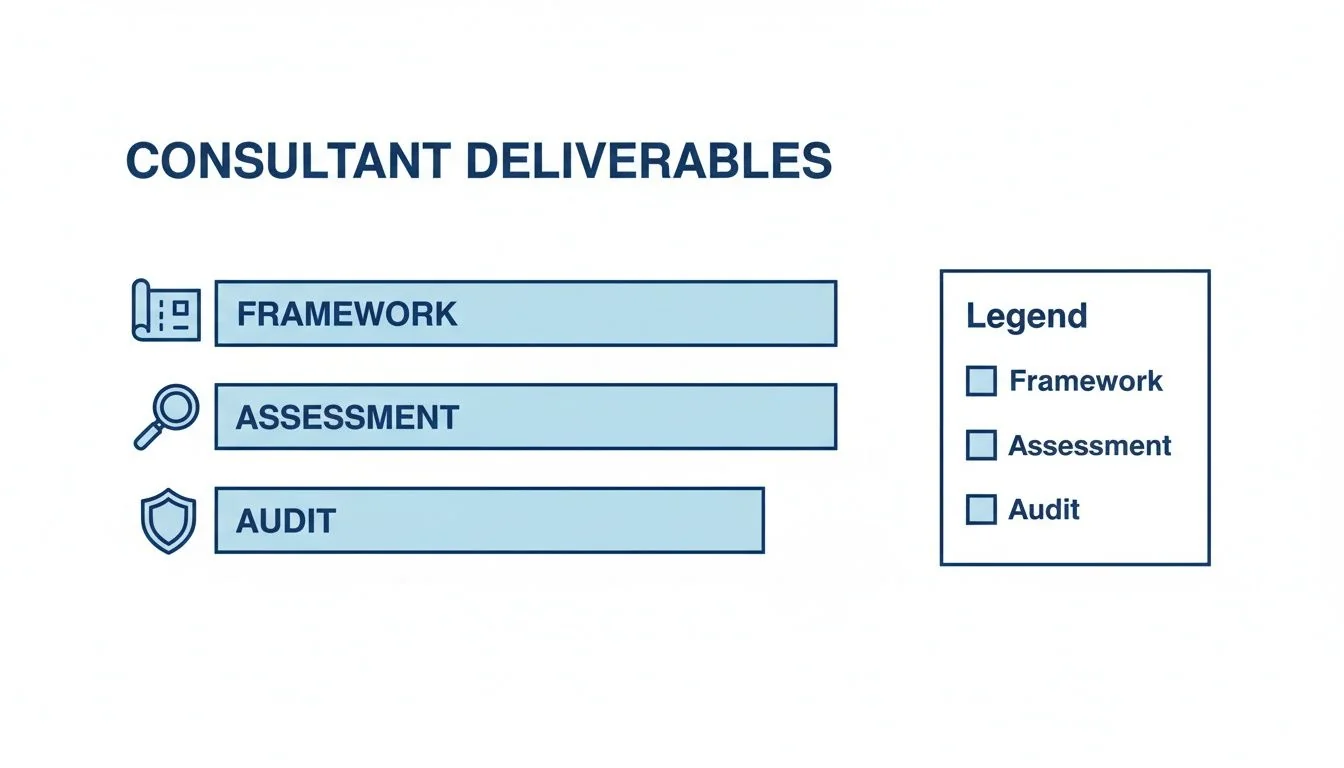
This illustrates how different activities map to concrete outcomes, helping you align your needs with the appropriate engagement model.
An Analysis of Consultant Rate Structures
Consultant rates are determined by experience, technical specialization, firm size, and geography. Understanding these drivers is essential for developing a realistic budget.
The data governance market is a component of a USD 4.75 billion global industry, with North America representing 40.3% of the market share. Demand is driven by enterprises managing massive data volumes (projected to reach 181 zettabytes by 2025) under increasing regulatory pressure from laws like GDPR and CCPA.
Focusing solely on hourly rates is a common mistake. A Principal Architect at $450/hour who solves a complex problem in 10 hours provides greater value than an Analyst at $150/hour who requires 40 hours to deliver a suboptimal solution. Evaluate cost in terms of outcomes, not hours.
Expertise in specific platforms like Databricks Unity Catalog or Snowflake’s row-level security commands a premium. This specialized knowledge reduces implementation time and maximizes the value of your existing technology investments.
Below are typical hourly rate bands for the North American market.
Data Governance Consultant Rate Bands (North America, USD)
| Consultant Role | Typical Hourly Rate (USD) |
|---|---|
| Principal or Strategic Advisor | $350 - $500+ |
| Technical Architect (Snowflake/Databricks) | $250 - $400 |
| Lead Consultant or Project Manager | $200 - $325 |
| Senior Consultant | $175 - $250 |
| Consultant or Analyst | $125 - $200 |
Use these figures to benchmark proposals against the level of experience being offered.
How to Select the Right Consulting Partner
Selecting a data governance consultant is a high-stakes procurement decision. A poor choice results not just in financial loss but in strategic setbacks that can take years to recover from. Diligence must extend beyond marketing materials to a rigorous evaluation of capabilities.
Move past surface-level inquiries. A top-tier firm will demonstrate its expertise through detailed case studies, a transparent methodology, and a nuanced understanding of your specific data ecosystem.
A Practical Evaluation Checklist
To properly vet potential partners, use a checklist that assesses process, platform expertise, and industry track record.
1. Proven Methodology and Frameworks: A reputable consultant operates from a battle-tested playbook for assessment, design, and implementation. Require them to detail their standard methodology, from initial discovery workshops to final knowledge transfer and hand-off.
2. Deep Platform Expertise (Snowflake & Databricks): Modern data governance is implemented on the data platform itself. Generic advice without hands-on expertise in your specific tech stack is a major red flag. Architects must hold current certifications and be able to discuss technical specifics, such as implementing controls via Databricks Unity Catalog or configuring Snowflake’s dynamic data masking and row-access policies.
3. Relevant Industry Case Studies: Governance requirements for financial services are fundamentally different from those in retail or healthcare. Demand case studies from companies of similar size, industry, and data maturity. This is the only way to verify their understanding of your specific regulatory pressures, business drivers, and organizational culture.
Asking Questions That Reveal True Expertise
The interview stage is for separating genuine experts from theorists. Ask open-ended, experience-based questions that cannot be answered with buzzwords. Focus on past performance.
- “Describe a data governance project you led that failed or encountered significant obstacles. What was the root cause, what did you learn, and how did you adapt your methodology as a result?”
- “How do you quantify the ROI of a data governance program? Provide a specific example of the business value metrics you established for a previous client.”
- “Walk us through your process for establishing a data stewardship council in a historically siloed, decentralized organization.”
- “From a technical standpoint, what are the most common mistakes you see clients make when implementing governance controls in Snowflake (or Databricks)?”
The answers reveal problem-solving capabilities, intellectual honesty, and the ability to navigate organizational politics—the core challenges of any governance initiative. An experienced partner will have learned from past failures and can articulate how that experience will benefit you.
This level of vetting ensures you select a partner capable of delivering a lasting governance program that functions as a strategic business asset. For a more structured approach, use these best practices for the RFP process.
Identifying Red Flags and Measuring Success

Hiring a data governance consultant is a high-stakes decision. A successful engagement accelerates your data strategy; a failed one wastes budget and creates more complex problems.
Knowing what to avoid is as critical as knowing what to seek. A common error is being swayed by a consultant’s proprietary software or tooling. A superior firm will focus first on diagnosing your specific business problems, not on selling a pre-packaged technical solution. Their objective should be to architect a strategy that fits your organization, not to force your organization to fit their template.
Critical Red Flags to Watch For
During your evaluation, be vigilant for signals that indicate a rigid, one-size-fits-all approach. A skilled data governance consultant customizes their methodology to your specific context.
- An Overemphasis on Tools: If a consultant promotes a specific data catalog or quality tool before completing a thorough diagnosis of your core issues, it is a major red flag. Strategy must always precede technology selection.
- Vague Success Metrics: Be wary of firms that define success with ambiguous terms like “improved data culture” or “better data-driven decisions.” They must be able to link their activities to specific, measurable business outcomes.
- Lack of a Knowledge Transfer Plan: The primary goal of a good consultant is to make themselves redundant. A credible partner will present a clear, actionable plan for training and enabling your internal team to own and operate the governance program long-term.
A consultant who cannot articulate a clear knowledge transfer plan is not a partner; they are creating a dependency. Success is measured by your team’s ability to sustain the program independently, not by the delivery of a one-time project.
This focus on enablement is non-negotiable. Without it, any progress will erode after the engagement ends, locking you into a costly cycle of re-engagement.
Defining and Measuring Success
Before signing a contract, define what a successful engagement looks like in clear, quantifiable business terms. A successful project is not a completed checklist of deliverables; it is a measurable improvement in business operations.
For example, a successful data governance program might reduce the time your data science team spends on data cleaning and preparation from 80% to 20%, freeing them to focus on high-value modeling and analysis.
From Vague Goals to Tangible Business Outcomes
Insist that success be measured against concrete KPIs. A successful engagement should produce clear, quantifiable improvements in these areas:
- Measurable Reduction in Data Errors: Tracked via a decrease in customer support tickets related to bad data or a reduction in manual rework required by the finance team for monthly reporting.
- Reduced Time-to-Insight: Measured by the time it takes the analytics team to find, trust, and use data for new reports and dashboards (e.g., from weeks to days).
- Quantifiable Risk Reduction: Demonstrated by passing an internal or external audit, or the ability to produce data lineage reports for regulators on demand, proving a reduction in compliance exposure.
- Increased User Adoption of Data Assets: Measured by the usage rates of self-service BI tools. When data is trusted, it is used, leading to a genuine shift toward data-informed decision-making.
A 4-Step Action Plan for Partner Selection
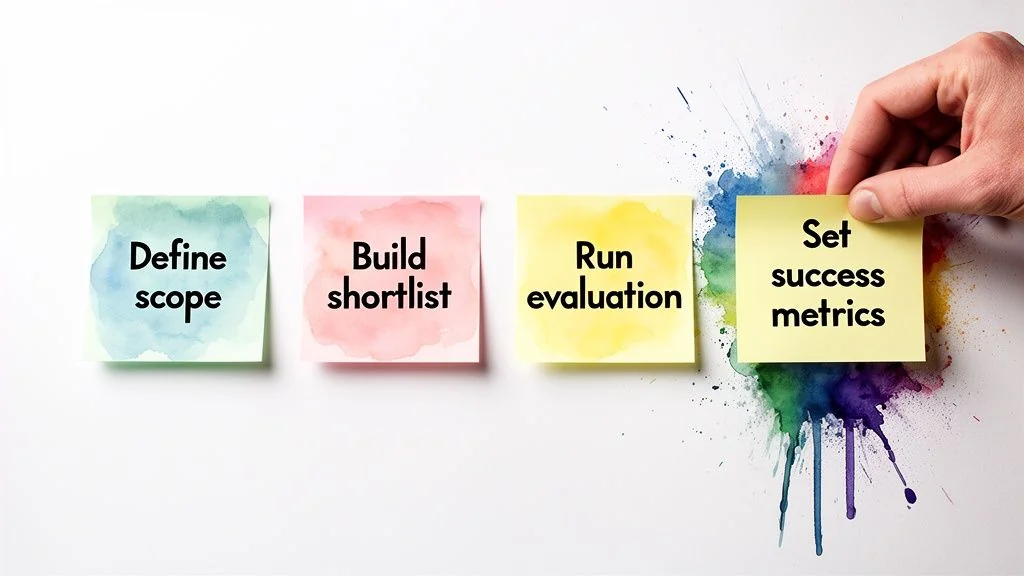
Engaging the right data governance consultants is a methodical process, not a speculative one. This is a strategic investment to convert a chaotic liability—your data—into a high-value asset that drives growth and mitigates risk.
The critical mindset shift is to approach this as a core business initiative, not an IT project. The objective is to build a lasting organizational capability that improves decision-making, reduces risk, and provides a stable foundation for analytics and AI. The right partner acts as the catalyst for this transformation.
A Four-Step Action Plan
This structured plan synthesizes the preceding insights into an actionable sequence to guide you from initial consideration to a successful partnership.
-
Define Your Business Case and Scope: First, analyze your internal needs. What specific business problem must be solved? Is it an unacceptable compliance risk? Is poor data quality hindering analytics? Is a reliable data foundation required for a new AI initiative? A tightly defined scope and a clear business case are essential for guiding the selection process.
-
Build a Vetted Shortlist of Firms: Avoid broad, unfiltered web searches. Use curated resources to identify firms with demonstrated experience in your industry and with your data platform, such as Snowflake or Databricks. Resources like the shortlists on DataEngineeringCompanies.com can accelerate this process by providing pre-vetted candidates that match your budget and technical requirements.
Hiring a data governance consultant is fundamentally an exercise in de-risking a complex, high-stakes initiative. The right partner brings not just technical skill, but a battle-tested methodology and the political savvy to navigate your organization’s culture.
-
Run a Structured Evaluation Process: Compare firms objectively using a standardized set of criteria. Use the experience-based questions detailed earlier to probe their expertise. A formal tool like this RFP checklist for data projects ensures all critical areas, from methodology to technical depth, are consistently evaluated across all candidates.
-
Define Success Metrics Before Signing: This is the most critical step. Before executing a contract, agree on what “success” looks like in measurable business terms. This must go beyond project deliverables. Define the specific outcomes you expect, such as a 30% reduction in manual data remediation efforts or a 50% improvement in time-to-insight for the analytics team. These metrics should be formally documented in the statement of work.
Following this structured process transforms a daunting task into a manageable, strategic exercise, ensuring you select a partner capable of building a high-value, well-governed data estate.
Frequently Asked Questions
Final practical questions often arise before engaging a data governance consulting firm. Here are direct answers to common inquiries from data leaders and procurement teams.
How Long Does a Typical Data Governance Engagement Last?
The duration depends entirely on the scope. A foundational assessment and roadmap project is typically a 4 to 8-week engagement, delivering a clear analysis of your current state and a prioritized action plan.
A full program implementation, including framework design, tool selection, and initial rollout, typically requires a 6 to 12-month commitment. For large, federated enterprises, these can extend into multi-year partnerships. Structure long-term engagements in phases with clear milestones to ensure early and continuous value delivery.
Is it Feasible to Implement Data Governance Without Consultants?
While technically possible, attempting a full implementation with only internal resources is high-risk, particularly without a dedicated, experienced team. Internal projects are often deprioritized by daily operational demands and stymied by organizational politics.
Consultants act as a catalyst. They bring field-tested methodologies, an objective external perspective, and specialized skills that accelerate execution. Crucially, they are experts in the change management required to overcome internal resistance—the most common reason for the failure of internally led governance initiatives.
Their outsider status empowers them to drive difficult conversations and enforce new standards in ways that are often politically untenable for an internal employee.
What Is The Difference Between a Governance Tool and a Consultant?
A governance tool—such as Collibra, Alation, or Atlan—is the software platform that automates the data catalog, lineage, and policy enforcement. It is the vehicle.
A data governance consultant is the architect and operator. They develop the strategy, design the processes, and define the policies that are implemented within the tool. They determine what data requires governance, why it is critical to the business, and how to integrate the new system into your team’s existing workflows. A sophisticated tool without a sound strategy is shelfware; the consultant ensures the technology solves real business problems and is successfully adopted by the organization.
Is Platform-Specific Experience (Snowflake/Databricks) Necessary?
Yes, absolutely. In 2025, generic, platform-agnostic governance advice is obsolete. Effective governance on Snowflake requires deep expertise in its native features like dynamic data masking, row-access policies, and object tagging.
Similarly, on Databricks, a consultant must have hands-on experience designing governance models that are tightly integrated with Unity Catalog for managing fine-grained permissions and automating data lineage. A consultant without deep practical experience on your specific data platform cannot design a solution that is both effective and technically sound. Verify platform-specific certifications and real-world implementation experience before signing a contract.
Ready to find a partner that fits your exact needs? The 2025 expert rankings on DataEngineeringCompanies.com provide transparent, data-driven reviews of top firms, complete with rate bands, platform specializations, and industry experience. Use our free tools to build your shortlist and de-risk your selection process.
Data-driven market researcher with 20+ years in market research and 10+ years helping software agencies and IT organizations make evidence-based decisions. Former market research analyst at Aviva Investors and Credit Suisse.
Previously: Aviva Investors · Credit Suisse · Brainhub · 100Signals
Top Data Engineering Partners
Vetted experts who can help you implement what you just read.
Related Analysis
The Engineering Leader's Guide to Supply Chain Data Platforms
Explore expert supply chain data engineering strategies for resilient pipelines, modern architecture, and data platform selection for Snowflake and Databricks.
The 10-Point Data Engineering Due Diligence Checklist for 2026
Don't hire a consultant without this data engineering due diligence checklist. Vet firms on architecture, cost, governance, and team skills before you sign.
A CTO's Guide to Databricks Unity Catalog Implementation
A proven guide for CTOs on Databricks Unity Catalog implementation. Get actionable frameworks for architecture, governance, migration, and CI/CD.