10 Actionable Data governance Best Practices for 2026
In 2026, data governance is no longer a theoretical back-office function; it is the critical foundation for scalable analytics, trustworthy AI, and non-negotiable regulatory compliance. As organizations race to modernize their data platforms with technologies like Snowflake and Databricks, the absence of a robust governance strategy is not a risk—it is a guaranteed inhibitor of value. Generic advice and surface-level checklists are insufficient for navigating the complexities of hybrid cloud environments and the demands of generative AI initiatives. Success requires a pragmatic, actionable approach that directly addresses today’s enterprise challenges.
This article cuts through the marketing fluff to deliver 10 analytical, field-tested data governance best practices. It is designed specifically for enterprise buyers, technology leaders, and procurement teams evaluating modernization partners and planning large-scale data initiatives. We will move beyond high-level concepts to detail the practical steps required for tangible implementation.
You will learn how to:
- Establish a modern governance framework with clear executive sponsorship.
- Master metadata management and implement a proactive data catalog.
- Define clear ownership models that empower data stewards.
- Implement data contracts within a Data Mesh architecture to ensure quality at the source.
- Measure the true effectiveness of your program with relevant KPIs.
These insights provide a clear roadmap for building a governance program that drives trust, mitigates risk, and accelerates innovation. Each practice is designed to be both immediately relevant for the current data landscape and evergreen in its strategic value, ensuring your investment delivers lasting returns.
1. Establish a Data Governance Framework, Executive Sponsorship, and Policies
A formal data governance framework is the foundational blueprint for managing an organization’s data assets. It is not just a technical document; it is a strategic business structure that defines how data is collected, stored, used, and protected. This approach moves data management from a reactive, siloed function to a proactive, enterprise-wide discipline, ensuring data becomes a reliable asset for decision-making and innovation. Without this structure, even the most advanced analytics tools will fail, as they will be built on a foundation of inconsistent, untrustworthy data.
Why It’s a Foundational Best Practice
Effective data governance begins at the top. Securing executive sponsorship, often through a Chief Data Officer (CDO) or a dedicated governance council, is non-negotiable. This leadership provides the authority needed to enforce policies and secure resources. The framework itself should codify critical policies addressing data classification, retention, security, and regulatory compliance.
For instance, a global financial institution subject to regulations like SOX and GDPR would use its framework to map specific data elements to compliance controls. This ensures that financial reporting data has clear access controls and audit trails, while customer data handling aligns with privacy consent requirements. This structured approach is a core component of modern data platforms, with providers like Snowflake and Databricks building governance capabilities directly into their architectures.
Key Insight: A data governance framework without executive sponsorship is merely a set of suggestions. True governance requires top-down authority to align disparate business units, resolve conflicts, and enforce standards consistently across the enterprise.
Actionable Implementation Steps
- Secure Executive Sponsorship: Appoint a CDO or form a steering committee with C-level representation. This group must meet quarterly at a minimum to review progress and resolve escalations.
- Define and Document Policies: Start by creating policies for data classification, access control, and retention. Ensure these are mapped directly to business objectives and regulatory requirements like HIPAA or CCPA.
- Launch a Pilot Program: Avoid a “big bang” rollout. Select a single business domain or critical data set, such as “customer data,” to pilot the framework. This allows you to refine processes and demonstrate value quickly.
- Establish a Central Knowledge Base: Use a tool like Confluence or SharePoint to create an accessible, version-controlled repository for all governance policies, standards, and procedures. This ensures all stakeholders are working from the same playbook.
2. Implement Data Cataloging and Metadata Management
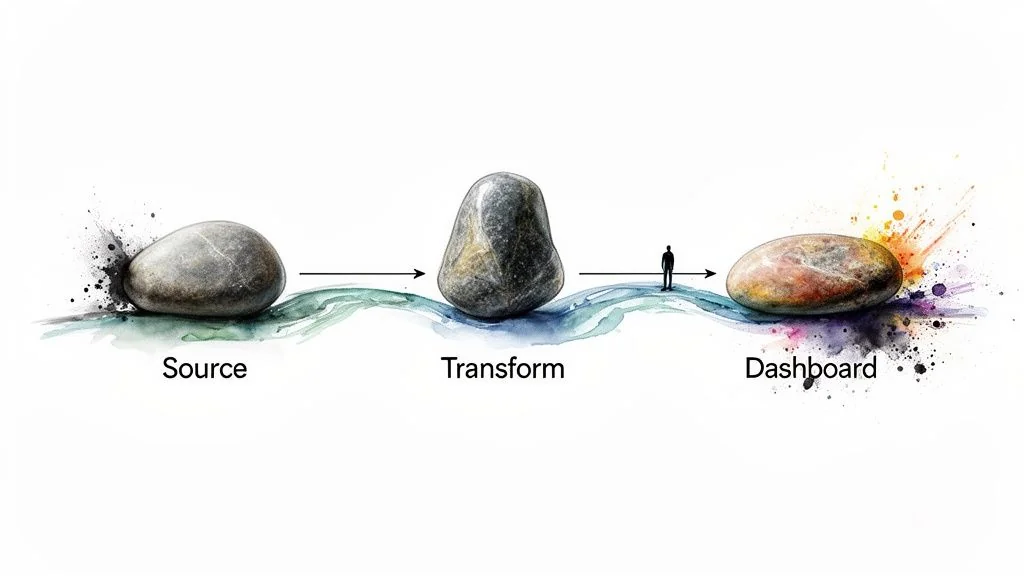
A data catalog is a modern inventory of an organization’s data assets, providing a searchable, contextualized view that helps analysts, data scientists, and business users find, understand, and trust the data they need. It moves beyond simple lists of tables to create a rich, collaborative ecosystem powered by metadata. Effective metadata management documents the “who, what, when, where, and why” of data, including lineage, definitions, quality scores, and ownership, making data a truly self-service, enterprise-wide resource.
Why It’s a Foundational Best Practice
Without a centralized catalog, data discovery becomes a tribal knowledge-driven, inefficient process that erodes trust and slows down analytics. Teams waste valuable time searching for data or recreating datasets that already exist. A catalog serves as a single source of truth, automating the documentation of complex data environments. For example, a retail company can use a catalog like Alation or Collibra to trace a “customer lifetime value” metric from its executive dashboard all the way back to the raw transactional data, ensuring everyone understands its calculation and trusts its accuracy.
Modern data platforms like Databricks’ Unity Catalog embed these capabilities natively, capturing lineage automatically. Tech giants like Uber and Lyft built proprietary catalogs (Databook and Amundsen) precisely because scalable data discovery is essential for innovation. This practice is a cornerstone of any effective data governance strategy, turning data swamps into organized, accessible libraries.
Key Insight: Data that cannot be found or understood is useless. A data catalog acts as a Google-like search engine for your enterprise data, transforming it from a hidden, siloed liability into a discoverable, trusted asset.
Actionable Implementation Steps
- Start with High-Value Datasets: Instead of attempting to catalog everything at once, focus on the top 20% of data assets that drive 80% of business value, such as critical “customer,” “product,” or “sales” domains.
- Integrate with Your Data Stack: Connect your cataloging tool directly to your cloud data platform (Snowflake, Databricks) and transformation tools (like dbt). Use dbt’s metadata API to automatically populate column descriptions and lineage.
- Appoint and Empower Data Stewards: Assign business and technical data stewards to specific data domains. Task them with curating definitions, certifying key assets, and enriching metadata within the catalog.
- Establish a Business Glossary: Work with business leaders to define and document key business terms (e.g., “Active User,” “Gross Margin”). Link these glossary terms directly to the physical data assets in the catalog to ensure consistent interpretation across the organization.
3. Define Data Ownership and Stewardship Models
Assigning clear roles for data ownership and stewardship is essential for establishing accountability across the data lifecycle. This practice transforms data from an unmanaged, free-floating asset into a clearly governed one with designated guardians. Data Owners, typically business leaders, are ultimately accountable for the strategic value and compliance of a data domain, while Data Stewards, often subject matter experts, are responsible for the day-to-day operational management, including quality, metadata, and access controls.
Why It’s a Foundational Best Practice
Without defined ownership, data quality degrades, security risks increase, and accountability vanishes. When a critical report fails due to poor data, the question “Who is responsible for this data?” must have a clear, immediate answer. This model operationalizes accountability, ensuring that specific individuals are empowered to make decisions and enforce standards for their respective data domains.
For example, a large retailer implementing this practice would designate the VP of Marketing as the “Data Owner” for all customer-level data. This executive is accountable for its compliant use in campaigns. A Senior Marketing Analyst, acting as the “Data Steward,” would then be responsible for defining what constitutes a “valid customer address” and working with IT to implement quality rules. This is a core principle in modern data governance best practices, preventing the all-too-common scenario of organizational finger-pointing when data issues arise.
Key Insight: Data governance without clear ownership is a system of rules with no one to enforce them. Ownership assigns accountability, while stewardship provides the hands-on expertise needed to maintain data as a trustworthy enterprise asset.
Actionable Implementation Steps
- Document Roles with a RACI Matrix: Create a formal Responsible, Accountable, Consulted, and Informed (RACI) matrix for key data domains like “Customer,” “Product,” and “Finance.” This explicitly defines the responsibilities of owners versus stewards, eliminating ambiguity.
- Start with Critical Data Domains: Rather than attempting to assign owners for every dataset, prioritize high-value, high-risk domains first. This demonstrates immediate value and builds momentum for the program.
- Establish a Steward Community of Practice: Create a formal council or forum for data stewards to share knowledge, standardize definitions (e.g., a universal definition for “Active Customer”), and solve cross-functional data challenges collaboratively.
- Integrate Stewardship into Performance Reviews: Link data stewardship activities to job descriptions and performance metrics. Recognizing and rewarding these contributions elevates the role from a “side project” to a core professional responsibility.
4. Establish Data Quality Standards and Monitoring
Data quality is not an afterthought; it is an active, continuous process that ensures the information fueling business decisions is accurate, complete, and reliable. Establishing clear quality standards moves data validation from a manual, reactive task to an automated, proactive discipline embedded directly within the data lifecycle. This prevents the classic “garbage in, garbage out” scenario, where flawed data corrupts everything downstream, from business intelligence dashboards to machine learning models.
Why It’s a Foundational Best Practice
Poor data quality erodes trust and carries significant financial and operational costs. By defining and monitoring quality dimensions such as accuracy, completeness, consistency, and timeliness, an organization creates a system of checks and balances. These rules should be treated like code: version-controlled, documented, and integrated early into data ingestion and transformation pipelines. This proactive approach ensures issues are caught and remediated at the source, long before they impact critical business processes.
For example, a marketing analytics team relies on customer contact data for campaign segmentation. A data quality rule enforcing 99.9% completeness for the email_address field and validating its format via regex prevents invalid records from entering their marketing automation platform. This is a core component of modern data governance best practices, supported by tools like dbt for in-workflow testing and platforms like Soda and Great Expectations for comprehensive pipeline monitoring.
Key Insight: Proactive data quality monitoring is a form of preventative maintenance for your data assets. It is far more efficient and cost-effective to prevent bad data from entering your analytics ecosystem than it is to find and fix it after it has caused damage.
Actionable Implementation Steps
- Define Quality Dimensions and Thresholds: Start by defining clear, measurable standards for critical data elements. For instance, set a
timelinessSLA of 2 hours for sales data ingestion and anaccuracythreshold of 98% for product SKUs against a source system. - Integrate Quality Checks into Pipelines: Embed data quality tests directly into your data transformation workflows. Using dbt tests or similar tools, you can run validations on every model build, stopping the pipeline if a critical quality threshold is breached.
- Implement Automated Monitoring and Alerting: Deploy a dedicated data quality tool like Great Expectations or Soda to continuously profile data and execute validation suites. Configure tiered alerts that send warnings for minor deviations and critical escalations for severe data quality failures.
- Establish a Feedback Loop: Create a clear process for data consumers to report quality issues. This could be a dedicated Slack channel, a Jira service desk, or a feature within your data catalog. Link these reports back to data owners for investigation and remediation.
5. Implement Role-Based Access Control (RBAC) and Data Security
Effective data governance is incomplete without robust security controls that dictate who can access what data and under which conditions. Implementing Role-Based Access Control (RBAC) and its more granular counterpart, Attribute-Based Access Control (ABAC), moves security from an afterthought to an integral part of your data architecture. This approach ensures that data access is not just granted but is precisely managed according to a user’s role, function, and the data’s sensitivity, creating a secure yet enabling environment for self-service analytics.
Why It’s a Foundational Best Practice
A well-defined access control strategy is the frontline defense against both external threats and internal data misuse. It directly supports the principle of least privilege, ensuring employees have access only to the data necessary to perform their jobs. Modern data platforms like Snowflake and Databricks have made this a core capability, offering features like row-level security and dynamic column masking directly within the platform.
For example, a healthcare system can use RBAC to grant doctors access to patient records within their department, while a billing specialist can only see financial information. ABAC takes this further by adding conditions, such as restricting access to records only during a clinician’s active shift. This fine-grained control is critical for meeting strict regulatory requirements like HIPAA and is a key focus when addressing modern cloud data security challenges.
Key Insight: Data security and data access are two sides of the same coin. The goal isn’t to lock data down but to enable broad, secure access. A well-implemented RBAC system builds trust and encourages data use by assuring stakeholders that sensitive information is protected.
Actionable Implementation Steps
- Design a Clear Role Hierarchy: Map out organizational roles (e.g., “Financial Analyst,” “Data Scientist,” “Marketing Manager”) and define the data access permissions required for each. Align these roles with your identity provider groups in Okta or Azure AD.
- Implement the Principle of Least Privilege: When defining roles, start with zero access and incrementally grant only the necessary permissions. This minimizes the attack surface and reduces the risk of unauthorized data exposure.
- Automate Provisioning and Deprovisioning: Integrate your data platform with your central identity provider (IdP). This ensures that when an employee joins, changes roles, or leaves the company, their data access rights are updated automatically, preventing orphaned accounts and privilege creep.
- Conduct Quarterly Access Reviews: Schedule regular audits to review and certify who has access to critical data. This process helps identify and revoke excessive or outdated permissions, ensuring the access control model remains accurate and secure.
6. Create Data Lineage and Impact Analysis Capabilities
Data lineage is the process of mapping and visualizing the flow of data from its origin to its destination. It provides a complete audit trail, showing how data is sourced, transformed, and consumed by downstream analytics, reports, and machine learning models. This capability moves teams from reactive debugging to proactive management, enabling them to understand the “blast radius” of any proposed change before it happens. In a modern data stack, this is essential for maintaining trust and reliability.
Why It’s a Foundational Best Practice
Without clear lineage, a simple change to a source system column can break dozens of critical dashboards without warning. Impact analysis, powered by lineage, prevents this by identifying all dependent assets. This visibility is not just a technical nice-to-have; it is a core requirement for compliance, root cause analysis, and efficient data pipeline maintenance.
Modern transformation tools like dbt have made automated lineage capture a standard feature, parsing SQL code to build dependency graphs. Dedicated governance platforms such as Collibra and Alation take this further, offering cross-system, column-level lineage that connects technical metadata to business context. This level of detail is crucial when a team needs to trace a key performance indicator (KPI) on a C-level dashboard all the way back to the raw source tables.
Key Insight: Manual lineage documentation is a recipe for failure; it is always outdated and incomplete. True data governance best practices demand automated lineage capture directly from data processing tools and platforms, ensuring the map always reflects the territory.
Actionable Implementation Steps
- Automate Lineage Capture: Leverage native features in tools like dbt (
dbt docs generate) or Databricks Delta Live Tables. Integrate open standards like OpenLineage to capture lineage metadata from orchestrators like Airflow and Prefect. - Establish Naming Conventions: Implement and enforce strict, consistent naming conventions for all data assets (tables, columns, schemas). This creates a predictable structure that makes automated tracing and discovery significantly easier.
- Implement Column-Level Lineage for Sensitive Data: For Personally Identifiable Information (PII) or other sensitive data, implement column-level tracking. This allows you to perform precise impact analysis for privacy compliance and data security audits.
- Integrate Impact Analysis into CI/CD: Before deploying changes to data pipelines, use lineage tools to run an automated impact analysis report. Require approvals from owners of downstream assets if the impact score exceeds a predefined threshold.
7. Implement Data Contracts and Data Mesh Architecture
Modern data environments are shifting from centralized, monolithic architectures to decentralized models. A data mesh architecture decentralizes ownership, empowering domain teams to own their data as a “product.” To prevent this distributed model from creating chaos, data contracts serve as formal, machine-readable agreements between the data producers (domain teams) and data consumers, defining the structure, quality, and service levels of a data product. This approach moves governance from a centralized bottleneck to a federated, automated responsibility embedded directly into data pipelines.
Why It’s a Foundational Best Practice
As organizations scale, centralized data teams cannot keep up with the diverse needs of the business. A data mesh architecture, supported by data contracts, scales data management by distributing ownership. Data contracts are the critical enforcement mechanism in this model. They define schema, semantics, and quality assertions as code, which are then validated automatically in CI/CD pipelines. This prevents breaking changes and ensures that data consumers can rely on the data products they use, fostering trust and accelerating innovation.
For example, a marketing team consuming customer data from a sales domain can rely on a contract that guarantees the customer_id field will always be present and conform to a specific format. If the sales team attempts to deploy a change that violates this contract, the CI/CD pipeline fails the build, preventing downstream analytics from breaking. Tools like dbt now include contract features, while platforms like Confluent Schema Registry enforce schema evolution for streaming data.
Key Insight: Data contracts transform governance from a manual, after-the-fact cleanup process into an automated, proactive discipline. They are the API for data, ensuring that as data ownership becomes decentralized, reliability and trust are programmatically enforced.
Actionable Implementation Steps
- Start with Critical Data Products: Identify high-value data sets with multiple downstream consumers. Begin by defining contracts for these “data products” to demonstrate immediate value.
- Automate Contract Validation in CI/CD: Integrate contract testing into your deployment pipelines. Use tools like dbt contracts or schema registries (e.g., Confluent Schema Registry) to automatically validate schema, data types, and quality rules before code is merged.
- Establish a Contract Review Process: Before deployment, new contracts or changes to existing ones should undergo a formal review by both producer and consumer teams to ensure alignment on expectations.
- Define a Clear Deprecation Policy: Create and communicate a standardized process for making breaking changes. This should include versioning, a notification period, and migration support for consumers.
- Monitor for Contract Violations: Implement automated monitoring and alerting to notify data product owners immediately when a contract is breached in production, enabling rapid response and remediation.
8. Build Data Governance Communities and Training Programs
Data governance is ultimately a human endeavor, not just a technological one. Establishing communities of practice and robust training programs transforms governance from a top-down mandate into a shared, grassroots responsibility. This cultural approach fosters data literacy, accelerates the adoption of standards, and builds a sustainable governance culture. Without engaged people, even the best policies and tools will fail to gain traction, becoming shelfware in a sea of data chaos.
Why It’s a Foundational Best practice
Policies are ineffective if they are not understood, adopted, and championed by the people who work with data every day. Building a community, often through a data steward council, creates a vital feedback loop between the central governance team and business units. It empowers data stewards to share solutions, troubleshoot common issues, and operationalize policies within their specific contexts.
For example, a large retailer could create a “Product Data Steward Council” that meets monthly. Stewards from merchandising, marketing, and supply chain could collaborate to standardize product attributes, resolving discrepancies that cause downstream reporting errors. This peer-to-peer problem-solving is far more effective than a central team trying to dictate standards in a vacuum. Organizations like Microsoft and Snowflake now offer extensive training and certifications, recognizing that educated users are essential for successful platform adoption and governance.
Key Insight: Technology and policies provide the “what” of data governance, but communities and training provide the “how” and “why.” A well-trained, engaged community of data stewards acts as a force multiplier, embedding best practices directly into daily workflows.
Actionable Implementation Steps
- Establish a Data Steward Council: Form a cross-functional council of data stewards that meets at least monthly. The initial focus should be on sharing challenges, standardizing definitions for critical data elements, and celebrating early wins.
- Develop Role-Specific Training: Create tailored training modules for different roles like data owners, data stewards, and data consumers. Leverage platforms like Coursera or LinkedIn Learning for foundational courses, supplemented with internal training on your specific tools and policies.
- Launch a Governance Knowledge Hub: Use a wiki or intranet site to create a central, accessible repository for all governance assets, including glossaries, policy documents, process maps, and contact lists for data stewards.
- Host Quarterly Governance Forums: Organize wider forums that include executive participation to share success stories, provide updates on the governance roadmap, and publicly recognize the contributions of data stewards. This builds momentum and reinforces leadership commitment.
9. Establish a Data Governance Technology Stack and Tool Integration
A modern data governance program cannot operate at scale on spreadsheets and manual processes alone. Establishing an integrated technology stack is essential for automating policy enforcement, providing self-service data discovery, and embedding governance directly into data workflows. This stack transforms governance from a burdensome, after-the-fact checklist into an active, automated system that supports agility while managing risk. Without the right tools, governance policies remain theoretical and difficult to enforce consistently.
Why It’s a Foundational Best Practice
A well-integrated toolset is the engine that powers a data governance framework, making it operational and scalable. These tools, which cover data cataloging, quality, lineage, and access control, must work together to create a unified governance plane. The key is integration, especially with core data platforms like Snowflake and Databricks. When a data catalog like Atlan or Alation integrates with a transformation tool like dbt and an access control layer like Okta, the result is automated governance that reduces manual effort and human error.
For example, a retail company could use this integrated stack to automatically tag all data containing Personally Identifiable Information (PII) as it enters their Snowflake environment. The catalog detects and classifies the data, a data quality tool like Great Expectations validates its format, and access policies are automatically applied based on user roles defined in their identity management system. This level of automation is a cornerstone of effective, modern data governance best practices.
Key Insight: Technology doesn’t replace a governance framework; it enables it. The goal is not to buy every tool, but to build an interconnected ecosystem where the catalog, quality, and access control systems communicate seamlessly to enforce policies automatically.
Actionable Implementation Steps
- Conduct a Tool Evaluation: Assess tools based on their ability to integrate with your existing data platforms (e.g., Snowflake, Databricks) and identity systems. Prioritize native connectors and robust API support.
- Start with a Core Set: Begin with 3-5 essential tools covering data cataloging, data quality, and access management. Avoid a “big bang” implementation of a dozen specialized solutions.
- Prioritize Automation: Select tools that can automate critical tasks like data classification, lineage mapping, and policy enforcement. For instance, use Databricks Unity Catalog to manage fine-grained access control directly within the platform.
- Assign Tool Ownership: Designate clear owners for each tool in the stack to manage configuration, maintenance, and user training. This ensures accountability and maximizes the value of your technology investment.
10. Implement Continuous Governance and Regular Effectiveness Reviews
Data governance is not a one-time project; it is a continuous, iterative program that must evolve with the business. Implementing a system of regular effectiveness reviews and ongoing monitoring transforms governance from a static set of rules into a dynamic, living discipline. This approach ensures that policies remain relevant, controls are effective, and the program consistently delivers measurable value as data sources, regulations, and business priorities change. Without this feedback loop, even the best-designed framework will quickly become obsolete.
Why It’s a Foundational Best Practice
Treating governance as an ongoing program is crucial for long-term success and ROI. Continuous monitoring provides the data needed to justify investments and demonstrate business impact. It shifts the conversation from a cost center to a value driver by linking governance activities to tangible improvements in data quality, risk reduction, and operational efficiency. This is one of the most critical data governance best practices for maintaining executive buy-in and organizational momentum.
For example, a healthcare organization can use a governance dashboard to track metrics like the percentage of patient records compliant with HIPAA standards or the average time to resolve a data quality issue. Seeing these metrics improve over time provides clear evidence of the program’s value. This continuous improvement cycle is supported by maturity models from firms like Gartner, which provide structured frameworks for organizations to benchmark their capabilities and plan their evolution.
Key Insight: A “set it and forget it” approach to data governance guarantees failure. The value of governance is not in the initial framework, but in its persistent application and adaptation to the ever-changing data landscape.
Actionable Implementation Steps
- Define Key Performance Indicators (KPIs): Establish 5-10 core governance metrics to track. Examples include data quality scores, policy compliance percentages, issue resolution times, and the number of certified data assets.
- Create a Governance Dashboard: Use a BI tool to build and socialize a dashboard that visualizes governance KPIs. Make this accessible to executives and data stewards to promote transparency and accountability.
- Conduct Quarterly Reviews: Hold quarterly meetings with the data governance steering committee to review KPI trends, address roadblocks, and adjust priorities based on performance.
- Perform Annual Maturity Assessments: Use an established framework, like the Gartner or CMMI models, to conduct a comprehensive annual assessment of your governance program’s maturity. Use the findings to update your strategic roadmap.
- Systematically Collect User Feedback: Deploy annual surveys and hold focus groups with data consumers to gather qualitative feedback on the program’s effectiveness and identify areas for improvement.
Top 10 Data Governance Best Practices Comparison
| Item | Implementation Complexity | Resource Requirements | Expected Outcomes | Ideal Use Cases | Key Advantages |
|---|---|---|---|---|---|
| Establish a Data Governance Framework, Executive Sponsorship, and Policies | High — organization-wide change, policy design | Executive sponsorship, CDO/lead, legal/compliance, long-term budget | Clear accountability, consistent policies, regulatory compliance | Regulated industries, large platform migrations | Central authority, reduced legal/reputational risk, audit readiness |
| Implement Data Cataloging and Metadata Management | Medium — integrations and ongoing curation | Catalog tool, metadata automation, data stewards | Improved discovery, documented lineage and definitions | Mid/enterprise analytics teams, migrations with inherited assets | Faster data discovery, impact analysis, better trust |
| Define Data Ownership and Stewardship Models | Medium — role definition and cultural change | Role assignments, training, RACI matrices | Clear ownership, improved data quality and SLAs | Data mesh adoption, scaling governance across domains | Domain alignment, faster decisions, accountability |
| Establish Data Quality Standards and Monitoring | Medium–High — rule definition and pipeline integration | Quality tools, tests in pipelines, monitoring and remediation workflows | Reliable analytics, fewer downstream errors, SLAs met | AI/ML production, critical reporting and regulatory data | Prevents bad data, early detection, reduces remediation cost |
| Implement Role-Based Access Control (RBAC) and Data Security | High — fine‑grained controls and IAM integration | IAM, access controls, audit logging, security ops | Reduced unauthorized access, compliance, audit trails | Regulated enterprises, multi‑tenant or sensitive data environments | Strong access enforcement, auditability, least‑privilege control |
| Create Data Lineage and Impact Analysis Capabilities | Medium — automated capture and visualization | Lineage tools, instrumented pipelines, visualization dashboards | Faster root‑cause analysis, clear change impact | Large/complex pipelines, migrations, compliance audits | Traceability of data flows, reduced change risk |
| Implement Data Contracts and Data Mesh Architecture | High — CI/CD, schema governance, cultural shift | Schema registries, CI pipelines, developer discipline | Stable producer-consumer interfaces, decentralized delivery | Organizations scaling domains, streaming platforms | Prevents breaking changes, enables autonomous domains |
| Build Data Governance Communities and Training Programs | Low–Medium — coordination and curriculum development | Training materials, facilitators, time from participants | Increased data literacy, adoption, sustained governance | Cultural transformation, post-migration enablement | Peer learning, faster adoption, broader ownership |
| Establish Data Governance Technology Stack and Tool Integration | High — tool selection and cross‑platform integration | Tool licenses, engineers for integration, ongoing maintenance | Automated enforcement, centralized visibility, fewer manual tasks | Enterprise governance, heterogeneous tool environments | Automation, consolidated governance view, simplified audits |
| Implement Continuous Governance and Regular Effectiveness Reviews | Medium — programmatic monitoring and iteration | Metrics, dashboards, periodic reviews, executive oversight | Measured governance ROI, continuous improvement, relevance maintained | Mature governance programs, regulated organizations | Sustained governance value, data‑driven prioritization and improvements |
Activating Your Governance Strategy: Next Steps
Navigating the landscape of data governance requires a structured, practical approach. This article has detailed ten critical components, from establishing foundational frameworks to implementing sophisticated capabilities like data lineage, data contracts, and a modern technology stack. The path from theory to tangible business value is paved with deliberate, iterative action. Merely adopting these data governance best practices in isolation is insufficient; their true power is unleashed when they are woven together into a cohesive, enterprise-wide strategy.
The central theme connecting these practices is the shift from a reactive, compliance-driven posture to a proactive, value-centric one. Governance is no longer just about locking data down; it’s about unlocking its potential safely and efficiently. It is the essential scaffolding that supports every ambitious data-driven initiative, from migrating to cloud platforms like Snowflake or Databricks to pioneering generative AI applications that demand pristine, reliable data.
Synthesizing Your Action Plan
To move forward effectively, avoid the trap of a “big bang” implementation. Instead, focus on a phased approach that delivers incremental wins and builds momentum. Here is a distilled action plan to guide your next steps:
-
Foundation First (The First 90 Days): Your immediate priority is to solidify the organizational and policy groundwork.
- Secure Sponsorship: Confirm your executive sponsor and form a lean, cross-functional data governance council. This group’s first task is to define the initial scope, focusing on a high-impact business domain.
- Draft Core Policies: Do not aim for perfection. Start with a minimum viable policy set covering data classification, access control, and quality. These are living documents that will evolve.
- Appoint Initial Stewards: Identify and empower data stewards within your pilot domain. Provide them with clear roles, responsibilities, and the authority to make decisions.
-
Technology and Enablement (Months 4-9): With the human framework in place, you can begin layering in the technology to automate and scale.
- Pilot a Data Catalog: Implement a data catalog for your chosen domain. Focus on populating it with critical metadata, defining business terms, and mapping lineage for a few key data pipelines. This demonstrates immediate value to data consumers.
- Establish Quality Baselines: Implement data quality monitoring on critical data elements. Define initial rules and dashboards to track metrics like completeness, accuracy, and timeliness, making data quality visible for the first time.
-
Scaling and Optimization (Months 10+): Now, you can expand your program’s reach and sophistication.
- Expand Domain by Domain: Replicate the process from your pilot in other business areas, refining your approach based on lessons learned.
- Formalize Training: Develop and roll out a formal data literacy and governance training program. Culture change is the ultimate goal, and it requires continuous education and reinforcement.
- Integrate and Automate: Focus on deeper integration between your governance tools (catalog, quality, security) to create a seamless user experience and automate policy enforcement wherever possible.
The Strategic Imperative of Governance
Ultimately, mastering these data governance best practices is a strategic imperative. It’s the difference between data being a potential liability and it becoming your organization’s most powerful competitive asset. A well-governed data ecosystem accelerates analytics, reduces operational risk, ensures regulatory compliance, and builds the trust necessary to innovate with confidence. It transforms your data from a chaotic swamp into a well-organized, high-performance library that fuels insight and drives growth. As you embark on this critical journey, remember that progress, not perfection, is the goal.
Finding the right partner to guide your implementation can dramatically accelerate your timeline and de-risk the process. For a curated directory of vetted data engineering and governance consultancies, explore DataEngineeringCompanies.com. Their platform helps you identify firms with proven expertise in building the robust data governance programs required for modern data platforms and AI. Find your ideal implementation partner at DataEngineeringCompanies.com.
Data-driven market researcher with 20+ years in market research and 10+ years helping software agencies and IT organizations make evidence-based decisions. Former market research analyst at Aviva Investors and Credit Suisse.
Previously: Aviva Investors · Credit Suisse · Brainhub · 100Signals
Top Data Engineering Partners
Vetted experts who can help you implement what you just read.
Related Analysis
What Is Data Observability? A Practical Guide
Understand what is data observability and why it's crucial for reliable AI and analytics. This guide covers core pillars, KPIs, and implementation.
The Top 12 Data Pipeline Monitoring Tools for Enterprise Teams
Discover the 12 best data pipeline monitoring tools for 2026. Our expert guide provides practical, no-fluff reviews to help you choose the right solution.
Practical Data Governance Strategies for the Modern Data Stack
Discover data governance strategies you can implement in cloud environments with practical KPIs, frameworks, and real-world value.