Data Governance vs. Data Management: A Practical Comparison
The distinction between data governance and data management comes down to strategy versus execution. Data governance is the strategic framework that establishes the policies, standards, and decision rights for data. Data management is the operational work of implementing those policies across the entire data lifecycle.
Understanding The Core Distinction
Organizations frequently use “data governance” and “data management” interchangeably. This mistake leads to tangled roles, unclear responsibilities, and poor technology investments. Clarifying the distinction is the first practical step toward building a culture that trusts and uses its data effectively.
A useful analogy: Data governance designs the architectural blueprint for a house, specifying foundation requirements, electrical codes, materials, and room layouts. Data management is the construction crew that takes the blueprint and builds the house—laying the foundation, running the wires, and erecting the walls.
This partnership is essential. Governance sets the policies for who can access and use data, while management delivers the technical infrastructure to organize, integrate, and secure that data. The distinction has significant real-world consequences. Data management without governance creates chaotic, inconsistent data silos. Governance without management is merely a theoretical document with no operational impact. As the experts at Atlan.com explain, mastering both is critical for turning data into a functional enterprise asset.
The relationship between governance’s strategic blueprint and management’s operational execution is laid out in this visual.
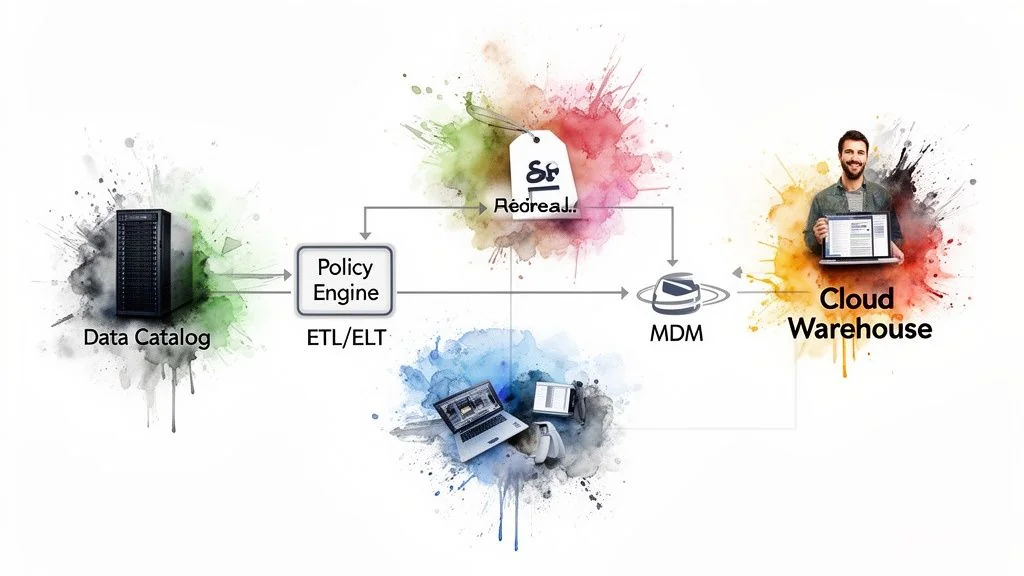
As the chart illustrates, governance provides the guiding principles that direct the hands-on activities of data management.
Key Differentiating Factors
To clarify the distinction, let’s break down how these two disciplines differ. Governance is about authority, policy, and decision-making. Management is concerned with technical implementation and day-to-day data operations. One defines the rules of the game; the other plays the game according to those rules.
The bottom line is this: You cannot have effective data management without a clear data governance strategy. Governance provides the necessary guardrails that make all data management activities—from building pipelines to ensuring security—consistent, compliant, and valuable to the business.
This table offers a direct comparison to clarify the distinct roles each plays.
Data Governance vs. Data Management: A Quick Comparison
Here’s a high-level look at how strategic governance and operational management compare across essential business dimensions.
| Dimension | Data Governance (Strategic Framework) | Data Management (Operational Execution) |
|---|---|---|
| Core Purpose | Establishes accountability, policies, and standards for data as a strategic asset. | Implements the processes and systems for collecting, storing, protecting, and using data. |
| Primary Focus | The “why” and “what”—defining data-related rules, roles, and decision rights. | The “how”—executing data lifecycle tasks from ingestion to archival. |
| Key Activities | Policy creation, data stewardship, compliance monitoring, and metadata definition. | Data integration (ETL/ELT), database administration, data warehousing, and quality control. |
| Business Scope | Enterprise-wide, cross-functional, and focused on strategic outcomes and risk mitigation. | Primarily technical and operational, focused on specific projects, systems, and platforms. |
Ultimately, this breakdown shows that while governance sets the strategic direction, management brings that strategy to life through technology and daily operations.
Why This Matters For Your Data Strategy
Differentiating between data governance and data management has moved from a technical detail to a business-critical priority. In the current environment, failing to grasp the distinction directly impacts your bottom line, exposes the company to risk, and stifles innovation. This is no longer about definitions; it’s about strategic survival.
This is particularly true with the proliferation of AI. Models are only as good as their training data. Without a strong governance foundation, even the most sophisticated data management on platforms like Snowflake or Databricks will produce unreliable, biased, or non-compliant results. It’s the classic “garbage in, garbage out” problem, but now at an enterprise scale with significant financial and reputational stakes.
The New Regulatory and AI Landscape
Pressure is mounting from a growing web of global regulations. The EU AI Act, for example, demands strict adherence to data quality, traceability, and human oversight for AI systems. Proving compliance is impossible without a documented governance framework that specifies how data is sourced, labeled, and used for training. That framework is the playbook data management teams execute.
Consider a practical example:
- Data Governance sets the policy: “All customer data used to train personalization algorithms must have documented consent and be fully anonymized.”
- Data Management builds the solution: Data engineers create ETL pipelines that automatically apply masking functions to personally identifiable information (PII) before it enters a training environment.
Without the governance rule, the management team might build a technically perfect pipeline that leaks sensitive data, violating privacy laws and turning the AI model into a massive legal liability.
From Cost Center to Competitive Edge
Leading organizations have stopped treating governance as a restrictive chore or a compliance checkbox. They now see it as the essential foundation for unlocking data value. When governance works, it creates trust. Analysts, data scientists, and business users can finally use data with confidence, knowing it’s accurate, secure, and appropriate for the task.
A robust data governance framework is the only way to transform data from a raw, risky liability into a reliable, strategic asset. It provides the confidence and control needed to drive innovation, from advanced analytics to generative AI, without compromising security or compliance.
This is not just a change in mindset; market trends confirm the shift. The data governance market has seen explosive growth, jumping from US$1.81 billion in 2020 to a projected US$5.28 billion by 2026, a compound annual growth rate (CAGR) of 20.83%. This acceleration shows how critical structured governance has become. Tellingly, cloud-based solutions commanded 72.44% of the market share in 2025, signaling a clear move toward modern, scalable architectures. You can explore more data governance market trends to see how legal and compliance functions are now a key driver of this growth.
The Business Case for Cohesion
For CTOs and Heads of Data, the message is clear: you cannot achieve effective data management without solid data governance. Investing in a powerful data platform without a corresponding investment in governance is like buying a Formula 1 car but having no traffic laws, road signs, or a licensed driver. The technology is impressive, but the result is chaos.
A cohesive strategy that integrates both disciplines ensures that:
- Data is trustworthy and reliable, leading to better business decisions.
- Regulatory compliance is built-in, not bolted on during a last-minute panic.
- Data initiatives deliver ROI because teams can use high-quality data safely and effectively.
Ultimately, understanding the data governance vs data management dynamic is fundamental. Governance provides the strategy and the rulebook; management provides the operational muscle to bring it to life. One cannot succeed without the other.
Defining Roles And Responsibilities
Understanding the theory of data governance versus data management is one thing; making it work requires a clear organizational structure. To move from high-level strategy to daily operations, you need absolute clarity on who is responsible for what. Without it, blurred lines of accountability lead to operational gaps, duplicated work, and friction between teams.
The fundamental split is this: governance roles are strategic, focused on oversight, while management roles are tactical, focused on implementation. Think of it like building a highway. The governance team designs the blueprints, sets speed limits, and defines the rules of the road. The management team paves the asphalt, paints the lines, and keeps traffic flowing. This separation is crucial for building a data culture that’s both innovative and compliant.
The Governance Team: Strategic Oversight
The governance team is concerned with the “what” and the “why” of your data strategy. They do not write Python scripts or configure databases. Instead, they create the policies that guide how data should be handled across the entire company.
Key governance roles typically include:
- Data Owner: A senior business leader with ultimate accountability for a specific data domain, like “customer data” or “product data.” They make final decisions on data quality standards, access rights, and security to ensure alignment with business goals.
- Data Steward: A subject matter expert, usually embedded within a business function, who handles the day-to-day stewardship of a data domain. They define what each data element means, set quality rules, and investigate the root cause of any issues.
- Governance Council: A cross-functional committee of Data Owners and other key leaders. This group is the final authority for ratifying enterprise-wide data policies, resolving inter-departmental disputes, and providing executive oversight for the governance program.
To align everyone, you’ll need a practical data governance policy. This document translates abstract goals into concrete, assigned responsibilities for each of these roles.
The Management Team: Tactical Execution
On the other side are the data management professionals. These are the hands-on technical experts who build, operate, and maintain the systems that bring governance policies to life. They are focused on the “how” of the data lifecycle.
Common data management roles include:
- Data Engineer: The builders. They construct and maintain the data pipelines that extract, transform, and load data. They are tasked with implementing the data quality checks and security protocols defined by Data Stewards.
- Database Administrator (DBA): A DBA is responsible for the performance, security, and availability of databases. They execute the access control policies set by Data Owners, ensuring only authorized individuals can see specific data.
- Data Architect: This person designs the overall structure of the organization’s data ecosystem. Their job is to ensure the system is scalable, efficient, and able to support both governance rules and practical management needs.
A common failure point in the data governance vs. data management relationship is when governance policies are created in a vacuum without consulting the technical teams responsible for implementation. Effective collaboration between Data Stewards and Data Engineers is non-negotiable for success.
Here is a real-world workflow. A healthcare provider’s Governance Council decides on a new policy: all patient Personally Identifiable Information (PII) must be masked in non-production environments. The Data Owner for patient data approves this. The Data Steward for patient records then defines the specific masking rules (e.g., replace the last five digits of a Social Security Number with ‘X’).
Finally, the management team executes. The Data Engineering team modifies their ETL pipelines to apply this masking logic, while the DBA confirms that production database access controls remain locked down. This complete workflow, from policy decision to production change, demonstrates how these two essential disciplines must work in partnership.
Connecting Processes And Technologies
A data governance strategy is merely a document until it is connected to your tech stack. This is where abstract governance rules meet the concrete, day-to-day work of data management. It’s the critical link that turns policies into automated actions within your data pipelines and platforms.
Without this connection, your governance framework is all theory, and your data management practices lack the necessary guardrails. The goal is to embed governance rules directly into your operational workflows, making high-quality, compliant data the default, not a painful afterthought.
Governance Processes And The Tools That Enable Them
Governance processes form the strategic, decision-making layer. This is where you define the rules of the road for your organization’s data—establishing accountability, setting standards, and ensuring a common vocabulary.
These high-level processes are enabled by a specific class of tools designed for visibility and control:
- Policy Creation and Stewardship: The human side of governance, where Data Stewards and Owners collaborate to create business glossaries, define data quality standards, and set access rules. This involves documenting what the data means and who is allowed to use it.
- Compliance Audits: Systematically checking that data handling practices align with regulations like GDPR or CCPA, as well as internal security policies. This creates a provable record of adherence.
- Key Enabling Tech: The central nervous system for governance is the Data Catalog. A modern catalog from a vendor like Alation or Collibra acts as a searchable inventory of all your data assets. It makes policies discoverable and links them directly to the datasets they govern. Alongside catalogs, policy engines help automate the enforcement of access controls defined by stewards.
The real power of governance tech is making policies active, not just passive documents in a shared drive. A good data catalog surfaces a rule to a data analyst at the moment they are about to run a query.
Data Management Processes And The Platforms That Drive Them
Data management is where theory becomes practice. These are the hands-on, operational activities that data engineering and operations teams perform to move, store, clean, and deliver reliable data to the business.
These activities rely on a different set of technologies—the workhorses built for execution, scale, and performance:
- Data Integration and Transformation (ETL/ELT): The core work of building data pipelines. This involves ingesting data from source systems, cleaning and transforming it, and loading it into a data warehouse or lakehouse.
- Master Data Management (MDM): A specialized process focused on creating a “single source of truth” for critical business data like customers, products, or suppliers. It involves consolidating data from multiple systems into one authoritative record.
- Data Quality Monitoring: The technical implementation of quality rules defined by governance. This involves building checks into pipelines to detect anomalies, validate formats, and measure accuracy over time. For more detail, see this guide on managing data quality.
- Key Enabling Tech: The toolkit here includes ETL/ELT platforms (like Fivetran), data pipeline orchestrators (like Apache Airflow), dedicated MDM platforms (Informatica, Profisee), and specialized data quality tools (Monte Carlo, Great Expectations).
Mapping Technology To Governance And Management Functions
Mapping common tools to their primary purpose helps clarify their roles. While many platforms now offer features that cross both domains, most still have a clear center of gravity in either governance or management.
| Tool Category | Primary Function | Supports Governance or Management | Example Vendors Or Tools |
|---|---|---|---|
| Data Catalogs | Discoverability, metadata management, business glossary, data lineage | Governance | Alation, Collibra, Atlan |
| Data Quality Tools | Data profiling, anomaly detection, rule-based validation | Both (Rules from Gov, Exec from Mgmt) | Monte Carlo, Great Expectations, Soda |
| MDM Platforms | Creating and managing a single source of truth for key entities | Management | Informatica, Profisee, Semarchy |
| Data Warehouses/Lakehouses | Storing, processing, and analyzing large volumes of structured data | Management | Snowflake, Databricks, Google BigQuery |
| Access Control/Masking | Enforcing rules on who can see what data, often at the platform level | Governance | Native platform features (Snowflake), Immuta, Okera |
| ETL/ELT Tools | Ingesting and transforming data from source to target systems | Management | Fivetran, dbt, Matillion |
This table shows how different parts of the modern data stack are designed to solve different problems—either defining the rules (governance) or executing the work (management).
How Modern Platforms Are Bridging The Gap
The lines between governance and management tools are blurring, especially with the rise of unified data platforms like Snowflake and Databricks. These platforms now offer native features that serve both sides, creating a much tighter, more integrated ecosystem.
Take Snowflake as an example of this convergence:
- For Data Governance: It offers robust, role-based access controls (RBAC), object tagging to classify sensitive PII, and dynamic data masking policies. These are pure governance features that let a Data Steward enforce rules directly on the data.
- For Data Management: It provides a powerful SQL engine, Snowpipe for continuous data ingestion, and scalable compute and storage. These are the core management capabilities data engineers need to build and run pipelines.
This fusion is a game-changer. When governance controls are baked directly into the data platform, enforcing policy becomes simpler and more automated. A steward can define a masking policy in Snowflake once, and it is automatically applied every time a data engineer’s transformation job or an analyst’s query touches that data. This creates a tangible, unbreakable link between your governance strategy and your technical execution.
Measuring Performance And Ensuring Compliance
Defining policies and running data pipelines is only half the battle. If you cannot measure the impact of your work, you cannot justify the investment. Without clear metrics, data governance can feel like a bureaucratic drag, and data management can look like a cost center with no clear return on investment (ROI). This is where understanding the distinction between the two becomes essential for proving success.
Performance must be viewed through two different lenses. Governance success is strategic, focusing on the big picture. Management success is operational, focused on day-to-day execution.
Defining Governance KPIs
With data governance, you’re tracking risk reduction, trust, and alignment with business goals. The focus is not on pipeline speed but on the health and reliability of the entire data ecosystem.
Effective governance KPIs point to real business outcomes:
- Percentage of critical data elements under stewardship: This metric indicates maturity. How much of your most vital data has a dedicated owner accountable for its quality and use?
- Reduction in data-related compliance incidents: This is a direct measure of risk mitigation. Are you seeing fewer audit findings or regulatory fines this year compared to last?
- Data literacy score improvements: Tracked through simple surveys, this shows whether people across the organization understand and trust the data they’re using.
Data governance proves its worth not through speed, but through safety and confidence. A successful program transforms compliance from a reactive, fire-drill activity into a predictable, systematic business function that auditors can easily verify.
Measuring Data Management Performance
Data management metrics are more concrete and technical. These KPIs track the efficiency and accuracy of the systems that move and transform data daily. They provide data engineering leads with the hard numbers needed to justify resources or new tools.
Key management KPIs often include:
- Data pipeline reliability (Uptime/SLA adherence): What percentage of your data ingestion jobs finish on time without errors?
- Query performance improvements: How much faster are critical dashboards loading? A 20% improvement can translate directly into more productive analytics teams.
- Master data accuracy: In your MDM system, what percentage of customer or product records are complete, unique, and error-free?
The Compliance Connection
Ultimately, a solid governance framework is the only practical path to sustainable regulatory compliance. You need documented policies, clear ownership, and auditable controls to satisfy regulators for laws like GDPR and CCPA. When navigating these rules, especially with AI, a practical AI GDPR compliance guide can provide much-needed clarity.
It’s a two-way street. Your governance team defines the rules for compliance, and your data management team builds the technical controls—like data masking or access logging—to make them a reality. The KPIs from both sides come together to tell the full story of a data program that is not just efficient, but also secure and trustworthy.
Choosing The Right Data Engineering Partner
Selecting a data engineering partner is a critical decision that goes beyond technical skills. Any firm can build a data pipeline, but true experts know that robust data management is useless without solid data governance embedded from the start. A partner’s ability to navigate the relationship between data governance vs data management is the clearest indicator of their strategic value.
Your goal is to find a team that doesn’t just build what you ask for, but challenges you to build what you need—a data platform that’s not only powerful but also trustworthy. To find that, you must look past surface-level questions about tool proficiency and dig into their methodology and philosophy. The best partners think like data strategists, not just coders.
Vetting Expertise Beyond The Tech Stack
Any consultancy can list Snowflake or Databricks on their website. What separates the professionals is their ability to make governance a core part of their engineering workflow. How they answer specific, process-oriented questions will reveal whether they see governance as fundamental or as an afterthought.
Use these pointed questions to assess a potential partner’s real capabilities:
-
Governance Integration in Development
- Don’t ask: “Do you have experience with data governance?”
- Ask this instead: “Describe your process for embedding governance rules, like data quality checks and masking policies, directly into your CI/CD pipelines for data transformations.”
-
Measuring Data Quality as a Service
- Don’t ask: “Can you help us with data quality?”
- Ask this instead: “How do you measure and report on data quality as a managed service? Can you show us examples of data quality dashboards or reports you provide to clients?”
-
Stewardship and Collaboration
- Don’t ask: “How do you work with our business teams?”
- Ask this instead: “Walk us through a past project where you collaborated with business-side Data Stewards. How did their input on data definitions and business rules directly influence the design of the data models and ETL logic?”
These questions force them to demonstrate, not just claim, their capabilities. The conversation moves from vague assertions to concrete proof of what they can deliver.
The RFP Checklist For Strategic Alignment
When sifting through proposals, it’s easy to get lost in technical jargon. A structured evaluation framework helps you stay focused on what matters: strategic alignment. The right partner must prove they understand how to both build the infrastructure (management) and enforce the rules that make it valuable (governance). When you’re ready to select a team, a specialized data governance consultant can bring invaluable expertise to the process.
The ultimate test of a data engineering partner is whether they deliver a platform that empowers users with reliable data or one that simply moves messy data around faster. True success is measured by the business’s confidence in its data assets, not just by pipeline uptime.
Here’s a checklist of criteria to build into your RFP scorecard. It ensures you’re weighing a partner’s ability to deliver a data platform that is both well-governed and well-managed—one that will generate lasting business value.
Essential Partner Evaluation Criteria
| Evaluation Area | What to Look For | Red Flags |
|---|---|---|
| Methodology | A clear, documented approach for integrating governance checks into every stage of the data lifecycle. | Treating governance as a separate, final “step” or a box to be checked before go-live. |
| KPIs & Reporting | Proactive suggestions for both operational (management) and strategic (governance) KPIs. | A focus on technical metrics like pipeline speed without connecting them to data trust or quality. |
| Team Structure | Evidence of roles or training that bridge the gap between engineering and business stewardship. | A team composed entirely of engineers with no proven experience working with business stakeholders on policy. |
| Tooling Philosophy | A platform-agnostic approach that prioritizes solving your business problems over pushing a specific vendor’s tools. | Insisting on using a specific toolset without a clear justification tied to your governance and management needs. |
By using this focused vetting process, you can move beyond a simple comparison of technical skills. You can confidently select a partner who won’t just build your data platform, but will help you build the trust and control needed to turn it into a true strategic asset.
Frequently Asked Questions
Even with a solid strategy, the real-world application of data governance and data management often raises tough questions. Here are some of the most common ones we see.
Can You Have Data Management Without Data Governance?
Yes, but it is a recipe for disaster. Data management without governance is like building a house without a blueprint. You can lay pipes and run wires (the data management activities), but without an architectural plan (data governance), you’ll create a chaotic, unreliable, and non-compliant system. This ad-hoc approach inevitably leads to data silos and technical debt that becomes exponentially harder to resolve later.
Where Should Our Organization Start First?
For most organizations, the best starting point is a small, focused data governance initiative. Instead of launching a massive, enterprise-wide program, select one critical data domain—like “customer” or “product”—and define ownership and quality rules for it.
Start by defining the “what” and “why” for a single, high-value data asset. Once you have a clear governance mandate for that specific area, your data management team can execute on that vision. This ensures your first steps deliver tangible business value.
This targeted approach allows you to achieve quick wins and build momentum. Once the governance rules are clear for that first domain, your data management team has a precise roadmap to follow for implementation.
How Does AI Impact The Need For Both?
The proliferation of AI and machine learning dramatically raises the stakes for both disciplines. The data governance vs data management discussion is amplified because AI models are entirely dependent on high-quality, trustworthy training data.
- Data Governance provides the critical ethical and compliance guardrails. It is where you define policies for data usage, bias detection, and model transparency—all essential for navigating regulations like the EU AI Act.
- Data Management delivers the technical muscle. It is responsible for building the robust pipelines needed to clean, label, and version the enormous datasets required to train and retrain AI models reliably.
Without strong governance, AI can become a significant legal and reputational risk. Without effective management, your models will fail to perform.
Are Data Catalogs A Governance Or Management Tool?
Data catalogs are a prime example of a tool that sits at the intersection of both, but their primary function is to enable governance. Think of a catalog as the central inventory for all your data assets, making governance policies discoverable and actionable.
While data management teams use the catalog to find and understand data for their projects, its core purpose is to operationalize governance. It provides context, lineage, and quality metrics directly within the user’s workflow, making abstract policies tangible and real.
Navigating the complexities of data governance and management is much easier with the right partner. DataEngineeringCompanies.com offers independent, data-driven rankings and reviews of top data engineering consultancies. We help you find a firm that truly understands how to deliver a well-governed and well-managed data platform. Find your ideal data engineering partner today.
Data-driven market researcher with 20+ years in market research and 10+ years helping software agencies and IT organizations make evidence-based decisions. Former market research analyst at Aviva Investors and Credit Suisse.
Previously: Aviva Investors · Credit Suisse · Brainhub · 100Signals
Top Data Engineering Partners
Vetted experts who can help you implement what you just read.
Related Analysis
Data Governance Consulting: A Practical Guide to Implementation
Explore data governance consulting to learn how experts deliver results, pricing, and how to hire the right firm.
A Practical Data Governance Framework Template for 2026
Discover the data governance framework template to guide implementation and unlock scalable value for your business.
A Practical Guide to Hiring Data Governance Consultants
Hiring data governance consultants? This guide unpacks their roles, costs, and selection criteria to help you find the right partner for your modern data stack.