Data Governance Consulting: A Practical Guide to Implementation
Data governance consulting provides specialized, external expertise to establish the systems and processes required to make organizational data accurate, secure, and useful. The core function is to translate abstract governance theory into practical, operational policies that transform data from a poorly managed liability into a strategic asset.
What is Data Governance Consulting?
A useful analogy is urban planning. An unplanned city results in gridlock, failing utilities, and chaos. An expert urban planner designs a functional, thriving city. Data governance consulting is the urban planning discipline for enterprise data.
Consultants act as the architects who design the rules, define roles, and implement the systems to convert data chaos into a reliable, valuable resource. This involves building a lasting program that treats data as a critical business asset.
This strategic planning is essential. Organizations are focused on building trustworthy AI, navigating complex global regulations like GDPR, and enabling self-service analytics. These initiatives are not viable without a solid data foundation. Attempting them without governance is akin to building a skyscraper on sand.
Why Is This Expertise Critical Now?
Many organizations attempt to launch governance programs internally but often fail due to a lack of niche experience, dedicated resources, or the objective viewpoint needed to succeed. A data governance consulting firm provides both the blueprint and the implementation expertise, accelerating progress while sidestepping the internal politics that can derail these projects.
The primary value of a consultant is the ability to convert abstract governance concepts into concrete actions that directly support business objectives—such as improved decision-making, reduced compliance risk, or increased operational efficiency.
The demand for this expertise is growing. The global data governance market, which relies heavily on consulting for implementation, is projected to reach USD 3.8 billion in 2025 and expand to USD 15.8 billion by 2034. This growth is driven by the massive volume of data being generated—an estimated 181 zettabytes by 2025.
Without professional guidance, an estimated 70-80% of data projects fail due to poor governance, highlighting the significant risk of internal-only initiatives. You can read more about data governance market growth projections to understand the business implications.
Directory Insight: In our directory of 86 data engineering firms, 51% rate “Expert” in business analytics — the capability most closely tied to governance outcomes. Financial Services (48% of firms) and Healthcare (37%) are the most-represented industries, both sectors where governance is non-negotiable due to regulatory pressure. Rates for governance-adjacent engagements typically fall in the $100–$199/hr range, where 51% of directory firms operate.
Ultimately, engaging a data governance consultant is about transforming data from a potential liability into a powerful strategic asset. It is the difference between managing a data swamp and a well-curated reservoir of actionable insights.
Core Components of a Modern Data Governance Program
Consultants focus on establishing several key pillars that form the foundation of any successful data governance program. This table outlines these components and the consultant’s role in delivering them.
| Governance Pillar | Consultant’s Role & Key Deliverable |
|---|---|
| Data Policy & Standards | Draft clear, enforceable rules for data quality, access, security, and usage. Deliverable: A formal Data Governance Policy document. |
| Data Stewardship | Identify and train business users as “Data Stewards” accountable for specific data domains. Deliverable: A Data Stewardship Model and RACI matrix. |
| Data Catalog & Lineage | Implement a central inventory of data assets to make data discoverable, understandable, and trusted. Deliverable: A fully populated and searchable Data Catalog. |
| Metadata Management | Define and manage “data about data” (definitions, sources, formats) to provide essential business context. Deliverable: A Metadata Management Strategy. |
| Roles & Organization Design | Structure the human elements of governance, including a Data Governance Council and defined roles/responsibilities. Deliverable: An organizational chart and RACI matrix. |
These components are interdependent. A failure in one pillar undermines the others. An effective consultant ensures all pieces are built correctly and integrated to support specific business requirements.
What Data Governance Consultants Actually Deliver
Engaging a data governance consulting firm is an investment in the foundational scaffolding of a functional, trustworthy data program. The objective is to move beyond vague goals like “we need better data” and into a concrete, operational system.
Consultants act as the architects and general contractors for your data infrastructure. They provide the blueprints, building codes, and operating manuals required to build the system correctly and maintain it. A successful engagement produces tangible assets, not just a report.
Establishing Clear Data Ownership and Stewardship
One of the first problems a consultant addresses is ambiguity over data ownership. Without clear accountability, data becomes everyone’s problem and no one’s responsibility. The solution is to build a Data Stewardship Model.
This is a practical system for accountability, not just a concept. Key deliverables include:
- A Defined RACI Matrix: This chart clarifies who is Responsible, Accountable, Consulted, and Informed for critical data domains, such as customer or product data. It is designed to eliminate circular debates over authority.
- Data Steward Role Descriptions: These are concise job descriptions that define the day-to-day responsibilities of a Data Steward, facilitating the integration of these duties into existing roles.
- A Data Governance Council Charter: This foundational document establishes the senior leadership committee that oversees the program, defining its mission, authority, and decision-making processes.
These deliverables embed the abstract concept of “ownership” directly into the organization’s structure and operational workflows.
Developing the Official Data Rulebook
Once ownership is established, the rules must be defined. Consultants are tasked with creating the official rulebook for how the organization manages, protects, and uses its data. This typically takes the form of official policies and standards.
The value of these documents lies not in their length but in their clarity and practicality. A consultant’s role is to create rules that align with business operations, not academic ideals that are impossible to follow.
The key documents they produce are:
- A Formal Data Governance Policy: A high-level, executive-sponsored document—often just a few pages—that officially authorizes the program and grants it authority.
- Data Standards Documents: These documents contain the detailed specifications. For example, a Customer Data Standard would specify the required format for a phone number or define which fields are mandatory when creating a new customer record.
Creating a Library Map for Your Data Assets
You cannot govern what you cannot find. Therefore, a central part of any modern engagement is the implementation of a Data Catalog. This tool functions as a search engine or library card catalog for all enterprise data—a single source for discovering what data exists, its origin, and its meaning.
An effective consultant delivers a working system, not just a tool recommendation. This includes:
- Tool Selection & Configuration: They assist in evaluating vendors like Collibra, Alation, or Atlan and manage the initial technical setup.
- Populated Business Glossary: This is a definitive dictionary for business terms, ensuring consistent definitions across the organization. For example, it provides a single, unambiguous definition for “Active Customer.”
- Initial Data Asset Curation: Consultants initiate the process by connecting the catalog to critical data sources (e.g., CRM, ERP) and documenting key datasets with their owners, lineage, and quality scores. There are many powerful data governance strategies that can make this process far more effective.
Building a Framework for Trustworthy Data
Finally, consultants deliver a Data Quality Framework. This is the operational mechanism that ensures data is accurate, complete, and reliable. It shifts data quality management from a reactive, fire-fighting exercise to a proactive, managed discipline.
The tangible outputs from this workstream include:
- Data Quality Scorecards: Simple dashboards that monitor the health of critical data, flagging issues like missing email addresses or incorrectly formatted zip codes.
- Issue Resolution Workflows: A documented process for addressing data errors. It outlines how to log an issue, who is assigned to fix it, and how to verify resolution, ensuring problems are permanently solved.
- Data Quality Rule Library: A collection of business rules that can be automated to continuously check data accuracy. For example, a rule might automatically flag any new sales order that is missing a shipping address.
Mapping Your Consulting Engagement Timeline
A data governance consulting project must have a clear timeline to set proper expectations with internal teams and leadership. While each engagement is tailored to a company’s specific needs, budget, and capacity for change, they generally follow predictable paths.
Engagements typically fall into two categories. The first is a strategic advisory retainer, which provides ongoing access to senior consultants for guidance, roadmap adjustments, and high-level planning. This model works best for organizations that already have an implementation team but require experienced oversight.
The more common model is a project-based implementation. This is a structured engagement with defined phases, concrete deliverables, and a predictable timeline designed to achieve a specific outcome.
The Typical Phased Approach
For a foundational data governance program, consultants almost always recommend a phased lifecycle. This methodical approach ensures the foundation is correctly built before expanding the program. Each phase builds on the previous one, systematically reducing risk and increasing the likelihood of long-term success.
This visual outlines the progression from initial discovery to a full-scale, enterprise-wide program.
The structure begins with a short, intensive assessment, followed by a longer period of building, testing, and scaling. This provides natural checkpoints to evaluate progress and deliver quick wins that maintain executive buy-in.
Phase 1: Assessment and Roadmap (4–6 Weeks)
The first phase is a rapid, intensive analysis. For 4 to 6 weeks, consultants conduct interviews with key stakeholders, review existing documentation, and analyze the technical stack. The goal is to produce an objective assessment of the current state—identifying strengths, weaknesses, and organizational readiness for a governance program.
The primary deliverable of this phase is a Data Governance Roadmap. This is a custom, actionable strategy that includes:
- A Maturity Assessment: An objective score of the current state, often benchmarked against industry peers.
- Prioritized Use Cases: A short list of high-impact business problems that governance can solve first, such as cleansing customer data for marketing or validating data for regulatory reporting.
- A Phased Implementation Plan: A detailed timeline, resource plan, and budget estimate for the subsequent phases of the project.
This roadmap serves as the business case for securing funding and support for the full initiative.
Phase 2: Foundation and Pilot (3–4 Months)
With a plan in place, the project moves to the implementation phase. Over the next 3 to 4 months, the focus is on building the core components of the governance program and testing them on a small, high-impact pilot project. This is where theory is validated through practical application.
The success of the pilot is paramount. It functions as the internal proof-of-concept and provides tangible evidence to win over skeptics and build momentum. A well-chosen pilot can neutralize critics and convert stakeholders into advocates.
During this stage, consultants work with the internal team to:
- Establish the Governance Body: Formally launch a Data Governance Council and train the initial group of Data Stewards.
- Develop Core Policies: Draft and ratify the first essential data policies and standards, focusing them tightly on the pilot’s data domain (e.g., “Customer Data”).
- Implement a Tool: Deploy a data catalog or data quality tool, but limit its scope to the pilot use case to avoid over-engineering.
- Execute the Pilot: Run the project from start to finish, measuring its impact on a key metric such as data quality improvement or time saved.
By the end of this phase, the organization has a small, working version of a data governance program and the metrics to prove its value.
Phase 3: Enterprise Rollout (6–12+ Months)
The final phase focuses on scaling the program. Using the lessons learned from the successful pilot, the program is methodically expanded across other departments, business units, and critical data domains. The timeline for this phase can vary significantly—a mid-sized company might complete it in 6 months, while a large global corporation could require a multi-year effort.
This stage is less about invention and more about repetition and refinement. The consultant’s role often shifts from direct implementation to coaching and mentoring, empowering the internal team to take ownership. The ultimate goal is to integrate data governance into the organization’s standard operating procedures until it becomes a routine part of business operations.
Understanding the Costs of Data Governance Consulting
Budgeting for a data governance consultant requires understanding the key cost drivers. The investment breaks down into predictable components. The goal is not to find the lowest hourly rate but to match the right level of experience to the specific problem being solved.
The total cost reflects the project’s scope, complexity, and the experience of the consulting firm. The U.S. market, which represents the largest consumer of these services, was valued at USD 1,475.3 million in 2024 and is projected to reach USD 8,381.4 million by 2033. This growth is driven by new privacy regulations and the need for reliable data in cloud environments. This trend also explains why 55.1% of spending is on integrated solutions that combine consulting with technology. For a deeper analysis, you can review detailed data governance market insights.
Breaking Down Consultant Rate Bands
The primary cost of a data governance engagement is the expertise of the project team. Rates vary by geography and firm prestige but generally fall into predictable tiers. An effective consulting firm will provide a blended team to optimize value.
- Analyst/Consultant: Junior professionals who handle data analysis, process documentation, and workshop support under senior guidance.
- Senior Consultant: Experienced practitioners who lead specific workstreams, such as designing the data stewardship model or implementing a data catalog pilot.
- Manager/Principal: The project lead responsible for overall delivery, client relationship management, and ensuring the project remains on schedule and within budget.
- Partner/Director: The senior executive who provides high-level strategic guidance, ensures quality, and holds ultimate accountability for the project’s success.
Focusing solely on the hourly rate is a critical mistake. A highly experienced consultant may solve a complex problem in 10 hours that would take a junior resource 40 hours. In this scenario, the senior expert is the more cost-effective option.
Why You’ll See Minimum Project Thresholds
Most credible data governance firms have a minimum project size, often starting in the $50,000 to $75,000 range. This is not an arbitrary number; it represents the minimum viable investment required to deliver tangible, lasting results rather than just a strategic presentation.
A project below this threshold does not allow sufficient time for essential activities: stakeholder interviews, a thorough current-state assessment, building a customized roadmap, and piloting a solution to prove its value. Firms with these minimums are signaling their commitment to delivering outcomes, not just billable hours.
The Key Factors That Drive Your Total Project Cost
The final cost of a data governance project is determined by several interconnected variables. Understanding these drivers enables a more productive conversation with potential partners and helps scope a project that aligns with your budget.
This table breaks down the factors that significantly influence cost. The total engagement cost is a function of the team’s composition, the project’s duration, and its overall complexity. These rates should be used as a guidepost; a final quote will reflect a blend of these roles tailored to specific project needs.
Data Governance Consulting Cost Factors and Rate Bands (2025 Estimates)
| Factor / Role | Description | Typical Rate Band (USD/hr) |
|---|---|---|
| Project Scope | The number of business units, data domains (e.g., Customer, Product), and systems included in the engagement. | High Impact: A larger scope requires more interviews, analysis, and coordination, directly increasing consultant hours. |
| Organizational Complexity | The company’s size, geographic distribution, and the alignment of its internal teams. | High Impact: A decentralized, global organization requires significantly more change management effort. |
| Tool Implementation | Whether the project includes selecting and configuring a new platform, such as a data catalog or a data quality tool. | Medium to High Impact: Adding technology introduces technical tasks, vendor management, and specialized configuration work. |
| Deliverable Depth | The level of detail required, from a high-level strategic roadmap to granular, operational policies and workflows. | Medium Impact: Operational-level deliverables require more time to create than high-level strategic frameworks. |
| Analyst / Junior Consultant | Entry-level professional handling data gathering, documentation, and workshop support under supervision. | $150 - $250 |
| Senior Consultant | Experienced practitioner leading specific workstreams, like policy development or stewardship design. | $250 - $400 |
| Manager / Principal | The day-to-day project lead responsible for delivery, client relationships, and budget management. | $375 - $550 |
| Partner / Director | Provides senior oversight, strategic guidance, and ultimate accountability for project success. | $500 - $800+ |
These factors are interdependent. A project with a wide scope in a complex organization will naturally require more senior-level oversight and a longer timeline, increasing the total cost. A clear understanding of these variables will help you and your potential consulting partner scope an engagement that delivers real value without exceeding your budget.
How to Choose the Right Consulting Partner
Selecting the right data governance consulting partner is the single most critical decision in your program’s lifecycle. The wrong choice leads to a wasted budget, a stalled project, and diminished internal credibility. The right partner acts as an accelerator, ensuring the framework delivers tangible business value.
This decision requires moving beyond rate cards and marketing presentations to focus on what predicts success. The evaluation process should be similar to selecting a specialist surgeon: prioritize specific expertise, a proven track record, and success with cases analogous to yours.
Look Beyond Generic Frameworks
The first filter should be to eliminate any firm promoting a generic, one-size-fits-all methodology. Data governance is not a commodity. A framework designed for a global financial institution is inappropriate for a regional healthcare provider or a direct-to-consumer retail brand. The objective is to find a team with deep, hands-on experience in your specific industry.
Industry expertise is critical because it dictates regulatory constraints (e.g., HIPAA in healthcare), data definitions (e.g., “product” in manufacturing vs. “policy” in insurance), and business processes. Market data confirms this: financial services account for 29.56% of the market share for risk management governance, while healthcare and manufacturing have unique demands for metadata and quality. You can see more in this data governance consulting services market report.
The Technical and Practical Evaluation Checklist
Your Request for Proposal (RFP) and interview process must rigorously evaluate a firm’s practical skills. Use this checklist to guide your selection:
-
Platform-Specific Technical Chops: Do they have certified, hands-on experience with your modern data stack (e.g., Snowflake, Databricks, Google BigQuery)? Request examples of governance controls they have built within these platforms, not just as an overlay.
-
Proof of Implementation, Not Just Theory: Ask to see anonymized deliverables from past projects, such as a data stewardship RACI matrix, a data quality scorecard, or a business glossary from a data catalog. This quickly distinguishes practitioners from theorists.
-
Relevant Industry Case Studies: Do not accept generic success stories. Request two or three detailed case studies from companies of similar size, industry, and complexity. Analyze the specific business problems they solved and the measurable results they delivered.
-
A Flexible, Collaborative Approach: The best partners co-create the solution with your team. Knowledge transfer should be a contractual obligation from day one. Their methodology must be adaptable, not a rigid, proprietary system.
A top-tier consulting partner enables your organization to become self-sufficient. The primary goal of a successful engagement is to build internal capability, not to create a long-term dependency on consultants.
Critical Red Flags to Watch For
Knowing what to look for is only half the battle; you must also know what to avoid. These red flags often indicate a partner who will underdeliver.
- Pushing Proprietary Tools: Be wary of firms that insist their own software is the only solution. This often leads to vendor lock-in and indicates they are selling a product, not a tailored strategy.
- The “Bait and Switch”: The senior partner who leads the sales process should not disappear after the contract is signed, leaving a team of junior analysts. Insist on meeting the project manager and senior consultant who will be executing the work.
- Vague Success Metrics: If a potential partner cannot define how they will measure success with concrete KPIs, disengage. They must be able to link their work directly to business outcomes, such as improved data quality, reduced compliance risk, or faster decision-making.
Using a structured evaluation process mitigates the risks of selection. Finding the right data governance consultant means finding a true partner—one who understands your business, possesses the necessary technical skills, and is committed to building a sustainable program that thrives long after their engagement ends.
Taking the Next Step: From Plan to Action
To move from theory to reality, avoid the temptation of a large-scale, company-wide overhaul from the start. This approach often leads to budget overruns and organizational fatigue.
The most effective path forward begins with a focused, strategic first step: translate the general problem of “our data is a mess” into a specific, high-impact problem that can be solved with a pilot project. This approach manages risk and builds momentum by demonstrating value quickly, which is critical for securing long-term internal support.
Your Pre-Flight Checklist
Before contacting consultants, conduct some internal preparation. This will position you to have a more productive conversation and scope a project with a higher probability of success.
Complete the following tasks first:
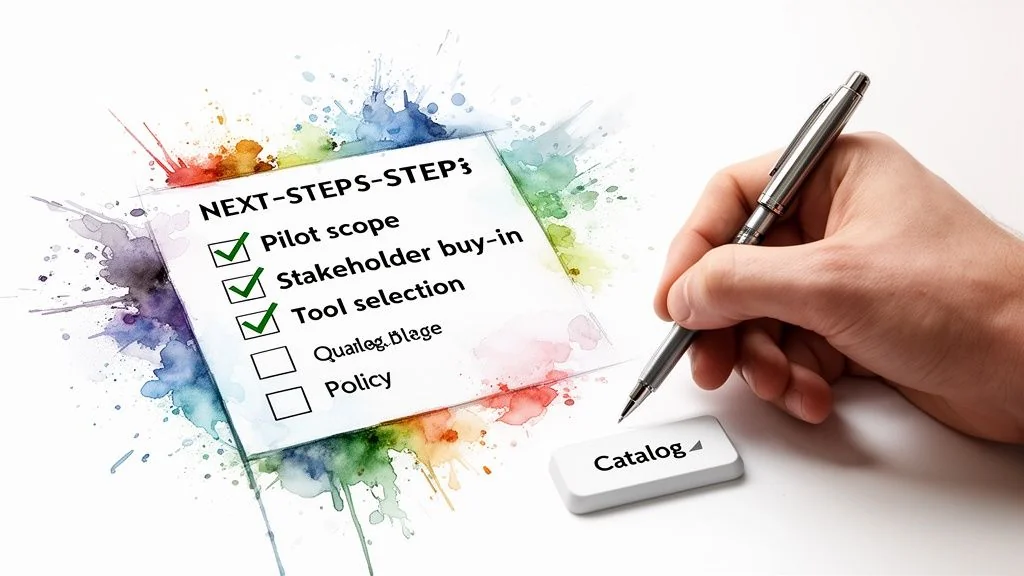
- Identify a High-Value Pilot: Do not try to fix everything at once. Pinpoint a single, persistent business problem. For example, is the marketing team hindered by poor customer data quality? Is the e-commerce team constrained by unreliable product data? These are ideal starting points.
- Sketch Out a Preliminary Scope: Be specific. Document the target data domain (e.g., Customer Data), the primary systems involved (e.g., Salesforce, ERP), and the business teams most affected by the problem.
- Secure an Executive Sponsor: This is non-negotiable. Identify a leader who is directly impacted by this data problem and is willing to advocate for the initiative. Their political capital is essential.
- Socialize the Business Case: Begin discussions with stakeholders, but frame the project as a solution to their specific business problem, not as a “data governance project.” You are not building a framework; you are helping them achieve their business targets.
With these elements in place, you have the necessary information for a good consulting partner to help you build a formal roadmap and secure funding.
A Word of Caution About Tools
The conversation will inevitably turn to technology. The market is saturated with data governance platforms from vendors like Collibra, Alation, and Atlan. These tools are effective for scaling a governance program, but they are not the program itself.
A common mistake is for a company to purchase an expensive data catalog, believing it to be a silver bullet. Six months later, it is an unused asset because no one defined data ownership or established the rules. Tools enable a process; they do not create it.
This is where an experienced consultant provides significant value. They help you define your processes and operating model first, then guide you in selecting and implementing the technology that supports your specific needs.
This ensures you do not over-invest in technology or select a platform that cannot scale with your program. A consultant’s role in this process typically includes:
- Deep-Dive Requirements Gathering: Translating business goals into a detailed list of technical requirements.
- Objective Vendor Evaluation: Managing the selection process, from creating a vendor shortlist to conducting proof-of-concept bake-offs.
- Phased, Value-Driven Implementation: Rolling out the tool in a way that directly supports the pilot project, delivering tangible value from day one.
By focusing on the framework before the tools, you ensure that technology serves your strategy, not the other way around. To get a head start on these foundational elements, check out resources like this data governance framework template to help organize your thoughts. Armed with a clear pilot and a healthy perspective on technology, you’re ready to find a partner who can help you turn your data from a liability into your most powerful asset.
Common Questions Answered
When considering data governance consultants, several practical questions consistently arise.
What’s the Real ROI on a Data Governance Project?
Quantifying a direct ROI for data governance is challenging but achievable. It is typically measured across three areas. First is cost avoidance, which includes preventing regulatory fines and the costs associated with data breaches.
Second is operational efficiency. When teams are not wasting time searching for data, questioning its accuracy, or fixing errors, they can perform their primary functions more effectively. The time savings accumulate quickly.
Finally, the most significant impact comes from revenue enablement. Good governance is the foundation for faster, more accurate decision-making. It enables the development of effective AI models and drives business growth. A good consulting team will help connect governance metrics to these bottom-line results. In most cases, a well-executed project achieves a positive ROI within 18-24 months.
Can’t We Just Do This Ourselves Without Consultants?
While an internal attempt is possible, it is a significant challenge. Most companies lack the specialized expertise, dedicated time, or neutral perspective that a consultant provides. Consultants bring experience from dozens of implementations and can help organizations avoid common pitfalls.
They accelerate the entire process and, crucially, manage the complex change management that often derails internal initiatives.
An internal-only data governance program often gets bogged down in politics, stalls from a lack of clear progress, and ultimately fails to demonstrate value. The cost of failure is often far greater than the cost of consulting.
How Do We Make Sure Our Team Actually Learns This Stuff?
Knowledge transfer must be a core, contractual component of the engagement. Any credible data governance consulting partner will include a detailed knowledge transfer plan in the Statement of Work (SOW).
Ensure the plan includes these key elements to build internal self-sufficiency:
- A “co-delivery” model: Your team members should work alongside the consultants, not as passive observers.
- Thorough documentation: Every process, policy, and technical configuration should be clearly documented for your team to own and manage.
- Formal training sessions: There must be structured workshops for data stewards and governance council members.
Insist on these components from the outset. The objective is for the consultants to make themselves redundant by enabling your team to become self-sufficient.
Ready to find the right expert partner for your data initiative? DataEngineeringCompanies.com offers independent rankings and practical tools to help you select a top-tier consultancy with confidence. Explore our 2025 Expert Rankings to streamline your search and make a smarter decision, faster. Start your search at https://dataengineeringcompanies.com.
Top Data Engineering Partners
Vetted experts who can help you implement what you just read.
Related Analysis
A Practical Guide to Data Governance Consulting Services
Discover how data governance consulting services turn data chaos into a strategic asset. Learn deliverables, vendor selection tips, and ROI.
A Practical Data Governance Framework Template for 2026
Discover the data governance framework template to guide implementation and unlock scalable value for your business.
How to Hire a Data Governance Consultant Who Delivers Real Business Value
Hiring a data governance consultant? Our guide provides actionable advice on crafting RFPs, evaluating partners, and avoiding common pitfalls. Find your expert.