What is data ingestion: a practical guide for 2025
Data ingestion is the process of moving data from disparate sources to a centralized system where it can be stored, processed, and analyzed. It’s the foundational layer of any functional data architecture—the how to build a data pipeline begins here. Without a reliable ingestion mechanism, data remains isolated in application silos, rendering it useless for analytics, business intelligence, or machine learning.
The Foundation of a Data-Driven Architecture
Think of data ingestion as the supply chain for enterprise data. Raw data is generated constantly from multiple sources: user interactions in a mobile app, transactions in a Point-of-Sale system, operational logs from servers, telemetry from IoT devices, or data feeds from third-party APIs. Each source produces a distinct type of raw material.
Data ingestion provides the logistics network—the transport and receiving infrastructure—to move these materials to a central processing facility, typically a data lake or cloud data warehouse. Only once the data is centralized can it be refined into a valuable business asset.
Why Data Ingestion Is a Core Technical Function
Ineffective data ingestion is a primary source of technical debt and a bottleneck to innovation. A well-architected ingestion strategy is the prerequisite for any effective business intelligence, machine learning, or operational analytics initiative. It addresses the fundamental challenge of converting distributed, chaotic data streams into a structured, queryable asset.
A robust ingestion framework delivers quantifiable technical and business advantages:
- Creates a Single Source of Truth: It dismantles data silos by consolidating scattered information. This ensures all stakeholders operate from a consistent and unified dataset.
- Enables Low-Latency Decision-Making: Moving data efficiently provides business units with the timely information required to react to market conditions, not just analyze historical trends.
- Powers Advanced Analytics and ML: Machine learning models are dependent on a continuous supply of high-quality training and inference data. Ingestion provides this critical data stream.
- Improves Operational Efficiency: Automating data collection and transport reduces manual overhead, minimizes the risk of human error, and frees up engineering resources for higher-value tasks.
Data ingestion is not merely a data transport task. It is the architectural foundation for data accessibility, reliability, and trust. A well-implemented ingestion layer simplifies every subsequent stage in the data lifecycle, from transformation to analysis and activation.
The growing dependency on this function is reflected in market forecasts. The global data integration market—a category encompassing ingestion and related processes—is projected to reach USD 15.22 billion in 2025 and is expected to grow to USD 25.69 billion by 2029. This represents a compound annual growth rate (CAGR) of 14%, indicating its critical role in modern enterprise architecture. Without this foundational layer, data remains a liability, not an asset.
Choosing Your Ingestion Method: Batch vs. Streaming
The core architectural decision in data ingestion is choosing how to move the data. The two primary methods are batch and streaming ingestion. The correct choice is determined by the business requirements for data freshness (latency), not by a purely technical preference.
The logistics analogy is useful here. Transporting bulk goods across an ocean is best handled by a large cargo ship on a fixed schedule (batch). Delivering a time-sensitive document across a city requires a dedicated courier for immediate transport (streaming).
The Case For Batch Processing
Batch processing is the established method for handling large-scale data workloads. Data is collected over a defined interval (e.g., hourly, daily), aggregated into a large “batch,” and then moved and processed in a single operation. This approach is computationally efficient, reliable, and cost-effective for large data volumes.
A practical parallel is a retail store’s end-of-day financial reconciliation. Transactions are not sent to the bank individually. Instead, all receipts are collected, batched together, and deposited in a single, efficient operation.
This method is optimal for use cases where near-real-time data is not a business requirement:
- End-of-Day Financial Reporting: Aggregating daily transaction data to populate executive dashboards for review the following morning.
- Periodic Payroll Processing: Executing payroll calculations for all employees on a bi-weekly or monthly schedule.
- Weekly Inventory Reconciliation: Syncing warehouse stock levels against sales data to inform procurement.
Batch processing is predictable and operationally straightforward. Its primary trade-off is latency; the data reflects a past state. For business functions that can operate on data that is several hours or a day old, batch is a robust and economical solution.
When Real-Time Data Is Non-Negotiable
Streaming data ingestion is designed for immediacy. It processes data as it is generated, typically on an event-by-event basis or in micro-batches of a few seconds. This architecture is essential for systems that must react to events in real time.
Consider credit card fraud detection. The system cannot wait for a nightly batch job to analyze a transaction. It must process the purchase data—location, amount, vendor, user history—within milliseconds to approve or deny the charge. This is a canonical example of streaming’s value. For a deeper technical comparison, review this guide on stream processing vs batch processing.
Streaming represents a paradigm shift from historical analysis to real-time operational response. It enables systems to act on events as they happen, moving a business from a reactive to a proactive posture.
Streaming is a mandatory requirement for an increasing number of modern applications:
- Live Operational Dashboards: A logistics firm monitoring its vehicle fleet requires real-time location data, not positions from an hour ago.
- Real-Time Personalization: An e-commerce platform tailoring product recommendations based on a user’s current clickstream behavior.
- Cybersecurity Threat Detection: An intrusion detection system analyzing network packet data in real time to identify and block malicious activity.
This low latency comes with increased architectural complexity and operational cost. Streaming systems require specialized tooling like Apache Kafka or Google Cloud Pub/Sub for message queuing and are generally more resource-intensive due to their “always-on” nature.
Comparison of Data Ingestion Methods
The choice between ingestion methods is a trade-off between latency, cost, and complexity, driven by a specific business need.
| Method | Latency | Cost Profile | Typical Use Case | Key Technology Example |
|---|---|---|---|---|
| Batch | High (Hours to Days) | Lower (Optimized for Bulk) | Historical BI Reporting, End-of-Day Financials | Scheduled ETL/ELT Jobs |
| Micro-Batch | Low (Seconds to Minutes) | Moderate | Near-Real-Time Analytics, Frequent Data Syncs | Spark Structured Streaming |
| Streaming | Near-Zero (Sub-second) | Higher (Always-on Compute) | Fraud Detection, Live Dashboards, IoT Sensor Data | Apache Flink, AWS Kinesis |
Ultimately, selecting the right ingestion method involves aligning technical architecture with a clearly defined business outcome, balancing the requirement for data freshness against the associated cost and operational overhead.
Exploring Modern Data Ingestion Architectures
Defining the data transport schedule (batch vs. stream) is the first step. The next is designing the system architecture that executes the data movement. This architectural pattern is the blueprint for the entire data platform, determining its flexibility, scalability, and maintainability.
Historically, the primary architectural pattern was ETL. Today, the dominant approach for cloud-based analytics is ELT.
The Legacy Pattern: ETL (Extract, Transform, Load)
The traditional architecture is ETL (Extract, Transform, Load). In this model, data is extracted from the source system, immediately subjected to transformations (cleaning, structuring, aggregation), and then loaded into the target data warehouse in its final, query-ready state.
This pattern was necessitated by the constraints of on-premises data warehouses, which had high storage costs and limited computational power. It was imperative to pre-process and shrink the data before loading to conserve expensive resources.
The Modern Standard: ELT (Extract, Load, Transform)
The advent of cloud data platforms like Snowflake and Databricks, with their separation of storage and compute, inverted this model. This led to the widespread adoption of the ELT (Extract, Load, Transform) architecture.
In the ELT pattern, data is extracted from the source and loaded directly into a cloud data lake or warehouse in its raw, unaltered format. All transformations are performed after loading, leveraging the massive, scalable compute power of the target system.
This seemingly minor change offers significant advantages:
- Flexibility: The raw source data is preserved. If business requirements change, transformations can be re-run on the raw data without re-ingesting it from the source system.
- Ingestion Speed: Ingestion is faster because it is decoupled from the time-consuming transformation step. This reduces the time-to-availability for raw data.
- Scalability: Cloud platforms are purpose-built for large-scale data transformations, executing these jobs far more efficiently than the intermediary servers used in traditional ETL pipelines.
By separating the “load” and “transform” stages, ELT creates a more agile and resilient foundation for modern analytics. To see these patterns in practice, explore these data pipeline architecture examples.
Essential Data Flow Mechanisms
Beyond the macro ETL/ELT pattern, data movement is implemented using a few core mechanisms: push vs. pull flows and Change Data Capture.
A pull-based system operates on a schedule. The destination system initiates a connection to the source system at a predefined interval (e.g., every 15 minutes) and “pulls” any new or updated data. This is the dominant mechanism for batch workflows.
A push-based system is event-driven. The source system actively “pushes” data to the destination as soon as an event occurs (e.g., a new record is created). This is the foundation for most streaming architectures.
This diagram contrasts batch and streaming methods, which are typically implemented with pull and push mechanisms, respectively.
The diagram highlights the trade-offs between latency and cost that drive the architectural choice for a given business requirement.
Change Data Capture (CDC) is a highly efficient technique for replicating data from operational databases. Instead of repeatedly querying a database to find changes, CDC directly reads the database’s transaction log. It captures every insert, update, and delete operation as a stream of events in real time.
This method is superior to query-based polling as it imposes minimal load on the source production database while enabling near-zero latency replication.
Many of the best data pipeline tools now offer native CDC capabilities. A firm understanding of ELT, push/pull mechanics, and CDC is essential for designing, building, and evaluating robust data ingestion systems.
Navigating Key Operational Challenges at Scale
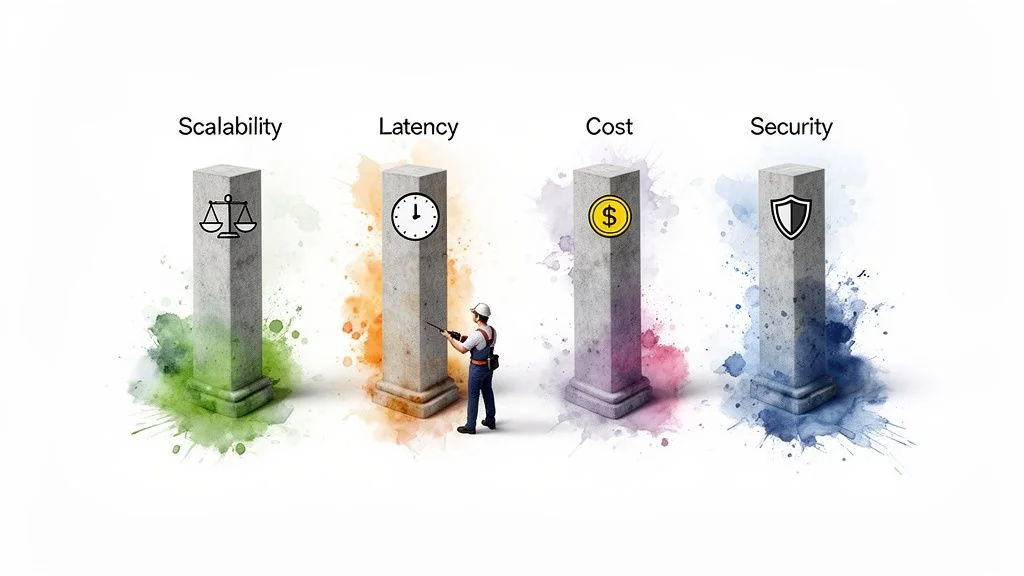
Designing a data ingestion architecture is distinct from operating it reliably under production load. A sound theoretical design can fail when confronted with fluctuating data volumes, stringent business requirements, and budget constraints. Bridging the gap from design to a production-ready system requires mastering key non-functional requirements.
These operational pillars distinguish a robust, enterprise-grade pipeline from a brittle, high-maintenance one.
The Scalability Imperative
Data volume growth is rarely linear. A successful product launch, a new fleet of IoT devices, or seasonal marketing campaigns can cause data volumes to spike by 10x to 100x. The ingestion system must handle these surges autonomously without performance degradation or failure.
A scalable architecture is designed for elasticity. It leverages infrastructure that can automatically provision additional resources to handle peak loads and de-provision them as the load subsides.
Cloud-native and serverless technologies are well-suited for this challenge, enabling a pay-for-use model that avoids the cost of maintaining idle, over-provisioned infrastructure.
- Elastic Compute: Serverless functions like AWS Lambda or Azure Functions can scale to thousands of parallel invocations to process high-volume data streams and scale to zero when idle.
- Auto-Scaling Queues: Message brokers like Apache Kafka or Google Cloud Pub/Sub act as a shock absorber, ingesting massive bursts of data and feeding them to downstream systems at a manageable rate.
A scalable system handles load spikes gracefully and cost-effectively.
Meeting Latency and Service Level Agreements
Latency measures data freshness—the elapsed time from event generation at the source to its availability for analysis at the destination. While high latency is acceptable for some use cases (e.g., historical reporting), it is unacceptable for others (e.g., real-time fraud detection).
Service Level Agreements (SLAs) formalize the business’s expectations for data timeliness and availability. For instance, an SLA might stipulate that 99.9% of all user interaction events must be available in the analytics platform within 5 minutes of generation.
An SLA is a business contract, not just a technical metric. A breach can result in direct financial loss, degraded user experience, or a loss of competitive advantage. The ingestion architecture must be designed explicitly to meet these contractual obligations.
Achieving low-latency SLAs at scale requires selecting appropriate technologies (streaming over batch), optimizing network paths, and implementing comprehensive monitoring to detect and resolve bottlenecks before they cause an SLA violation. Our guide on data pipeline monitoring tools details the practices for maintaining this critical visibility.
Controlling Runaway Costs
The elasticity of cloud infrastructure is a primary driver of both scalability and cost. Without careful management, compute and data transfer costs can escalate unpredictably.
| Cost Driver | Description | Best Practice for Control |
|---|---|---|
| Data Egress | Fees for moving data out of a cloud region or service. | Process data as close to the source as possible; use private networks. |
| Compute Resources | The processing power needed to run ingestion jobs. | Lean on serverless functions and auto-scaling to perfectly match compute to demand. |
| Data Storage | The cost of storing both raw and processed data. | Set up data lifecycle policies to automatically move older data to cheaper storage tiers. |
| API Calls | Fees from third-party sources for each data request. | Use smart batching and caching to avoid making redundant API calls. |
Effective cost management requires integrating FinOps principles into the engineering workflow. This involves tagging resources for cost allocation, setting up budget alerts, and conducting regular cost-optimization reviews to ensure the data ingestion platform remains economically sustainable at scale.
Upholding Security and Governance
Data must be protected throughout its lifecycle, from source to destination. A security breach within an ingestion pipeline can lead to significant regulatory fines under frameworks like GDPR and CCPA, as well as severe reputational damage.
Security and governance are non-negotiable architectural requirements.
- Encryption in Transit and at Rest: Data must be encrypted using strong protocols (e.g., TLS) while moving between systems and encrypted at rest using standards like AES-256 in storage.
- Access Control: Employ role-based access control (RBAC) to enforce the principle of least privilege, ensuring only authorized principals (users or services) can access sensitive data.
- Data Lineage: Maintain a comprehensive audit trail that tracks data from its origin through all transformation steps to its final destination, which is essential for compliance and debugging.
- Data Masking and Anonymization: Implement processes to automatically detect and redact or anonymize personally identifiable information (PII) during the ingestion process to minimize risk.
Within the enterprise, robust data ingestion is the enabling technology for the multi-cloud and hybrid data strategies adopted by over 90% of Fortune 500 companies. This is why specialized consultancies are often engaged; seamless ingestion is the critical bridge connecting fragmented data sources into a unified analytical plane. You can learn more about these data integration market trends to understand the broader context.
Building Your Data Ingestion RFP: A Practical Checklist
Selecting a data engineering consultancy is a critical decision that significantly impacts the success of a data strategy. A well-structured Request for Proposal (RFP) is the primary tool for de-risking this decision. It compels vendors to move beyond marketing claims and provide specific evidence of their technical and operational capabilities.
Use this checklist to structure your RFP and elicit the information needed to make an informed choice.
Technical Proficiency and Architectural Acumen
A qualified partner must demonstrate a deep, practical understanding of modern data architecture, including the trade-offs between different technologies and patterns.
Key Questions to Ask:
- Streaming Expertise: “Describe a scenario where you’d recommend Apache Kafka over Google Cloud Pub/Sub for a high-throughput streaming pipeline. What specific factors would drive that decision?”
- CDC Implementation: “Detail a project where you implemented Change Data Capture (CDC) from a relational database. Specify the tool used (e.g., Debezium) and describe the performance tuning required to achieve low latency.”
- Architectural Philosophy: “Under what specific conditions do you advocate for an ELT (Extract, Load, Transform) architecture over a traditional ETL pattern? What are the primary drivers and potential drawbacks of your preferred model?”
- Connector Development: “Describe your experience developing custom connectors for proprietary or legacy data sources that lack off-the-shelf integrations.”
These questions require vendors to demonstrate applied expertise, not just list familiar technologies.
Operational Maturity and Production Readiness
A superior architectural design is meaningless without the operational discipline to run it reliably. Evaluate a vendor’s ability to maintain system health, respond to incidents, and adhere to service level commitments.
A vendor’s monitoring dashboards and Service Level Objectives (SLOs) are a direct window into their operational maturity. An inability to provide clear, metric-driven examples of how they monitor pipeline health is a significant red flag.
Assess their operational capabilities with these questions:
- Monitoring and Alerting: “Provide anonymized examples of your standard monitoring dashboards. What key metrics do you track for pipeline latency, throughput, and error rates?”
- Service Level Objectives (SLOs): “What are your standard SLOs for data freshness and pipeline uptime? Describe your process for handling an SLO breach.”
- Incident Response: “Describe your incident response runbook for a critical pipeline failure. Define the on-call structure, escalation paths, and target Mean Time to Resolution (MTTR).”
Financial Transparency and Total Cost of Ownership
A trustworthy partner will provide a transparent and comprehensive cost model that accounts for all factors, not just their service fees. Hidden costs related to cloud infrastructure can easily derail a project budget.
Essential Financial Inquiries:
- Detailed TCO Model: “Provide a sample Total Cost of Ownership (TCO) breakdown for a solution comparable to our requirements. This must include estimated cloud costs for compute, storage, and data egress in addition to your professional service fees.”
- Cost Optimization Strategy: “How do you actively manage and optimize cloud spend for data pipelines? Provide specific examples of cost-reduction measures you have implemented for other clients.”
- Scaling Costs: “Explain how your pricing model accommodates data volume growth. Are there pricing tiers or potential cost escalations we should anticipate?”
Using this structured inquiry process transforms the RFP from a simple vendor pitch into a rigorous evaluation of technical, operational, and financial capability. This is how you select a partner equipped to deliver a scalable, reliable, and cost-effective data ingestion solution.
Data Ingestion FAQs
These are common, practical questions from technical and business leaders navigating data ingestion.
Data Ingestion vs. ETL: What’s the Difference?
These terms are often used interchangeably, but they represent different levels of abstraction. Understanding the distinction is crucial for modern data architecture.
Data ingestion is the broad process of moving data from any source to a central destination. It is a general term for data transport.
ETL (Extract, Transform, Load) is a specific architectural pattern for data ingestion. In the traditional ETL pattern, data is transformed before it is loaded into the destination. In the modern ELT (Extract, Load, Transform) pattern, raw data is loaded first, and transformations happen later inside the target system, which is a much faster and more flexible approach.
How Do I Choose the Right Data Ingestion Tool?
There is no single “best” tool; the optimal choice depends entirely on the specific use case, technical environment, and team capabilities.
The selection process should be guided by these key criteria:
- Sources and Connectors: Does the tool provide pre-built, reliable connectors for your critical data sources (e.g., Salesforce, production databases, third-party APIs)? Custom development is costly and slow.
- Latency Requirements: What is the business need for data freshness? Real-time use cases (fraud detection) demand streaming tools like Apache Kafka. Daily reporting can be served perfectly well by batch-oriented tools like Fivetran or Airbyte.
- Team Skillset: Evaluate the tool against your team’s existing expertise. Does your team have the engineering capacity to manage a complex open-source platform, or would a managed SaaS solution provide a faster time-to-value?
- Scalability: Can the tool handle peak data volumes without performance degradation or cost overruns?
Define the business problem and its technical requirements first, then evaluate tools against those specific needs for scalability, maintainability, and total cost of ownership.
What Are the First Steps to Improve Our Data Ingestion?
Effective data strategy begins with focused, incremental projects, not a “big bang” overhaul. The goal is to deliver tangible value quickly and build momentum for broader initiatives.
The objective of an initial data project is not to solve every data problem at once. It is to solve one high-impact business problem, thereby demonstrating the value of a modern data stack and building the organizational capacity for more complex future projects.
Follow this three-step process:
- Map Your Data Sources. Begin by creating an inventory of your critical data sources. Identify the data owner, format, volume, and rate of change for each. You cannot manage what you have not cataloged.
- Define a Business Problem. Collaborate with stakeholders to identify a high-value business question they are currently unable to answer due to data accessibility issues. This will define the specific data required and its necessary latency.
- Execute a Proof-of-Concept (POC). Select one valuable data source and build a single pipeline to address the defined business problem. This small-scale project serves as a low-risk environment to validate your choice of tools, architectural patterns, and assumptions before committing to a larger investment.
Ready to find the right partner to build your data ingestion pipelines? The expert-vetted rankings on DataEngineeringCompanies.com provide the transparency and data you need to choose with confidence. Explore detailed firm profiles, cost calculators, and our comprehensive RFP checklist.
Find your ideal data engineering partner at https://dataengineeringcompanies.com.
Data-driven market researcher with 20+ years in market research and 10+ years helping software agencies and IT organizations make evidence-based decisions. Former market research analyst at Aviva Investors and Credit Suisse.
Previously: Aviva Investors · Credit Suisse · Brainhub · 100Signals
Top Data Engineering Partners
Vetted experts who can help you implement what you just read.
Related Analysis
A CTO's Guide To Real-Time Data Pipeline Architecture
Build a winning real-time data pipeline architecture. This guide helps engineering leaders compare patterns, choose components, and select the right partner.
Data Pipeline Cost Estimation Guide 2026
How much does a data pipeline cost to build and run? Complete breakdown by pipeline type, cloud platform, team model, and project scope — with rate benchmarks from 86 verified data engineering firms.
What Is Data Observability? A Practical Guide
Understand what is data observability and why it's crucial for reliable AI and analytics. This guide covers core pillars, KPIs, and implementation.