A Practical Guide to Streaming Data Platforms
A streaming data platform ingests, processes, and analyzes data continuously as it’s generated, instead of waiting for a scheduled batch job to load it hours later. That gap - reacting to an event in milliseconds versus querying it the next morning - is what separates real-time systems from traditional batch warehousing.
Why Does Real-Time Processing Matter for a Business?
Historically, businesses ran on a store-then-analyze model: sales, clickstream, and log data piled up for hours or days before landing in a warehouse for reporting. That model still works for historical analysis, but it’s too slow for decisions that need to happen while the event is still relevant. A streaming platform processes data in motion, so patterns get detected, events get reacted to, and personalization happens in milliseconds rather than after the fact.
The Business Case for Streaming
Three patterns show up repeatedly across industries that adopt streaming:
- Instant Personalization: An e-commerce platform can process a user’s clickstream in real time to immediately serve relevant product recommendations, directly impacting conversion rates.
- Immediate Fraud Detection: A financial institution can analyze transaction patterns as they occur, blocking a fraudulent purchase before it completes, rather than flagging it for review hours later.
- Dynamic Operational Monitoring: A logistics company can monitor vehicle and sensor data to predict maintenance needs or reroute fleets around emergent traffic issues, avoiding costly delays.
A streaming data platform closes the gap between when an event occurs and when you can act on it. This “decision latency” is a primary competitive differentiator, where success is measured in seconds, not days.
The streaming analytics market itself reflects this shift: valued around $23.4 billion in 2026, it’s projected to reach $128.4 billion by 2030 - a 28.3% compound annual growth rate, according to MarketsandMarkets.
Batch Processing vs Streaming Data Platforms at a Glance
| Attribute | Batch Data Platform | Streaming Data Platform |
|---|---|---|
| Data Scope | Large, bounded datasets | Unbounded, continuous streams of events |
| Latency | High (minutes, hours, or days) | Low (milliseconds to seconds) |
| Analysis | Retrospective analysis of past events | Real-time analysis of current events |
| Primary Use | Historical reporting, BI dashboards | Live monitoring, alerting, instant actions |
| Analogy | A library for historical research | A reflex system that reacts as events happen |
The shift from batch to streaming is a transition from retrospective analysis to proactive operational control. One informs what happened; the other influences what happens next.
What Are the Core Components of a Streaming Architecture?
A streaming architecture has four components: ingestion (collecting raw events), processing (transforming them in flight), storage (persisting results for fast queries), and serving (delivering insights to dashboards and applications). Each stage is typically owned by a different technology.
The Ingestion Layer: The Data Entry Point
All data processing begins at the ingestion layer. Its function is to collect high-volume streams of raw data from diverse sources, such as application logs, user clickstreams, IoT sensor readings, and financial data feeds.
This component has to handle massive throughput without dropping data, and scale as volume grows. A standard technology for this layer is Apache Kafka, which functions as a distributed, durable commit log. It receives raw data from producers and organizes it into topics for subsequent processing.
The Processing Engine: The Transformation Core
Once ingested, data moves to the stream processing engine. This is where real-time computation occurs. The engine consumes data streams from the ingestion layer and applies business logic, performs calculations, or enriches the data as it flows through the system.
Common operations include filtering irrelevant data, aggregating data into time windows (e.g., calculating the average transaction value over the last 60 seconds), or joining multiple streams to create a more complete contextual record.
The core distinction from batch processing is that the query logic is applied continuously to the data in motion, rather than being executed against stored data at a later time.
Key technologies in this space include:
- Apache Flink: An engine known for stateful processing, enabling complex logic with very low latency.
- Apache Spark Streaming: Often uses a micro-batch approach, processing events in small, discrete time windows for rapid analysis.
- Kafka Streams: A lightweight library that lets applications process data directly from Kafka topics without a separate processing cluster.
For a deeper look at how these pieces fit together end to end, see data pipeline architecture examples.
The Storage Layer: The Real-Time Repository
After processing, the enriched data requires storage. While some of this data may be loaded into a system like Snowflake for long-term analysis, a streaming architecture also needs a storage layer optimized for fast queries on real-time data.
This layer must handle high-velocity writes from the processing engine and support equally fast reads to power live dashboards and applications.
The Serving Layer: The Delivery Mechanism
Finally, the serving layer delivers the processed insights to their destination. This is the component that end-users and applications interact with directly - the real-time analytics dashboards for operations teams, the fraud alerts for financial services, the recommendation engines for e-commerce sites.
Technologies like Apache Druid or ClickHouse are often used here. Both are databases built to deliver sub-second query responses on large, streaming datasets. Together, these four components turn a constant flow of raw data into continuous business intelligence.
True Streaming vs. Micro-Batch: Which Do You Need?
True streaming processes each event the instant it arrives, at millisecond latency. Micro-batching collects events into short windows - usually a few seconds - before processing them together, trading a small delay for higher throughput and lower operational complexity. The right choice depends on how much that delay actually costs you.
True stream processing (or native streaming) processes each data event individually the moment it arrives. This approach delivers latency measured in milliseconds, making it essential for use cases where every fraction of a second is critical.
Micro-batch processing, conversely, collects data into small batches over a short time window (typically a few seconds) and then processes each batch at once. It is significantly faster than traditional batch processing but introduces a small, inherent delay compared to true streaming.
The Trade-Off: Latency vs. Throughput
- Algorithmic Trading: In financial markets, a delay of even a few milliseconds can result in significant financial loss. True streaming is required to analyze market data and execute trades at machine speed.
- Real-Time Bidding: In ad tech, ad placements are auctioned in the milliseconds it takes for a webpage to load. Micro-batching is too slow to compete effectively.
- Critical Anomaly Detection: For monitoring industrial equipment or utility grids, an immediate alert from a sensor anomaly can prevent a costly failure.
Micro-batching, however, often achieves higher throughput, since processing events in groups can be more computationally efficient. That makes it a practical choice for “near-real-time” use cases where sub-second latency isn’t a strict requirement. For more detail, our guide on stream processing vs batch processing covers the decision in depth.
The question is not which approach is superior, but which is appropriate for the specific business requirement. Applying true streaming to a dashboard that only needs 10-second refresh intervals is over-engineering. Using micro-batching for high-frequency trading is unviable.
When Is Micro-Batching Good Enough?
Many business requirements are satisfied by rapid updates that don’t demand millisecond-level immediacy. In these scenarios, the relative simplicity and often lower cost of a micro-batch architecture are advantageous.
Consider these common use cases:
- Live Operational Dashboards: An operations team monitoring website traffic or sales trends is well-served by data that refreshes every 5-10 seconds.
- Log Analytics: Aggregating and analyzing application logs to detect error spikes can be done effectively in small batches without impacting response time.
- Near-Real-Time Personalization: Updating product recommendations based on a user’s recent clicks can occur within seconds and still feel instantaneous to the user.
Map your actual latency requirement to the processing model before you pick a stack - the gap between “instant” and “a few seconds” is often invisible to the end user but expensive to build for unnecessarily.
What Business Problems Does Streaming Actually Solve?
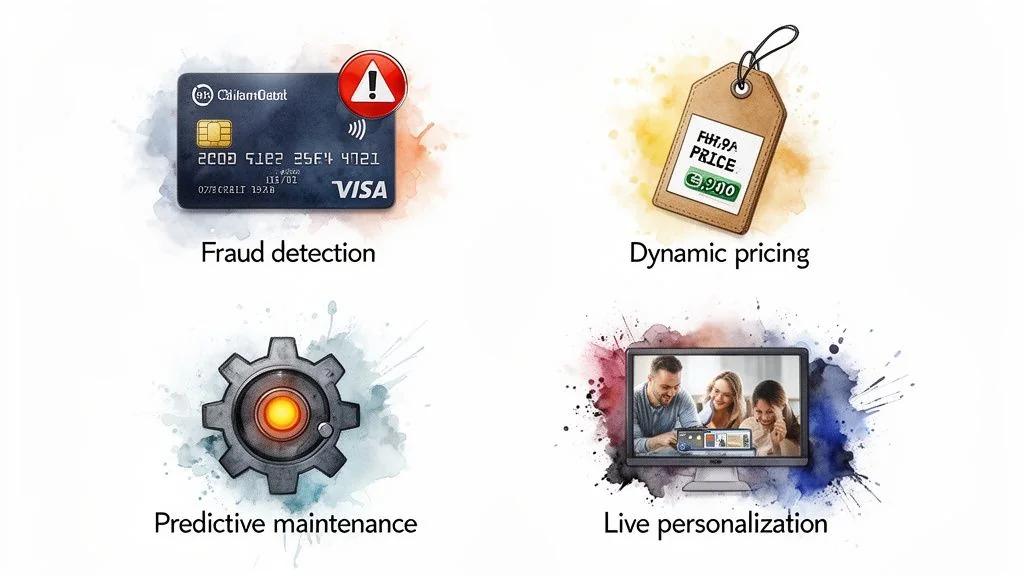
Four patterns account for most production streaming deployments: fraud detection, dynamic pricing, predictive maintenance, and live personalization. Each maps a real-time signal directly to a decision that has to happen before the moment passes.
Real-Time Fraud Detection in Finance
-
The Problem: Financial institutions lose substantial revenue to fraud annually. Traditional batch systems detect suspicious activity hours or days later, by which time funds are lost and customer trust is damaged.
-
The Streaming Solution: When a transaction occurs, the streaming platform ingests the data instantly. In milliseconds, it analyzes the customer’s spending patterns, location, and purchase details against historical models, flagging anomalies before the transaction is approved.
-
The Bottom Line: This proactive approach blocks fraudulent transactions instantly, preventing financial loss, while avoiding the false positives that come from reviewing transactions after the fact.
Dynamic Pricing in E-Commerce
-
The Problem: Static or manually updated pricing in e-commerce fails to capitalize on real-time market dynamics, such as a competitor’s promotion, a sudden demand spike, or changing inventory levels.
-
The Streaming Solution: By processing clickstream data, inventory levels, and competitor price scrapes in real time, a platform can continuously recalculate optimal pricing. If a competitor runs out of a popular item, the system can adjust the price upward. If an item isn’t selling, it can be discounted to clear inventory.
-
The Bottom Line: Dynamic pricing leads directly to improved profit margins and conversion rates, letting retailers respond to market shifts in real time - a capability unavailable to slower, batch-based systems.
The core principle is to connect data directly to an outcome. Instead of analyzing what happened yesterday, the business can influence what happens in the next second.
Predictive Maintenance in Manufacturing
-
The Problem: Unexpected equipment failure in manufacturing causes production halts, schedule disruptions, and safety hazards. Maintenance is often reactive (fixing what’s already broken) or based on fixed schedules that don’t reflect actual equipment condition.
-
The Streaming Solution: A streaming platform ingests a continuous flow of data from IoT sensors on machinery, monitoring variables like vibration, temperature, and energy consumption. Feeding these live streams into machine learning models lets the system flag subtle anomalies that predict impending failure.
-
The Bottom Line: Predictive maintenance catches equipment problems before they cascade into a production stop, instead of after. That translates to fewer unplanned outages, lower repair costs, and a safer work environment.
Live Customer Personalization in Media
-
The Problem: Media and entertainment companies compete for user engagement. Generic content and irrelevant advertising lead to user churn.
-
The Streaming Solution: A streaming platform tracks every user interaction in real time - content viewed, clicks, skips. This data instantly fuels personalized content recommendations and relevant ad serving. The live streaming market, valued at around $100 billion in 2024, shows the scale of this domain: platforms like Twitch depend on this infrastructure to manage analytics and monetization for millions of concurrent users, per industry data.
-
The Bottom Line: Real-time personalization drives higher engagement, longer session duration, and better ad revenue. Relevant experiences build loyalty and increase customer lifetime value.
How Do You Choose the Right Streaming Platform?
Score candidates against your actual latency needs, ecosystem fit, total cost, and in-house skills before you look at vendor marketing - platform choice is a multi-year commitment that shapes team structure and budget, not just a technology pick.
Establish Your Core Evaluation Criteria
Before evaluating vendors, define your success criteria on a scorecard built from your own business and technical requirements:
- Scalability and Elasticity: How does the platform handle data volume spikes? Does it support automatic scaling to manage costs and performance without manual intervention?
- Latency Guarantees: Define your actual data freshness requirements. Is sub-second latency for critical operations necessary, or is near-real-time (a few seconds) sufficient for your use case?
- Ecosystem Compatibility: Verify native integrations with existing systems, particularly your data warehouse (e.g., Snowflake or Databricks) and BI tools that plug in without custom glue code - a core requirement of the modern data stack approach.
- Total Cost of Ownership (TCO): Analyze costs beyond the initial license fee. Account for infrastructure, data egress, support, and the engineering resources required for maintenance.
- Required Team Skills: Assess whether your current team has the necessary skills in distributed systems engineering or if you’ll need to hire or train personnel. Underestimating the skills gap is a common failure point.
The optimal platform is not the one with the most features, but the one that best aligns with your team’s skills, budget, and latency requirements. Over-engineering is as risky as under-provisioning.
Real-time infrastructure investment now underpins a large share of consumer-facing services, from media and gaming to payments and logistics, which is why streaming platforms have moved from a niche capability to a mainstream one.
Right-Sizing Your Platform Approach
There are three primary approaches, and the best choice depends on your team’s capabilities and project scale.
Streaming Platform Approach Selection Matrix
| Platform Approach | Typical Cost Band | Required In-House Skills | Best For |
|---|---|---|---|
| DIY Open Source (e.g., Self-hosted Kafka & Flink) | $-$$ | Deep Expertise: Requires a dedicated team of engineers skilled in distributed systems, networking, and cluster management. | Organizations with highly specific requirements, a strong engineering culture, and the need for maximum control and customization. |
| Cloud-Native Services (e.g., AWS Kinesis, Google Pub/Sub) | $$-$$$ | Moderate Expertise: Requires cloud architects and developers familiar with the specific cloud provider’s ecosystem and IAM policies. | Teams already committed to a specific cloud provider who need to move quickly and offload infrastructure management for standard use cases. |
| Managed Platform / SaaS (e.g., Confluent Cloud, Decodable) | $$$-$$$$ | Low-to-Moderate Expertise: Requires data engineers who can focus on building pipelines and business logic rather than managing infrastructure. | Companies that want the power of open-source standards like Kafka without the operational overhead, prioritizing speed-to-market and reliability. |
If you’re also weighing scheduling and workflow orchestration alongside streaming, our data orchestration platforms comparison covers the batch side of that decision.
Streaming Data Platform FAQ
How Is a Streaming Platform Different from Event-Driven Architecture?
The two concepts are related but distinct.
Event-Driven Architecture (EDA) is an architectural pattern where software components communicate by producing and consuming events. This promotes loose coupling, allowing services to evolve independently.
A streaming data platform is the infrastructure that implements this pattern at scale for high-volume, real-time data flows. It consists of the technologies, like Apache Kafka and Apache Flink, that process continuous streams of events.
A simple event-driven system can exist without a full streaming platform. However, a streaming data platform is inherently event-driven. The platform is the engine that enables the architectural pattern for data-intensive applications.
How Does a Streaming Platform Fit in with Snowflake or Databricks?
A streaming platform complements, rather than replaces, systems like Snowflake or Databricks. They work together, with real-time and historical data enriching each other in two directions:
- Stream to Warehouse: The streaming platform processes events in real time and then lands the clean, structured data into a data warehouse or lakehouse. This builds a rich historical dataset for business intelligence, trend analysis, and machine learning model training.
- Warehouse to Stream: The platform can also pull data from the warehouse to enrich real-time events. For example, as a stream of user clicks is processed, the system can fetch the customer’s lifetime value from a table in Databricks to add context before triggering a personalized offer.
What Are the Biggest Hurdles in Adopting a Streaming Architecture?
Transitioning from batch to streaming is a paradigm shift that involves operational and cultural changes. Three hurdles come up consistently:
-
The Skillset Gap: The primary challenge is often human, not technical. It requires engineers proficient in distributed systems, stateful stream processing, and fault tolerance. Finding or training people who can work with unbounded data streams is a major consideration.
-
Data Governance and Quality: In batch processing, there may be hours to detect and correct data quality issues. In a streaming environment, that window shrinks to milliseconds. Real-time data monitoring, schema enforcement, and automated quality checks are complex but essential for trusted output.
-
Cost Management: Streaming platforms are “always on,” which can lead to escalating cloud costs if not managed carefully. Disciplined capacity planning, effective auto-scaling policies, and continuous cost monitoring are necessary to prevent uncontrolled infrastructure spending.
Not every data engineering firm actually works with streaming systems. Of the 86 firms profiled in the Data Engineering Companies Index, 15 name streaming or Kafka expertise specifically - worth checking before you assume a generalist consultancy can staff a Flink or Kafka Streams build.
Researched & written by
Data-driven market researcher with 20+ years in market research and 10+ years helping software agencies and IT organizations make evidence-based decisions. Former market research analyst at Aviva Investors and Credit Suisse.
Previously: Aviva Investors · Credit Suisse · Brainhub · 100Signals
Vetted partners
Top Data Pipeline Partners
Vetted firms whose specialty matches this article.
More in Data Pipeline Architecture
What Is Lakehouse Architecture? A Practical Guide
Discover what is lakehouse architecture and how it merges data lakes and warehouses to power modern AI and analytics. An expert guide to the essentials.
A Leader's Guide to Apache Spark Optimization: Moving Beyond Quick Fixes
A practical framework for Apache Spark optimization: diagnosing the real bottleneck, tuning shuffle partitions and executor sizing, and choosing code fixes that cut runtime and cloud cost.
Data Contracts in Data Engineering: A Guide for Engineering Leaders
Explore data contracts in data engineering to enforce agreements, prevent pipeline failures, and boost data reliability across Snowflake and Databricks.