A Practical Guide to Data Orchestration Platforms
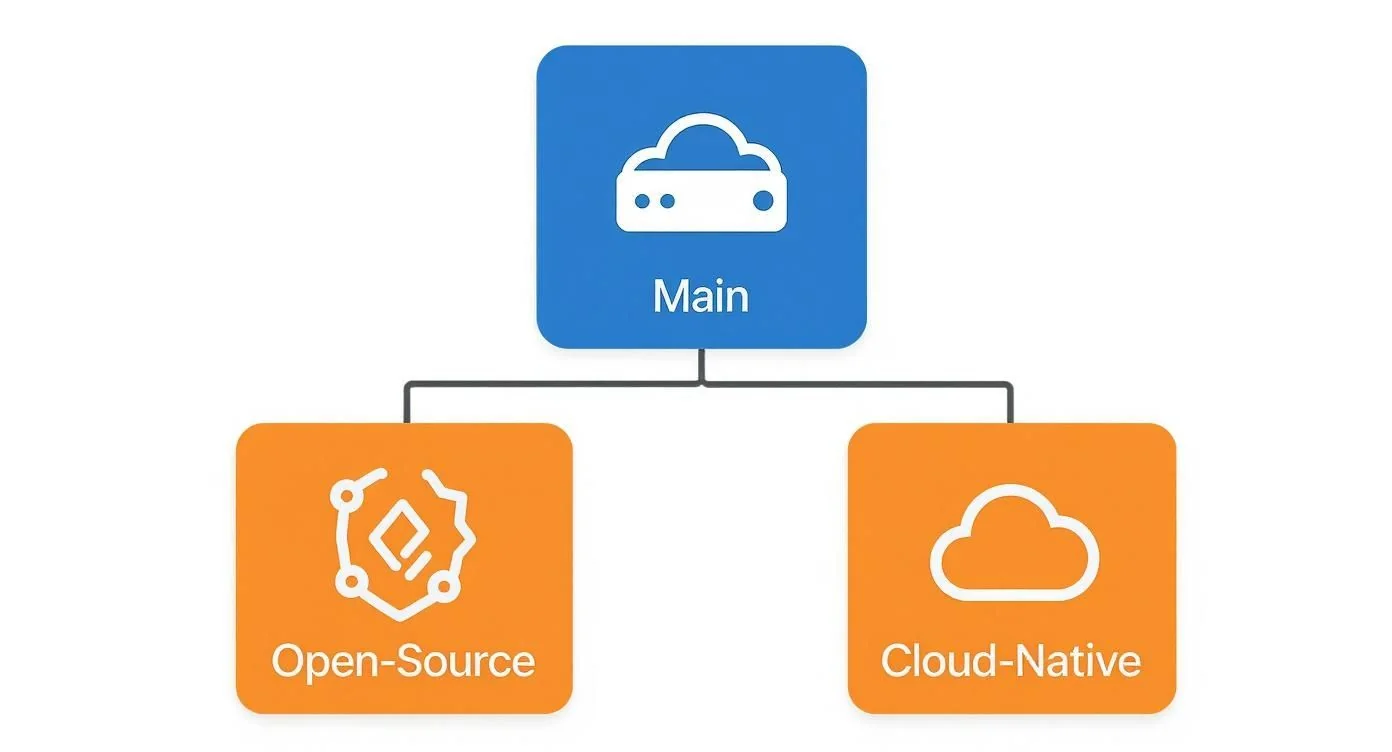
A data orchestration platform manages the dependencies, retries, and monitoring for every task in a data pipeline, so a transformation only fires after its source data has loaded and passed validation. The practical choice most teams face is open-source tools you run yourself, such as Airflow, Dagster, and Prefect, versus managed cloud-native services, such as AWS Step Functions and Google Cloud Composer, that trade some control for lower operational overhead.
Orchestration and the transformation layer overlap constantly in practice - 20 of the 86 firms profiled in the Data Engineering Companies Index list dbt among their capabilities, and most production Airflow or Dagster deployments end up orchestrating dbt runs somewhere in the DAG.
What this guide covers:
- How orchestration differs from a scheduler, and why that difference matters for reliability.
- Where AI is genuinely changing the orchestration layer, and where the marketing gets ahead of the product.
- How to match a platform to your architecture: event-driven, data mesh, or MLOps.
- What to evaluate before you commit: governance, AI/MLOps fit, and cost.
What does a data orchestration platform actually do?
A data orchestration platform tracks dependencies between pipeline tasks and only runs a job once its prerequisites are actually met, replacing fixed-time scheduling with logic that reacts to real pipeline state.
Early data workflows relied on time-based tools like cron, which executed scripts on a fixed schedule with no awareness of data availability or the status of upstream jobs. That’s similar to an airport dispatching flights on a rigid timetable regardless of weather or runway traffic - it works until it doesn’t, and when it fails it tends to fail badly.
Modern data orchestration platforms track dependencies instead of just time. A transformation job only starts after the source data has been ingested and validated, which is what stops one upstream hiccup from cascading into a dozen downstream failures.
What separates orchestration from scheduling?
An orchestrator gives you one place to see the state of every pipeline, which matters once a data estate has dozens of sources, tools, and destinations feeding into it. The capabilities that distinguish a real orchestrator from a scheduler:
- Dependency management. Explicit, graph-based relationships between tasks - a failure in one node pauses or reroutes what depends on it.
- Automated error handling. Retry logic, alerting, and failure notifications that cut down on manual firefighting.
- Observability and lineage. Logs, monitoring dashboards, and lineage that show where data came from and what happened to it along the way.
- Event-driven triggers. The ability to react to a new file landing in cloud storage, not just a fixed clock time.
Fragmented, hard-to-monitor pipelines are a common reason data teams struggle to get consistent value out of otherwise-good data. Turning siloed, manually watched processes into dependency-aware, automated workflows is what makes timely BI reporting and production ML deployment possible in the first place.
How orchestration platforms compare to traditional schedulers
| Capability | Traditional schedulers (e.g., cron) | Modern data orchestration platforms |
|---|---|---|
| Triggering | Time-based (e.g., run at 2 AM) | Event-driven, API calls, time-based, and manual |
| Dependencies | None; tasks are independent | Complex, graph-based dependencies (DAGs) |
| Error handling | Minimal; script must handle its own errors | Automated retries, alerting, and failure logic |
| Observability | Limited to system logs; no central view | Centralized UI, logging, monitoring, and lineage |
| Scalability | Limited to a single machine | Distributed architecture for massive scale |
| Flexibility | Rigid and difficult to change | Code-as-configuration; dynamic and adaptable |
Moving from a scheduler to an orchestrator is what makes pipelines reliable and auditable instead of a pile of cron jobs someone half-remembers. See data integration best practices for the practices that pair with a good orchestration layer.
How is AI actually changing orchestration platforms?
AI is moving orchestration from alerting a human about a failure to diagnosing and fixing it directly - catching a schema change or data quality anomaly and triggering a correction automatically, instead of waiting on manual intervention.
Vendors including Prefect and Databricks Workflows are building agents directly into the orchestration layer for this purpose. Operational complexity in the underlying data pipelines is one of the reasons AI pilots stall before reaching production, which is exactly the bottleneck AI-infused orchestration targets. The AI orchestration platform market is projected to grow substantially through 2034, which tracks with how much enterprise budget is now going toward managing AI workloads rather than just building them.
From reactive to predictive operations
The real shift happens when a system moves from reacting to failures to anticipating them: analyzing historical run data to scale compute ahead of a known peak, or flagging a likely data quality issue before it reaches downstream tables. Done well, this can meaningfully cut the time engineers spend diagnosing incidents, though the actual gains depend heavily on how mature the existing pipeline observability already is.
That shift changes what data engineering teams spend their time on: less time chasing down why a DAG failed at 3 a.m., more time on the pipelines and models that actually move the business.
What does a hybrid batch-streaming setup look like in practice?
The practical first step toward more autonomous orchestration is a hybrid trigger model that handles real-time events without abandoning scheduled batch work. For example, a pipeline could:
- Listen to a Kafka stream to trigger real-time validation and anomaly detection.
- Scale resources dynamically when an unusually large file lands in cloud storage.
- Retry a failed task with more memory based on what past failures for that specific task actually looked like.
This hybrid pattern is the foundation most teams will need before taking on more autonomous, agentic orchestration - systems that pick a compute engine for a workload or rewrite a query for performance without a human in the loop. That’s a capability most organizations are still a couple of years from needing to architect around.
Should you choose an open-source or cloud-native orchestrator?
Choosing a data orchestration platform means picking between the control of open-source tools and the lower operational overhead of managed cloud-native services. Neither path is inherently better; the right one depends on your team’s skills, your architecture, and how much infrastructure you actually want to own.
The case for open source
Apache Airflow remains the default open-source choice, and it offers real control over how tasks run with no vendor lock-in. A common pattern is running Airflow on Kubernetes through a managed service like Astronomer or AWS MWAA, which combines the flexibility of open source with someone else handling the cluster operations.
The Airflow UI’s DAGs view gives engineers a single place to monitor recent runs and spot failures immediately, and that kind of centralized visibility is a big part of why Airflow displaced so many bespoke cron setups in the first place.
Open-source tools tend to show up in organizations building data stacks meant to last years, not just survive the next platform migration. An open-source orchestrator running on Kubernetes scales cost-effectively and keeps you out of a single cloud provider’s stack, which matters for teams that value architectural independence over convenience.
Running dbt models as tasks inside Airflow DAGs also simplifies governance: declarative, version-controlled transformations make compliance audits across multi-cloud environments far more straightforward than untangling ad hoc scripts. If you’re weighing Airflow against Dagster or Prefect specifically, the differences matter more for asset-centric and event-driven use cases than for straightforward batch ETL.
The case for cloud-native and serverless
Cloud-native serverless platforms like AWS Step Functions and Google Cloud Dataflow are built into their respective cloud ecosystems and bill on a pay-per-use basis, which suits event-driven orchestration well. Instead of managing clusters, you define the workflow logic and pay for active execution time.
This model tends to make the most financial sense for teams that don’t want to own infrastructure operations at all. The cloud orchestration market is projected to more than triple by 2032, which tracks with how many teams are moving ETL workloads, like S3-to-BigQuery pipelines, onto serverless orchestrators.
Practices that get the most out of cloud-native orchestration:
- LLM-driven query generation. Lets pipelines adapt to new analytical requirements without manual code changes for every new query shape.
- Infrastructure as code. Partitioning tasks with Terraform builds in resilience against schema evolution and keeps deployments consistent and version-controlled.
- A clear cost case. A well-run serverless setup typically pays for itself faster than a comparable self-hosted one, which is the argument that actually gets a migration approved.
The decision between open-source and cloud-native data orchestration platforms comes down to your team’s skills, budget, and how much infrastructure ownership you actually want. Open source gives you control and flexibility; cloud-native gives you simplicity and less to operate.
How do you match orchestration patterns to modern architectures?
Simple, linear pipelines don’t hold up against real-time event processing, decentralized data ownership, and production machine learning - the right orchestration pattern depends on which of these three problems you’re actually solving.
Event-driven, real-time orchestration with Dagster’s asset model
Moving from nightly batch processing to real-time insight requires a shift from task-centric to asset-centric orchestration. Dagster is built around this idea: the model centers on the data assets a pipeline produces, not just the code that generates them.
This asset-centric approach fits low-latency pipelines well, such as Kafka streams landing in Delta tables, because it makes the relationships between data assets visible instead of buried in task logs - a real advantage when debugging complex dependency chains. Teams running Dagster for real-time fintech pipelines report fewer incidents tied to silent schema drift, since failures surface at the asset level instead of downstream.
Handling volatile streams from sources like IoT devices also requires backpressure management and automated lineage tracking, so a burst of incoming data doesn’t overwhelm the system. Done well, this cuts down on false alerts and shortens the time it takes to trace an incident back to its source. See data pipeline architecture examples for more on how these patterns fit together.
Data mesh orchestration with decentralized domains
As organizations scale, a centralized data team inevitably becomes a bottleneck. Data mesh addresses this by distributing data ownership to individual business domains, which requires an orchestration platform that supports federated, self-serve environments rather than one team gatekeeping every pipeline.
Prefect and Mage are well-suited to this pattern. They support domain-owned pipelines with federated catalogs, so teams like marketing and finance can manage their own data products while still contributing to a shared ecosystem:
- Domain-owned pipelines. Each team is directly accountable for the quality and freshness of its own data products.
- Federated catalogs. A shared metadata layer with clear SLAs supports self-serve data discovery across domains.
- Outcome-based metrics. Defining data freshness SLAs and similar outcome metrics keeps the architecture adaptable as requirements shift.
This model scales well because it distributes ownership instead of routing every request through one central team, and it lets domains build on their own data products without waiting on a bottleneck upstream.
A production MLOps orchestration stack
MLOps pipelines chain together experiment tracking, feature versioning, model deployment, and inference monitoring, and the orchestration layer has to manage that entire lifecycle, not just the training run.
A common pattern is sequencing MLflow experiments into Prefect or Airflow flows for an end-to-end path from feature store to inference. That stack typically includes:
- MLflow for experiment tracking - logs parameters, metrics, and model artifacts for reproducibility.
- DVC for versioning - version control for large datasets and models, the equivalent of Git for code.
- A feature store - centralizes feature engineering so training and serving stay consistent.
- CI/CD via GitHub Actions - automates testing and deployment for both pipeline code and models.
A reproducible stack like this is what lets a team move an AI product from prototype to something that actually ships reliably, instead of re-solving the same deployment problems on every release.
Matching patterns to platforms
| Architecture pattern | Recommended platform(s) | Key enabling feature | What it’s good for |
|---|---|---|---|
| Event-driven & asset-centric | Dagster, Kestra | Declarative, software-defined assets | Real-time systems where fast incident resolution matters |
| Data mesh & decentralized domains | Prefect, Mage, Dagster | Multi-tenancy, federated governance, domain isolation | Cross-team collaboration and faster data product delivery |
| End-to-end MLOps | Prefect, Airflow, Kubeflow | Strong integrations with MLflow, DVC, and dynamic workflow generation | Reproducible AI/ML workflows and faster model deployment |
| Streaming-first unified processing | Flink on Databricks | Unified batch/stream APIs, exactly-once processing | Low-latency event processing at large scale |
There’s no single “best” orchestrator here, only the best fit for the architecture you’re actually running. Use this table as a starting point, then validate it against your own team’s skills and the specific problems you’re trying to solve.
How should you evaluate and select an orchestration platform?
Evaluate an orchestration platform on how it performs under real production load, not on a feature checklist - test governance, AI/MLOps fit, and cost behavior against your own workloads before committing to one.
Choosing an orchestration platform is a multi-year commitment. A tool that looks fine in a demo can fall apart under real load, so evaluate how it performs under stress and whether it scales as your organization’s needs change, not just what it can do on day one.
What should you check for governance and compliance?
Governance has to be built into the orchestration logic itself, not bolted on afterward. Look for these features specifically:
- Automated PII redaction. The platform should identify and mask personally identifiable information in transit, supporting compliance with regulations like GDPR.
- Immutable audit trails. A clear, unchangeable log of data access, transformations, and user actions is non-negotiable for audits.
- Metadata versioning. Enforcing data contracts across pipelines through metadata versioning gives you a defensible architecture as regulations evolve. See data pipeline monitoring tools for the observability layer that pairs with this.
Platforms that treat compliance as a first-class workflow, rather than a separate audit step tacked on at the end, tend to hold up better as regulatory requirements change.
How well does the platform support AI and MLOps workflows?
Modern analytics increasingly runs on multi-modal AI pipelines, including retrieval-augmented generation (RAG) workflows that chain together LLMs, vector stores like Pinecone, and human-in-the-loop validation steps. Your orchestrator needs to manage these multi-step processes as first-class work, not as an afterthought bolted onto a batch-ETL tool.
A platform’s ecosystem is a good proxy for how well it will hold up here. Look for solid integrations with CI/CD tools like GitHub Actions, data quality frameworks like Great Expectations, experiment trackers like MLflow, and versioning tools like DVC - that combination is what lets teams scale AI from pilot to production without losing track of data provenance.
How should you think about cost across hybrid architectures?
As more data gets generated at the edge, orchestrating hybrid edge-to-cloud flows becomes a real cost lever, not just a technical nicety. The market for edge management and orchestration platforms is projected to grow roughly fourfold by 2034, which reflects how much ingestion work is moving closer to where data is actually generated.
Tools like Apache NiFi are a common choice for drag-and-drop scaling at the edge, particularly in manufacturing and IoT contexts. A good orchestrator here offers a modular framework with geo-fencing and auto-failover to meet tight latency SLAs, which matters more each year as data residency requirements get more specific by region.
Use a structured evaluation instead of a vendor demo to compare platforms against your own workloads - test governance, AI/MLOps support, and cost behavior with your own data before signing anything.
Frequently asked questions
What’s the difference between data orchestration and workflow scheduling?
A scheduler, like cron, is a simple timer that starts a single, isolated task at a specific time. It has no awareness of dependencies or the broader process around it.
A data orchestration platform works more like an air traffic controller managing interconnected flights: it knows Task B can’t start until Task A finishes successfully, manages retries and alerts across the whole process, and can be triggered by events like a file arriving in an S3 bucket. Scheduling is one component of orchestration, not a substitute for it.
Should I choose an open-source tool or a cloud-native service?
There’s no universally correct answer here - it depends on your team’s expertise, budget, and long-term strategy.
- Choose open-source tools like Airflow or Dagster if you need maximum flexibility and control and want to avoid vendor lock-in. The trade-off is that you own the operational burden of running the infrastructure.
- Choose cloud-native services like AWS Step Functions or Google Cloud Composer if rapid development and minimal infrastructure management matter more than control. These are typically serverless, pay-per-use, and integrate tightly with their parent cloud ecosystem.
Plenty of organizations run both, using open source where they need control and managed services where they don’t.
Can one platform handle both batch and streaming data?
Yes - unifying batch and streaming under one management framework is a defining feature of modern orchestration platforms, and it removes the need for separate, siloed systems for each. See stream processing vs. batch processing for how the two models differ at the processing layer.
Dagster and Prefect are both built with this hybrid model in mind, using software-defined assets and event-driven triggers to react to real-time events from sources like Kafka with the same mechanics they use for scheduled batch jobs. A genuinely hybrid system lets a pipeline trigger from a message queue, a schedule, an API call, or a manual action, all through one consistent interface.
How does orchestration work in a data mesh?
Orchestration in a data mesh architecture is decentralized to match the principle of distributed data ownership. Instead of one monolithic orchestrator, responsibility is split across business domains.
In practice, each domain, such as marketing, sales, or finance, runs its own orchestration instance for its own data products. The central platform team’s job shifts from running every pipeline to providing standardized tools, templates, and best practices that domain teams build on. Domain teams, as the actual experts on their own data, take responsibility for building and operating their pipelines, which tends to speed up development once the initial setup is done.
For the pipeline layer that orchestration sits on top of, see modern data stack for how ingestion, transformation, and BI tooling fit around it, or browse the Data Engineering Companies Index for firms that build and run these systems for a living.
Researched & written by
Data-driven market researcher with 20+ years in market research and 10+ years helping software agencies and IT organizations make evidence-based decisions. Former market research analyst at Aviva Investors and Credit Suisse.
Previously: Aviva Investors · Credit Suisse · Brainhub · 100Signals
Vetted partners
Top Data Pipeline Partners
Vetted firms whose specialty matches this article.
More in Data Pipeline Architecture
A Leader's Guide to Apache Spark Optimization: Moving Beyond Quick Fixes
A practical framework for Apache Spark optimization: diagnosing the real bottleneck, tuning shuffle partitions and executor sizing, and choosing code fixes that cut runtime and cloud cost.
Data Contracts in Data Engineering: A Guide for Engineering Leaders
Explore data contracts in data engineering to enforce agreements, prevent pipeline failures, and boost data reliability across Snowflake and Databricks.
10 Actionable Data Pipeline Testing Best Practices for 2026
Discover 10 actionable data pipeline testing best practices. This guide covers everything from unit tests to chaos engineering for modern data stacks.