What Is Lakehouse Architecture? A Practical Guide
what is lakehouse architecture, data lakehouse, data engineering, big data, cloud architecture
TL;DR: Key Takeaways
- The Unification: Lakehouse architecture merges the reliability/structure of Data Warehouses with the scale/flexibility of Data Lakes into a single platform for both BI and AI.
- Technical Core: It relies on open table formats (Delta Lake, Iceberg, Hudi) to bring ACID transactions, time travel, and schema enforcement to low-cost cloud object storage.
- Cost & Performance: By decoupling storage (cheap object store) from compute (specialized engines like Spark or Trino), it offers massive cost savings over proprietary warehouses without sacrificing query speed.
- AI Enablement: It eliminates data movement friction, giving data scientists direct access to fresh production data, which accelerates model development and enables real-time AI use cases.
- Migration Strategy: Move incrementally. Start with a pilot project, establish governance first, and use a phased approach rather than a high-risk "rip-and-replace."
Lakehouse architecture is a data platform design that stores all data - structured and unstructured - in low-cost object storage, then adds a transactional layer on top so that layer behaves like a database. It gives you the ACID transactions, schema enforcement, and query performance of a data warehouse, running directly on the open, cheap storage of a data lake, so one copy of data can serve both BI dashboards and AI/ML workloads.
Why Did the Lakehouse Replace the Old Warehouse-vs-Lake Split?
Data teams used to choose between two incomplete options: a data warehouse for structured, governed reporting, or a data lake for flexible, ungoverned storage. Neither handled both AI and BI well, so companies built costly pipelines to shuttle data between the two. The lakehouse merges both into one governed system.
The Old Split: Data Warehouse vs. Data Lake
A data warehouse is a highly structured repository, optimized for fast SQL queries and business reporting. Data must be cleaned, transformed, and loaded into a predefined schema before it can be analyzed (a process called schema-on-write). This ensures data quality and performance for BI but is rigid, expensive, and cannot handle unstructured data like video, audio, or raw logs.
A data lake, in contrast, is a vast, low-cost storage repository that holds raw data in its native format. It can store any type of data - structured, semi-structured, or unstructured - without a predefined schema (schema-on-read). This flexibility makes it ideal for data science and machine learning, which require massive, diverse datasets. The primary drawback is a lack of governance and transaction support, which often leads to a “data swamp” - a repository of unreliable, untrustworthy data.
The core conflict was clear: you could have the structure and reliability of a warehouse or the flexibility and scale of a lake, but not both in a single system. This forced companies to build complex and costly data pipelines to move data between the two, creating data duplication, latency, and governance headaches.
The rise of AI and the demand for real-time analytics pushed both models past their limits at once - teams needed diverse data types and the reliability required for production decisions. The lakehouse was designed specifically to close that gap.
What Are the Core Components of a Lakehouse Architecture?
A lakehouse is built from four decoupled layers: cloud object storage for raw files, an open table format that adds ACID transactions on top of that storage, a metadata and governance catalog, and a processing layer where separate query engines read the same data. Each layer can be swapped independently, which is what keeps the stack from locking you into one vendor.
The Storage Layer
The architecture begins with the storage layer. This is the physical repository for all data - structured, semi-structured, and unstructured. The key characteristic is its reliance on low-cost, highly scalable cloud object storage.
Instead of proprietary storage systems common in traditional data warehouses, a lakehouse uses standard cloud services:
- Amazon S3 (Simple Storage Service)
- Azure Data Lake Storage (ADLS) Gen2
- Google Cloud Storage (GCS)
This approach cuts storage costs by roughly an order of magnitude compared to a traditional warehouse’s proprietary storage. Data is stored in open-source columnar formats like Apache Parquet or ORC, which are optimized for analytical query performance by allowing engines to read only the necessary columns, significantly speeding up queries.
What Is the Table Format Layer, and Why Does It Matter?
The table format layer is a metadata and transaction log that sits on top of raw files in object storage, adding database-like reliability to a file-based system. It is what closes the traditional data lake’s biggest gap: no transaction support and no schema enforcement.
The key enabling technologies are open table formats:
These formats provide ACID transactions (Atomicity, Consistency, Isolation, Durability) directly on the data lake. This allows multiple users and processes to safely read and write data concurrently without risking data corruption. They also enable governance features like schema enforcement (preventing bad data from being written) and time travel (querying data as it existed at a specific point in the past).
This is the component that turns a potential “data swamp” into a reliable, high-performance database. It is the technical piece that lets BI dashboards and AI models run on the same copy of data with full transactional integrity.
This diagram shows how the lakehouse evolved, borrowing the best traits from its predecessors.
As you can see, the lakehouse isn’t a replacement but a hybrid, inheriting the structure from the data warehouse and the flexibility from the data lake.
The Central Nervous System: The Metadata And Governance Layer
While the table format layer ensures reliability, the metadata and governance layer provides intelligence and control. It functions as a central catalog for all data assets within the lakehouse, defining what the data is, where it is located, who can access it, and its lineage.
This layer centralizes several critical functions:
- Data Discovery: A searchable catalog of datasets, tables, and schemas enables users to find the data they need without manual intervention.
- Access Control: It manages permissions at a granular level (table, row, or column), ensuring data security and compliance.
- Data Lineage: It tracks the origin of data and all transformations applied to it. This matters for auditing, debugging, and understanding dependencies - a common challenge in complex data pipeline architecture examples.
A central catalog, such as AWS Glue Data Catalog or Unity Catalog by Databricks, enforces a single set of governance rules, regardless of the tool used to access the data.
The Engine: The Processing Layer
Finally, the processing layer provides the computational power to execute queries and run jobs on the data. A key advantage of the lakehouse is the separation of storage and compute, which allows organizations to select the optimal processing engine for a specific workload.
This flexibility means different engines can operate on the same single source of data. Common engines include:
- Apache Spark: The standard for large-scale data processing and machine learning.
- Trino (formerly PrestoSQL): A high-performance, distributed SQL query engine designed for interactive analytics and BI.
- Photon, Dremio, and others: Specialized query engines optimized for accelerating specific types of BI and reporting queries.
With a multi-engine architecture, a data scientist can use Spark for model training while a business analyst uses Trino to power a BI dashboard. Both are accessing the exact same, up-to-date data without interference. This eliminates data silos and the operational overhead of synchronizing data between different systems.
How Does Lakehouse Architecture Power AI and Analytics?
A lakehouse lets data scientists and BI analysts query the same governed dataset instead of working from separate copies. In the older two-tier model, raw ML data sat in a data lake while business-ready data was locked in a warehouse, so teams built ETL pipelines just to move and duplicate data between them - and data scientists often ended up working with stale, isolated datasets.
The lakehouse removes that separation by giving both groups one governed platform for all data types.
Unifying Data For Smarter AI
The primary benefit for AI is the ability to serve both historical and real-time data directly to machine learning models from a single source of truth. This has a profound impact on the AI development lifecycle.
Instead of waiting for data engineering to provision and move datasets, data scientists gain immediate access to fresh, production-quality data. This direct access dramatically shortens the model development lifecycle, enabling faster iteration and the deployment of more accurate models.
This pattern is now common practice. Dremio’s 2025 State of the Data Lakehouse report found most surveyed organizations already using data lakehouses to support AI model development.
Enabling Powerful Real-World Use Cases
The practical applications of this architectural shift are immediate and impactful. The ability to combine structured transactional data with unstructured data like images, text, and sensor logs enables new classes of applications.
Here are a few technical examples:
- Real-Time Fraud Detection: A financial institution can train models on a live stream of transaction data combined with historical customer behavior, allowing them to detect and block fraudulent activity in milliseconds.
- Predictive Maintenance: An industrial company can analyze IoT sensor data from machinery alongside maintenance logs and production schedules to predict part failure before it occurs, preventing costly downtime.
- Generative AI and LLMs: Training large language models requires processing massive, diverse text and code datasets. A lakehouse provides a scalable, governed environment for storing and processing these unstructured datasets efficiently.
In each scenario, the lakehouse removes the friction that previously existed between data storage and its use in data science applications.
The key takeaway is that the lakehouse isn’t just a storage strategy - it’s what turns data from a passive asset locked in silos into a resource models and dashboards can both use directly.
Accelerating The Entire Analytics Spectrum
The benefits extend beyond AI. The lakehouse improves the entire analytics workflow. The same platform used to train complex machine learning models can also power the interactive business intelligence (BI) dashboards used by business leaders.
This means a business analyst and a data scientist can query the same, up-to-the-minute data concurrently. The analyst gets fast, reliable reports for dashboards, while the data scientist has direct access to the raw, granular data needed for deep exploration. This single source of truth ensures consistency and builds trust in data across the organization.
By removing the architectural barriers between BI and AI, the lakehouse fosters a more collaborative and efficient data culture. It provides the flexible, scalable, and reliable foundation required to answer today’s business questions and build the intelligent applications of tomorrow.
How Does a Lakehouse Compare to a Data Warehouse and a Data Lake?
A data warehouse gives you strong BI performance but rigid, structured-only data. A data lake gives you flexible storage for any data type but weak governance. A lakehouse combines both: open storage for any data type, plus the schema enforcement and transaction guarantees a warehouse provides. The tradeoffs below determine which workloads each one handles well. For a deeper look at the storage-layer differences alone, see data warehouse vs. data lake.
The decision is not always about replacing one system with another but about selecting the right architecture for the intended workload.
Data Types And Flexibility
The most significant differentiator is how each architecture handles data.
A data warehouse is highly prescriptive. It is designed for structured data, such as transactional records from an ERP or CRM. It requires a rigid schema-on-write process, where data must be structured before loading. This guarantees data quality but makes it unsuitable for unstructured or semi-structured data.
The data lake is the opposite. It employs a schema-on-read approach, allowing any data type to be ingested without prior structuring. This provides maximum flexibility for exploratory analysis and data science but often leads to a “data swamp” of ungoverned, low-quality data.
The lakehouse architecture strikes a balance. It stores all data types on low-cost object storage like a data lake but imposes structure and governance through open table formats. This hybrid model offers the flexibility to store any data type with the reliability and schema enforcement needed for production analytics.
BI Performance vs. AI Workloads
Performance characteristics also vary significantly across these systems.
Data warehouses are purpose-built for high-performance SQL queries for business intelligence. Their proprietary storage formats and tightly coupled query engines are optimized for slicing and dicing structured data. For this specific use case, they remain highly performant. However, they are poorly suited for AI and machine learning, which require access to large, diverse datasets that a warehouse cannot store.
A pure data lake can store the necessary data for AI but lacks the performance and transactional integrity to serve BI dashboards directly and reliably.
A lakehouse bridges this performance gap. It supports high-performance SQL for BI while also providing direct, efficient access to the underlying raw data files for AI and ML workloads. This eliminates the need for separate systems, allowing both analysts and data scientists to work from a single, consistent copy of the data.
Cost Structure And Schema Management
The economic models are as different as the technologies.
Data warehouses typically bundle storage and compute, which becomes costly at scale. Their proprietary nature also creates vendor lock-in, making future migrations expensive and complex.
Data lakes, built on commodity object storage like Amazon S3 or Google Cloud Storage, offer a much more cost-effective storage foundation. A lakehouse inherits this low-cost storage and adds a control layer on top of it. By using open table formats like Delta Lake, Apache Iceberg, and Apache Hudi, it reintroduces schema enforcement. This prevents data corruption and allows schemas to evolve over time without breaking downstream pipelines.
Lakehouse vs Data Warehouse vs Data Lake: A Feature Comparison
This table provides a clear breakdown of the differences, highlighting the core capabilities and ideal use cases for each architecture.
| Feature | Data Warehouse | Data Lake | Lakehouse Architecture |
|---|---|---|---|
| Primary Data Types | Structured (Relational) | All types (raw, unstructured) | All types (structured, unstructured) |
| Schema Management | Schema-on-Write (rigid) | Schema-on-Read (flexible, but risky) | Balanced (schema enforcement & evolution) |
| BI Performance | Excellent | Poor to Fair | Good to Excellent |
| AI/ML Support | Limited to None | Excellent (but ungoverned) | Excellent (governed, direct access) |
| Cost-Effectiveness | High (proprietary storage) | Low (commodity object storage) | Low (commodity storage with added value) |
| Data Reliability | High | Low | High (ACID transactions) |
While a traditional warehouse may still be suitable for specific, high-concurrency reporting workloads, a pure data lake is rarely a viable foundation for production analytics. The lakehouse has established itself as the modern standard, offering a unified platform that serves the dual requirements of both BI and AI.
Which Lakehouse Platforms Should You Consider?
Databricks and Snowflake dominate the lakehouse market, with the major cloud providers offering their own native alternatives. Understanding the architecture in theory is different from picking a platform: each vendor implements it differently, and the right choice depends on your existing stack and team skills. Of the 86 firms profiled in the Data Engineering Companies Index, 66 list Snowflake and 64 list Databricks as a core platform - a rough proxy for how often each shows up in active consulting engagements.
The Pioneers and the Power Players
Databricks and Snowflake built their platforms from opposite starting points, and that history still shapes how each product works today.
Databricks originated the lakehouse concept. Its platform is built on open-source technologies, primarily Apache Spark for processing and Delta Lake for the storage management layer. This open-core model is a key differentiator for organizations seeking to avoid vendor lock-in.
- Philosophy: Prioritize open standards and provide granular control over the data environment.
- Target User: Organizations with strong data engineering capabilities who want to build a customizable platform on top of the open-source ecosystem.
Snowflake, a leader in the cloud data warehouse market, has evolved its platform to incorporate lakehouse capabilities. It offers a fully managed, proprietary system focused on ease of use. With features like Snowpark and support for Iceberg tables, Snowflake enables data science and engineering workloads within its established platform.
- Philosophy: Provide a polished, all-in-one “data cloud” that abstracts away underlying complexity.
- Target User: Companies that prioritize rapid time-to-value, simplified management, and a single platform for both BI and emerging AI use cases.
The decision often comes down to a strategic choice between the flexibility and control of an open ecosystem versus the turnkey experience of a fully managed service.
The Cloud Giants Weigh In
The major cloud providers - AWS, Google Cloud, and Microsoft Azure - have also built lakehouse solutions from their native services. Their advantage: storage, catalog, and compute already share IAM, networking, and billing with the rest of the account, which matters most for organizations already committed to a specific cloud platform.
-
Amazon Web Services (AWS): AWS offers the components to build a custom lakehouse. This typically involves using Amazon S3 for storage, AWS Glue for the data catalog, and Amazon Athena or Redshift for querying. This approach provides maximum flexibility but requires more integration effort.
-
Microsoft Azure: Azure Synapse Analytics is positioned as an integrated platform for data warehousing, data integration, and big data analytics, working in conjunction with Azure Data Lake Storage and Power BI.
-
Google Cloud Platform (GCP): GCP’s approach is centered on BigQuery. Its architecture, which has always separated storage and compute, is well-suited for lakehouse workloads. By querying data directly in Google Cloud Storage, BigQuery effectively blurs the line between a warehouse and a lake.
Each cloud provider offers a viable path, particularly for organizations looking to consolidate their technology stack with a single vendor. These platforms are often core components of a comprehensive modern data stack.
How Do You Migrate to a Lakehouse Architecture?
Migrate in phases, not all at once - a full cutover across every system is the most common way these projects fail. Start with a well-defined pilot: a new AI initiative or a reporting dashboard struggling with data integration, rather than the most complex legacy system. Each stage should deliver a measurable result before the next one starts.
This focused approach allows the team to gain experience with the new architecture in a controlled environment. Once the POC demonstrates clear value, the migration can be expanded strategically.
A Phased Migration Roadmap
A structured, step-by-step process cuts the risk of the migration stalling out.
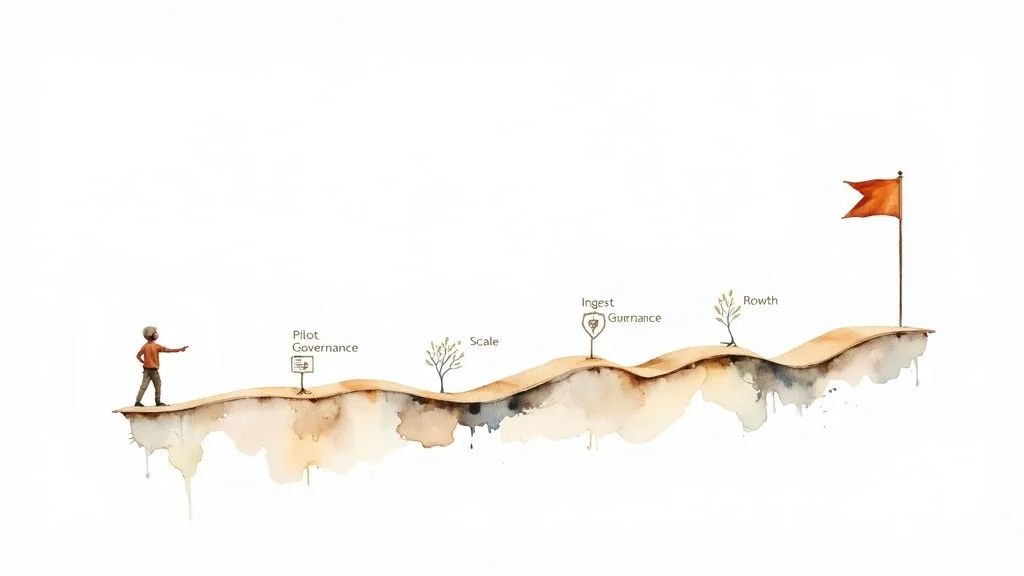
- Start with a Single Business Use Case: Select one specific, tangible problem to solve, such as building a predictive model for customer churn or creating a unified sales dashboard. Maintain a narrow focus.
- Establish Governance from Day One: Data governance cannot be an afterthought; otherwise, you risk creating another data swamp. Implement a unified catalog, define access control policies, and establish data quality monitoring from the outset.
- Ingest Relevant Data Incrementally: Begin by ingesting only the data required for the pilot project. Use modern tools to stream data or replicate it in batches. This is more manageable than a large, one-time data dump. For complex workflows, data orchestration platforms handle the scheduling and dependency management.
- Demonstrate Value and Scale Out: After the pilot succeeds, communicate its value across the organization. Use it as an internal case study to showcase business outcomes, such as faster insights, more accurate models, or reduced costs. This success will help secure the resources needed to tackle subsequent workloads.
The objective is a series of tactical wins, not a “big bang” cutover. Each successful project builds technical expertise and organizational confidence, creating a flywheel effect that accelerates the broader migration.
Vetting Your Data Engineering Partner
Unless your organization has a large, specialized data team, you will likely need an external data engineering partner to guide the migration. Selecting the right partner is critical to avoiding costly errors and accelerating time-to-value.
When evaluating potential consultancies, ask specific, technical questions.
- Open Table Formats: “Describe your hands-on experience with Delta Lake, Apache Iceberg, and Hudi. Provide a specific example where you used features like time travel or schema evolution to solve a client’s problem.”
- Cloud Cost Optimization: “What are your primary strategies for managing and optimizing cloud spend on a lakehouse?” A strong answer should include details on compute instance selection, storage tiering, and query optimization techniques.
- MLOps on the Lakehouse: “Provide a case study of a production MLOps pipeline you have built directly on a lakehouse.” This demonstrates practical experience in operationalizing AI, not just building data tables.
Choosing a partner is about verifying technical capability. The right firm will act as an extension of your team, providing the experienced guidance needed for a successful migration.
Got Questions? We’ve Got Answers
Here are answers to common questions from teams evaluating a lakehouse architecture.
Does this mean I have to scrap my data warehouse?
Not necessarily, and certainly not immediately. A rip-and-replace migration is rare. The more common approach is a hybrid model where the lakehouse and data warehouse coexist.
Your existing data warehouse may still be the optimal tool for specific high-performance BI dashboards. The lakehouse often begins by handling new projects, especially those involving unstructured data, streaming analytics, or machine learning. The long-term goal may be consolidation, but the process is typically a gradual migration.
What is the significance of open table formats like Delta Lake and Iceberg?
These formats are the core enabling technology of the lakehouse. They function as a transactional layer on top of raw data files (e.g., Parquet) in cloud storage.
These formats bring the reliability of a traditional database to the data lake. They add critical features like ACID transactions, schema enforcement, and data versioning (“time travel”). This is what transforms a potential data swamp into a structured, governed, and trustworthy source of truth.
How does a lakehouse reduce data engineering work?
By simplifying the data stack. The primary benefit is the elimination of data duplication and movement between different systems. Instead of maintaining a separate lake for raw data and a warehouse for refined data, you have one unified platform.
This consolidation results in several efficiencies:
- Less Data Movement: It reduces the need for costly and fragile ETL jobs to copy data from the lake to the warehouse, saving on compute costs and engineering overhead.
- Fewer Systems to Manage: A single platform reduces operational complexity. The team has one system to secure, govern, and maintain.
- Single Source of Truth: All users - from BI analysts to data scientists - work from the same consistent data, which eliminates discrepancies and conflicting reports.
Most lakehouse migrations fail on governance and partner selection, not on the technology itself. If you’re vetting outside help, use the questions above and compare implementation options in our Databricks consulting directory.
- Part of our guide: Databricks Consulting →
- Part of our guide: Data Pipeline Architecture →

Researched & written by
Peter Korpak , Chief Analyst & Founder
Data-driven market researcher with 20+ years in market research and 10+ years helping software agencies and IT organizations make evidence-based decisions. Former market research analyst at Aviva Investors and Credit Suisse.
Previously: Aviva Investors · Credit Suisse · Brainhub · 100Signals
- Entrans100 people · unverified
End-to-end data engineering; data lakehouse implementations
Listed, not reviewed - Aimpoint DigitalNot verified
Consider Aimpoint for programs using Snowflake, Databricks, and dbt. It lists credentials for all three; ask for relevant references and the names of the proposed consultants.
Reviewed - Algoscale200 people · unverified
Data engineering and analytics; distributed data processing
Listed, not reviewed
More in Databricks Consulting
A Leader's Guide to Apache Spark Optimization: Moving Beyond Quick Fixes
A practical framework for Apache Spark optimization: diagnosing the real bottleneck, tuning shuffle partitions and executor sizing, and choosing code fixes that cut runtime and cloud cost.
Parquet vs Avro: A Technical Guide to Big Data Formats
Choosing between Parquet vs Avro? This guide provides a deep, practical comparison of performance, schema evolution, and use cases for data engineering.
Data Warehouse vs. Data Lake: A Practical Decision Guide
Choosing between a data warehouse vs data lake? This guide cuts through the noise with practical comparisons of architecture, cost, and real-world use cases.