A Practical Guide to Data Management Services
A data management service is the engagement of an external team to own the operational lifecycle of an organization’s data. This scope extends beyond storage to include the systematic organization, security, and preparation of data for reliable use in analytics, business intelligence, and AI applications.
In short, it is the discipline of converting raw, often disparate information into a secure, governed, high-value corporate asset.
Unpacking Data Management as a Service
Consider an organization’s data as a large-scale industrial supply chain. One could attempt to manage every component internally—sourcing raw materials, refining them, ensuring quality control, and distributing the final product. Alternatively, one could partner with a logistics specialist to manage the entire complex operation, ensuring efficiency, reliability, and security. A data management service is that specialist for your data infrastructure.
This model has become critical as organizations contend with increasing data volume, velocity, and variety from a multitude of sources. The primary challenge is maintaining data integrity, security, and accessibility. A dedicated service addresses this foundational business problem directly.
The objective is to establish a reliable, single source of truth. By implementing structured processes and appropriate technology, these services solve several core challenges:
- Taming Complexity: They integrate disparate data sources, from legacy databases to real-time IoT streams, into a unified, logical system.
- Ensuring Reliability: They implement and enforce data quality rules and governance policies, ensuring that business intelligence reports and dashboards are based on trustworthy, verifiable data.
- Accelerating Insights: They build and maintain the technical infrastructure—data pipelines, warehouses, and catalogs—enabling data scientists and analysts to focus on analysis rather than infrastructure management.
The Strategic Value in Outsourcing Data Operations
Engaging a data management service is a strategic decision, not merely a technical one. It allows internal IT and data teams to shift focus from routine operational tasks, such as managing databases and ETL pipelines, to high-impact activities like developing machine learning models or identifying new revenue streams through data analysis. This strategic shift is essential for maintaining a competitive advantage.
Market data validates this trend. The global enterprise data management market was valued at USD 111.28 billion in 2025 and is projected to reach USD 294.99 billion by 2034. This growth reflects the increasing reliance on expert partners to manage complex data platforms like Snowflake and Databricks. The fact that 85% of enterprises plan to modernize their data infrastructure by 2027 further underscores this need. Learn more about the enterprise data management market trends.
A data management service shifts the internal dialogue from “How do we access this data?” to “What business problems can we solve with this data?” It transitions data from a cost center to a strategic enabler of innovation.
The Building Blocks of Modern Data Management
An effective data management service operates as a system of interconnected components, each performing a specific function. Together, these components transform raw data inflows into a reliable, secure, and accessible asset for decision-making.
Understanding these fundamental building blocks is necessary to evaluate a provider’s capabilities. This diagram illustrates the high-level workflow, where data moves through core functions of ingestion, storage, and governance to become a trusted resource.
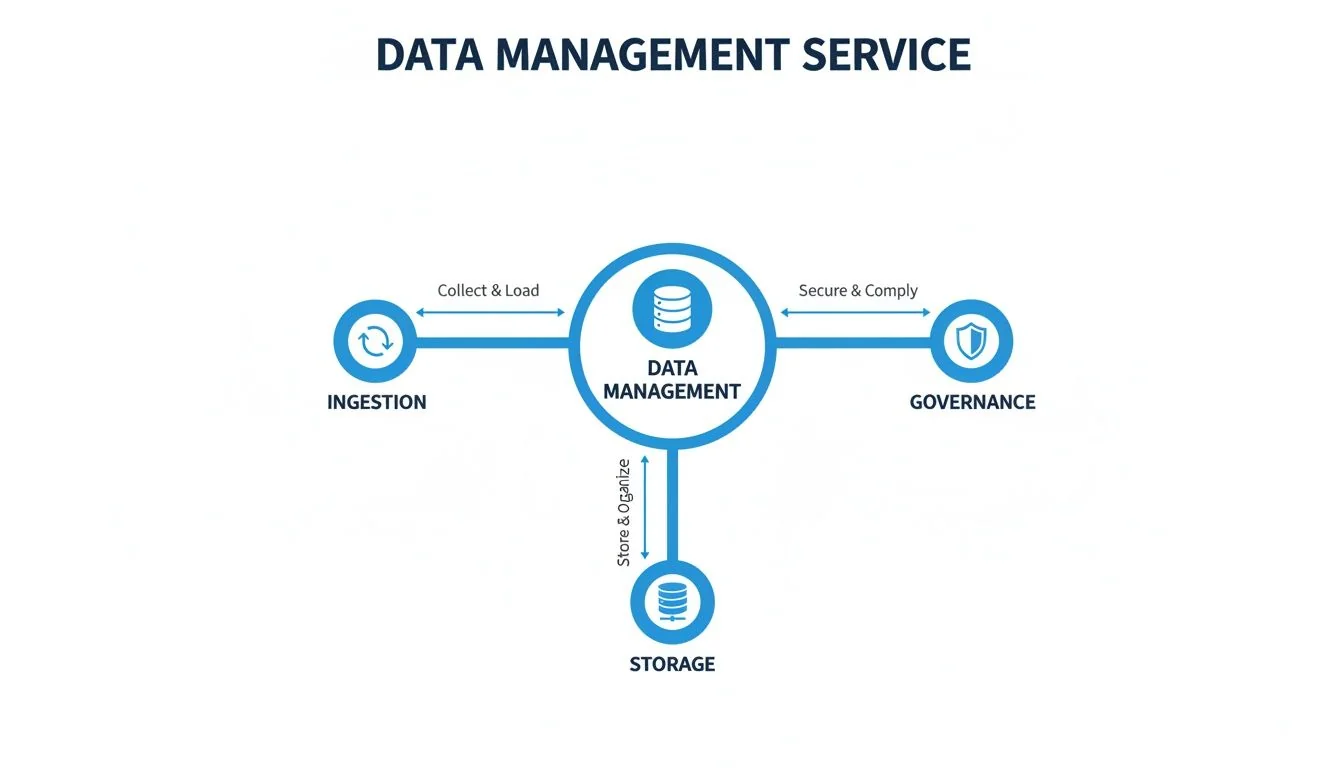
Each stage is critical for converting raw data into a reliable input for analytics and strategic planning. A breakdown of each component follows.
Data Ingestion and Integration
The initial step is collecting data into the system. Data ingestion involves extracting raw data from various sources, such as internal CRMs, ERP systems, third-party APIs, and real-time IoT sensors. Integration is the subsequent process of transforming and consolidating this disconnected information into a unified, cohesive format.
This process is analogous to a central kitchen receiving ingredients from multiple suppliers in varied packaging. The ingestion and integration phase involves unpacking, cleaning, and preparing these raw materials into standardized components ready for use by chefs. A competent data management service automates this supply chain to ensure a continuous and consistent flow of data.
Data Storage and Warehousing
Once ingested and integrated, data requires a managed storage solution. Modern data strategies utilize specialized platforms like data warehouses and data lakes. A data warehouse, such as Snowflake, is architected to store structured, processed data optimized for business intelligence and analytics. A data lake, often built on platforms like Databricks, is designed to store vast volumes of raw data in its native format.
A provider’s responsibility includes designing and managing this storage architecture to balance performance and cost. For instance, they might implement a tiered storage strategy where frequently accessed “hot” data resides on high-performance, higher-cost storage, while infrequently accessed “cold” data is archived on a lower-cost tier.
Data Governance and Compliance
This component establishes the rules and policies for data management. Data governance defines the standards, processes, and controls that dictate data access, usage, and security. It addresses critical questions: Who is authorized to access sensitive customer data? What is the enterprise-wide definition of an “active user”? How do we ensure compliance with regulations like GDPR?
For example, in managing patient records, a hospital must adhere to strict privacy laws. A data management service implements a governance framework to enforce these rules automatically, such as by masking personally identifiable information (PII) and maintaining detailed access logs for auditing purposes.
With the enterprise data management market projected to reach USD 200.6 billion by 2033, effective governance is a significant driver. The financial risk of non-compliance is substantial; GDPR fines alone surpassed EUR 2.7 billion in 2024. You can discover more about the data management platform market dynamics.
Data Quality and Master Data Management
Data is useless if it is inaccurate. Data quality is the continuous process of cleansing, validating, and enriching data to ensure its accuracy and reliability. A critical discipline within this area is Master Data Management (MDM), which focuses on creating a single, authoritative record—a “single source of truth”—for core business entities like customers, products, or suppliers.
MDM solves common problems such as duplicate customer records resulting from varied email addresses or data entry errors. An MDM system identifies, merges, and remediates these duplicates into a single master record, which is then propagated across all business systems, ensuring consistency for sales, marketing, and support functions.
Data Security and Privacy
If governance defines the rules, data security is the enforcement mechanism. It comprises the technical and operational measures to protect data from unauthorized access, breaches, and corruption. This is a multi-layered defense strategy that includes:
- Encryption: Rendering data unreadable both in storage (at rest) and during network transmission (in transit).
- Access Controls: Implementing role-based access control (RBAC) to ensure individuals can only view and modify data necessary for their job functions.
- Threat Monitoring: Continuously monitoring systems for suspicious activity and potential security threats.
Data Cataloging and Discovery
Once data is secured and organized, it must be discoverable and usable by authorized personnel. A data catalog functions as a searchable inventory of an organization’s data assets. It provides essential metadata—context about each dataset, including its origin, contents, and intended use.
This improves productivity significantly. An analyst needing sales figures can search the catalog, identify the certified dataset, and understand its schema without needing to consult an IT team member. This democratizes data access, transforming it from a guarded resource into a self-service asset.
Comparing Data Management Service Models
Selecting a data management service involves choosing a partnership model that aligns with your organization’s operational needs, budget, and internal capabilities. The structure of this partnership dictates the level of control, cost, and required internal resources. Understanding the three primary service models is the first step toward making an informed decision.
Each model presents a distinct approach to solving data challenges. One is analogous to outsourcing an entire data department, another to engaging a specialist for a specific initiative, and the third to licensing advanced tools for an internal team. The optimal choice depends on your organization’s current maturity and strategic objectives.
Managed Services: The Ongoing Partnership
A managed service is a long-term engagement where an external provider assumes full operational responsibility for your data environment. This is functionally equivalent to outsourcing your data operations department. Your organization sets the business objectives, and the managed service provider (MSP) executes the day-to-day management.
This model is ideal for organizations that lack a large, specialized internal data team or prefer to allocate their internal resources to core business functions rather than infrastructure management. The MSP acts as an extension of your team, responsible for uptime, performance, and security, governed by a formal Service Level Agreement (SLA).
Key characteristics include:
- Predictable Costs: Typically involves a flat monthly or annual fee, simplifying budgeting.
- Proactive Management: Providers continuously monitor systems to preemptively address issues and perform routine maintenance.
- Access to Expertise: Provides immediate access to a team of specialists (e.g., database administrators, security experts, cloud cost optimization analysts) without direct hiring costs.
Professional Services: The Project-Based Experts
In contrast to the continuous nature of managed services, professional services (consulting) are project-based. A firm is engaged for a single, well-defined initiative with a clear start and end date, such as migrating a data warehouse to Snowflake, designing a new data governance framework, or building a proof-of-concept for an AI application.
This model is suitable for organizations with an established internal team for daily operations but require specialized expertise for a complex, one-time project. Upon completion, the provider transitions ownership back to the internal team.
The primary value of professional services lies in accelerating project delivery and mitigating risk. Organizations acquire concentrated expertise to complete critical initiatives more efficiently and with fewer errors than would be possible independently.
Platform as a Service (SaaS): The Technology-Led Solution
The Platform as a Service (SaaS) model is fundamentally different. Instead of outsourcing personnel, you license technology. A SaaS vendor provides data management software, which your internal team uses to perform their work. The vendor manages the backend infrastructure, maintenance, and software updates, allowing your team to focus on leveraging the platform’s capabilities.
SaaS platforms are optimal for organizations with skilled data professionals who need best-in-class tools. The client retains full control over strategy and execution while benefiting from specialized software for data integration, quality monitoring, or cataloging. The provider supplies the technology; the client’s team operates it.
Managed Services vs Professional Services vs SaaS
The appropriate model depends on your organization’s specific context. The needs of a startup differ significantly from those of a large, regulated enterprise. A direct comparison clarifies the decision.
This table outlines the core differences to help you align your requirements, resources, and objectives with the most suitable model.
| Criteria | Managed Service | Professional Service (Consulting) | Platform as a Service (SaaS) |
|---|---|---|---|
| Engagement Type | Ongoing, long-term partnership | Project-based, finite duration | Continuous software subscription |
| Cost Structure | Recurring monthly/annual fee (predictable) | Fixed-price or T&M for a specific project | Usage-based or tiered subscription |
| Level of Control | Lower (provider manages operations) | High (client directs and owns outcome) | High (client team uses the tool) |
| Internal Expertise | Minimal in-house team required | Internal team needed for handover/ops | Strong in-house team required |
| Best For | Outsourcing daily data ops and maintenance | Specific, complex projects like migration | Empowering a skilled internal data team |
There is no universally “best” model, only the one that aligns with your organization’s operational and strategic reality. Understanding these distinctions enables you to select a partner and platform that will deliver measurable results.
How to Select the Right Data Management Partner
Choosing a data management service is a significant strategic decision. The right partner can unlock business value and provide a competitive advantage, while the wrong one can lead to budget overruns, project delays, and unreliable data.
A structured evaluation process is necessary to penetrate marketing claims and assess true capabilities. The goal is to identify a partner with demonstrable industry experience, deep technical expertise on modern platforms, and a proven track record of delivering business outcomes, not just technical outputs.
Core Evaluation Criteria for a Data Service
A confident decision requires an evidence-based evaluation across several key domains. Focusing on these eight critical factors provides a comprehensive assessment of a provider’s capabilities.
-
Technical Expertise: The provider must demonstrate deep, proven experience with your specific technology stack, particularly complex platforms like Snowflake or Databricks. Require certifications and detailed project examples that substantiate their claims.
-
Delivery Quality: Demand evidence of successful outcomes. Request detailed case studies with quantitative results and measurable business impact. Insist on speaking directly with current clients in a similar industry or with a comparable use case.
-
Relevant Industry Experience: A partner with experience in your vertical (e.g., finance, healthcare, retail) will understand your specific data sources, regulatory requirements, and key business metrics, accelerating implementation and improving solution quality.
-
Cost-Effectiveness and TCO: Evaluate the total cost of ownership (TCO), not just the service fee. This includes the provider’s rates, underlying cloud consumption costs, and the internal resources required to manage the partnership.
A cost-effective partner actively works to optimize your cloud spend, not just send a low invoice. They should be able to demonstrate how their management practices will reduce your long-term data infrastructure costs.

A valuable partner helps balance cost and control, ensuring maximum value from the investment. Their expertise in cost optimization is a key part of their value proposition.
Beyond the Basics: Strategic Alignment
Technical proficiency and cost are foundational, but a successful partnership requires strategic alignment. Assess how a provider’s service model and vision align with your company’s long-term objectives.
- Scalability: Can the provider’s model (architecture, support, pricing) accommodate your projected data growth and complexity over the next three to five years?
- Market Focus: Is the provider structured to serve companies of your size and type? A firm focused on large enterprises may have processes and pricing models ill-suited for a mid-market business.
- Innovation and Automation: Inquire about their use of AI and automation in their own service delivery. Leading partners leverage modern tools to improve efficiency, proactively identify issues, and reduce manual effort, which translates to cost savings for you.
- Support Models and SLAs: Scrutinize the Service Level Agreement (SLA). It must clearly define uptime guarantees, response times for different issue severities, and the escalation process. A vague SLA is a significant risk.
A Practical RFP Checklist to Guide Your Decision
The Request for Proposal (RFP) is an essential tool for a structured, objective comparison of providers. A well-designed RFP compels specific, written responses to critical questions, testing a provider’s strategic thinking as well as their technical knowledge.
Ensure your RFP includes questions covering all eight criteria mentioned above. For an exhaustive list, our guide on RFP process best practices for data engineering services provides over 50 evaluation questions.
Begin with these essential inquiries:
- Describe a complex data migration project you completed on Snowflake/Databricks. What were the primary challenges, and what specific actions did you take to resolve them?
- How do you measure and report on data quality? What tools and processes do you use for automation?
- Provide a specific example of how you helped a client optimize their cloud data warehouse costs. What was the percentage of savings achieved?
- Describe your standard operating procedure for handling a critical data pipeline failure outside of standard business hours.
A systematic evaluation process using sharp, probing questions transforms the decision from a subjective choice to a data-driven one, increasing the likelihood of selecting a partner that will deliver long-term value.
A Practical Roadmap for Implementation and Migration
Onboarding a new data management service or migrating from a legacy system requires a structured plan. This roadmap deconstructs the process into distinct phases, converting a complex technical undertaking into a series of manageable milestones.
Throughout the process, recognize that this is a change management initiative, not just a technology project. Consistent and clear communication with all stakeholders regarding the project’s objectives, timelines, and individual roles is critical for success.
Phase 1: Discovery and Scoping
Before designing the future state, you must thoroughly understand the current state. This initial phase involves a comprehensive audit of existing data assets, pipelines, and workflows, conducted collaboratively by your team and the service provider.
The objective is twofold: to create a detailed inventory of the current environment and to define specific, measurable business objectives for the project. These goals will guide all subsequent decisions.
Phase 2: Architecture and Design
With a clear understanding of the current state and future goals, the next step is to design the new data architecture. This is a collaborative process involving critical decisions on technology stacks, data models, and integration patterns.
The final design must directly support the business objectives defined in Phase 1. For example, if enabling real-time analytics is a key objective, the architecture must be designed for low-latency data streaming from the outset.
Phase 3: Pilot and Proof of Concept
A full-scale migration without prior validation is high-risk. A Pilot or Proof of Concept (POC) serves as an essential risk mitigation step. The objective is to test the new architecture on a small, well-defined use case that is large enough to be meaningful but small enough to be manageable.
A successful POC accomplishes two critical goals: it validates the technical design in a real-world scenario and demonstrates tangible business value to stakeholders early in the project. This builds momentum and confidence for the broader initiative.
This limited-scope trial allows for identifying and resolving issues, testing performance, and gathering user feedback before committing to a full-scale rollout. The lessons learned during this phase are invaluable. For more detail, review our guide on proven data migration best practices.
Phase 4: Phased Migration and Rollout
Following a successful POC, the full migration can commence. A phased migration is the recommended approach, moving data, pipelines, and users to the new environment in planned, incremental stages.
This methodology minimizes business disruption. The migration might begin with data from a single department or a specific set of analytics dashboards. This allows the team to manage the transition in controlled waves, ensuring stability and providing targeted support to users.
Phase 5: Go-Live and Optimization
The “go-live” marks the official transition to the new system as the organization’s primary data platform. While this is a major milestone, the work is not complete.
Post-launch, the focus shifts to continuous optimization. This includes performance tuning, monitoring data pipeline efficiency, and providing ongoing user training to ensure the organization extracts maximum value from the new platform.
Measuring Success and Calculating ROI
To justify the investment in a data management service, you must articulate its business value. This requires connecting technical achievements, such as terabytes managed or pipelines built, to tangible business outcomes that are meaningful to executive leadership. The goal is to position data operations as a profit driver, not a cost center.
This involves shifting from purely technical metrics to Key Performance Indicators (KPIs) that demonstrate a clear return on investment.
With the right measurement framework, you can construct a compelling narrative that shows how expert data management directly impacts the bottom line, elevating data from an operational expense to a core business asset.
Business-Centric KPIs to Track
To build a strong business case, focus on metrics that reflect efficiency, cost savings, and growth. These KPIs provide evidence that the data management service is delivering on its value proposition.
- Operational Efficiency Gains: Measure the reduction in time spent by analysts and data scientists on manual data preparation. A 30% decrease in this area frees up high-value personnel to focus on innovation rather than data janitorial tasks.
- Cost Reduction: Track direct savings from optimized cloud storage and compute costs. A competent provider should be able to reduce infrastructure spend by 15-25% through continuous optimization.
- Improved Decision-Making Speed: Quantify the “time-to-insight”—the time required to answer a business question with data. Reducing this cycle time provides a significant competitive advantage in a fast-moving market.
- Risk Reduction: Monitor compliance adherence scores and the reduction in data quality errors. Effective data governance mitigates the risk of regulatory fines and poor decisions based on flawed data. For more on this topic, see our guide on managing data quality.
- Revenue Enablement: Connect data initiatives to top-line growth. Can new sales opportunities be attributed to more accurate AI models? Do improved customer segmentation models lead to higher campaign conversion rates? This directly links better data management to revenue generation.
Calculating a Simple ROI
A straightforward ROI calculation can translate these KPIs into a financial argument that resonates with leadership.
ROI (%) = [ (Financial Gain - Investment Cost) / Investment Cost ] x 100
In this formula, “Financial Gain” is the sum of cost reductions, the monetized value of efficiency gains, and any new attributable revenue. “Investment Cost” is the total fee paid to the data management service provider.
This calculation provides the quantitative evidence needed to justify current expenditures and secure budget for future data initiatives. A positive ROI demonstrates that a data management service is a strategic investment, not an operational expense.
Got Questions? We’ve Got Answers
Here are direct answers to common questions from leaders evaluating a data management service.
What’s This Actually Going to Cost?
The cost of a data management service varies significantly based on the service model, data volume, and the complexity of your existing environment. Costs generally fall into three categories:
- Managed Services: Expect a recurring monthly fee, typically ranging from $10,000 to $50,000+, covering ongoing operations and expert support.
- Professional Services: A one-time project, such as a large-scale platform migration, can range from $50,000 to over $500,000, depending on scope and complexity.
- SaaS Platforms: Pricing is typically tiered based on data volume, feature sets, or user count.
It is crucial to analyze the total cost of ownership (TCO), which includes the provider’s fees, underlying cloud infrastructure costs, and the time commitment required from your internal team.
How Long Does It Take to Migrate to a New Data Platform?
A typical data platform migration project requires 6 to 12 months. The timeline is influenced by the complexity of source systems, the volume of data to be migrated, and the number of data pipelines that need to be rebuilt.
A phased rollout, beginning with a high-impact pilot project, is the most effective approach to manage risk and demonstrate early value.
The most significant variable impacting migration timelines is data quality. Uncovering and remediating previously unknown data quality issues in source systems is the most common cause of project delays.
What Are the Biggest Red Flags When Vetting a Data Partner?
During the evaluation process, certain indicators should be considered red flags. Be cautious of providers who lack transparent pricing or are unable to provide a clear cost structure.
Other major red flags include an inability to furnish relevant case studies from your industry or a reluctance to provide client references. A provider who focuses exclusively on technology without connecting it to your business objectives is likely a vendor, not a strategic partner. A true partner is focused on solving your business problems, with data as the enabling tool.
Finding the right partner is critical. At DataEngineeringCompanies.com, we provide independent rankings and data-driven tools to help you select the best data management service with confidence. Explore our 2025 expert rankings to accelerate your search.
Data-driven market researcher with 20+ years in market research and 10+ years helping software agencies and IT organizations make evidence-based decisions. Former market research analyst at Aviva Investors and Credit Suisse.
Previously: Aviva Investors · Credit Suisse · Brainhub · 100Signals
Top Data Engineering Partners
Vetted experts who can help you implement what you just read.
Related Analysis
Data Contracts in Data Engineering: A Guide for Engineering Leaders
Explore data contracts in data engineering to enforce agreements, prevent pipeline failures, and boost data reliability across Snowflake and Databricks.
A Data Lineage Tools Comparison Framework for Engineering Leaders
Cut through the noise with this data lineage tools comparison. Evaluate top vendors on architecture, integration, and pricing for your modern data platform.
A Practical Guide to Modern Data Pipeline Architecture
Discover how a modern data pipeline architecture can transform your business. This practical guide covers key patterns, components, and vendor selection.