A Data Lineage Tools Comparison Framework for Engineering Leaders
Data lineage tools split into two architectures: automated, parser-based systems that trace SQL and code programmatically down to the column level, and catalog-driven systems where stewards manually map data to business context. The right choice depends on whether your primary problem is operational - debugging broken pipelines - or governance - satisfying auditors and building a trusted data dictionary. Most enterprise stacks eventually need both.
This guide compares the two architectures against the platforms you actually run: Snowflake, Databricks, BigQuery, dbt, and Airflow. Only 11 of the 86 firms profiled in the Data Engineering Companies Index list data governance among their core capabilities, which is a good reason most teams end up building lineage requirements into a broader consulting engagement instead of shopping for a standalone tool in isolation.
What this guide covers:
- Untangling complex SQL transformations buried in warehouses like Snowflake or BigQuery.
- Tracking data flow across multi-cloud environments (AWS, Azure, GCP).
- Integrating with the modern data stack, including dbt and Airflow.
The decision is not just about features - it’s about matching a tool’s architecture to your primary problem, whether that’s operational stability, data governance, or change management.
Three ways to categorize lineage tools
Your first decision point is the architectural approach that fits your needs. It defines the tool’s capabilities, its limits, and its value to your organization.
| Category | Primary Strength | Best For |
|---|---|---|
| Automated Parsers | Deep, technical, column-level lineage | Engineering teams needing root cause analysis and impact analysis. |
| Catalog-Driven | Rich business context and governance | Enterprise-wide governance, compliance, and data discovery. |
| Open-Source | Maximum flexibility and no license cost | Teams with strong engineering resources to build and maintain their own solution. |
The rest of this guide walks through that decision in detail, plus a platform-by-platform integration checklist and an RFP framework you can run against actual vendors.
What’s the real difference between automated and catalog-driven lineage tools?
Automated tools parse your code and query logs to build lineage programmatically, down to individual columns. Catalog-driven tools rely on data stewards to manually declare connections between technical assets and business context. The architecture you pick determines who can use the tool day to day and how much ongoing upkeep it needs.
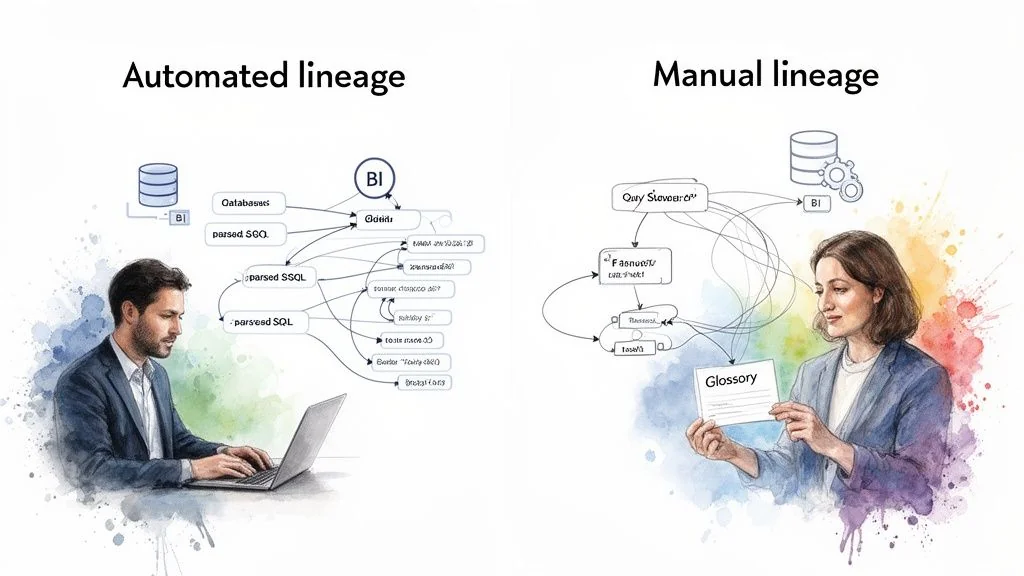
Automated, Parser-Based Architecture
Automated tools connect directly to your data stack - databases, transformation layers like dbt, BI platforms, and source code repositories - then parse SQL query logs, transformation scripts, and BI metadata to construct a column-level map of how data actually moves.
- Who it’s for: data engineers, analytics engineers, and BI developers.
- Best at: root cause analysis and impact analysis. When a dashboard breaks, an engineer traces the failure upstream through the transformations that produced it.
- Main benefit: column-level lineage with low manual upkeep once it’s configured. This scales with the complexity of the stack instead of a governance team’s headcount.
- The catch: initial setup is involved - it needs broad permissions to access and parse metadata - and the resulting map reflects technical reality accurately but with little business context attached.
Automated lineage is built to answer “what broke this pipeline” in minutes by pointing to the exact code and column responsible. That capability sits next to data pipeline monitoring: lineage tells you what’s connected, monitoring tells you when it breaks.
Manual and Catalog-Driven Architecture
In this model, lineage is declared, not discovered. These tools, usually part of a broader data catalog, prioritize business context: stewards manually connect technical tables and columns to glossary entries, governance policies, and ownership records. Our data catalog tools comparison covers how catalog platforms differ from pure lineage tools if you’re weighing both.
- Who it’s for: business users, data stewards, compliance officers, and auditors.
- Best at: enterprise governance and compliance reporting, giving non-technical stakeholders a trusted view of where sensitive data comes from and how it’s used.
- Main benefit: a business-centric lineage map that’s easy for anyone to read, tying technical assets to the rules and regulations that govern them.
- The catch: it’s a manual, labor-intensive process that doesn’t scale without a fully staffed governance team, and lineage - often only at the table level - goes stale the moment a pipeline changes without a corresponding catalog update.
Architectural Showdown: A Clear Choice
The differences in philosophy show up directly in practice.
| Evaluation Criterion | Automated Lineage (e.g., Manta, Octopai) | Manual/Catalog-Driven Lineage (e.g., Collibra, Alation) |
|---|---|---|
| Primary Goal | Technical troubleshooting & impact analysis | Business governance & compliance |
| Granularity | Column-level, highly detailed | Table-level, high-level & conceptual |
| Scalability | High; scales with the complexity of the data stack | Low; scales with the size of the governance team |
| Accuracy | High; reflects the “as-is” technical reality | Dependent on human upkeep; becomes stale |
| Setup Effort | High initial configuration, low maintenance | Low initial setup, high ongoing maintenance |
| Key User | Data Engineer / Analytics Engineer | Data Steward / Business Analyst / Auditor |
| Context | Technical context (code, queries, transformations) | Business context (glossary, policies, ownership) |
If your team is dealing with broken pipelines and unclear blast radius from code changes, an automated, parser-based tool fits. If the driving need is an enterprise governance framework and audit-ready documentation, a catalog-driven approach gives you that business context, but budget for the ongoing manual effort it requires.
Which platform integrations actually matter for Snowflake, Databricks, and dbt?
A tool’s value comes from how deeply it integrates with the platforms you actually run, not how many connectors are on the sales sheet. Shallow, table-level lineage for systems like Snowflake, Databricks, BigQuery, dbt, and Airflow is close to useless operationally - what matters is whether the tool can parse the messy logic inside those systems.
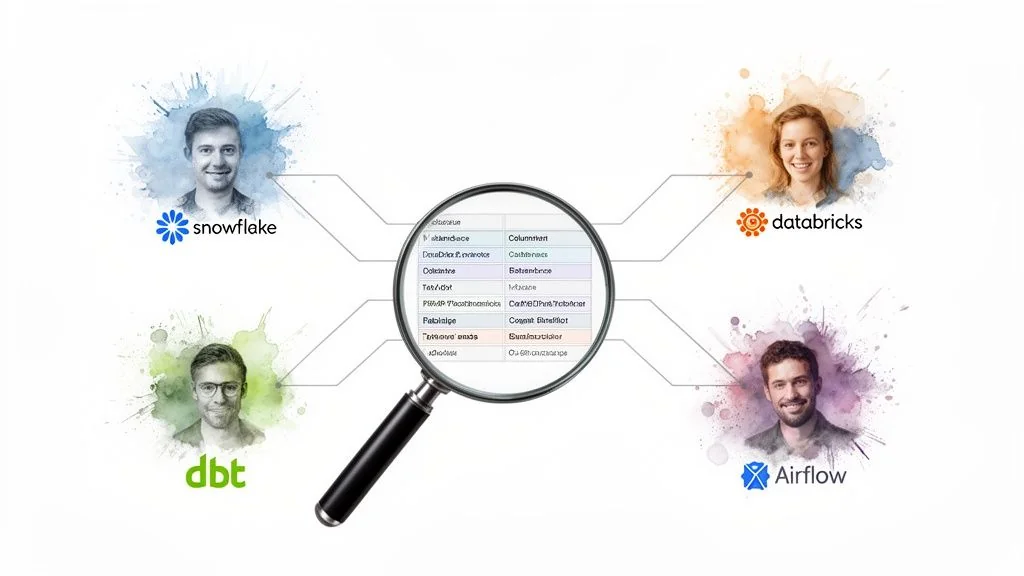
Differentiating by Platform Integration Depth
Test vendors against the specific nuances of your environment, not a generic demo. A tool’s ability to correctly parse column-level lineage from a deeply nested dbt macro is a real differentiator - many tools fail here, unable to unpack the logic and map dependencies accurately. The same test applies to orchestration: tracing data through a complex Airflow DAG, or any data orchestration platform, requires understanding how data actually passes between tasks, not just that the tasks ran in sequence.
Integration depth, not connector count, is the differentiator that holds up once a stack spans more than one cloud and more than one processing layer.
An Evaluation Framework for Stack Integration
Cut through marketing claims with a structured evaluation of how each tool performs in your actual stack. Score every vendor against these criteria:
- Connector Maturity: basic connectivity, or can it parse complex, platform-specific logic like Snowpark UDFs or Databricks notebooks?
- Granularity of Capture: can it reliably deliver column-level lineage for your most important platforms, or does it degrade to table-level lineage when transformations get complex?
- Support for Platform Features: how well does it handle Snowflake Streams, the Databricks Unity Catalog, or dbt exposures?
- BI vs. Processing Support: some tools trace lineage well into BI platforms like Tableau but are weak on the processing side with Spark or Airflow. Identify which part of the stack matters most to you.
A lineage tool that can’t answer these questions cleanly in a proof of concept won’t hold up in production. Test the specific edge cases in your own stack, not the vendor’s rehearsed demo.
Which lineage tool fits your use case?
A lineage tool without a clear problem to solve is an expensive diagramming utility. Match the tool’s architecture to your highest-priority use case - root cause analysis, governance and compliance, or change impact analysis - rather than buying on feature count.
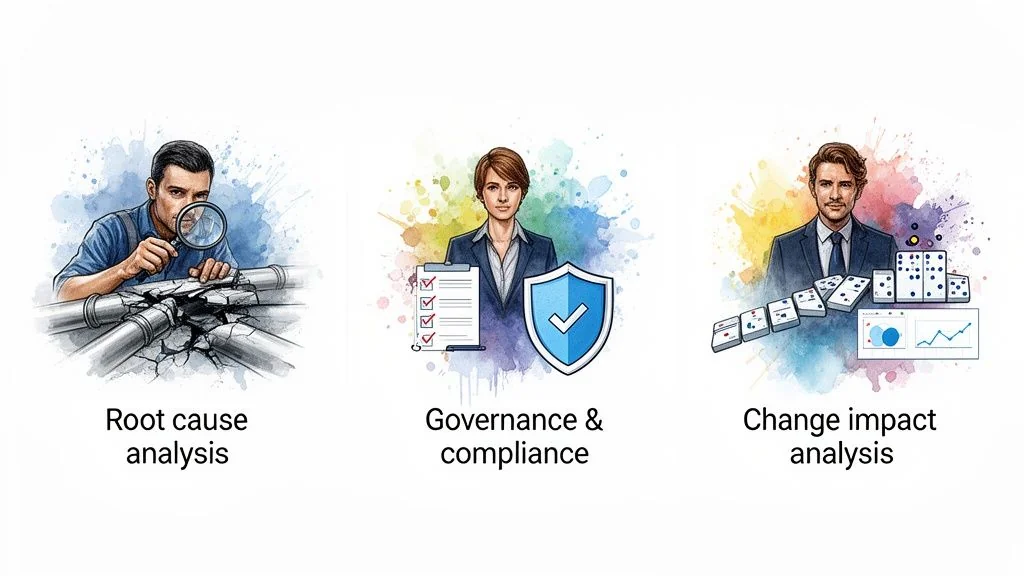
Use Case 1: Operational Root Cause Analysis
A critical dashboard breaks at 3 a.m. The on-call engineer doesn’t need a business glossary - they need column-level lineage that traces the anomaly back through the transformations that touched it.
Automated, parser-based tools like Manta are built for this moment, parsing SQL queries, dbt models, and ETL jobs to show engineers the precise point of failure in the code. When incident response is the priority, pick a tool with detailed, code-aware lineage over one built primarily for business context.
Use Case 2: Enterprise Data Governance and Compliance
The goal here is not firefighting - it’s satisfying auditors, proving compliance with regulations like GDPR, and maintaining a trusted enterprise data dictionary. That’s a business-meaning problem more than a code problem.
Catalog-first platforms like Collibra are built for this: they link physical data assets to the business glossary, data owners, and governance policies. The lineage is often conceptual, at the table level, but it supplies the business context that compliance and governance teams need for reporting and audits. Our data governance best practices guide covers how to build that program end to end.
Use Case 3: Change Impact Analysis
Your team is about to ship a schema change and needs to know what it will break downstream. This is proactive risk management - catching broken dashboards and failed pipelines before they happen, not after.
Tools with strong impact analysis, such as Alation, let engineers simulate the ripple effects of a proposed change, showing which reports, ML models, and data products a column modification will touch, so teams can coordinate changes and avoid production failures. This overlaps with the discipline behind data contracts: both are ways of making downstream dependencies explicit before you break them.
What should be in your lineage tool RFP checklist?
Choosing a lineage tool is a significant investment that deserves more than a vendor demo. Run each finalist through a structured RFP across three areas - technical and integration capability, governance and security, and usability - and treat a vague answer in any of the three as a red flag.
Technical and Integration Capabilities
This is where you determine if the tool can actually handle your environment.
- Lineage Capture Method: how is lineage captured - by automatically parsing query logs and code, or by relying on manual declaration?
- Granularity: does it provide true column-level lineage or just table-to-table flows? Demand proof, not a slide.
- Platform-Specific Parsing: how well does it interpret the reality of your stack, including complex dbt macros, historical Snowflake queries, or lineage inside the Databricks Unity Catalog?
- API Access: is there a well-documented API for programmatic access to lineage metadata?
- Real-Time Support: can it handle streaming data? Ask how it visualizes lineage from sources like Kafka.
- Extensibility: can your team write custom parsers for proprietary or unsupported data sources?
Governance and Security
A lineage tool has visibility into where your sensitive data lives and moves, so it needs to meet your security and governance requirements from day one, not after deployment.
- Role-Based Access Control (RBAC): can you restrict visibility for sensitive data pipelines or metadata based on user roles?
- Identity Provider Integration: does it integrate with your SSO provider (e.g., Okta, Azure AD)?
- Audit Trails: does the platform log all user actions and changes to lineage?
- Policy Integration: can you link an asset’s lineage directly to its data classification, owner, or access policies?
Usability and Adoption
A technically powerful tool is worthless if your team won’t use it. User experience matters as much as the back-end engine.
- Visualization Quality: is the lineage graph clean, navigable, and useful, or just visual noise?
- Search and Discovery: during a production incident, how quickly can an on-call engineer find a broken asset and trace it back to its source?
- Collaboration Features: can users add comments, tag owners, or certify assets as “trusted” within the tool?
A common failure mode is a tool that produces technically accurate but unusable lineage graphs. If your engineers can’t find what they need during an incident, the tool has failed, regardless of how complete its lineage graph is on paper. Score usability with the same rigor you apply to connector depth.
How do you make the final decision?
After evaluating features and architectures, the decision comes down to your primary goal: giving engineers technical visibility to fix pipelines, or giving auditors and stewards a governed view of the business. Most teams eventually need both, but buy first for the one that’s actually broken today.
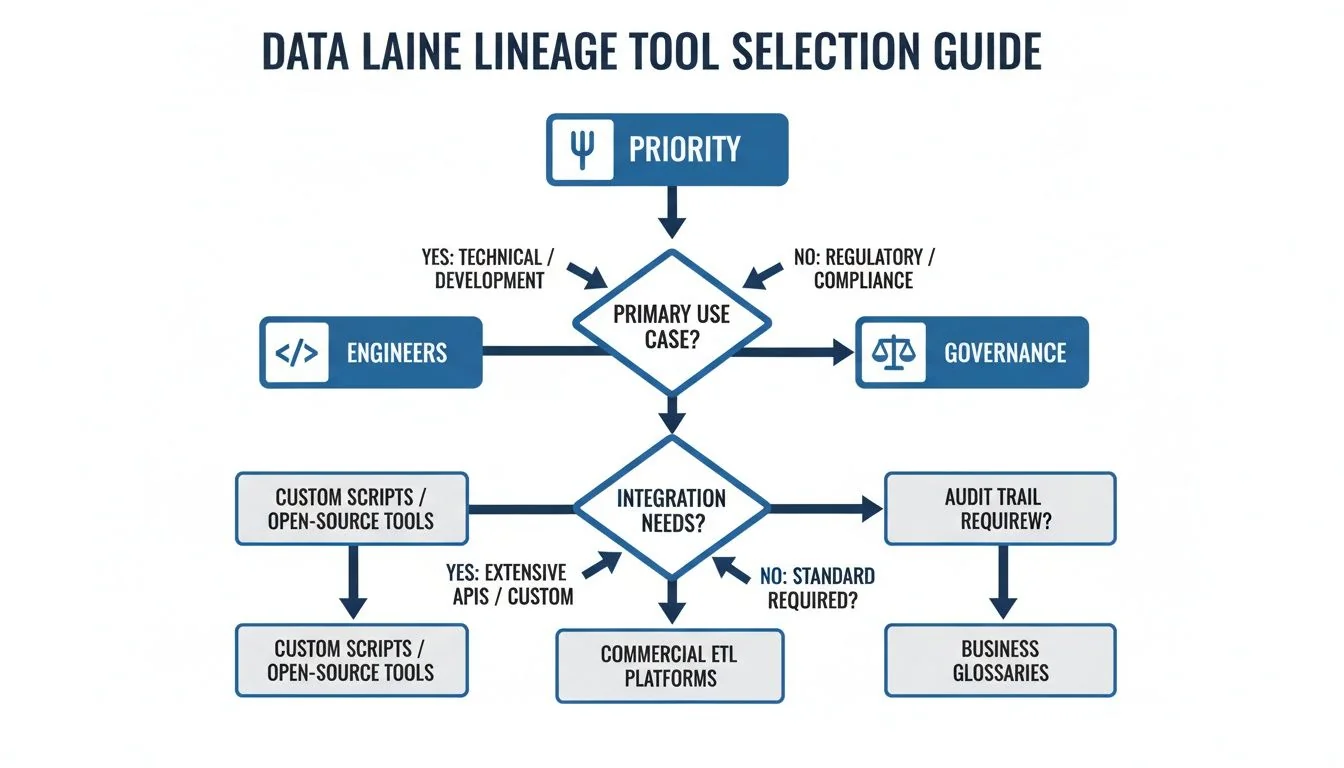
The flowchart above splits the decision into two starting points: the needs of your data engineering team, or the requirements of your enterprise governance program.
Engineer-Centric vs. Governance-Centric Paths
If your priority is giving data engineers technical visibility to fix broken pipelines in code-heavy environments like dbt or Airflow, an automated, parser-based architecture is the better starting point. A tool like Manta delivers the column-level detail engineers need for root cause and impact analysis.
If your priority is an enterprise governance framework that keeps auditors satisfied, a catalog-first platform like Collibra makes more sense. These tools connect technical metadata to business glossaries and policies, which is what compliance reporting actually requires.
Your Immediate Next Steps
A hands-on evaluation beats another round of vendor slide decks.
- Define your top two use cases. One highly technical (debugging a specific, troublesome pipeline) and one business-focused (certifying a critical regulatory report).
- Run a focused proof of concept. Do not try to test everything at once. Pick one vendor from each category - one parser-based, one catalog-first - and test both against a single, difficult pipeline in your own environment.
- Score the results. Use the RFP checklist above to score how each tool performed on your specific use cases, not the vendor’s canned demo.
A short POC against your actual pipelines gives you evidence of which architecture earns its cost, instead of a debate that stays theoretical.
Frequently Asked Questions
These are the most common questions engineering leaders face when evaluating data lineage tools.
What Is the Biggest Mistake When Choosing a Data Lineage Tool?
The biggest mistake is being impressed by a long list of connectors. A vendor might show a slide with 50 logos, but that’s often marketing fluff. What matters is the depth of the connectors for the systems most critical to your business, whether that’s dbt, your main BI tool, or a core ETL orchestrator. A real comparison requires digging deep: does the tool provide only table-level lineage, or can it trace all the way down to the column level through complex logic? The quality of lineage from your most important sources determines the project’s success.
How Do Open Source Tools Like OpenLineage Compare to Commercial Vendors?
This is a classic build-vs-buy decision. Open-source frameworks like OpenLineage are powerful and flexible but are not a complete solution on their own. They require a real engineering commitment to implement collectors, build a user interface, and maintain the system. Commercial tools deliver value faster with a polished UI, pre-built parsers, and enterprise support, in exchange for a license fee. Open source gives you full control but carries a high total cost of ownership paid in engineering hours. A commercial tool speeds up time-to-value, assuming the price fits your budget.
Can a Data Lineage Tool Integrate with Both Snowflake and Databricks?
Yes. Most modern tools are built for a multi-cloud, multi-platform world. The real question is not if they can connect to both Snowflake and Databricks, but how well they stitch the lineage together across them. A good POC test is tracing a single data flow from a Databricks job, into a Snowflake table, and finally out to a Tableau dashboard. Can the tool show you that entire journey as one connected, unified graph? This common scenario is a frequent failure point for less mature platforms - make vendors prove it.
Choosing the right lineage tool is only half the evaluation - finding a firm that can implement and maintain it is the other half. DataEngineeringCompanies.com profiles data engineering firms with transparent capabilities across Snowflake, Databricks, and cloud data projects, so you can compare implementation partners the same way you compare tools. Find a data engineering partner.
Researched & written by
Data-driven market researcher with 20+ years in market research and 10+ years helping software agencies and IT organizations make evidence-based decisions. Former market research analyst at Aviva Investors and Credit Suisse.
Previously: Aviva Investors · Credit Suisse · Brainhub · 100Signals
Vetted partners
Top Data Governance Partners
Vetted firms whose specialty matches this article.
More in Data Governance
Data Contracts in Data Engineering: A Guide for Engineering Leaders
Explore data contracts in data engineering to enforce agreements, prevent pipeline failures, and boost data reliability across Snowflake and Databricks.
Data Lakehouse vs Data Mesh: A 2026 Decision Guide
Choose the right architecture for your enterprise. A detailed comparison of data lakehouse vs data mesh on cost, governance, performance, and vendor selection.
Data Reliability Engineering A Guide for CTOs
Learn what Data Reliability Engineering (DRE) is, why it matters, and how to implement it. A complete guide for leaders evaluating data engineering partners.