A Practical Guide to Build a Data Warehouse That Delivers Value
Building a data warehouse is a foundational business investment, not an IT project. A successful strategy begins with business objectives, leads to selecting the right architecture—often a modern data lakehouse—and culminates in choosing a cloud platform like Snowflake or Databricks. Success depends on executive buy-in and a phased roadmap that delivers demonstrable value quickly.
Directory Insight: Among the 86 data engineering firms in our directory, 65% rate “Expert” in data modernization and 49% rate “Expert” in platform migration — the two capabilities most critical for warehouse builds. Snowflake (77% of firms) and AWS (88%) dominate the platform landscape, but 74% also support Databricks Lakehouse, giving you flexibility. For warehouse-focused projects, 73% of directory firms are rated “High” or “Very High” for mid-market fit.
Why a Modern Data Warehouse Is a Business Imperative
In 2025, a data warehouse is the engine of competitive advantage. The legacy view of it as an archive for historical reports is obsolete. Today, it serves as the central nervous system for operations, powering everything from real-time dashboards to predictive AI models.
Most organizations are managing a sprawling ecosystem of SaaS tools—Salesforce, Marketo, NetSuite—each creating its own data silo. This traps critical information and makes a unified view of the business impossible. A modern data warehouse is the tool that breaks down these walls, creating a single source of truth.
Beyond Reporting to Unlocking New Capabilities
A well-architected data warehouse does more than consolidate information; it enables strategic initiatives that are otherwise out of reach.
- Advanced Analytics and AI: The quality of machine learning models depends entirely on the data they are trained on. A warehouse provides the clean, structured, and comprehensive datasets required to build accurate predictive models for everything from demand forecasting to customer churn analysis.
- Enhanced Governance and Compliance: Regulations like GDPR and CCPA mandate strict data handling protocols. A modern warehouse is designed to enforce granular security policies, track data provenance, and streamline audits, significantly reducing compliance risk.
- Operational Agility: When marketing, sales, and finance all operate from the same trusted dataset, decision-making becomes faster and more coherent. This eliminates the “dueling spreadsheets” problem and ensures cross-departmental alignment.
Many data warehouse projects fail because they are framed as a technical exercise. The project must be tied directly to business outcomes. If you cannot articulate how it will drive revenue, reduce costs, or mitigate risk, you will not secure the sustained executive support needed for completion.
Market growth underscores this imperative. The global data warehousing market is expected to grow from USD 6.988 billion in 2024 to USD 8.045 billion in 2025. By 2035, forecasts project a market size of USD 32.89 billion. This expansion is driven by the urgent need for real-time analytics and scalable cloud infrastructure. You can explore the full market projections to understand the industry’s trajectory.
Deferring the decision to build a modern data warehouse is a significant strategic risk. It means leaving valuable insights untapped, struggling with compliance, and allowing competitors to make more informed, data-driven decisions. This guide provides the practical steps to ensure your investment yields a positive return.
Creating Your Strategic Blueprint for Success
Attempting to build a data warehouse without a detailed blueprint is a recipe for failure. A successful project is built on meticulous planning that extends beyond merely listing data sources.
The process must begin by translating high-level business goals into specific, answerable questions. This is where many projects derail; teams jump into technology discussions before defining what success looks like for the business. The objective is not to centralize data but to empower the marketing team to calculate customer lifetime value or enable the operations team to foresee supply chain disruptions.
Define Business Requirements, Not Technical Tasks
Your primary role is to guide stakeholders from vague requests like “we need a sales dashboard” to articulating the specific, high-value questions they need to answer. What precise decisions will that dashboard inform? What metrics are essential for making those decisions?
- Finance: Instead of “track revenue,” the requirement should be “analyze product profitability by region, factoring in logistics and marketing spend, on a weekly basis.”
- Operations: “Monitor inventory” is too general. A more useful objective is “forecast stockouts for our top 50 SKUs over the next 30 days based on historical sales trends and seasonality.”
This shift in focus ensures you are building a tool that solves concrete business problems, which is the only way to demonstrate value and maintain project funding. The market is growing because of this need; what was a USD 31.80 billion market in 2023 is projected to reach USD 64.79 billion by 2030, driven by the need to manage data from IoT and digital channels.
The journey is one of moving from data chaos to analytical clarity.
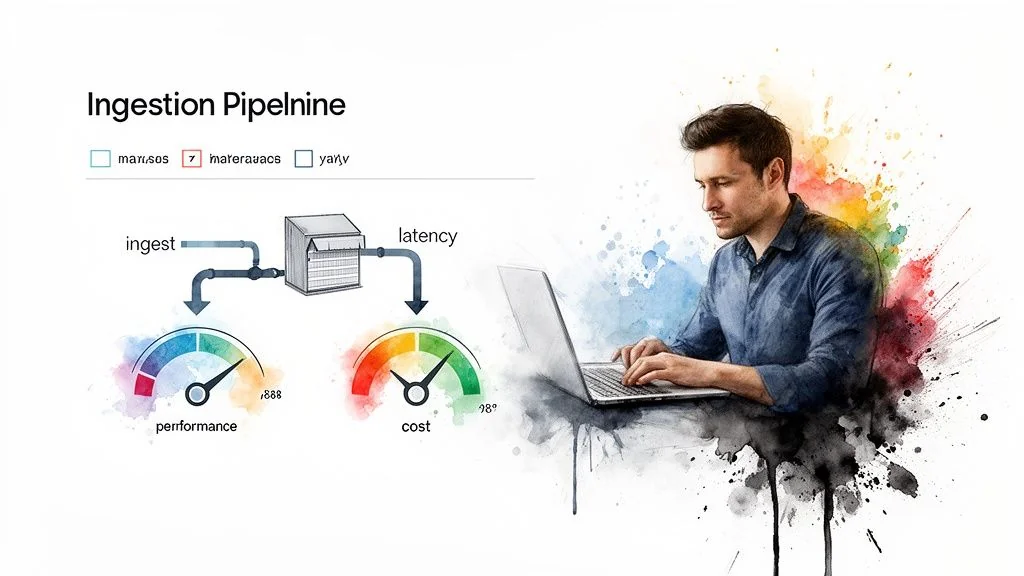
As illustrated, a modern data warehouse acts as a critical bridge, transforming disconnected data silos into a structured foundation suitable for advanced analytics, AI, and machine learning.
Develop a Phased Roadmap with Quick Wins
An enterprise data warehouse should not be treated as a monolithic project. The most effective approach is a phased roadmap that prioritizes quick wins to build momentum and demonstrate immediate value to the business.
The initial phase might focus on a single high-impact area, such as sales analytics. Delivering a genuinely useful solution to one department within the first few months creates powerful internal advocates for the project. This success simplifies securing buy-in and resources for subsequent phases, like integrating operations or finance data.
A common mistake is attempting to connect every data source from day one, leading to prolonged planning cycles and stakeholder disengagement. Instead, focus on delivering tangible value in 90-day sprints.
This iterative methodology allows for learning and adaptation. Insights gained from the first phase will inevitably improve the next, leading to a more resilient and business-aligned project.
Establish a Robust Governance Framework Early
Data governance cannot be an afterthought; it must be integrated into the blueprint from the outset. Neglecting governance leads to a “data swamp”—a centralized repository of untrusted, undocumented, and insecure data that is unusable.
Your initial governance framework must clearly define:
- Data Ownership: Who is accountable for the quality of data from each source system? For example, the sales department owns the accuracy of its Salesforce data.
- Access Controls: How will permissions be managed? A plan is needed to ensure sensitive information is accessible only to authorized users based on their roles.
- Data Quality Standards: What are the baseline metrics for data completeness, accuracy, and timeliness? How will these be monitored and remediated?
Establishing these rules upfront prevents future chaos and builds trust in the data. It ensures that as the warehouse grows, it remains a reliable and secure asset. For a deeper dive, consult our guide on how to build an effective data governance strategy.
Making Core Architectural Decisions That Matter
The architectural choices made today will dictate your data capabilities for the next five to ten years. This is not about adopting the latest trend but about building a foundation that supports business goals, handles your specific data characteristics, and scales cost-effectively.
The first critical decision is selecting the right architectural paradigm. This choice governs how you store, process, and serve data, with significant downstream implications for cost, performance, and analytical capabilities.
This decision directly impacts who can use your data and how efficiently they can derive value from it.
Choosing Your Core Architecture Paradigm
The choice is between a traditional Data Warehouse, a Data Lake, or the modern hybrid Data Lakehouse. Each is designed for a different purpose. A classic data warehouse is optimized for structured, historical data, making it extremely fast for standard BI reporting.
A data lake is a repository for raw data in any format, such as IoT sensor streams, social media feeds, or server logs. It is ideal for data science and discovery but requires significant effort to produce clean, report-ready insights.
The data lakehouse aims to combine the best of both worlds: the low-cost, flexible storage of a data lake with the robust data management and transactional capabilities of a warehouse. This allows for both BI dashboards and advanced machine learning models to run on the same platform.
For a more detailed examination, our comparison of data warehouse vs data lake architectures provides an in-depth analysis.
To frame the decision, comparing the paradigms across key attributes can clarify the trade-offs.
Choosing Your Architecture Paradigm: Data Warehouse vs Lake vs Lakehouse
| Attribute | Data Warehouse | Data Lake | Data Lakehouse |
|---|---|---|---|
| Primary Use Case | Business Intelligence, Reporting | AI, Machine Learning, Discovery | Both BI and AI/ML on one platform |
| Data Types | Structured, processed | All types (raw, unstructured) | All types (structured & unstructured) |
| Data Schema | Schema-on-write (pre-defined) | Schema-on-read (flexible) | Schema-on-read with enforcement |
| Performance | Very high for optimized queries | Slower for BI, high for big data | High for BI, optimized for AI/ML |
| Users | Business Analysts, Executives | Data Scientists, Data Engineers | All data users across the org |
| Cost-Effectiveness | Higher cost per TB | Lower storage cost, higher processing | Optimized for both storage & compute |
The final choice should be driven by primary business objectives. If the focus is 100% on BI, a warehouse may suffice. If the goal is an AI-driven future, a lakehouse is the most strategic long-term investment.
The Great Debate: ETL vs. ELT
Once the storage architecture is determined, the method for data ingestion must be decided. This is the classic engineering debate: ETL (Extract, Transform, Load) versus ELT (Extract, Load, Transform).
- ETL: The traditional approach. Data is extracted from a source, transformed on a separate server, and then the processed data is loaded into the warehouse. This was necessary when compute and storage were tightly coupled and expensive.
- ELT: The modern, cloud-native approach. Raw data is extracted and loaded directly into the platform. All transformations occur within the platform, leveraging its scalable compute engine.
For nearly all new projects in 2025, ELT is the recommended approach. It offers greater flexibility, handles large data volumes efficiently, and provides data scientists access to raw data. ETL remains relevant for niche use cases, such as intensive data cleansing for compliance before data enters the core platform.
Selecting a Data Modeling Approach
The organization of data within the warehouse is another critical decision. An incorrect model leads to slow queries and user confusion. The two dominant methodologies are Kimball and Inmon.
The Kimball Model (Bottom-Up): This approach prioritizes speed to value. It involves building focused “data marts” for individual business functions (e.g., sales, marketing) which are later integrated. It is pragmatic, faster to implement, and favored by business analysts.
The Inmon Model (Top-Down): This approach focuses on building a single, highly structured, normalized enterprise-wide data source first. Departmental data marts are then created from this central repository. It requires more upfront effort but delivers superior consistency and governance, which is essential in regulated industries.
This choice has practical consequences. A retail company needing quick insights into daily sales would benefit from Kimball’s speed. A financial institution requiring a single, auditable view of customer transactions would be better served by Inmon’s rigor.
The Power of Separating Compute and Storage
The separation of storage and compute is a defining feature of the modern data stack. In legacy on-premises systems, these were bundled, meaning an increase in processing power required a corresponding purchase of storage, and vice versa. This was highly inefficient.
Modern cloud platforms like Snowflake, Google BigQuery, and Databricks have decoupled them. This changes the economics and capabilities entirely.
- Scale compute on demand: A massive compute cluster can be provisioned for a heavy machine learning training job and then shut down upon completion, with costs incurred only for the minutes used.
- Store everything affordably: Petabytes of data can be stored in low-cost object storage without requiring expensive compute resources to be attached 24/7.
This separation provides the elasticity to handle variable workloads while maintaining cost control, an economic model that was impossible with previous-generation technology.
Selecting the Right Technology Stack and Partners
With the architectural blueprint finalized, the process shifts to procurement. This involves selecting specific tools and, equally important, the expertise to implement the vision.
These decisions have a profound impact on total cost of ownership, time-to-value, and ultimate project success. The right choices provide a powerful, scalable foundation; the wrong ones result in budget overruns and an underperforming system.
The task is not just selecting a database but an entire ecosystem. The cloud data platform market is dominated by a few major players, each with a distinct approach. To make an informed decision, you must look beyond marketing and match a platform’s core strengths to your specific business and technical requirements.
Navigating the Major Cloud Data Platforms
When you build a data warehouse, four platforms dominate enterprise discussions. Understanding their core differentiators is the first step in creating a shortlist.
- Snowflake: Known for its clean separation of storage and compute, Snowflake prioritizes simplicity. It excels at traditional BI and analytics workloads and offers a robust data marketplace. It is often selected by organizations that value ease of use and a fully managed, SQL-first experience.
- Databricks: Originating from Apache Spark, Databricks champions the “data lakehouse” architecture. It is the platform of choice for companies with significant AI and machine learning ambitions, as it unifies data engineering, analytics, and data science. It is favored by engineering-led teams seeking control and flexibility.
- Google BigQuery: A serverless data warehouse that excels with massive datasets and real-time analytics. Its tight integration with the Google Cloud ecosystem and powerful ML features make it a strong choice for companies on GCP or those handling large volumes of streaming data.
- Amazon Redshift: The first major cloud data warehouse has evolved significantly. Redshift is deeply integrated into the AWS ecosystem and offers excellent price-performance, especially for stable, predictable workloads. It is a natural fit for organizations heavily invested in AWS.
No single platform is universally superior. The optimal choice for a financial institution focused on risk modeling (likely Databricks) differs from that of a mid-market e-commerce company focused on marketing analytics (perhaps Snowflake or BigQuery). The use case must drive the selection.
Top-Tier Data Platform Feature Checklist
After narrowing the field, a structured evaluation is necessary to move beyond demonstrations and conduct an objective comparison. This checklist covers critical features for enterprise-grade deployments.
| Feature Category | Snowflake | Databricks | BigQuery | Redshift |
|---|---|---|---|---|
| Architecture | Decoupled Storage/Compute | Lakehouse (Unified) | Serverless, Columnar | Cluster-Based, MPP |
| Core Use Case | BI & Data Warehousing | AI/ML & Data Engineering | Large-Scale Analytics | Traditional DW & BI |
| Scalability | Instant, On-Demand | Cluster Auto-Scaling | Fully Serverless | Node-Based Scaling |
| Data Formats | Structured, Semi-Structured | All (Parquet, Delta Lake) | Structured, Semi-Structured | Structured |
| Governance | Strong RBAC, Tagging | Unity Catalog (Fine-Grained) | IAM Integration, Column-Level | Strong IAM, RBAC |
| Ecosystem | Strong Partner Network | Open-Source Centric | Google Cloud Integrated | AWS Integrated |
This feature-by-feature analysis facilitates a discussion about what is truly important for your team, ensuring the final decision aligns with both technical and business requirements.
The market is projected to grow from USD 31.35 billion in 2024 to USD 60.21 billion by 2032, driven by demand for real-time analytics and AI. With nearly 94% of small businesses now cloud-based, the pressure on implementation partners to execute complex projects flawlessly is immense. You can discover more data warehousing market insights on databridgemarketresearch.com.
Choosing the Right Implementation Partner
The platform is only half of the equation.
Unless you have an in-house team of data engineers with recent, relevant project experience, an implementation partner is necessary. Selecting the right consultancy is as critical as selecting the right technology.
You need a partner with proven, verifiable experience on your chosen platform. Request detailed case studies and client references from projects similar to yours in scale and industry. Investigate their project management methodology; an agile, iterative approach is almost always preferable to a “big bang” waterfall model.
Finally, ensure a clear plan for knowledge transfer. The objective should be self-sufficiency, not a perpetual consulting engagement. A good partner should aim to upskill your team and make themselves redundant.
If you are looking for assistance, our guide on what to look for when hiring a specialized cloud data warehouse consultant can be a useful resource.
Time to Build: Implementation and Optimization
With the architecture defined and vendors selected, execution begins. This phase translates theoretical plans into a functioning data warehouse, requiring disciplined engineering, rigorous testing, and a sharp focus on performance and cost management.
This is the critical implementation stage. Success builds a trusted engine for insight; failure results in an expensive, underutilized asset.
The data pipelines built now will fuel all analytics for years to come. A fragile pipeline undermines the entire system’s credibility from the start.
Building Resilient Data Ingestion Pipelines
A data warehouse is useless without a reliable data supply. These ingestion pipelines are the arteries of the analytics platform and must be robust. In a modern enterprise, two primary modes of data movement are common.
- Batch Ingestion: This is the standard for large volumes of historical or less time-sensitive data, such as daily extracts from an ERP or hourly syncs from a CRM. Reliability and idempotency—the ability to re-run a failed job without creating duplicate records—are key.
- Streaming Ingestion: For real-time applications like fraud detection or live inventory management, streaming is required. This approach ingests data continuously from sources like IoT devices or application logs, demanding a toolset optimized for low latency.
Every pipeline, regardless of type, must be instrumented with robust logging, monitoring, and alerting to ensure immediate notification and diagnosis of failures.
Your Non-Negotiable Testing and Validation Strategy
Business decisions should not be based on untested data. A multi-layered testing strategy is essential before any user access is granted.
A comprehensive plan includes:
- Unit Tests: Verify that individual pieces of transformation logic function correctly (e.g., does a function accurately calculate gross margin?).
- Integration Tests: Confirm that data can move from source to warehouse without errors.
- Data Quality Checks: Automate the detection of nulls, duplicates, and referential integrity violations.
- Business Logic Validation: The most critical step for building trust. Work with stakeholders to prove that metrics in new dashboards align with their existing, trusted reports.
Only after data has passed all these checks can it be considered production-ready.
Mastering the Twin Arts of Performance and Cost
In a cloud environment, performance and cost are directly linked. An inefficient query is not just slow; it consumes budget. Optimization must be a continuous discipline, not a one-time task, to build a data warehouse that is sustainable.
A significant mistake is treating optimization as an afterthought. A cost-aware culture must be established from day one. In a consumption-based pricing model, every engineer and analyst is a de facto budget owner.
Begin by implementing monitoring and governance. Set alerts for long-running queries, establish resource quotas for teams, and use cost-allocation tags to track spending by department or project.
Focus on these high-impact techniques:
- Right-Sizing Compute: Analyze workloads to select appropriately sized virtual warehouses or clusters. It is more cost-effective to scale up on demand than to over-provision for infrequent peak loads.
- Query Optimization: Educate users on best practices, such as avoiding
SELECT *, applying filters early, and using partitions and clusters to reduce data scanning. - Materialization Strategies: For frequently run, complex queries, pre-calculate the results using materialized views to improve performance and reduce recurring compute costs.
Driving Real Adoption Through Change Management
The most advanced data warehouse is a failure if it is not used. The final rollout is a human challenge, requiring a thoughtful change management plan to prepare users for a new way of working.
Start with clear communication about the “why” behind the project and the specific benefits for each team. Follow up with hands-on, role-based training.
- For Business Analysts: Provide training on navigating new data models and using the BI tool.
- For Executives: Offer a tour of high-level dashboards and demonstrate how to access key metrics.
- For Data Scientists: Conduct deep dives on raw datasets, explain data lineage, and share best practices.
Finally, establish a clear feedback channel, such as a dedicated Slack channel or ticketing system, to handle questions, bug reports, and new data requests. This fosters a sense of partnership and helps prioritize future development.
Frequently Asked Questions About Building a Data Warehouse
Even the most detailed plan encounters practical questions. Here are direct answers to common queries from executives and data leaders involved in a data warehouse build.
How Long Does It Realistically Take to Build a Data Warehouse?
Timelines vary, but a foundational warehouse for a single business area—such as a customer 360 view integrating CRM and marketing data—can typically be delivered in 4 to 6 months, assuming clear objectives and a competent partner.
A full enterprise-wide data warehouse is a more extensive undertaking, generally requiring a multi-phase project spanning 12 to 18 months or more. The timeline depends on the number and complexity of data sources, the state of data quality, and the clarity of business requirements.
Be skeptical of any claims to deliver a comprehensive enterprise solution in a few weeks. Such speed usually compromises governance, testing, and scalable design, leading to technical debt and costly rework later. An iterative, value-driven approach is superior.
What Are the Most Common Hidden Costs to Watch For?
The cloud platform subscription is only the beginning. Operational costs are often overlooked. A culture of cost-awareness is the best defense against budget overruns.
Monitor these expenses closely:
- Data Egress Fees: Moving data out of your cloud provider’s ecosystem incurs costs that can accumulate quickly, especially in multi-cloud or third-party application integration scenarios.
- Inefficient Queries: In a consumption-based model, a poorly written query that scans terabytes of unnecessary data can exhaust credits in minutes.
- Idle Compute Resources: Paying for virtual warehouses or compute clusters that are running but not actively processing workloads is a common and avoidable expense.
- Third-Party Tooling: Costs for data ingestion tools (e.g., Fivetran), transformation frameworks (e.g., dbt), and BI platforms must be factored into the total budget.
- Ongoing Governance: The work is not finished at launch. Dedicated resources are required for monitoring data quality, performing security audits, and conducting routine maintenance.
Should We Build In-House or Hire a Consultancy?
This is a strategic “build vs. buy” decision.
Building fully in-house provides complete control but requires an elite, expensive, and difficult-to-hire data engineering team with recent experience on modern cloud platforms. This is viable if you already possess such talent.
Hiring a specialized consultancy accelerates the timeline and mitigates risk by leveraging proven methodologies and deep expertise that would take years to develop internally.
The optimal approach for most organizations is a hybrid model. Engage an expert partner to architect the foundation and deliver the initial data products while ensuring knowledge transfer is a core part of the engagement. They should actively train and upskill your internal team, enabling quick wins while building long-term self-sufficiency.
Choosing the right partner is just as critical as choosing the right technology. DataEngineeringCompanies.com provides independent, data-driven rankings of top data engineering firms to help you make this decision with confidence. Compare 50+ consultancies, access transparent pricing data, and use our free tools to create a shortlist that matches your exact project needs. Start your evaluation at DataEngineeringCompanies.com.
Top Data Engineering Partners
Vetted experts who can help you implement what you just read.
Related Analysis
Snowflake Schema and Star Schema: A Practical Guide for Modern Data Warehouses
snowflake schema and star schema explained: a concise comparison of performance, costs, and real-world use cases for modern data warehouses.
A Practical Guide to the Modern Architecture of a Data Warehouse
Explore the modern architecture of a data warehouse. This guide breaks down core layers, cloud patterns, and how to build a scalable data foundation.
A Practical Guide to Cloud Data Integration for Modern Data Stacks
Discover cloud data integration essentials, compare ETL vs ELT, and learn to secure and optimize your data strategy with trusted partners.