A Practical Guide to the Modern Architecture of a Data Warehouse
A data warehouse is not a scaled-up operational database. It is an analytical system engineered for a single purpose: converting raw data into reliable, high-speed business insights. It serves as the central repository for historical and current data, structured specifically for querying and analysis, creating a single source of truth that decouples analytical workloads from transactional systems.
Understanding Modern Data Warehouse Architecture
A modern data warehouse functions as the core of a data-driven organization’s analytical capabilities. It ingests data from disparate sources—CRMs, ERPs, application databases, event logs—and transforms it into a queryable format.
Raw data from operational systems (e.g., Salesforce, PostgreSQL) is ingested, cleansed, standardized, and organized across logical layers. The final, structured data is then made available through business intelligence (BI) dashboards, reporting tools, and data science platforms, enabling decision-makers to query and analyze it efficiently.
This architecture moves beyond passive data storage to become an active analytics engine. Its fundamental goal is to provide a comprehensive, unified view of the business. The entire structure is optimized to handle complex analytical queries over large datasets without impacting the performance of the source operational systems.
The Driving Force Behind Modernization
The shift to modern data warehouse architecture is driven by the exponential growth in data volume and the business demand for faster, more complex analytics. The global data warehousing market was valued at $33.76 billion in 2024 and is projected to reach $37.73 billion in 2025, with forecasts showing a potential expansion to $69.64 billion by 2029. This growth reflects the critical role these systems play in modern enterprises.
A modern architecture is designed to answer high-value business questions that legacy systems struggle with:
- How does a customer’s website interaction journey correlate with their long-term value?
- Which marketing channels generate the highest lifetime value customers, not just initial conversions?
- What are the latent inefficiencies in our supply chain, identifiable only through integrated historical data?
The value of a data warehouse lies not in data storage but in its structure. A well-designed architecture enables an organization to use historical data to build predictive models, identify trends, and address operational issues proactively.
Core Principles of Today’s Architecture
Legacy, on-premise data warehouses were characterized by their rigidity, high latency, and significant scaling costs. Modern, cloud-native architectures are founded on principles of elasticity, efficiency, and separation of concerns, forming the foundation of the modern data stack.
The most significant architectural principle is the separation of storage and compute. This allows an organization to scale its data storage capacity independently from its data processing power. A massive influx of data can be ingested and stored (scaling storage) without incurring the cost of high-performance processing clusters until a complex query is executed (scaling compute). This elastic model optimizes both performance and cost.
Deconstructing the Core Architectural Layers
A data warehouse is a multi-layered system, not a monolithic application. Each layer performs a specific function in the data lifecycle, transforming raw data into business intelligence. Understanding this layered approach is essential for building a robust and maintainable architecture. Data flows through a series of zones where it is cleansed, integrated, and structured for analysis.
This process is a data value chain, moving from raw, unprocessed data at the source layer to refined, actionable insights at the presentation layer.
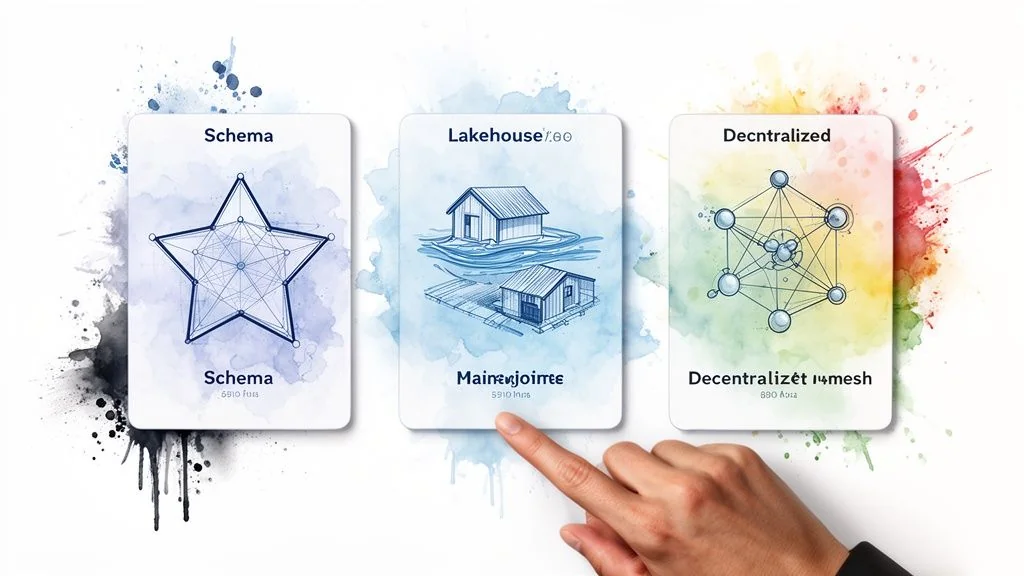
This diagram illustrates the fundamental data flow: ingestion from various sources, processing and storage within the warehouse, and consumption by end-users via analytical tools.
The Data Source Layer
This is the origination layer, comprising all systems that generate business-relevant data. It is a heterogeneous environment of internal and external platforms.
Common data sources include:
- Transactional Databases: OLTP systems like PostgreSQL or MySQL that power core business applications and record daily operations.
- Cloud Applications: SaaS platforms such as Salesforce for CRM, Marketo for marketing automation, or Zendesk for customer support.
- Logs and Events: Machine-generated data from web servers, application logs, and IoT devices that capture user interactions, system errors, and other events.
Data in this layer is raw, often inconsistent, and exists in disparate formats. The initial challenge is establishing connectivity and extraction processes for these sources.
The Staging and Integration Layer
After extraction, data is loaded into a staging and integration layer. This is the initial processing zone where transformation begins. In modern architectures following an ELT (Extract, Load, Transform) pattern, raw data is loaded directly into a dedicated staging area within the cloud data warehouse.
This layer serves as a buffer to isolate the analytical environment from the inconsistencies of source data. Core data engineering work occurs here, including data cleansing, deduplication, and standardization.
Practical transformations in this layer include standardizing country codes (e.g., mapping “USA,” “U.S.A.,” and “United States” to a single canonical value) or enriching customer records by joining data from CRM and support ticket systems.
The Storage and Modeling Layer
This is the core of the data warehouse, where cleansed, integrated data is stored for long-term analysis. Unlike transactional databases optimized for write operations, this storage layer is optimized for high-speed read access across large datasets.
Data is structured using specific analytical modeling techniques to optimize query performance. For a deep dive, see our guide on data warehouse data modeling. The primary goal is to organize data in a way that is both intuitive for business users and computationally efficient for analytical tools, enabling queries to return results in seconds.
The Analytics and Presentation Layer
This is the user-facing layer where data is transformed into business value. It comprises the tools and applications that analysts, data scientists, and business leaders use to interact with the data stored in the warehouse. This layer submits queries to the storage layer and visualizes the results.
Common components include:
- Business Intelligence (BI) Tools: Platforms like Tableau, Power BI, or Looker, which provide interactive dashboards and data visualization capabilities.
- Reporting Applications: Tools for generating static, standardized reports such as monthly sales summaries or quarterly financial statements.
- Data Science Platforms: Environments like Jupyter Notebooks that allow data scientists to access curated datasets for building predictive models and performing advanced statistical analysis.
The success of the data warehouse architecture is ultimately measured by the effectiveness of this layer—how efficiently it enables users to derive insights and make informed decisions.
Core Data Warehouse Architectural Layers and Functions
| Layer | Core Function | Example Technologies & Processes |
|---|---|---|
| Data Source | The origination point for all raw business data. | Transactional databases (PostgreSQL, MySQL), SaaS apps (Salesforce), IoT sensors, logs. |
| Staging & Integration | A temporary holding and processing area for data cleansing, standardization, and integration. | Data ingestion tools (Fivetran, Airbyte), raw storage zones in a cloud warehouse (Snowflake, BigQuery). |
| Storage & Modeling | The central repository for cleaned, structured, and historically-tracked data optimized for analytics. | Cloud data warehouses (Snowflake, Redshift), data modeling (star/snowflake schemas), data marts. |
| Analytics & Presentation | The user-facing layer where data is queried, visualized, and consumed to generate insights. | BI tools (Tableau, Power BI), reporting software, machine learning platforms (Jupyter). |
Each layer logically builds upon the previous one, creating a structured data pipeline that converts raw operational data into a strategic business asset.
Choosing Your Architectural Blueprint
Selecting a data warehouse architecture is a strategic decision, not merely a technical one. There is no universally “best” design; the optimal choice depends on organizational scale, data latency requirements, and long-term data strategy. The chosen blueprint dictates how data is organized, accessed, and governed for years to come.
This decision should be based on a pragmatic assessment of business needs rather than industry trends. A startup’s requirements for agile marketing analytics are fundamentally different from a multinational corporation’s needs for governed financial reporting.
Foundational Models: The Kimball and Inmon Approaches
Modern cloud architectures are built upon two classical, influential methodologies that remain relevant today.
The Kimball method, developed by Ralph Kimball, is a “bottom-up” approach focused on rapid delivery of business value. It involves building discrete, business-process-oriented data marts. These marts typically use a star schema—a design with a central fact table (containing quantitative measures like sales revenue) surrounded by dimension tables (containing contextual attributes like customer, product, and date).
- Pros: Highly intuitive for business users and optimized for fast BI queries. Enables incremental development, allowing teams to deliver analytics for specific departments quickly.
- Cons: Integrating data across different data marts can become complex, potentially leading to data silos or inconsistencies without strong governance.
The Inmon method, developed by Bill Inmon, is a “top-down” approach. It begins with the creation of a centralized, normalized, enterprise-wide data warehouse that serves as the single source of truth. Department-specific data marts are then derived from this central repository.
- Pros: This “hub-and-spoke” model ensures high data integrity and consistency across the enterprise, reducing data redundancy.
- Cons: Requires significant upfront planning and data modeling, making the initial implementation slower and more resource-intensive than the Kimball approach.
In practice, many modern implementations are hybrids. Organizations often build a normalized, Inmon-style central data store for enterprise-wide data governance, while exposing data to business users through Kimball-style star schema data marts for performance and ease of use.
Modern Cloud Patterns: Lakehouse and Data Mesh
Two dominant architectural patterns have emerged to address the challenges of data volume and variety in the cloud.
The Lakehouse architecture merges the low-cost, flexible storage of a data lake with the performance and transactional reliability of a data warehouse. Instead of maintaining separate systems, a Lakehouse enables BI and analytics to run directly on data stored in open formats (e.g., Apache Iceberg, Delta Lake) within the data lake. This approach is ideal for organizations looking to unify their data platform, supporting both traditional BI and advanced AI/ML workloads on the same data repository. It minimizes data duplication and architectural complexity. For a detailed explanation, see our guide on what a Lakehouse architecture is.
The Data Mesh is an organizational and technical paradigm for decentralizing data ownership to overcome the bottlenecks of a centralized data team. It treats data as a product, applying principles of domain-driven design to analytics.
- Decentralized Ownership: Business domains (e.g., marketing, finance) are responsible for their data end-to-end.
- Data as a Product: Each domain delivers high-quality, reliable data products for consumption by other domains.
- Self-Serve Infrastructure: A central platform team provides the tools and infrastructure to enable domain teams to build and manage their data products independently.
- Federated Governance: A common set of standards ensures interoperability, security, and compliance across all data products.
This approach is best suited for large, complex organizations where a centralized model impedes agility and scalability. It empowers teams with deep domain knowledge to manage their own data assets effectively.
The Cloud Versus On-Premise Decision
The deployment model for a data warehouse—cloud or on-premise—is a fundamental architectural choice with significant implications for cost, scalability, and operations.
While the industry trend is overwhelmingly toward cloud adoption, on-premise solutions remain relevant for organizations with stringent security or regulatory constraints. Although 53% of companies still operate on-premise data warehouses, cloud adoption is dominant among smaller firms, with 94% already migrated. This shift has also driven the prevalence of ELT, as cloud platforms offer the necessary computational power to perform transformations in-database. For more details, see these data warehouse best practices from Estuary.
An objective evaluation requires analyzing the practical trade-offs of each model.
Cost Structure: A Tale of Two Models
The financial models are fundamentally different.
An on-premise deployment represents a Capital Expenditure (CapEx). It requires significant upfront investment in servers, storage, networking hardware, and data center facilities. This results in a predictable, fixed cost but creates a high barrier to entry and locks the organization into hardware with a limited lifespan.
Cloud data warehouses operate on an Operational Expenditure (OpEx) model. Organizations pay a recurring subscription based on consumption (storage and compute usage). This model eliminates the need for large capital outlays, making advanced analytical capabilities accessible to a broader range of companies by converting a major capital project into a manageable operating expense.
Scalability and Performance: Elastic Versus Fixed
This is a key differentiator.
On-premise systems have fixed capacity. Scaling to meet peak demand—such as during end-of-quarter reporting—requires a lengthy and expensive procurement cycle for new hardware. This forces organizations to provision for maximum anticipated load, resulting in underutilized resources during normal operations.
Cloud platforms provide elastic scalability. Compute resources can be provisioned on-demand to handle intensive workloads and de-provisioned when complete. This is enabled by the architectural separation of storage and compute. Users pay only for the resources they consume, when they consume them.
A practical benefit is workload isolation. A finance team can execute resource-intensive month-end reports without degrading the performance of real-time marketing dashboards, as each workload can be assigned its own dedicated compute cluster.
Security: The Shared Versus Total Responsibility Model
The security paradigm shifts from total control to a specialized partnership.
With an on-premise warehouse, the organization assumes total responsibility for security, from physical data center access to network firewalls and user access controls. This level of control is often a requirement for organizations in highly regulated sectors like government, healthcare, and finance.
Cloud providers operate on a shared responsibility model. The provider (e.g., AWS, Google Cloud, Microsoft Azure) is responsible for securing the underlying infrastructure. The customer is responsible for securing their data within the cloud through proper configuration of access controls, encryption, and identity management. While this involves ceding some control, major cloud providers offer security expertise and tools that often exceed the capabilities of individual organizations.
Maintenance: Managed Services Versus In-House Teams
This determines who is responsible for operational uptime.
An on-premise warehouse requires a dedicated in-house team for hardware management, software patching, backups, and incident response. This builds internal expertise but incurs significant operational overhead and relies on the availability of specialized talent.
Cloud data warehouses are managed services. The cloud provider handles all underlying infrastructure maintenance, including hardware provisioning, patching, and system updates. This abstracts away low-level operational tasks, allowing data engineers to focus on higher-value activities such as data modeling, query optimization, and delivering business insights.
How to Select a Data Engineering Partner
Selecting the right technology is only one component of a successful data warehouse implementation. The expertise of the engineering partner who designs and builds the system is equally critical. Choosing a partner requires a rigorous evaluation of their technical competence, architectural philosophy, and proven experience.
A suitable partner must possess both deep technical knowledge and a practical understanding of how to build robust, scalable, and valuable data platforms. The wrong choice can result in a brittle system that is difficult to maintain and fails to meet business objectives.
Go Beyond Surface-Level Credentials
Certifications on platforms like Snowflake, Databricks, or BigQuery are a baseline indicator of theoretical knowledge, but they are not a substitute for hands-on experience.
Instead of asking, “Are your engineers certified?” ask, “Describe a project where you migrated a legacy on-premise warehouse to a cloud-native Lakehouse architecture.” This reframes the conversation from theoretical knowledge to demonstrated capability. An effective partner has experience navigating the real-world complexities of such projects.
An experienced partner understands platform-specific performance tuning, cost optimization strategies, and common implementation pitfalls that are only learned through practice. This expertise can prevent significant cost overruns and technical debt.
Request case studies and references for projects that are analogous to yours in scale, complexity, and industry.
Evaluate Their Architectural Philosophy
A strong partner acts as a strategic advisor, not just an order-taker. During the evaluation process, present your proposed architecture and ask them to critique it. Their response will reveal their depth of expertise and problem-solving approach.
Do they ask probing questions about your business objectives? Do they propose alternative approaches and articulate the trade-offs? A partner who passively accepts your initial design may lack the strategic foresight to build a durable solution.
You need a team that thinks architecturally. They should be able to explain the rationale behind different data modeling techniques, justify their technology recommendations, and design a system engineered for future growth.
Assess Industry-Specific Expertise
Every industry has unique data challenges, from regulatory compliance in finance (e.g., SOX) and healthcare (e.g., HIPAA) to supply chain complexities in manufacturing. A partner with experience in your vertical offers a significant advantage. They will be familiar with your domain-specific data sources, key performance indicators, and regulatory landscape.
This industry knowledge accelerates the project and mitigates risk:
- Faster Onboarding: They understand business terminology and KPIs from the outset.
- Reduced Risk: They can proactively design for compliance requirements like GDPR, HIPAA, or CCPA.
- Higher Value: They may suggest industry-specific analytics or use cases that you had not considered.
Ask for client references and case studies from your industry to verify their domain expertise.
Use a Scorecard for Objective Comparison
To ensure a structured and objective evaluation, use a vendor scorecard to compare potential partners across a consistent set of criteria. This tool helps document assessments, score candidates systematically, and identify potential risks before committing to a partnership.
The following table provides a template for your evaluation scorecard. It outlines key criteria, suggests specific questions, and highlights potential red flags.
Vendor Evaluation Scorecard for Data Engineering Partners
This scorecard will help you systematically assess data engineering firms, ensuring a fair and thorough comparison.
| Evaluation Criterion | Key Questions to Ask | Red Flags to Watch For |
|---|---|---|
| Technical Expertise | Can you walk us through a similar Lakehouse migration project? What were the key challenges and how did you solve them? | Vague answers, leaning heavily on buzzwords, or an inability to discuss the nitty-gritty of technical trade-offs. |
| Industry Experience | What is your experience with data compliance in our industry (e.g., HIPAA, GDPR)? Can you share specific examples? | Generic project stories that don’t connect to your industry’s specific data challenges or regulations. |
| Project Methodology | How do you manage project scope, budget, and timelines? What’s your process for keeping stakeholders in the loop? | No clear, documented methodology; rigid processes that can’t adapt when things inevitably change. |
| Team Composition | Who are the actual people who will be on our project? Can we review their experience and talk to them? | The old “bait-and-switch” where senior experts charm you in sales calls, but then junior staff do all the work. |
By methodically applying these criteria, you can make a data-driven decision and select a partner equipped to successfully deliver your modern data warehouse architecture.
Common Questions About Data Warehouse Architecture
Several fundamental questions consistently arise when designing a data warehouse architecture, particularly regarding the distinctions between modern and legacy concepts. Addressing these points clarifies the practical application of architectural principles.
What’s the Difference Between a Data Warehouse and a Data Lake?
A data warehouse is analogous to a library. It stores structured, processed, and verified data (books) that has been organized for a specific purpose: efficient querying and analysis. The data is clean, reliable, and ready for consumption.
A data lake is like a reservoir. It collects raw data in its native format from a multitude of sources. It can store structured, semi-structured, and unstructured data (JSON files, images, logs) at a low cost. However, this raw data must be processed and refined before it can be used for most analytical purposes.
The Lakehouse architecture aims to unify these two concepts. It combines the low-cost, flexible storage of a data lake with the performance, reliability, and governance features of a data warehouse, enabling direct analytical querying on raw data.
This hybrid model is becoming the standard for modern cloud data platforms because it supports a wide range of workloads—from standard BI to machine learning—within a single, unified architecture.
When Should We Choose an ELT over an ETL Architecture?
The choice between ETL and ELT depends primarily on the computational power of the target system.
ELT (Extract, Load, Transform) is the standard approach for modern, massively parallel processing (MPP) cloud data warehouses like Snowflake, Google BigQuery, or Amazon Redshift. These platforms possess sufficient computational power to execute complex transformations in-database more efficiently than a separate transformation engine.
- Key Advantage: Flexibility. Raw data can be loaded quickly, and transformations can be developed and modified later without re-ingesting the source data. This allows for greater agility as business requirements evolve.
ETL (Extract, Transform, Load) remains relevant in specific scenarios. It is necessary when the target database lacks the power to perform transformations efficiently. It is also required for compliance use cases where sensitive data must be anonymized or masked before it is loaded into the central repository.
How Can We Future-Proof Our Architecture for AI and ML?
Architecting for future AI and machine learning workloads is less about selecting specific tools and more about establishing sound foundational principles. High-quality, accessible data is the prerequisite for any successful AI initiative.
To build a future-ready platform, focus on three core architectural concepts:
- Separate Storage and Compute: This is essential. Decoupling these resources allows for the elastic provisioning of large compute clusters for model training without impacting concurrent BI workloads. Compute resources can be scaled up for training and scaled down upon completion to manage costs effectively.
- Embrace a Lakehouse Pattern: Data scientists require access to both raw, exploratory data and clean, feature-engineered data. A Lakehouse architecture provides a single, unified environment where they can access the full spectrum of data needed for model development.
- Prioritize Data Governance and Cataloging: The quality of an AI model is directly dependent on the quality of its training data. Robust data governance, automated data quality checks, and a comprehensive data catalog are critical for building trustworthy and reliable AI systems.
Adhering to these principles will create a flexible and scalable foundation capable of supporting both current analytical needs and future AI applications.
Selecting the right data engineering partner is just as critical as choosing the right architecture. DataEngineeringCompanies.com provides expert rankings and practical tools to help you vet and select a consultancy with confidence, ensuring your data warehouse project delivers real business value. Find your ideal partner at https://dataengineeringcompanies.com.
Data-driven market researcher with 20+ years in market research and 10+ years helping software agencies and IT organizations make evidence-based decisions. Former market research analyst at Aviva Investors and Credit Suisse.
Previously: Aviva Investors · Credit Suisse · Brainhub · 100Signals
Top Data Pipeline Partners
Vetted firms whose specialty matches this article.
Related Analysis
A Practical Guide to Snowflake Cost Optimization
Discover proven Snowflake cost optimization strategies. This guide covers compute, storage, and governance to help you reduce your Snowflake bill.
How to Build Data Pipelines That Last
Learn how to build data pipelines that are reliable, AI-ready, and efficient. A practical guide to modern data engineering strategies.
A CTO's Guide to Databricks Unity Catalog Implementation
A proven guide for CTOs on Databricks Unity Catalog implementation. Get actionable frameworks for architecture, governance, migration, and CI/CD.