What Is a Data Platform? A Practical Guide for 2025
what is a data platform, data platform architecture, cloud data platform, data engineering, enterprise data strategy
A data platform is a company’s central system for data processing and analysis. It is not a single database or tool - it’s an integrated architecture that ingests raw data, processes it, and makes it available for business intelligence, analytics, and operational applications.
How Is a Data Platform Different From a Data Warehouse?
A data warehouse stores clean, structured data for historical reporting - it’s static and retrospective. A data platform manages the entire data lifecycle: collection, storage, transformation, analysis, and application, across structured and unstructured data, moving a company from siloed information to coordinated, data-informed decisions.
The warehouse is one component inside the platform, not a competing system. A warehouse answers known, well-structured questions against clean data. A platform is the operational system that feeds it - and everything else, including data science and application workloads - from raw collection through to serving.
From Static Storage to an Active System
The fundamental shift is from passive data storage to an active, operational backbone. A data platform connects disparate systems and provides multiple teams with secure, efficient access to data.
This integrated approach supports a range of business functions simultaneously. The platform must be flexible enough to handle diverse data types and serve various end-users with different objectives.
- For Business Analysts: It supplies clean, reliable data for dashboards and reports in tools like Tableau or Power BI.
- For Data Scientists: It provides governed access to both raw and processed data required for building and training machine learning models.
- For Application Developers: It can expose data through APIs to power customer-facing features, such as real-time personalization.
The table below outlines the key differences.
Key Differences Between Traditional Warehouses and Modern Data Platforms
| Capability | Traditional Data Warehouse | Modern Data Platform |
|---|---|---|
| Data Scope | Primarily structured, historical data (e.g., sales records, financials). | All data types: structured, semi-structured, and unstructured (e.g., logs, images, social media feeds). |
| Primary Goal | Reporting and business intelligence (BI) on past performance. | Powers BI, real-time analytics, AI/ML models, and data-driven applications. |
| Architecture | Centralized and often rigid, designed for specific queries. | Decentralized, flexible, and scalable; supports diverse compute engines. |
| Users | Mostly business analysts and data professionals. | Serves the entire organization: analysts, data scientists, developers, and business users. |
| Operational Focus | Batch processing; data is updated periodically (e.g., nightly). | Supports both batch and real-time stream processing for up-to-the-minute insights. |
This comparison shows an evolution from a system of record that looked backward to an operational engine that drives the business forward.
The Strategic Business Asset
A data platform is more than a technical solution; it’s a strategic asset that fuels business growth and operational efficiency. It provides the capability to ingest, store, process, and analyze massive volumes of information at scale.
The economic impact is measurable. The U.S. data marketplace platform market, a component of this ecosystem, generated USD 417.4 million in revenue in 2024 and is projected to reach USD 1,459.5 million by 2030, according to Grand View Research.
This growth highlights a critical reality: a company’s ability to compete depends on how effectively it can turn raw data into measurable outcomes. A well-designed data platform is the infrastructure that enables this transformation by breaking down departmental silos and creating a single source of truth.
What Are the Core Components of a Data Platform?
A data platform is built from seven specialized, interconnected components: ingestion, storage, processing and transformation, metadata management, governance and security, orchestration, and serving. Each handles one stage of the data lifecycle, and vendors typically specialize in one or two rather than all seven.
A data platform is not a single product you buy off the shelf - it’s a system assembled from these building blocks, which is why designing the architecture or selecting vendors requires understanding each piece.
1. Data Ingestion
The first step is moving data into the platform. Data Ingestion is the process of collecting raw data from numerous sources - SaaS applications, internal databases, mobile devices, and IoT sensors - and loading it into a central storage layer.
Data arrives in different formats and at varying velocities. Some data is delivered in large, scheduled batches (e.g., nightly sales reports), while other data streams in continuously (e.g., website user clicks). The ingestion layer has to handle both without dropping records.
- Batch Ingestion: Tools like Fivetran or Airbyte are used to pull data on a schedule from applications, databases, and file systems.
- Stream Ingestion: For real-time data from IoT devices or application logs, technologies like Apache Kafka or AWS Kinesis are standard choices.
The objective is to create automated, reliable pipelines that deliver raw data to the storage layer.
2. Data Storage
Once ingested, data requires a central repository. The Data Storage layer serves as the primary warehouse for all ingested data. Modern storage layers are designed for flexibility.
They must handle structured data (e.g., tables from a CRM), semi-structured data (e.g., JSON files from APIs), and unstructured data (e.g., images, text). This versatility is why modern data lakes and lakehouses are more powerful than rigid, traditional data warehouses. Typically, this layer is built on cost-effective, highly scalable cloud object storage, such as Amazon S3 or Google Cloud Storage.
3. Data Processing and Transformation
Raw data is rarely useful in its original state. The Data Processing and Transformation layer is where raw data is cleaned, structured, enriched, and aggregated to create analysis-ready datasets.
This is where data engineers build pipelines to convert raw data into trusted information assets. For example, a transformation job might join customer order data with marketing campaign information to calculate return on ad spend. Adhering to data engineering best practices is critical for building a reliable platform.
This transformation stage is where a significant amount of business logic gets encoded. Raw inputs turn into meaningful metrics - customer lifetime value, sales trends - which is what makes the data directly useful for business intelligence and decision-making.
4. Metadata Management
A complex system requires a detailed catalog to track every asset - its origin, location, and usage. Metadata Management serves as this central catalog for the data platform. It is the “data about your data.”
This component captures technical details (e.g., data types, schemas) and business context (e.g., data ownership, metric definitions). A well-maintained metadata layer is what lets users find the data they need and trust where it came from - through discovery and lineage tracking.
5. Data Governance and Security
Data Governance and Security functions ensure that data is accurate, consistent, and handled in compliance with company policies and regulations like GDPR or CCPA.
This component covers several critical jobs:
- Access Control: Defining and enforcing permissions for who can view and modify which datasets.
- Data Quality: Establishing rules and monitoring to ensure data completeness and correctness.
- Data Masking: Obfuscating sensitive personally identifiable information (PII).
- Auditing: Maintaining a log of data access and changes for compliance purposes.
Without strong governance, a data lake can become a “data swamp” - an untrusted and insecure repository of unusable information.
6. Orchestration
An automated system requires a central controller to coordinate its various processes. Orchestration is the component responsible for scheduling, executing, and monitoring all data pipelines and workflows.
Tools like Apache Airflow or Dagster are used to define the complex dependencies between tasks. For example, an orchestrator ensures a sales report transformation job only runs after the daily sales data has been successfully ingested. This automation enables the platform to operate reliably at scale. See how these components fit together in our guide to the modern data stack.
7. Data Serving and Access
Finally, the processed data must be delivered to end-users. The Data Serving and Access layer makes high-value data available to analysts, data scientists, and other applications.
This layer’s implementation varies depending on the use case:
- BI Dashboards: Serving aggregated data to tools like Tableau for executive reporting.
- APIs: Exposing clean data to power features in other software applications.
- SQL Access: Providing analysts direct access to run ad-hoc queries against the data.
An effective serving layer provides fast, reliable, and secure access, ensuring the value created within the platform reaches those who can act on it.
Which Data Platform Architecture Should You Choose?
The three dominant patterns are the modern data warehouse (best for standardized BI on structured data), the lakehouse (best for combining BI and AI/ML on one system), and the data mesh (best for large, federated organizations where a central team has become a bottleneck). The right choice depends on company size, goals, and structure.
Selecting the right architecture is a strategic decision - what works for a startup will likely not scale for a large, regulated enterprise. It establishes the foundation for how an organization uses data for years: the right choice enables speed and agility, the wrong one leads to bottlenecks and technical debt.
Ingestion, storage, and processing are the foundation of every blueprint below - what differs is how each pattern organizes and governs them.
The Modern Data Warehouse
The modern data warehouse remains a strong choice for companies focused on enterprise-wide business intelligence (BI). It functions as a highly organized, central repository for structured and semi-structured data. Its primary strength is creating a single, reliable source of truth for reporting and analytics.
This architecture is optimal when the main goal is to serve clean, governed data to business analysts using tools like Tableau or Power BI. It is engineered for performance and simplicity, facilitating queries on historical data to answer well-defined business questions.
- Best For: Companies focused on standardized reporting, corporate BI, and establishing a single version of the truth for key business metrics.
- Trade-Offs: It can be rigid when handling raw, unstructured data and may create a bottleneck for advanced data science or machine learning experiments that require greater flexibility.
The Lakehouse Architecture
The lakehouse is a hybrid model that combines the low-cost, flexible storage of a data lake with the management features and query performance of a data warehouse. Pioneered by companies like Databricks and Snowflake, it has become a standard for many modern data teams.
A lakehouse allows organizations to store all data types - structured and unstructured - in a single system. This architecture enables both traditional BI analytics and advanced AI/ML projects to run on the same data, eliminating the need for separate, siloed systems and reducing data duplication. See our full breakdown of lakehouse architecture for the technical detail.
A key advantage of the lakehouse is its direct support for data science workflows. Machine learning models can be trained on the full, raw dataset and then deployed alongside business intelligence dashboards, all under a single, unified governance framework.
The Data Mesh
For large, complex organizations with numerous business units, the data mesh offers a decentralized alternative. Instead of a central data team building a monolithic platform, a data mesh puts individual domain teams in charge of owning and managing their own data as a “product.”
In this model, teams for marketing, sales, and logistics are each responsible for building and maintaining their own data products. They make these products discoverable and accessible to the rest of the organization through a shared, self-service infrastructure - placing data ownership with the domain experts to support agility at scale.
- Best For: Large, federated companies where a central data team has become a bottleneck and domain-specific expertise is critical.
- Trade-Offs: This is not a simple implementation. It requires a significant cultural and organizational shift. Building the necessary self-service tools and federated governance is complex and demands a high level of data maturity across the company.
Whichever pattern a company chooses, it’s built on a small set of cloud platforms in practice. Across the 86 firms profiled in the Data Engineering Companies Index, 76 list AWS, 70 Azure, 66 Snowflake, 64 Databricks, and 56 Google Cloud among their platforms - a rough proxy for where the implementation expertise actually concentrates. Each architectural blueprint is a different strategy for getting value out of that same underlying stack.
How Does a Data Platform Drive Business Results?
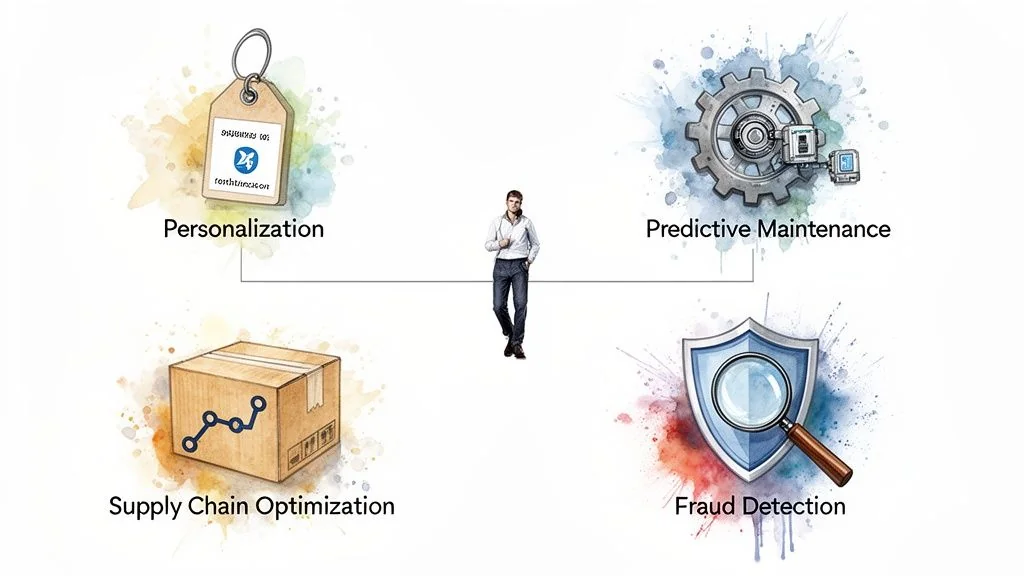
A data platform’s technical architecture matters only if it delivers business value. Four applications show the direct link most clearly: hyper-personalization in retail, predictive maintenance in manufacturing, supply chain optimization in logistics, and real-time fraud detection in financial services.
An effective data platform becomes the foundation for specific, high-impact business applications. It transitions from a passive data repository to an active engine for revenue generation, efficiency gains, and risk management.
Here are four concrete examples where a well-built platform translates directly into significant ROI.
Powering Hyper-Personalization in Retail
Today’s customers expect personalization. A Customer Data Platform (CDP), a specialized application built on a data platform, enables this. It ingests data from every customer touchpoint - website clicks, app usage, in-store purchases, support calls - to create a unified view of each individual.
This complete profile allows a retailer to move beyond generic marketing. They can deliver personalized product recommendations, timed promotions, and relevant content. The business outcome is a direct increase in customer loyalty, higher average order values, and reduced churn - which is why CDP spending has grown fast enough to become its own software category over the past several years.
By unifying disparate customer data streams, a CDP-powered data platform can identify high-value segments and predict which offers are most likely to convert. It turns raw data into a sales-driving asset.
Enabling Predictive Maintenance in Manufacturing
In manufacturing, unplanned downtime is a primary source of lost revenue. A single equipment failure can halt a production line, costing a company hundreds of thousands of dollars per hour. A data platform helps prevent this by enabling predictive maintenance.
The platform ingests and analyzes large streams of real-time sensor data from machinery, such as temperature, vibration, and pressure. Machine learning models running on the platform identify subtle anomalies that signal an impending failure, often weeks in advance. This allows maintenance teams to schedule repairs during planned downtime, avoiding costly emergencies. The business benefits are clear:
- Increased Asset Uptime: Equipment operates longer and more reliably.
- Reduced Maintenance Costs: Repairs are scheduled efficiently rather than as expensive emergencies.
- Improved Safety: Potential failures are identified before they create hazardous conditions.
Optimizing Supply Chains in Logistics
Logistics operates on thin margins, so efficiency directly determines profitability. A data platform provides the real-time visibility needed to manage complex supply chains. By integrating data from GPS trackers, warehouse management systems, weather forecasts, and traffic feeds, a company gains a live, comprehensive view of its entire operation.
This unified view powers analytics that can optimize truck routes to avoid delays, predict demand to prevent stockouts, and streamline warehouse workflows. For example, a logistics provider could automatically reroute a fleet to bypass a major traffic jam, saving fuel and ensuring on-time delivery. The result is a more resilient, efficient, and cost-effective supply chain.
Accelerating Fraud Detection in Financial Services
For financial institutions, combating fraud is a high-stakes, ongoing effort. Legacy rule-based systems are often too slow to detect sophisticated fraud patterns. A modern data platform changes this by enabling real-time fraud detection using advanced analytics and machine learning.
The platform can process millions of transactions per second, analyzing numerous variables - amount, location, time, and user behavior - to score the risk of each one instantly. High-risk activities can be automatically blocked or flagged for human review, stopping fraud before it occurs. This not only prevents direct financial losses but also protects the institution’s reputation and improves customer experience by reducing false positives.
How To Select The Right Data Platform Partner
Score prospective partners on four things: proven technical depth in your specific stack, relevant industry experience, a transparent delivery methodology, and the actual seniority of the team you’ll get - not the one in the pitch. Weight technical stack expertise and industry experience heaviest, since those are hardest to fake convincingly.
Technology selection is only one part of a successful data platform initiative. The expertise of the implementation partner is often the deciding factor, which means looking past sales presentations to assess a firm’s actual capabilities - the step that de-risks the investment and prevents project failure.
The goal is not to find the cheapest hourly rate, but a strategic partner who can accelerate the timeline, avoid common technical pitfalls, and maintain focus on business value.
Look For Proven Technical Expertise
Your partner must have deep, demonstrable experience with your chosen technology stack. Do not settle for vague claims of “cloud expertise.” If you are building on Snowflake, they need a proven track record of successful Snowflake projects. The same applies to Databricks, Google BigQuery, or any other core platform technology.
Ask for specific, anonymized case studies and referenceable clients. Inquire about their team’s certifications and the complexity of past projects. Understanding the realities of collaborating with a Snowflake partner, for example, can be very revealing. This level of detail separates firms with genuine hands-on skill from those who simply display logos on their website.
A critical question to ask is about their migration experience. Have they successfully moved a company with a similar data footprint and complexity from a legacy system to your target platform? That’s a massive indicator of whether they can handle a high-stakes, challenging project.
Verify Industry And Domain Knowledge
A data platform for a retail company will be fundamentally different from one for a financial services firm with extensive regulatory requirements. A partner with industry knowledge understands the specific challenges, data sources, and compliance hurdles relevant to your business.
This expertise leads to a faster, more effective project because they are not learning your industry at your expense. They can recommend industry-specific data models, suggest relevant KPIs, and build a platform that addresses the questions your stakeholders care about.
- Retail: Look for experience with Customer Data Platforms (CDPs), personalization engines, and supply chain optimization.
- Finance: They need deep knowledge of fraud detection, risk modeling, and regulatory reporting like GDPR or CCPA.
- Manufacturing: They should be familiar with IoT sensor data, predictive maintenance models, and production line analytics.
Evaluate Their Delivery Methodology
Ask every potential partner to describe their project management process. A transparent, agile methodology is a positive indicator. It suggests a focus on iterative progress and continuous communication, delivering value in stages rather than attempting a high-risk “big bang” launch.
A clear methodology demonstrates discipline. It should define roles, outline communication cadences, and specify how scope changes are handled. If a firm cannot clearly articulate its project management process, it is a warning sign of potential disorganization and budget overruns. Our guide to data engineering consulting services breaks down what to expect from a well-run engagement.
Finally, insist on knowing who will be on the team. Beware of the “bait and switch,” where senior architects participate in the sales process but are replaced by junior developers after the contract is signed. Ask for the profiles of the actual team members who will be assigned to your project to ensure you are getting the experience you are paying for.
Evaluation Checklist for Data Engineering Partners
To make the selection process more objective, use this scoring checklist. It helps vendor management and procurement teams compare potential partners using a consistent framework. Score each firm during the evaluation to facilitate a more data-driven decision.
| Evaluation Criteria | Weighting (1-5) | Partner A Score | Partner B Score | Key Observations |
|---|---|---|---|---|
| Technical Stack Expertise | 5 | e.g., “Partner A has 12 Snowflake certifications, B has 3.” | ||
| Relevant Industry Experience | 5 | e.g., “Partner B showed 3 retail case studies, A had none.” | ||
| Data Migration Experience | 4 | e.g., “A migrated a larger, more complex legacy system.” | ||
| Project Delivery Methodology | 4 | e.g., “A’s agile process is well-defined; B’s is vague.” | ||
| Team Seniority & Composition | 4 | e.g., “Met the actual lead engineer from Partner B.” | ||
| Client References & Case Studies | 3 | e.g., “Reference call with Partner A’s client was glowing.” | ||
| Cultural Fit & Communication | 3 | e.g., “Partner B’s team felt more collaborative and direct.” |
After scoring each potential partner, tally the results. While the highest score is a strong indicator, also review the “Key Observations” column. Qualitative feedback and your team’s overall impression can be the deciding factor between two closely-matched firms.
Planning Your Data Platform Journey
Implementing a data platform is a journey, not a single project. The best approach is a clear, deliberate plan that recognizes the different roles of various leaders.
The goal is to build momentum, demonstrate value quickly, and align the organization. This starts with strong executive sponsorship and a business case that ties every dollar of investment to a measurable outcome.
The Roadmap for CIOs and CTOs
As a CIO or CTO, your primary role is to define the high-level strategy and secure organizational alignment. You are responsible for building the organizational and financial foundation for the initiative.
-
Construct the Business Case: Frame the platform as an enabler of core business goals, not just a technology upgrade. For example, show how it could raise customer lifetime value or cut operational costs through predictive maintenance, then quantify the expected ROI against your own baseline numbers.
-
Secure Stakeholder Buy-In: Gain the support of other C-suite leaders. Walk the CFO through the financial model. Show the CMO how the platform will enable advanced personalization. Explain to the COO how it will drive operational efficiencies. Without this buy-in, securing budget and resources will be a struggle.
-
Define a Phased Implementation: Avoid a “big bang” rollout. Instead, lay out a multi-quarter roadmap. Start with a focused pilot project that can deliver a quick, high-impact win, then expand from there. This approach builds confidence and makes the overall investment more manageable.
The Action Plan for Heads of Data
As a data leader, your focus shifts from broad strategy to tactical execution. Your job is to translate the high-level vision into a concrete plan that your team can implement.
The most successful data platform projects begin with a laser focus on solving one specific, high-value business problem. Proving a quick win with a pilot project is the single best way to build momentum and secure funding for the broader initiative.
A methodical approach is essential. It ensures your team is prepared and that the first project delivers demonstrable value.
- Conduct a Current-State Analysis: Map your existing data sources, pipelines, and tools. Pinpoint the biggest bottlenecks and pain points - these represent the best opportunities for an early win.
- Identify a High-Value Pilot Project: Do not try to solve every problem at once. Select a single project with a clear business owner and trackable metrics. A good example is creating a unified customer view for the marketing team to improve campaign targeting. It is visible, valuable, and achievable.
- Prepare Your Team for New Workflows: A modern data platform changes how people work. Plan to upskill your team on new tools like Snowflake or Databricks. Define new governance processes and introduce concepts like data-as-a-product to foster ownership.
Frequently Asked Questions About Data Platforms
Common questions that come up when planning a major data platform initiative, drawn from what CIOs, data leaders, and procurement teams ask most often.
What’s the Real Difference Between a Data Platform and a Data Warehouse?
A traditional data warehouse is a component for storing and analyzing structured data, primarily for business intelligence reports. It is a highly organized archive.
A modern data platform is a complete ecosystem that manages the entire data lifecycle. It ingests, stores, processes, and serves all data types - structured and unstructured - to support a wide range of applications, from BI and analytics to data science and machine learning.
In short, a data warehouse is a critical part of a data platform, but it is not the entire system.
How Long Does It Actually Take to Implement a Modern Data Platform?
The timeline depends on the scope. A focused proof-of-concept for a single business unit can be implemented and deliver value in as little as 3-6 months.
A full, enterprise-wide rollout is a more extensive undertaking. A complete migration and modernization project is a strategic initiative that often takes 12-24 months or longer.
The recommended approach is to implement in phases, aiming for small, incremental wins that deliver value along the way. An experienced partner can often meaningfully shorten these timelines by drawing on prior implementations and avoiding common pitfalls.
Should We Build Our Own Platform or Buy a Managed Solution?
This is the classic “build vs. buy” decision, and there is no single correct answer.
Building a platform from scratch using open-source tools provides maximum control and customization. However, it requires a large, specialized, and expensive internal team for both initial development and ongoing 24/7 maintenance.
Buying a managed cloud platform from a vendor like Snowflake or Databricks significantly reduces the infrastructure management burden and accelerates time-to-value. For most companies, a hybrid approach is optimal: use a managed platform for the core foundation and work with expert partners to build the custom data pipelines and applications that provide a unique competitive advantage.
A data platform’s architecture only pays off once data actually moves through it reliably. If you’re still working out the mechanics of that movement, start with our guide to data pipelines, then compare the modern data stack against your current tooling, and see how data warehouses stack up against data lakes if you’re deciding where structured reporting should live inside the broader platform.
- Part of our guide: Data Pipeline Architecture →

Researched & written by
Peter Korpak , Chief Analyst & Founder
Data-driven market researcher with 20+ years in market research and 10+ years helping software agencies and IT organizations make evidence-based decisions. Former market research analyst at Aviva Investors and Credit Suisse.
Previously: Aviva Investors · Credit Suisse · Brainhub · 100Signals
- Algoscale200 people · unverified
Data engineering and analytics; distributed data processing
Listed, not reviewed - DataArt3000 people · unverified
Custom software development with data engineering; European nearshore
Listed, not reviewed - Dataroots50 people · unverified
AI-driven data engineering and MLOps implementation
Listed, not reviewed
More in Data Pipeline Architecture
A Leader's Guide to Apache Spark Optimization: Moving Beyond Quick Fixes
A practical framework for Apache Spark optimization: diagnosing the real bottleneck, tuning shuffle partitions and executor sizing, and choosing code fixes that cut runtime and cloud cost.
Data Contracts in Data Engineering: A Guide for Engineering Leaders
Explore data contracts in data engineering to enforce agreements, prevent pipeline failures, and boost data reliability across Snowflake and Databricks.
10 Actionable Data Pipeline Testing Best Practices for 2026
Discover 10 actionable data pipeline testing best practices. This guide covers everything from unit tests to chaos engineering for modern data stacks.