The CIO's Guide to Master Data Management Consulting
Your organization’s most critical initiatives—AI-driven personalization, supply chain optimization, and cloud-scale analytics—depend on a single, trusted source of truth for customer, product, and supplier data. When this master data is fragmented and inconsistent, these projects fail. Master data management (MDM) consulting is the discipline of building the systems and governance to fix this fragmentation, creating a unified data asset that drives business outcomes.
An MDM engagement is not a data-cleansing project; it’s an engineering initiative to build a lasting data infrastructure. For engineering leaders, selecting the right consulting partner and architectural approach is a high-stakes decision that directly impacts the ROI of your entire data strategy.
When to Engage an MDM Consulting Firm
You bring in MDM consultants when the cost of poor data quality becomes an undeniable drag on operations and a blocker for strategic goals. The market reflects this urgency; projected to grow from $11.3 billion to over $27.9 billion by 2025, the demand for MDM solutions is accelerating. This is not driven by IT wanting cleaner databases, but by business leaders demanding reliable data to compete.
Look for these specific trigger points within your organization:
- Failed or Stalled Strategic Initiatives: Your new CRM, ERP, or e-commerce platform fails to deliver expected value because it’s running on inconsistent customer or product data.
- Inability to Generate a 360-Degree View: Your marketing, sales, and service teams operate with conflicting customer records, making personalization impossible and frustrating customers.
- High Operational Overhead: Your teams spend an excessive amount of time manually reconciling data between systems, leading to errors in fulfillment, billing, and reporting. According to market analysts like Precedence Research, poor data quality costs the average firm $12.9 million annually.
- Compliance and Security Risks: You cannot demonstrate a clear data lineage for critical data elements, exposing the business to risks under regulations like GDPR and CCPA.
An MDM consulting engagement directly addresses these problems by implementing a centralized hub and a governance framework to create and maintain a “golden record” for each core business entity.
The Engineering Value of MDM
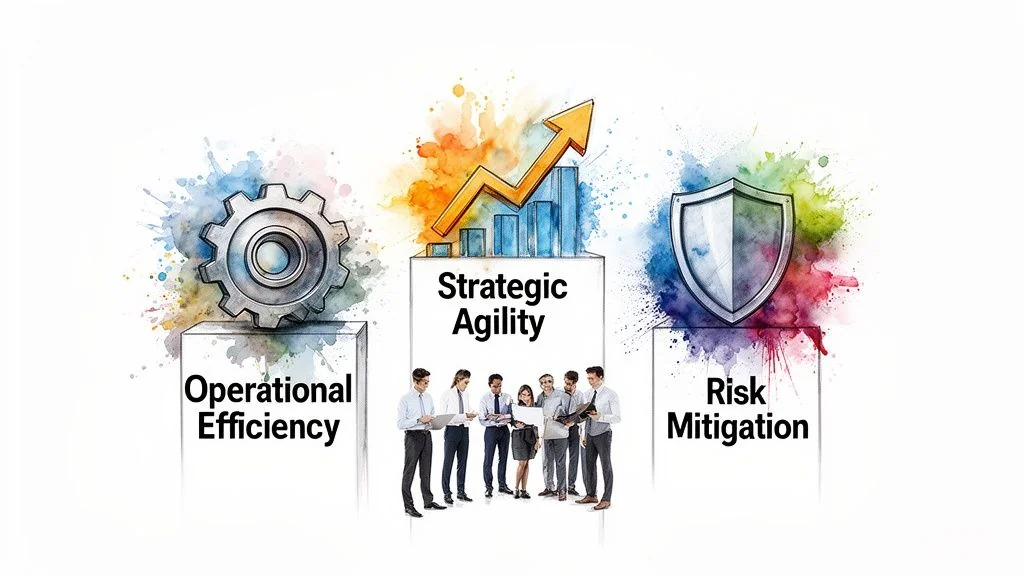
For a CTO or VP of Engineering, the value proposition is straightforward: MDM creates a stable, reliable data foundation for the entire tech ecosystem.
- Decouples Systems: A central MDM hub decouples point-to-point integrations. Instead of dozens of fragile connections, systems subscribe to the master record, simplifying architecture and reducing maintenance.
- Accelerates Analytics and AI: Clean, consolidated master data is the prerequisite for trustworthy analytics. BI platforms and AI models fed by a master data source produce more accurate and reliable outputs, faster.
- Enforces Governance Programmatically: An MDM platform operationalizes your data management services by enforcing data standards, validation rules, and ownership workflows directly within the tool.
MDM consulting moves your organization from a reactive state of fixing data errors to a proactive state of preventing them at the source, turning data from a liability into a strategic asset.
MDM Consulting Costs, Timelines, and Deliverables
Engagements are priced based on scope, complexity, and duration. According to DataEngineeringCompanies.com’s analysis of 86 data engineering firms, you can benchmark your budget against these typical project structures.
1. Strategic Advisory & Roadmap (2-4 months, $75k - $150k)
This is a blueprinting engagement for organizations that know they have a problem but need a clear plan. The focus is on building the business case and technical roadmap.
- Decision: “Which data domain should we tackle first, and what is the expected ROI?”
- Core Deliverables:
- MDM Readiness Assessment: An audit of a target data domain (e.g., Customer) identifying sources, quality issues, and business impact.
- Business Case & ROI Analysis: A financial model quantifying the cost of inaction vs. the expected benefits from operational savings and revenue uplift.
- Data Governance Charter: A foundational document defining data ownership, stewardship roles, and decision-making processes.
- Platform Shortlist & TCO Model: An unbiased recommendation of 2-3 MDM platforms (Informatica, Semarchy, Profisee) with a Total Cost of Ownership analysis.
2. Single-Domain Implementation (6-12 months, $150k - $400k)
This is the most common engagement model, focused on deploying an MDM platform for a single, high-value domain like Customer or Product.
- Decision: “How do we build, configure, and integrate an MDM hub to create a golden record for our customers?”
- Core Deliverables:
- Configured MDM Platform: A production-ready installation of the chosen MDM software in your cloud environment (AWS, Azure, GCP).
- Technical Data Model: The canonical schema for the master data entity.
- Integration Pipelines: Data pipelines built to ingest data from source systems into the MDM hub and syndicate the golden record to downstream consumers.
- Match, Merge & Survivorship Rules: The implemented business logic that identifies duplicates and programmatically creates the single source of truth.
- Data Stewardship Workflows: Configured UIs and processes for data stewards to manage exceptions and manual reviews.
3. Managed Services (Ongoing Retainer, $15k - $50k+/month)
After go-live, this model provides ongoing operational support for companies without a dedicated internal MDM team.
- Decision: “How do we ensure the MDM platform continues to deliver value and data quality remains high without hiring a full-time team?”
- Core Deliverables:
- Platform Monitoring & Maintenance: Proactive management of the MDM environment.
- Data Quality Reporting: Regular dashboards showing key metrics like match rates, completeness, and accuracy.
- Data Stewardship-as-a-Service: Execution of daily data stewardship tasks, such as resolving duplicates and validating new records.
The value of an MDM initiative is realized across key data domains, each solving a different business problem.
| Data Domain | Business Problem Solved | Key Metrics Impacted | Engineering Benefit |
|---|---|---|---|
| Customer Data | Inconsistent cross-channel experiences | Customer Lifetime Value (CLV), Churn Rate | A stable customer ID for all analytics. |
| Product Data | Slow time-to-market, high return rates | Product Launch Cycle Time, Order Accuracy | A single source of truth for e-commerce and ERP systems. |
| Supplier Data | Inefficient procurement, supply chain risk | Procurement Costs, Supplier Onboarding Time | Streamlined vendor management and risk assessment. |
| Location Data | Poor asset and territory management | Asset Utilization, Sales Territory Performance | Optimized logistics and sales operations. |
Choosing the right engagement model depends entirely on your organization’s maturity. Start with a strategic advisory project if the business case isn’t clear; move directly to implementation if the pain is well-defined and a budget is allocated.
Evaluating MDM Consulting Partners: An Actionable Framework
Selecting the wrong partner is the leading cause of MDM project failure. A glossy presentation is not evidence of capability. Engineering leaders must enforce a structured evaluation process that forces firms to prove their expertise.
Use this four-pillar framework to assess potential partners. A top-tier firm will provide concrete evidence in all four areas.
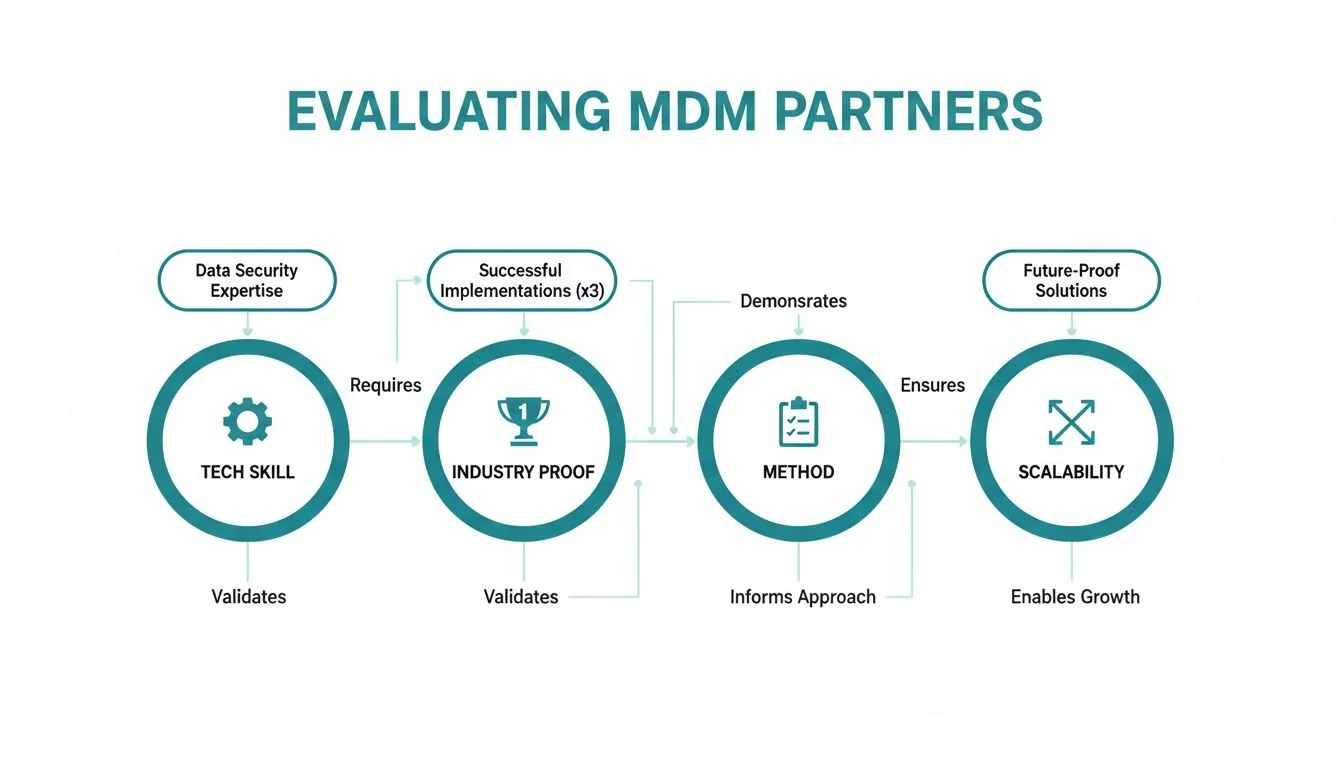
MDM Consulting Partner Evaluation Checklist
| Evaluation Criterion | Weight (1-5) | Questions to Ask | Red Flags to Watch For |
|---|---|---|---|
| Technical & Platform Expertise | 5 | Show us your team’s certifications for Informatica, Semarchy, or Profisee. Describe a complex data integration you built between an MDM hub and a legacy system. | Outdated certifications. Answers that are generic and not platform-specific. Inability to discuss cloud-native architecture (AWS, Azure, GCP). |
| Verifiable Industry Experience | 5 | Provide two case studies from our industry (e.g., Fintech, Healthcare). How have you handled industry-specific data standards and compliance needs? | Case studies are from unrelated industries. The team is unfamiliar with your domain’s regulations and terminology. A “one-size-fits-all” pitch. |
| Implementation Methodology | 4 | Walk us through your methodology for a single-domain MDM implementation. How do you define and operationalize a data stewardship program? | No documented methodology. A rigid, waterfall-only approach. Data governance is treated as a “Phase 2” item. |
| Strategic Vision & Scalability | 4 | How does this initial project set the foundation for a multi-domain enterprise MDM program? How will you measure and report on business ROI, not just technical metrics? | The proposal focuses only on the initial implementation. Success metrics are purely technical (e.g., “number of records matched”). |
| Team & Culture | 3 | Can we interview the proposed project lead and technical architect? How do you manage scope changes and technical disagreements? | A “bait-and-switch” where senior partners sell the deal, but junior staff deliver it. Poor communication during the evaluation process. |
The Litmus Test Question: “Describe your process for designing, testing, and implementing survivorship rules for a customer golden record.”
A partner with hands-on experience will describe a detailed, iterative process involving business stakeholder workshops, rule configuration in a sandbox, and quantitative testing. A weak partner will give a textbook definition. Their answer reveals their true level of expertise. A long-term tech partnership model is often preferable to a project-based approach, ensuring knowledge retention and strategic alignment as you scale from one domain to many.
MDM Architecture and Modern Data Stack Integration
The architectural pattern you select determines how data flows and where authority lies. An experienced master data management consulting partner will guide you to the right pattern for your goals, not just the one they know best.
The Four MDM Architectural Patterns
- Registry Style: The MDM hub acts as an index, maintaining unique identifiers and pointing to master data in source systems without moving it. It identifies duplicates but doesn’t create a central golden record. Use Case: Initial data discovery in complex, locked-down legacy environments.
- Consolidation Style: Data is copied from source systems to the MDM hub, where it is matched, cleansed, and consolidated into a golden record. This hub then becomes the source of truth for analytics and reporting. Use Case: Powering a data warehouse or BI platform with clean data.
- Coexistence Style: This pattern does everything the consolidation style does but also synchronizes the cleansed golden record back to the original source systems, gradually improving their data quality over time. Use Case: Improving both analytics and operational data quality simultaneously.
- Transactional Style: The most authoritative pattern. The MDM hub becomes the system of entry for all new master data. All new customer or product records are created directly in the hub, ensuring 100% quality and consistency from inception. Use Case: Mature organizations aiming for complete control over master data creation.
Integrating MDM with Snowflake, Databricks, and dbt
In a modern data stack, the MDM platform is an upstream, authoritative source. Its primary function is to feed clean, deduplicated, and enriched master data to your cloud data platform, whether it’s Snowflake or Databricks.
The integration pattern is direct:
- Source system data (e.g., Salesforce, NetSuite) is ingested into the MDM hub.
- The MDM platform applies matching and survivorship rules to create and maintain the golden record (e.g.,
dim_customer_master). - This master dimension table is replicated to a dedicated schema in your data warehouse.
- Data transformation models built in tools like dbt join transactional data against this master dimension, ensuring all analytics are built on the single source of truth.
This architecture prevents analysts from having to perform ad-hoc customer deduplication in their queries, which is inefficient and error-prone. The MDM system centralizes this logic, guaranteeing consistency for all downstream data consumers. Your consulting partner must have demonstrable experience building these specific integration pipelines into modern cloud data platforms.
Launching Your First MDM Initiative: A 3-Step Plan for Engineering Leaders
To ensure a successful engagement, you must prepare before the consultants arrive. A disciplined approach prevents scope creep and anchors the project to tangible business value.
Step 1: Define the Problem and Build the Business Case
Do not boil the ocean. Select one high-impact data domain—typically Customer or Product—where poor data quality creates the most friction. Quantify the business pain. Document the operational costs (e.g., hours spent on manual reconciliation), lost revenue (e.g., failed marketing campaigns), or compliance risks. This document is not an IT request; it is a business plan that will justify the investment and guide every decision.
Step 2: Create a Focused Vendor Shortlist
Use industry-specific directories and analyst reports to identify 3-5 potential consulting partners. Your primary filter must be verifiable experience in your industry (e.g., Retail, Fintech, Healthcare) and with your target tech stack (e.g., Azure + Profisee). Generalist firms without domain expertise introduce significant risk.
Step 3: Issue a Value-Based Request for Proposal (RFP)
A strong RFP forces vendors to demonstrate strategic thinking, not just technical knowledge. It should include:
- Your business case and the quantified pain points.
- A clear definition of the initial project scope (the single data domain).
- Questions that probe their methodology, governance approach, and experience with ROI measurement.
Use a structured RFP checklist to ensure you ask the right questions. This level of preparation shifts the dynamic, allowing you to lead the evaluation process and select a partner who will deliver measurable results.
Your MDM Consulting Questions, Answered
What is the difference between Master Data Management and Data Governance?
Data Governance is the framework of rules, roles, and processes for managing all data assets. It’s the “constitution.” A data governance consultant helps you write the laws.
Master Data Management (MDM) is the specific technology and discipline used to enforce those laws for your most critical data (customer, product, etc.). It’s the “court system” that actively creates and maintains the single source of truth. You cannot have effective MDM without governance, but MDM is the implementation that delivers tangible business value from that governance.
How much does an MDM consulting project cost?
Based on DataEngineeringCompanies.com’s analysis of 86 data engineering firms, budget ranges are predictable:
- Single-Domain Proof-of-Concept / Implementation: $150,000 to $400,000. This focuses on one domain (e.g., “Customer”) to prove business value quickly.
- Full Enterprise Multi-Domain Implementation: $750,000+. This is a large-scale transformation program that integrates multiple master data domains across the enterprise.
Key cost drivers include the number of source systems, the initial data quality, and the complexity of the business rules for survivorship. Most organizations see a clear return on this investment within 18-24 months.
Should we use an on-premises or cloud MDM solution?
For nearly all use cases, a cloud-native SaaS MDM platform is the superior choice. Cloud platforms offer faster time-to-value, lower TCO, better scalability, and seamless integration with modern data stacks like Snowflake and Databricks.
On-premises solutions are only viable for organizations with extreme data residency requirements or security policies that prohibit cloud usage. This choice comes with significant trade-offs: higher capital expenditure, longer implementation cycles, and a permanent need for a specialized internal team to manage the infrastructure. If your data ecosystem lives in AWS, Azure, or GCP, a cloud MDM platform is the logical, future-proof decision.
Ready to find a partner with the right expertise for your MDM initiative? DataEngineeringCompanies.com offers pre-vetted shortlists of top firms, transparent cost data, and actionable frameworks to help you choose with confidence. Use our free 60-second vendor match quiz to get started.
Data-driven market researcher with 20+ years in market research and 10+ years helping software agencies and IT organizations make evidence-based decisions. Former market research analyst at Aviva Investors and Credit Suisse.
Previously: Aviva Investors · Credit Suisse · Brainhub · 100Signals
Top Data Engineering Partners
Vetted experts who can help you implement what you just read.
Related Analysis
A Pragmatic Guide to Data Engineering Project Management
Master data engineering project management with this playbook. Learn proven strategies for on-time delivery of complex data pipelines and cloud platforms.
The Engineering Leader's Guide to Supply Chain Data Platforms
Explore expert supply chain data engineering strategies for resilient pipelines, modern architecture, and data platform selection for Snowflake and Databricks.
Data Contracts in Data Engineering: A Guide for Engineering Leaders
Explore data contracts in data engineering to enforce agreements, prevent pipeline failures, and boost data reliability across Snowflake and Databricks.