The Engineering Leader's Guide to Supply Chain Data Platforms
Supply chain data engineering is the work of replacing batch-processed, siloed analytics with pipelines that pull ERP, WMS, TMS, and IoT data together in close to real time, model it around a single source of truth, and serve it fast enough for forecasting, ETA, and inventory systems to act on. Legacy setups built for a predictable world can’t do this: when a container is delayed or demand spikes, data that’s a day old is already wrong, and the result is stockouts, bloated safety stock, and delivery estimates that are really just guesses.
Real-time work like this is a specialty, not a given capability every firm has. Only 15 of the 86 firms profiled in the Data Engineering Companies Index list streaming or Kafka experience, which narrows the field fast if IoT and ETA pipelines are actually what you’re hiring for. This guide covers platform architecture, the Snowflake vs. Databricks decision, data governance and MDM, the analytics use cases that pay off first, and how to evaluate a consulting partner.
Why do legacy supply chain analytics systems fail?
Legacy analytics setups, typically pulling from a monolithic ERP or Warehouse Management System (WMS), can’t keep up with the volatility of modern supply chains. That failure shows up in three places:
- Increased Stockouts: Inability to detect real-time demand surges means you cannot adjust inventory levels fast enough, leading to empty shelves and lost revenue.
- Inflated Inventory Costs: To buffer against uncertainty from poor data, you hold excess “just in case” stock. This ties up working capital and erodes profit margins.
- Inaccurate Delivery ETAs: Without a live, end-to-end view of logistics, delivery estimates are guesswork. This damages customer trust and operational efficiency.
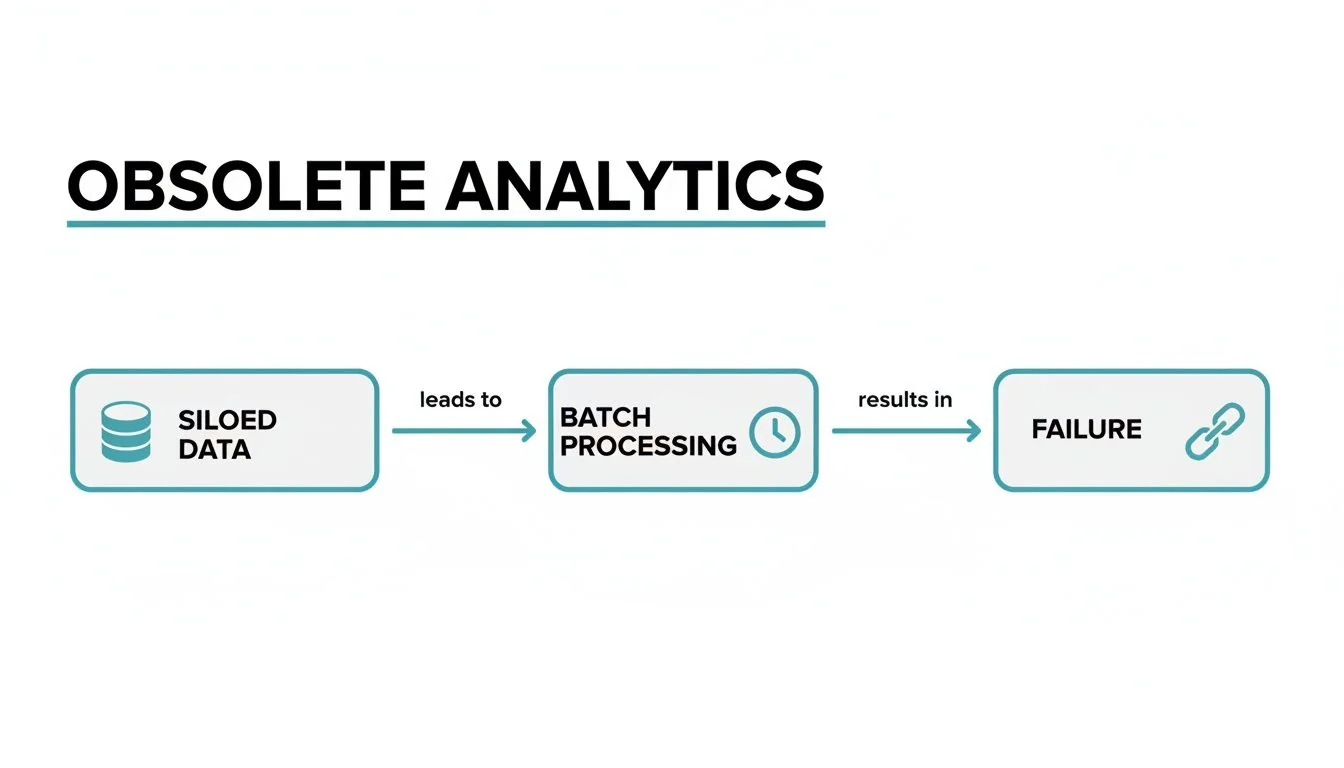
The outdated flow, where siloed data sits trapped in slow, overnight batch jobs, creates the blind spots behind these failures. A modern data platform replaces it with a unified, near real-time engine, shifting the team from firefighting to proactive, data-driven decisions.
What does a modern supply chain data platform architecture look like?
A modern supply chain data platform ingests data from your ERP, WMS, TMS, and IoT sensors, stores and transforms it in a lakehouse, and serves it to dashboards, forecasting models, and operational systems - each layer built to handle the data at the speed it actually needs to move.
Core Architectural Layers
Your platform’s architecture must handle the variety and velocity of supply chain data, selecting the right tool for each data source.
-
Ingestion: This layer acquires the data. For structured data from SaaS platforms and databases, automated tools like Fivetran provide efficiency. For high-volume, real-time streams from IoT devices or logistics feeds, a streaming platform like Apache Kafka or a cloud-native service like AWS Kinesis is necessary.
-
Storage and Transformation: Ingested data requires a flexible and powerful storage layer. A lakehouse architecture on a platform like Snowflake or Databricks is the current standard. It combines the raw storage capability of a data lake with the structured query performance of a data warehouse. Transformation is handled by tools like dbt (data build tool), which turns raw data into clean, analytics-ready models.
-
Serving: This is the final layer where clean data drives decisions. It powers dashboards in BI tools like Tableau, feeds predictive demand forecasting models, or pushes insights back into operational systems to trigger automated actions.
Your team’s ability to execute on this, from ingestion scripts to orchestration, determines how fast the platform goes from architecture diagram to production.
Snowflake or Databricks: which platform fits supply chain data engineering?
The choice usually comes down to two platforms, and it isn’t about which one is better in the abstract. It’s about which one matches your primary objective: Snowflake for a BI-centric strategy built on partner data sharing, or Databricks for an AI-first strategy built on custom modeling.
Platform Comparison for Supply Chain Use Cases
Snowflake and Databricks were built with different philosophies. Snowflake excels at SQL-based analytics and multi-enterprise data sharing. Databricks, born from Apache Spark, unifies data engineering and large-scale machine learning.
The following table provides an evaluation framework tailored for supply chain data engineering leaders.
| Criterion | Snowflake | Databricks | Leadership Recommendation |
|---|---|---|---|
| Primary Use Case | BI & Analytics: SQL-native, optimized for structured/semi-structured data analysis, reporting, and dashboarding. | AI/ML & Data Science: A unified platform for the entire machine learning lifecycle, from data prep to model deployment. | Choose Snowflake for a BI-centric strategy focused on enterprise-wide visibility. Choose Databricks for an AI-first strategy centered on custom modeling. |
| Multi-Party Data Sharing | Best-in-Class: Native Secure Data Sharing allows direct, secure data collaboration with suppliers, 3PLs, and retailers without data copies or ETL. | Good (Open Standard): Delta Sharing is an open protocol for sharing data, but lacks the integrated governance, marketplace, and ease-of-use of Snowflake’s feature. | For building a collaborative data ecosystem with external partners, Snowflake holds a significant architectural advantage. |
| Ease of Use & Adoption | Very High: Its fully managed service and familiar SQL interface reduce the barrier to entry for analysts and data-savvy business users. | Moderate to High: Requires specialized engineering skills (Spark, Python/Scala). The learning curve for non-engineers is steeper. | Snowflake enables faster time-to-value for teams with strong existing SQL skills. |
| Unstructured Data & ML | Improving: Snowpark and native unstructured data support are advancing but are not the platform’s core strength. Best for consuming ML outputs. | Excellent: The Lakehouse architecture is purpose-built to handle raw, unstructured data (images, text, sensor data) at scale for training ML models. | For advanced ML on diverse data types (e.g., computer vision for warehouse automation), Databricks is the superior choice. |
| Cost Model & Governance | Usage-Based: Separates storage and compute costs. This offers flexibility but requires diligent cost management to avoid unexpected bills. | Usage-Based (DBUs): Priced on Databricks Units (DBUs), which can be complex to forecast and optimize without deep expertise. | Both require strong governance. Snowflake’s model is generally easier for finance and operations teams to understand initially. |
The decision hinges on your strategic center of gravity. For organizations prioritizing a collaborative data hub for reporting and visibility across a partner network, Snowflake is the path of least resistance. Its data sharing capability is a meaningful advantage for supply chain ecosystems that depend on moving data across company lines.
Conversely, for organizations whose strategy relies on building proprietary, large-scale ML models using diverse data sets (e.g., predicting port congestion from satellite imagery), Databricks is the purpose-built platform. It provides a unified workspace for data engineers and data scientists to collaborate on complex AI applications.
The strategic question underneath this choice, storing data in a warehouse built for structured analytics versus a lake built for raw and unstructured data, is covered in more depth in data warehouse vs. data lake.
What data modeling and governance does supply chain analytics need?
Supply chain analytics needs two things working together: dimensional modeling to organize fact and dimension tables for fast querying, and Master Data Management (MDM) to create one authoritative record per product, customer, supplier, and location. Without MDM, “Supplier X, Inc.” in one system and “SuppX” in another get treated as different entities, and a basic question like total spend with a given supplier becomes unanswerable.
Data Modeling and MDM
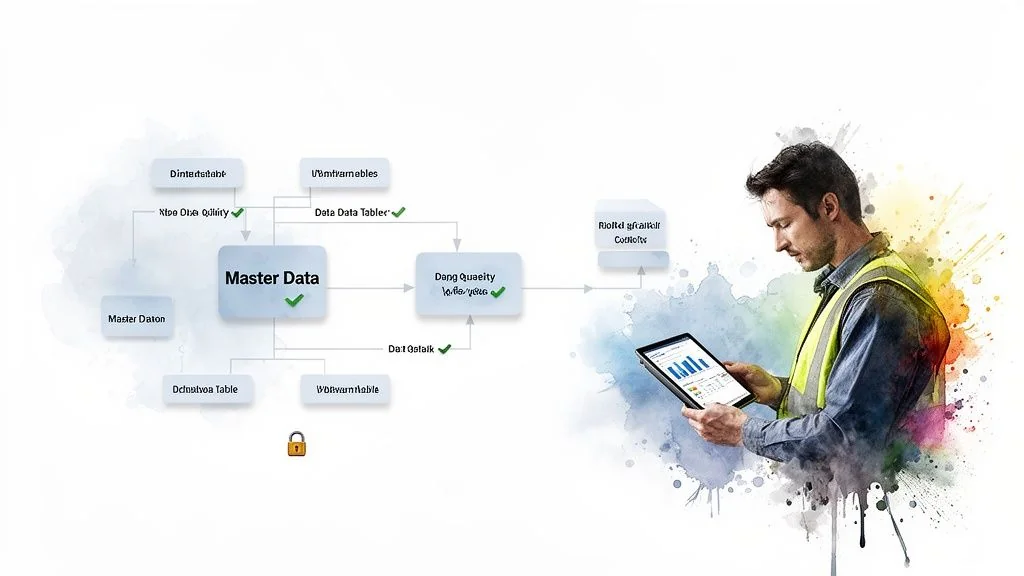
For supply chain analytics, dimensional modeling remains the most effective structure. It organizes data into “fact” tables (the numbers: order quantities, shipping costs) and “dimension” tables (the context: product, customer, location, time). This structure is highly optimized for fast querying by BI tools.
Master Data Management (MDM) is not optional. Core business entities like Product, Customer, Supplier, and Location exist in dozens of disconnected systems. MDM’s objective is to create a single, authoritative “golden record” for each, establishing the source of truth an enterprise-wide view depends on.
A Phased Framework for Data Governance
Implementing a massive, top-down governance plan is a recipe for failure. A pragmatic, phased approach delivers value quickly and builds organizational momentum.
- Phase 1: Assign Ownership & Establish Baselines. Assign clear owners for critical data domains (e.g.,
Product,Logistics). Implement automated data quality checks within your pipelines to measure completeness, accuracy, and timeliness. You cannot improve what you do not measure. - Phase 2: Implement Access Controls. Define and implement role-based access controls (RBAC) to ensure users only access data relevant to their function. This is essential for securing sensitive commercial data and ensuring regulatory compliance.
- Phase 3: Automate & Scale. Embed governance rules directly into your data pipelines using tools like dbt. This transitions governance from manual spot-checks to automated, preventative enforcement, ensuring all new data conforms to standards from the moment of ingestion.
See data governance best practices for a fuller framework behind these three phases.
Which analytics and ML use cases deliver the most value?
Data engineering earns its return by moving supply chain analytics from descriptive reporting (what happened) to predictive and prescriptive use cases: demand forecasting that blends external signals, real-time ETA prediction from IoT and TMS feeds, and digital twins that stress-test the network before a disruption hits.
Predictive Demand Forecasting
Traditional forecasting based on historical sales is insufficient. A modern approach integrates external signals, including weather data, economic indicators, social media trends, and competitor promotions, to build a more accurate picture of future demand.
- Engineering Requirement: Building reliable pipelines to ingest, clean, and integrate messy, diverse external data sources. The engineering team must also build a feature store to make these signals (e.g., a specific weather pattern) reusable across multiple ML models. Platforms like Databricks are a natural fit due to their strength in handling unstructured data and integrated ML tooling.
Real-Time ETA Prediction and Inventory Visibility
This use case provides live answers to two critical questions: “Where is my inventory?” and “When will it arrive?” It fuses real-time GPS data from Transportation Management Systems (TMS) and IoT sensors with external data on traffic, weather, and port congestion to calculate an accurate Estimated Time of Arrival (ETA).
- Engineering Requirement: The platform must support low-latency stream processing to analyze data as it arrives. This requires expertise in streaming technologies like Apache Kafka or Amazon Kinesis. See stream processing vs. batch processing for how to decide which parts of the pipeline actually need to run in real time.
Network Optimization with a Digital Twin
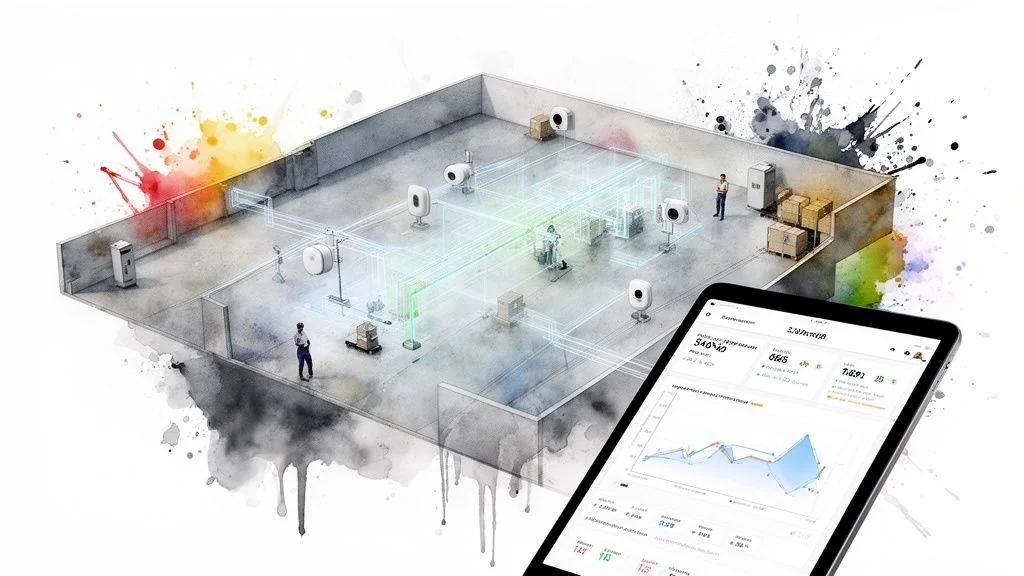
A digital twin is a virtual simulation model of your entire supply chain network. It allows you to run “what-if” scenarios to stress-test your network’s resilience against disruptions, such as a supplier shutdown, a blocked shipping lane, or a labor strike, before they occur.
- Engineering Requirement: The primary challenge is not the simulation itself, but the creation and maintenance of the complex, interconnected data model that mirrors physical reality. This is where Master Data Management (MDM) matters most. An inaccurate data foundation renders the digital twin useless.
How do you evaluate a supply chain data engineering consulting partner?
A qualified partner combines platform depth, verifiable supply chain domain experience, delivery discipline, and transparent rate cards. Test each with a specific question rather than trusting a capabilities slide deck.
1. Technical Depth and Platform Expertise
A qualified partner must have demonstrable experience across both streaming (e.g., Apache Kafka, Amazon Kinesis) and batch processing architectures. According to analysis by DataEngineeringCompanies.com of 86 data engineering firms, top-tier consultancies provide architectural blueprints from past projects on platforms like Snowflake or Databricks. Ask for them.
Vetting Question: “Show us an anonymized architecture diagram for a supply chain client where you integrated real-time logistics data with batch ERP data. Explain your choice of ingestion tools and transformation logic.”
2. Verifiable Supply Chain Domain Experience
Pure technical skill is insufficient. The partner must understand the nuances of supply chain data: the complexities of EDI feeds, TMS and WMS schemas, and metrics like inventory turns and landed cost.
Vetting Question: “Describe a project where you had to build a master data model for ‘Product’ using data from a client’s ERP, PIM, and WMS. What were the biggest data quality challenges and how did you resolve them?“
3. Delivery Discipline and Methodology
A vague project plan is a major red flag. The firm must operate with an agile methodology, clear sprint definitions, and transparent progress reporting.
Vetting Question: “Walk us through your process for managing a two-week sprint. What artifacts do you produce? How do you handle scope change or unforeseen technical debt discovered mid-sprint?“
4. Cost-Effectiveness and Rate Benchmarks
Focus on total cost of ownership and value, not the lowest hourly rate. An inexperienced, low-rate team often costs more in the long run due to rework and delays. A reputable partner provides transparent rate cards and realistic project cost forecasts tied to business value delivered.
Vetting Question: “Provide your rate card for the roles you propose for this project (e.g., Principal Data Engineer, Senior Consultant). What is your estimated timeline and cost for a 12-week MVP to establish a foundational data pipeline and two key BI dashboards?”
What are the first steps for engineering leaders to take?
Start with a rapid, honest data maturity assessment across four questions: integration, latency, source of truth, and analytics capability. Then translate the gaps into a business case tied to P&L impact, not technical tasks.
1. Conduct a Rapid Data Maturity Assessment
Before charting a course, establish your baseline. This is not a formal audit but a rapid, honest assessment. Convene your team and answer these questions:
- Data Silos: What is our “integration” between the ERP, WMS, and TMS? Is it an API or a manual CSV export?
- Data Latency: Is the data used for critical operational decisions hours, days, or weeks old? What is the business impact of that delay?
- Source of Truth: If we ask three different teams for “on-time delivery performance,” do we get three different numbers from three different reports?
- Analytics Capability: Are our analytics limited to historical reporting, or do we have any predictive capabilities in production?
The answers will define your problem statement and form the basis of your business case.
2. Build the Business Case and Assemble the Team
Frame the initiative in terms of business outcomes, not technical tasks. Connect platform investment directly to P&L impact. For example: “A 10% reduction in inventory carrying costs through improved forecasting,” or “A 15% reduction in expedited freight spend through real-time shipment tracking.”
The most powerful question to answer for the C-suite is: “What is the cost of doing nothing?” Quantify the financial impact of stockouts, excess safety stock, and manual reporting that your current state is already costing the business.
Simultaneously, prepare your organization for the required talent. Equip hiring managers with interview questions that specifically test for the skills needed to build these systems. When vetting partners, challenge them on their direct experience with messy supply chain data - their answers will quickly distinguish true experts from generalists.
Supply chain data engineering rewards specificity over generalist claims. DataEngineeringCompanies.com profiles firms by platform, capability, and industry vertical - browse the data engineering consulting firms directory or the retail data engineering hub to find partners who have actually built ERP-to-lakehouse pipelines, not just ones who say they can.
Researched & written by
Data-driven market researcher with 20+ years in market research and 10+ years helping software agencies and IT organizations make evidence-based decisions. Former market research analyst at Aviva Investors and Credit Suisse.
Previously: Aviva Investors · Credit Suisse · Brainhub · 100Signals
Vetted partners
Top Retail Partners
Vetted firms whose specialty matches this article.
More in Retail & E-commerce
A CTO's Guide to Ecommerce Data Engineering
Build a high-performance ecommerce data engineering architecture. Compare platforms, integration patterns, and vendor selection criteria for maximum ROI.
Top Data Engineering Managed Services for 2026
Compare leading data engineering managed services. Find models, pricing, & vendors. Use our RFP checklist to select your ideal Snowflake or Databricks partner.
Data Reliability Engineering A Guide for CTOs
Learn what Data Reliability Engineering (DRE) is, why it matters, and how to implement it. A complete guide for leaders evaluating data engineering partners.