A Pragmatic Guide to Data Engineering Project Management
Managing a data engineering project well comes down to five disciplines: define success in business terms before writing code, gate delivery through phases with real sign-offs, govern any outside consultancy as tightly as your own team, track velocity and cost together instead of separately, and treat risk as day-one work rather than a post-launch cleanup. Most data engineering projects that miss their deadline or blow through budget fail for one of these reasons, not because the engineering talent was weak.
This guide walks through the five-phase lifecycle for building a data platform, how to run an RFP and govern a consulting partner, the KPIs that actually predict whether a project is healthy, and a risk register you can adapt directly.
Why do data engineering projects fail?
Elite teams using platforms like Snowflake or Databricks still get derailed, and it is rarely a technical problem. The root cause is almost always a disconnect between engineering execution and a specific, agreed business outcome - a gap that shows up as scope creep, stakeholder disengagement, and budget overruns.
Anatomy of Failure: The Three Core Breakdowns
Data project failure follows a consistent pattern. These are the most common breakdowns engineering leaders must prevent.
- Unrealistic or Vague Scope: Projects that start with ambiguous goals (“modernize our analytics”) are the ones most likely to fail. Without a quantifiable, bounded scope, requirements shift continuously, and shifting requirements are what turn a project into rework and budget overruns. A tightly scoped Statement of Work is the first line of defense.
- Mismanaged Consulting Engagements: Engaging an external firm without disciplined oversight introduces significant risk. Ambiguous Statements of Work, inconsistent communication, and weak governance lead directly to misaligned priorities and uncontrolled budget expansion.
- Focus on Technology Over Business Value: Technical teams can become fixated on building a “perfect” or maximally scalable architecture. Stakeholders, however, measure success by tangible business results. A project that runs for months without delivering measurable value will lose executive support.
Projects that start without agreed success criteria are the ones most likely to blow through budget. Without a shared definition of “done,” scope keeps expanding, and cost follows it.
Common Failure Points in Data Engineering Projects and Their Solutions
These issues consistently derail data initiatives. This framework helps leaders identify and mitigate them proactively.
| Failure Point | Leading Indicator | Actionable Mitigation Strategy |
|---|---|---|
| Vague Business Requirements | Stakeholders use fuzzy terms like “better insights” or “modernize our data.” | Insist on quantifiable KPIs before any work begins. Translate business goals into specific data outcomes (e.g., “reduce report generation time from 4 hours to 15 minutes”). |
| Lack of Stakeholder Buy-In | Key business users repeatedly miss planning meetings or are slow to provide feedback. | Establish a formal project steering committee with defined roles and responsibilities. Schedule mandatory bi-weekly demos to maintain engagement and gather feedback. |
| Poor Source Data Quality | Engineers discover source data is incomplete, inconsistent, or undocumented mid-project. | Mandate a dedicated data audit and profiling phase during project discovery. Allocate 15-20% of the initial engineering timeline specifically for data cleansing and preparation. |
| ”Big Bang” Delivery Model | The project plan outlines a single, monolithic deployment after 6-9 months of development. | Re-architect the project plan for agile, milestone-based delivery. Mandate the delivery of a usable, high-value data product every 4-6 weeks to build momentum and demonstrate value. |
| Technology-Driven Development | The team spends the first month debating tools (e.g., Airflow vs. Dagster) instead of user needs. | Freeze all technology decisions until the business requirements and core use cases are documented and signed off. The problem must define the tool, not the other way around. |
Recognizing these patterns is the first step. A structured project management framework that prioritizes quantifiable goals, incremental delivery, and continuous communication turns high-risk data initiatives into predictable, value-driven successes.
What does the five-phase lifecycle for a data platform build look like?
Monolithic, “big bang” data platform projects are a direct path to failure. Building a modern data platform requires an iterative methodology that delivers business value quickly and adapts to new information. The most successful data engineering initiatives follow a structured, five-phase lifecycle built specifically for cloud-native tools like Snowflake or Databricks.
The purpose of this framework is to prevent the common failure sequence of data projects.
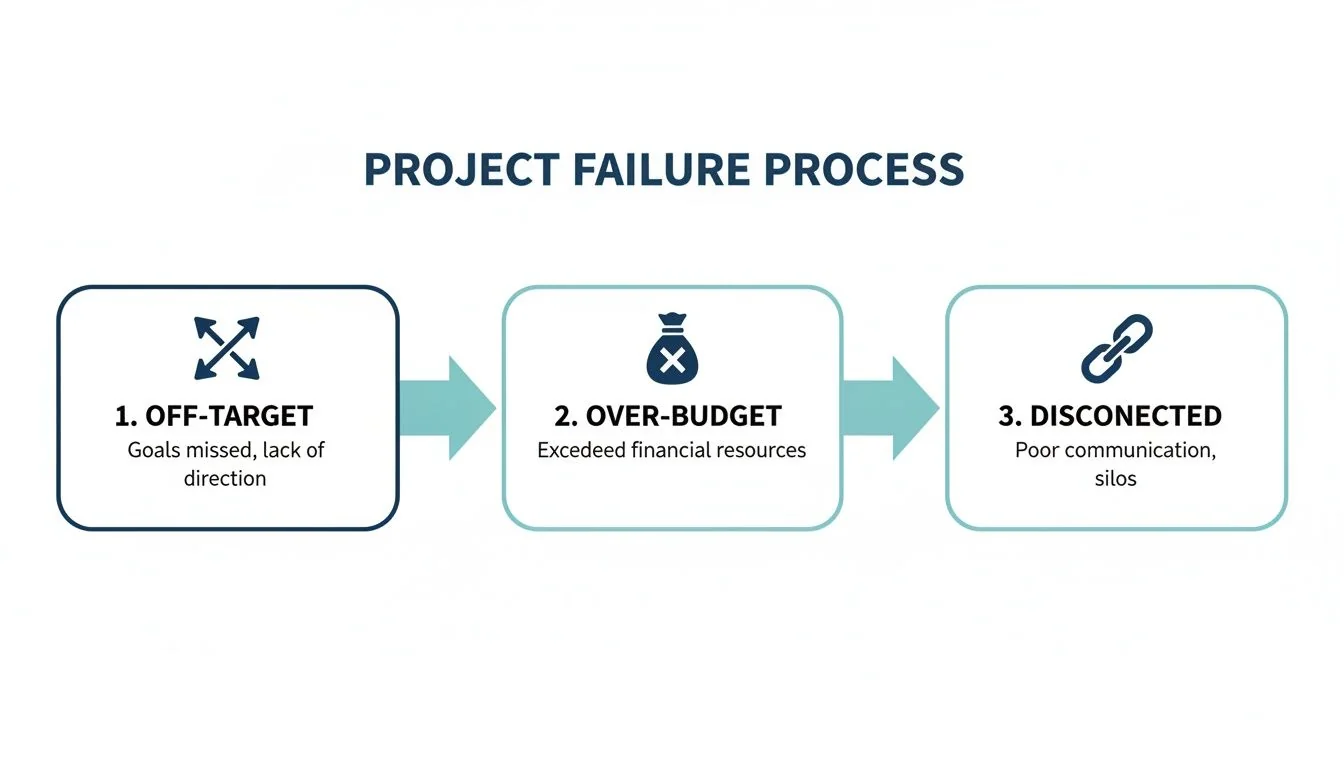
This outcome is avoidable by structuring work into gated phases. Each gate forces a critical alignment decision, so the project can’t proceed with a fundamental flaw baked in.
Phase 1: Discovery & Scoping (Weeks 1-4)
This phase translates vague business requests into a concrete, prioritized backlog. No code is written.
- Key Activities: Conduct stakeholder interviews to define specific business questions. Sketch a high-level entity-relationship diagram (ERD). Draft a Success Criteria Document defining quantifiable outcomes (e.g., “reduce customer churn analysis time from 3 days to 2 hours”).
- The Gate: This phase is not complete until business sponsors formally sign off on the prioritized use cases and their associated KPIs. This is the primary defense against building a platform no one uses.
Phase 2: Architectural Design (Weeks 5-6)
With a clear “what,” the team defines the “how.” This is where defensible technology choices are made based on the defined use cases, not trends.
- Key Deliverables: Produce a detailed technical design document specifying data flows, modeling layers, and CI/CD strategy. A mandatory component is a total cost of ownership (TCO) analysis comparing at least two viable platform options (e.g., Snowflake vs. Databricks) based on projected workloads and data volume.
- The Gate: The project does not proceed until the TCO is approved and the architectural design is signed off by the lead architect or VP of Engineering.
Phase 3: Iterative Build (Sprints, Weeks 7-20)
The project shifts into an agile execution rhythm. The team works in short sprints (typically two weeks) to build, test, and deliver functional components of the platform.
- Typical Cycle: Ingest a new data source, apply business logic with a tool like dbt, and expose the curated data mart for analyst use. Each cycle must produce a testable, usable output.
- The Gate: Each sprint concludes with a demo to stakeholders. The sprint is not “done” until the acceptance criteria for its user stories are met.
Phase 4: User Acceptance & Deployment (Weeks 21-22)
Moving from development to a stable production environment requires a dedicated process. This is about building a reliable, automated pipeline for code promotion.
- Core Activities: Configure CI/CD pipelines to automate testing and deployment. Conduct formal User Acceptance Testing (UAT) with business users. Finalize operational runbooks and on-call schedules.
- The Gate: The platform is not “live” until UAT is passed and the operations team formally accepts the handover documentation.
Phase 5: Optimization & Governance (Ongoing)
The project is not “done” at launch. It transitions into a continuous loop of monitoring, cost management, and enhancement based on real-world usage.
- Ongoing Tasks: Implement automated alerts for query performance degradation and budget anomalies. Fine-tune cloud spend based on usage patterns. Evolve data models to support new business requirements. This ongoing iteration is the core of effective data engineering project management.
How do you select and manage a data engineering consultancy?
Selecting a consulting partner is the highest-leverage decision an engineering leader makes on a data project. The right firm accelerates your roadmap by years; the wrong one consumes budget and delivers technical debt. The goal of an RFP is to cut through sales pitches and identify partners with proven, relevant expertise.

The evaluation process starts with a technically rigorous Request for Proposal. A well-structured RFP functions as a technical screen - it should force every firm, including any of the 86 profiled in the Data Engineering Companies Index, to demonstrate expertise instead of just claiming it. Our RFP checklist turns the scenario-based questions below into a document you can send out this week.
Structuring a Technically Rigorous RFP
Your RFP is a technical interview for an entire company. It must force prospective partners to demonstrate expertise, not just claim it.
- Technology-Specific Scenarios: Do not ask, “Do you have experience with Airflow?” Instead, provide a scenario: “Describe how you would design an idempotent and backfill-capable data pipeline using Airflow to process 1TB of daily event data from S3. What specific operators would you use and how would you manage state?”
- Architectural Trade-offs: Force a defensible position. For example: “Given our requirement for sub-second query latency on 10TB of nested JSON data, argue for either Snowflake or Databricks with Delta Lake. Your justification must include a TCO comparison for a 12-month period, factoring in compute, storage, and egress costs.”
- dbt Best Practices: Test their modeling discipline. Ask: “Provide a sample
dbt_project.ymland directory structure for a multi-layered data model (staging, intermediate, marts). How do you enforce data quality tests and documentation standards within this framework?”
From Contract to Kickoff: Establishing Governance
Once a partner is selected, the focus must shift immediately to governance. An ambiguous Statement of Work is an invitation for scope creep. The SOW must be airtight, with explicit deliverables, timelines, and quantitative acceptance criteria for each project phase.
From day one, establish a firm communication rhythm:
- Weekly Technical Syncs: For the core project team to resolve technical blockers and review progress at a granular level.
- Bi-Weekly Steering Committee: For executive sponsors and consultancy leadership to review budget vs. actuals, track major milestones, and ensure continued alignment with business goals.
This dual-track governance model maintains both tactical momentum and strategic alignment, so the partner you selected actually delivers what they promised.
Which KPIs actually measure data engineering project success?
Vanity metrics like “tasks completed” are insufficient for managing data engineering projects. Leaders need clear signals on project velocity, financial health, and business impact - a multi-faceted measurement framework, not a single number.
Engineering Velocity and Predictability
These metrics measure the engineering team’s throughput and process efficiency.
- Sprint Velocity (Predictability over Volume): The goal is not the highest number of story points, but a stable, predictable velocity. Consistency indicates the team has hit a sustainable pace, allowing for reliable forecasting of delivery dates.
- Cycle Time: This measures the wall-clock time from when a task begins to when it is deployed to production. A decreasing cycle time is a strong indicator of improving process efficiency and bottleneck removal.
Financial Discipline and Cloud Cost Control
Financial oversight is non-negotiable.
- Budget vs. Actual: This must be tracked monthly, comparing planned spend for both consulting services and cloud platforms (AWS, GCP, Azure) against actual consumption.
- Cloud Cost per Environment: Total cloud spend is an incomplete metric. Break down costs by environment (dev, test, prod) to identify waste, such as oversized or idle development resources.
Business Value and ROI
This is the ultimate measure of project success and justifies future investment. For a fuller framework on tying platform work to dollar figures, see our guide to measuring data engineering ROI.
- Data Uptime & SLA Adherence: Track the percentage of time critical datasets are available and meet quality standards. If you promise the finance team 99.95% uptime for their end-of-quarter reporting data, this metric proves you are delivering.
- Query Performance Improvement: This provides a tangible metric of success. Example: “The new data model reduced the P95 query time for the executive sales dashboard from 90 seconds to 5 seconds.” This is a clear win to report to stakeholders.
A Framework for Cloud Cost Control
Runaway cloud spend can derail a project. An effective cost control strategy is multi-layered, and it starts before the platform goes live: cost controls built in during the design phase are far cheaper to enforce than a post-launch cleanup, which usually means untangling months of untagged, oversized resources.
First, implement a mandatory resource tagging policy. Every resource must be tagged with project, environment, and owner. This is non-negotiable and provides immediate visibility for cost allocation. Couple this with automated budget alerts that notify stakeholders when spending crosses 75% of the monthly forecast.
Second, integrate cost control into the architecture. When using a platform like Snowflake, this means selecting the correct virtual warehouse size for each workload (do not default to Large) and setting aggressive auto-suspend policies (e.g., 60 seconds). These are not suggestions; they are fundamental budget controls. Proactive management prevents budget-breaking invoices.
How do you integrate risk management and governance into a data project?
Data pipelines handle a company’s most critical assets. Treating risk management as a post-launch activity is a significant liability. Effective data engineering project management involves identifying threats before they materialize and establishing clear ownership from day one.
Begin with a living risk register - a practical document tracking real-world threats, not a compliance checkbox. The most common risks for data platform projects are predictable:
- Data Quality Degradation: The “garbage in, garbage out” problem, amplified at scale.
- Security Vulnerabilities: Misconfigured IAM roles, unencrypted data in transit, or insecure API endpoints.
- Vendor Lock-In: Over-reliance on a single proprietary tool, limiting future architectural flexibility.
- Scope Creep: The accumulation of “small” stakeholder requests that derail timelines and inflate budgets.
From Risk Identification to Mitigation
For each identified risk, a specific mitigation strategy is required. This involves implementing technical and procedural guardrails.
| Risk | Mitigation Strategy |
|---|---|
| Data Quality Degradation | Implement data contracts at ingestion points. Use dbt tests to run automated data quality checks (freshness, uniqueness, referential integrity) on every pipeline run. |
| Security Vulnerabilities | Mandate peer review for all Infrastructure-as-Code (IaC) changes. Run automated security scans (e.g., Trivy, tfsec) within the CI/CD pipeline. Enforce principle of least privilege for all database roles. |
| Vendor Lock-In | Prioritize tools with open standards and APIs (e.g., SQL, Parquet). Isolate vendor-specific logic behind an abstraction layer to simplify future migration. |
| Scope Creep | Institute a formal change control process. All new requests must be evaluated for business value, cost, and timeline impact before being approved by the steering committee. |
A documented risk register with pre-defined mitigation plans turns a scramble after a production incident into a known, rehearsed response. The risks above are manageable precisely because they’re predictable - the register just has to exist before they show up.
A Lightweight, Effective Governance Model
Governance should provide clarity, not bureaucracy. An effective framework defines accountability.
- Data Owner: A business leader (e.g., VP of Marketing) who is accountable for a specific data domain (e.g., customer data). They have final authority on access and usage policies.
- Data Steward: A domain expert, often from the business unit, responsible for the day-to-day management of data quality, definitions, and metadata for their domain.
- Data Custodian: The technical team (data engineers) responsible for the secure transport, storage, and processing of the data, implementing the policies defined by owners and stewards. On platforms like Databricks, this often maps directly to Unity Catalog access roles.
This structure clarifies decision-making. Enforcing it takes a documented change-control process, so platform modifications are introduced in a controlled, predictable manner that protects the integrity of the data.
What do engineering leaders ask most about data platform projects?
These are the most common questions from leaders managing data platform projects, with direct answers.
What is a realistic timeline for a data platform MVP?
For a mid-sized enterprise building a core data platform MVP on Snowflake or Databricks, a realistic timeline is four to six months. Any proposal promising a fully governed platform in under three months is either drastically under-scoped or being presented by an inexperienced team.
This four-to-six-month timeline allows for the delivery of tangible value, typically scoped to:
- Ingestion of 3-5 critical data sources.
- Development of a foundational data model.
- Delivery of 1-2 high-impact business intelligence dashboards or data marts.
A typical project plan is structured as follows:
- Months 1-1.5 (Discovery & Design): Lock down requirements, finalize architecture, and develop a detailed, milestone-based project plan.
- Months 1.5-6 (Iterative Build & Deploy): Execute in an agile rhythm, building data pipelines and models, and delivering functionality to stakeholders for continuous feedback.
How much should we budget for a data engineering consulting engagement?
Hourly rates across the 86 firms profiled in the Data Engineering Companies Index run from $45 to $250, with a median of $100. Most firms (44 of 86) sit in the $100-$200 range; 35 charge under $100, and only 7 charge above $200/hr.
To size an engagement, multiply your team’s expected hours by the blended rate of the firms you’re evaluating, then budget cloud consumption costs as a separate line item - consulting spend and cloud spend get confused often enough to cause real problems if they aren’t tracked apart.
Insist on a detailed Statement of Work that ties payments to the delivery of specific milestones. This provides better budget control than an open-ended time-and-materials contract.
Key Takeaway: Be skeptical of a rate far below $45/hr. In data engineering, rock-bottom rates are a direct indicator of junior talent. That creates short-term savings but incurs substantial long-term costs from architectural errors, technical debt, and extensive rework.
Turning the Framework Into Practice
None of this works as a checklist you complete once. Scoping controls risk, phased delivery proves value early, KPIs catch drift before it becomes a crisis, and a risk register turns unpredictable failures into known, manageable ones. Skip a step and the risk does not disappear - it shows up later, more expensive.
If you’re still drafting the engagement itself, our guides to writing a data engineering Statement of Work and choosing the right partner cover the two decisions that do the most to prevent the failure modes above.
Researched & written by
Data-driven market researcher with 20+ years in market research and 10+ years helping software agencies and IT organizations make evidence-based decisions. Former market research analyst at Aviva Investors and Credit Suisse.
Previously: Aviva Investors · Credit Suisse · Brainhub · 100Signals
Vetted partners
Top Enterprise Partners
Vetted firms whose specialty matches this article.
More in Enterprise Data Engineering
Data Engineering for Startups: A 2026 Strategy Guide
Master data engineering for startups in 2026. Learn to assess maturity, choose cost-effective architectures, and build scalable foundations for AI and ML.
Data Engineering Vendor Evaluation Criteria: 35 Criteria for 2026
The complete 35-criterion evaluation framework for choosing a data engineering vendor in 2026 - definitions, verification, red flags, and weighting.

Data Engineering for SaaS Companies: Leaders' 2026 Guide
Elevate your data engineering for SaaS companies. This guide covers multi-tenancy, cost, vendor selection, & platform modernization for leaders.