A Pragmatic Guide to Data Strategy Consultation for ROI
A data strategy consultation isn’t about slide decks; it’s about turning your company’s data into a measurable asset that drives business outcomes. The process delivers a clear blueprint connecting data initiatives directly to core goals like revenue growth, operational efficiency, or competitive advantage. This is the mechanism that transitions data from a cost center to a value engine.
What a Data Strategy Consultation Actually Delivers
You wouldn’t construct a building without an architectural blueprint. The architect doesn’t lay the bricks, but they create the foundational plan that ensures the structure is sound, functional, and fit for purpose. A data strategy consultant does the same for your data ecosystem—they build the technical and operational roadmap that guides every subsequent data-related decision, investment, and project.
For any organization serious about competing in 2025, particularly with the demands of AI and complex cloud platforms, this strategic planning is non-negotiable. Without a coherent strategy, data initiatives become fragmented, expensive projects disconnected from tangible business needs.
From Ambiguous Goals to a Concrete Roadmap
A primary function of a data strategy consultation is translating high-level business ambitions into an actionable plan. It forces the organization to move beyond generic goals like “become more data-driven” and define a specific, sequenced set of actions. This roadmap clarifies what needs to be built, who is responsible, and how success will be measured.
To understand this engagement, let’s break down its essential components. The table below summarizes the core deliverables you should expect from any competent data strategy project.
Core Components of a Data Strategy Engagement
| Component | Core Objective | Tangible Outcome |
|---|---|---|
| Current-State Assessment | Establish an objective, evidence-based baseline of current capabilities. | A detailed audit of existing data architecture, governance processes, and team skills, identifying critical gaps. |
| Future-State Vision | Define the target data ecosystem required to meet business objectives. | A collaboratively designed technical and operational blueprint for the ideal data platform, tailored to specific goals. |
| Value Realization Plan | Create the step-by-step implementation guide. | An actionable playbook detailing phased rollouts, talent requirements, and a KPI framework to measure ROI. |
This structured approach ensures you are building a sustainable data capability that delivers measurable results, not just chasing technological trends.
Aligning Technology with Business Value
The demand for this expert guidance is significant. The Big Data Consulting Market, a key segment of the data strategy consultation landscape, is projected to reach USD 7.38 billion in 2025 and is forecast to grow to USD 13.97 billion by 2030. You can read more about the big data consulting market on MordorIntelligence.com. This growth reflects an urgent need for organizations to get expert help in modernizing data platforms to support critical initiatives like AI.
A successful consultation ensures that every dollar invested in data technology—whether for a cloud warehouse or an AI model—is directly tied to a specific, measurable business outcome. It eliminates “tech for tech’s sake” and focuses resources on initiatives that create maximum impact.
The final output isn’t just a document. It’s a shared vision and a clear execution plan that transforms data from a liability into a strategic asset.
The Three Pillars of a Modern Data Strategy
An effective data strategy is not an abstract concept. It is constructed through a methodical process that deconstructs a complex challenge into three logical, manageable phases: assessing the current state, designing the ideal future state, and building the practical playbook to bridge the gap.
This three-pillar approach ensures every action is deliberate and every dollar invested is tied to a quantifiable business outcome. The objective is to draw a direct line from technical data work to tangible improvements in the bottom line.
Pillar 1: The Current-State Audit
You cannot map a route to a destination without knowing your starting point. The first pillar is a deep, diagnostic analysis of your existing data ecosystem. Consider it a comprehensive technical and operational audit, where consultants act as objective investigators to map your entire data landscape.
This audit is a holistic review covering three critical areas:
- Technology and Architecture: An under-the-hood examination of your current data stacks, pipelines, and storage. Consultants assess everything from data ingestion methods to the performance and cost-efficiency of analytics platforms.
- Processes and Governance: The focus then shifts to how you manage, protect, and use your data. This covers data quality protocols, access controls, and compliance with relevant regulations.
- People and Skills: A strategy is useless without the people to execute it. This component assesses the data literacy and technical capabilities of your teams to identify critical talent gaps.
The output is an objective, evidence-based report detailing what is working, what is broken, and where your most significant risks and opportunities lie. This foundation is non-negotiable for building a realistic and successful strategy.
Pillar 2: The Future-State Roadmap
With a clear understanding of the “as-is,” the process moves from diagnosis to design. This pillar involves collaboratively building a detailed blueprint for your ideal data environment. It is not a technology wish list; it’s a strategic plan that aligns your data capabilities directly with your primary business goals over the next three to five years.
A critical part of this phase involves making platform and tooling decisions. For instance, the roadmap will determine if a platform like Snowflake is optimal for your business intelligence requirements, or if Databricks is better suited for your machine learning objectives. These choices are grounded in the specific use cases identified during the audit.
The Future-State Roadmap translates business objectives into a technical and operational blueprint. It answers the question: “What specific capabilities must we build to achieve our revenue, efficiency, and growth targets?”
This blueprint is a comprehensive package detailing the target architecture, the required data governance framework, and the optimal team structure to support it. The result is a shared vision that aligns stakeholders from the executive team to individual engineers.
Pillar 3: The Value Realization Plan
The final pillar translates the strategic blueprint into a step-by-step execution plan. A roadmap is worthless if it isn’t implemented. This phase focuses on the practical “how” and “when,” breaking down the future-state vision into a series of sequenced, manageable projects.
This plan addresses operational details:
- Phased Implementation: It outlines a logical rollout schedule, prioritizing quick wins to build momentum and demonstrate early ROI while tackling larger, foundational projects over time.
- Talent Development: The plan specifies the training and hiring required to close skill gaps identified in the audit, ensuring your team is equipped for new technologies and processes.
- KPI Framework: Crucially, it establishes clear metrics to track progress and measure success. This framework ties every activity back to business value, providing the evidence needed to prove the ROI of the investment.
This pillar ensures the data strategy consultation delivers a living playbook for tangible, sustainable change.
When to Engage a Data Strategy Consultant
Knowing the right time to initiate a data strategy consultation can be the difference between proactive growth and costly, reactive problem-solving. It is a strategic decision to inject specialized expertise at critical junctures to accelerate progress and mitigate predictable failures.
Certain business challenges are clear indicators that an external perspective is necessary. These triggers signal moments where a consultant can provide clarity that delivers both immediate and long-term value.
You Are Planning a Major Cloud or Platform Migration
Migrating to a new platform, such as moving to Snowflake or modernizing a legacy data warehouse, is a significant undertaking. It is far more than a simple “lift-and-shift.” Without a clear strategic roadmap, these projects frequently exceed budgets, miss deadlines, and fail to deliver their intended value.
A consultant acts as the architect hired before construction begins. They ensure the new platform is designed not only for current needs but is also scalable for future requirements, like AI integration. Their role is to help you avoid expensive architectural mistakes that could lock your company into an inefficient system for years.
You Are Launching an AI Initiative with a Poor Data Foundation
AI and machine learning models are only as effective as the data they are trained on. A common and expensive error is investing heavily in AI talent and tools before addressing foundational data issues. If your data is siloed, inconsistent, or untrustworthy, your AI initiative is destined to fail.
This is an ideal scenario for a data strategy consultant. They begin by conducting a realistic assessment of your data ecosystem.
- Data Quality Audit: They identify and quantify the data quality issues that will undermine your models.
- Pipeline Design: They design the robust, automated data pipelines required by your data science teams.
- Governance for AI: They establish the processes needed to track data lineage and ensure model accuracy over time.
This preparatory work is essential for giving your AI investment a realistic chance of delivering ROI.
Poor Data Quality Is Undermining Decision-Making
If meetings are consumed by debates over whose data is correct, or if executives have lost confidence in reports, you have a data integrity crisis. This is not a technical problem; it is a significant business risk that leads to flawed strategies, missed opportunities, and wasted resources.
When trust in data erodes, decision-making reverts to intuition. At that point, your investment in analytics tools and talent is effectively worthless. A consultant is brought in to rebuild that trust by identifying the root cause and implementing a durable solution.
They will help establish a data governance framework, assign clear ownership for key data assets, and implement systems to ensure data accuracy and consistency. The goal is to make reliable data the standard. This demand for trustworthy data is a major driver of growth in the consulting sector. The global consulting market is projected to grow from USD 1.06 trillion to USD 1.32 trillion by 2029, with data specialists representing a significant portion of that expansion. You can explore these 2025 consulting industry trends on expertnetworkcalls.com.
What Does a Data Strategy Consultation Actually Cost?
Understanding the financial structure of a data strategy engagement is critical for building a solid business case and managing expectations. Costs are a direct reflection of the project’s scope, its complexity, and the level of expertise required.
Aligning on a pricing model upfront ensures the partnership fits your budget, timeline, and risk tolerance. A boutique firm with deep specialists will have a different cost structure than a large global consultancy; the key is matching the provider to the problem.
Common Engagement Structures
A proposal’s price is always tied to a specific engagement model. Each has distinct advantages and disadvantages, making them suitable for different types of projects.
You will typically encounter one of these three models:
- Time & Materials (T&M): A flexible “pay-as-you-go” model where you are billed for the actual hours worked by the consulting team. This is ideal for projects with undefined scope, such as initial discovery phases or complex problem analysis. The risk is potential budget overruns if hours are not closely managed.
- Fixed-Price Project: A set price for a clearly defined scope of work and a specific list of deliverables. This offers complete budget predictability, making it suitable for well-understood projects like a current-state technology audit or roadmap development. The primary risk is scope creep, where any work outside the original agreement requires a change order and additional costs.
- Retainer: A set monthly fee that reserves a block of a consultant’s time for ongoing advisory and support. This model is effective for long-term guidance post-strategy development, such as overseeing implementation or serving as an advisor to a data governance council.
For a deeper comparison of the first two models, see our guide on fixed-price vs time and materials contracts.
Expected Cost Benchmarks
While a single price for a data strategy consultation is impossible to state, we can provide realistic cost bands based on provider type. Use these figures to benchmark proposals and identify outliers.
Typical Data Strategy Consultation Rates
The table below outlines common hourly rates and typical project fees for an engagement spanning 4-8 weeks.
| Consultant Tier | Typical Hourly Rate (USD) | Typical Project Fee (4-8 Weeks) |
|---|---|---|
| Independent/Freelance | $150 – $300 | $25,000 – $60,000 |
| Boutique/Specialist Firm | $250 – $450 | $60,000 – $150,000 |
| Global Consulting Firm | $400 – $800+ | $150,000 – $500,000+ |
These figures can vary based on geography, the seniority mix of the consulting team, and the specific technical skills required. A project requiring niche expertise in machine learning operations (MLOps), for example, will command a premium.
It is useful to reframe this expenditure. The investment in a data strategy consultation is not a project expense but a capital investment in the organization’s decision-making infrastructure. The objective is to generate an ROI that far exceeds the initial cost through improved efficiency, new revenue streams, and risk mitigation.
The Market for Strategic Advice Is Growing
The increasing demand for high-level guidance reflects its perceived value. Strategy consulting, with data strategy as a key component, is expanding rapidly.
The global market, valued at USD 60.32 billion in 2025, is projected to more than double to USD 126.92 billion by 2032. This growth is driven by the urgent need for companies to optimize digital operations and integrate AI—both impossible without a solid data foundation. This trend indicates that expert strategic guidance is no longer a luxury but a core requirement for competitive viability. You can discover more insights about the strategy consulting market on metastatinsight.com.
An Actionable Vendor Evaluation Checklist
Selecting the right partner for a data strategy consultation is a high-stakes decision. The right choice accelerates progress; the wrong one results in wasted budget and strategic setbacks. To move beyond a sales pitch, you need a structured, evidence-based method for vetting potential vendors.
This checklist provides a vendor-agnostic framework for creating a level playing field, allowing you to compare partners on what matters. We recommend incorporating these criteria into your Request for Proposal (RFP) and using them as a scorecard during interviews. The goal is to make a choice based on proven capabilities and strategic fit, not just promises. Rigor upfront de-risks the investment.
Technical Expertise and Platform Fluency
First, can they execute the work? A competent data strategy consultant requires deep, demonstrable expertise in the technologies relevant to your current and future needs. Superficial familiarity is a major red flag. You need a team with hands-on experience building real-world solutions.
Probe their capabilities with specific questions:
- Platform Certifications: Do their consultants hold advanced certifications in key platforms like Snowflake, Databricks, AWS, or Google Cloud? Ask for anonymized proof of certified experts who would be assigned to your project.
- Architectural Depth: Can they articulate the trade-offs between different architectural patterns—such as data mesh versus a data lakehouse—and apply this knowledge to your business context?
- Modern Data Stack Knowledge: Ask them to detail their experience with the entire modern data stack, from ingestion tools (Fivetran, Airbyte) and transformation (dbt) to BI and visualization (Tableau, Power BI).
Industry Specialization and Contextual Understanding
A generic data strategy is a failed data strategy. Your business has unique regulatory pressures, competitive dynamics, and operational complexities that a consultant must understand. A partner with a proven track record in your industry will be more efficient and deliver a more relevant, actionable roadmap.
Look for evidence of their industry experience:
- Relevant Case Studies: Request detailed case studies from your industry. A high-level summary is insufficient. You need to see the business problem, the implemented solution, and—most importantly—the quantifiable business outcomes achieved.
- Regulatory Knowledge: How have they addressed compliance challenges specific to your field, such as HIPAA in healthcare or GDPR for consumer data?
- Business Acumen: Do they understand your business? Assess whether they can discuss your challenges using industry-specific terminology and KPIs, not just technical jargon.
A consultant’s value lies not just in their technical skill but in their ability to apply it to your specific business problems. A firm that has solved similar challenges for your competitors brings an invaluable perspective and a playbook of what works in your market.
Delivery Methodology and Engagement Style
How a consultant works is as important as what they deliver. Their engagement model and communication style must align with your team’s culture. A mismatch can lead to friction, missed deadlines, and a well-crafted strategy that is never implemented due to a lack of ownership.
Gain clarity on their operational approach:
- Methodology: Do they use a rigid waterfall process or a more agile, iterative one? For data strategy, an agile approach is often superior, allowing the plan to evolve as new insights emerge during discovery.
- Communication Cadence: What is their standard protocol for communication? Expect a clear plan for weekly status updates, stakeholder check-ins, and executive presentations.
- Team Composition: Who will perform the work? Insist on meeting the core team members assigned to your project, not just the senior partner who secured the deal.
By systematically scoring each potential partner against these criteria, you transform a subjective choice into a data-driven decision. This process helps you select the best firm and sets clear expectations for a successful data strategy consultation. To further refine your selection process, consider our guide on optimizing the RFP process for data projects.
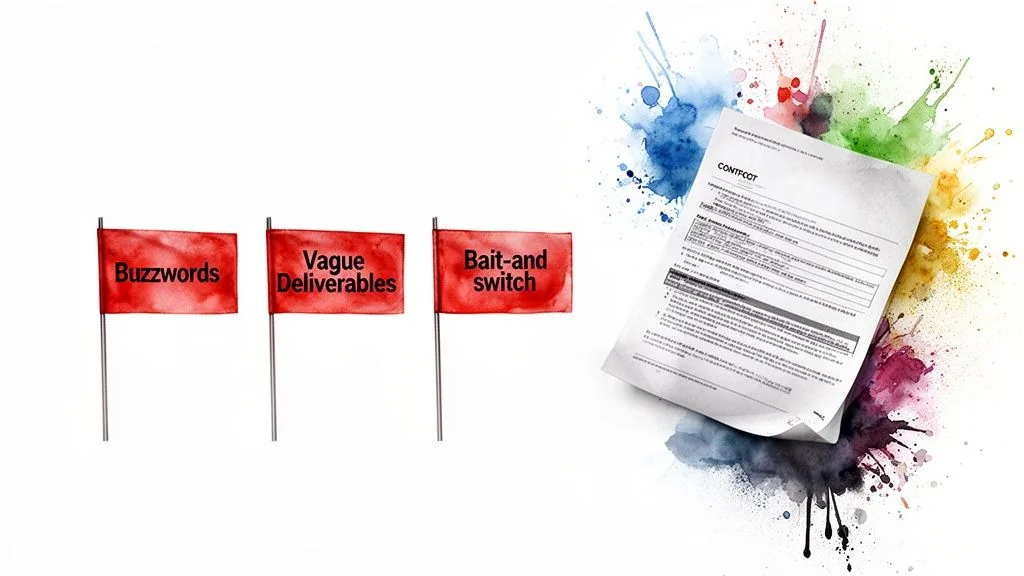
7 Red Flags to Watch for When Choosing a Partner
Selecting the wrong data strategy partner is more than a waste of money; it’s a strategic setback that can derail your objectives for years. A polished sales presentation can mask a lack of substance, so it is essential to approach these discussions with healthy skepticism. Identifying red flags early, before signing a contract, is the most effective way to de-risk this critical investment.
These warning signs often appear in initial conversations and can signal a mismatch in capabilities, work style, or integrity. Pay close attention to how they describe their work; it will reveal whether you are engaging a genuine strategic partner or an expensive liability.
They Overuse Buzzwords
Be wary of consultants who rely heavily on jargon—such as “AI-powered synergy” or “digital transformation frameworks”—without connecting these terms to a concrete action or a measurable outcome for your business. This is often a tactic to sound impressive while hiding a superficial understanding of the work involved. An effective consultant simplifies complex concepts.
If a consultant cannot explain their value without using industry buzzwords, it suggests they are selling a trend, not a solution. Their job is to solve your specific problems, not to demonstrate their vocabulary.
Example: A vendor proposes an “AI-driven data fabric solution” but becomes evasive when asked which specific data sources it integrates, what business questions it answers, or how it improves a key metric for your team.
They Pitch a One-Size-Fits-All Solution
If a potential partner presents a rigid, pre-packaged methodology as the only approach, it’s a problem. Every company has a unique combination of data systems, business goals, and internal culture. A high-quality data strategy consultation must be tailored to your reality, not forced into a generic template.
This inflexibility often indicates they are more interested in scaling their internal processes than in thoroughly understanding and solving your specific challenges. The best partners listen first, then adapt their approach.
Their Deliverables Are Vague
A strong proposal clearly defines what you will receive. Ambiguous promises like “enhanced data insights” or “a strategic roadmap” are red flags. You need specifics.
- Look for: A detailed list of tangible artifacts, such as a Current-State Assessment with gap analysis, a Future-State Architecture Diagram, and a phased implementation plan with clear milestones and timelines.
- Ask about: How will we measure success? A competent partner will want to collaborate with you to define clear KPIs that link the project directly to business value.
The Bait-and-Switch Tactic
This is a common and damaging practice. During the sales process, you meet the firm’s senior experts, who impress you with their strategic vision. However, once the contract is signed, they disappear, and your project is handed off to a junior team you have never met.
To prevent this, insist on meeting the key individuals who will be working on your project before signing. Get their bios and, more importantly, have their specific roles and time commitments documented in the Statement of Work (SOW). A successful partnership is built on trust and transparency, a key principle in our guide to vendor management best practices.
Common Questions About Data Strategy Consultation
Even with a clear understanding of the process, several key questions frequently arise when considering a data strategy consultant. Here are practical, direct answers to the most common inquiries.
How Long Does a Data Strategy Consultation Take?
While every engagement is unique, a comprehensive data strategy consultation typically falls within the 6 to 12-week range. This timeframe is sufficient to deliver substantial value without becoming an excessively long project.
A typical timeline includes:
- Weeks 1-3 (Discovery & Assessment): Consultants conduct a deep dive into your current data systems, workflows, and team skills to establish an accurate baseline.
- Weeks 4-8 (Future-State Design): The focus shifts to collaborative design through workshops and sessions to define the target architecture and build a strategic roadmap.
- Weeks 9-12 (Finalization & Handoff): All findings are documented in a detailed implementation plan, including financial models (TCO/ROI). The engagement concludes with a presentation of the actionable playbook to leadership and stakeholders.
What Is the Difference Between Data Strategy and Data Governance?
This distinction is critical. The simplest analogy is that of building a city.
Data strategy is the master blueprint. It answers the “what” and “why.” It determines which districts to build (e.g., sales analytics, operational dashboards), explains their importance to the city’s prosperity, and shows how they connect to the overall vision. It is the high-level plan for using data to achieve business objectives.
Data governance, in contrast, is the set of building codes, zoning laws, and inspectors. It is the “how.” It establishes the rules, standards, and controls to ensure every structure is safe, reliable, and functions correctly. Governance ensures that your data is accurate, secure, and trustworthy.
You can have a brilliant strategy, but without a solid governance foundation, it will ultimately fail.
Why Can’t Our Internal Team Build Its Own Data Strategy?
Your internal team possesses invaluable business knowledge. However, an external consultant brings capabilities that are difficult to replicate internally. An effective data strategy consultation combines your team’s institutional knowledge with an expert’s external perspective.
Consultants offer three key advantages:
- Cross-Industry Experience: They have seen what works—and what doesn’t—at numerous other companies. They bring proven solutions and can help you avoid common, costly mistakes.
- Dedicated Focus: Your internal team has daily operational responsibilities. A consultant’s sole focus is to deliver a high-quality strategy on schedule.
- Objective Neutrality: Every organization has internal politics and biases. An external partner can challenge long-held assumptions and build consensus across departments without being constrained by internal dynamics.
The purpose of a consultation is not to replace your team but to empower it. The optimal outcome is achieved by combining an expert’s broad experience with your team’s deep business understanding. This results in a better strategy, delivered in a fraction of the time.
At DataEngineeringCompanies.com, we provide transparent, data-driven insights to help you select the right data strategy partner with confidence. Our 2025 Expert Rankings and vendor evaluation tools are designed to help you navigate this critical decision, minimize risk, and accelerate your path to tangible business value. Explore our independent rankings and resources.
Researched & written by
Data-driven market researcher with 20+ years in market research and 10+ years helping software agencies and IT organizations make evidence-based decisions. Former market research analyst at Aviva Investors and Credit Suisse.
Previously: Aviva Investors · Credit Suisse · Brainhub · 100Signals
Vetted partners
Top Enterprise Partners
Vetted firms whose specialty matches this article.
More in Enterprise Data Engineering
Data Engineering Proof of Concept Scoping: A 4-Week Vendor PoC Playbook (2026)
How to scope a data engineering proof of concept — the 4-week vendor PoC template, SMART acceptance criteria, IP clauses, and the 11-day go/no-go rubric.
50 Data Engineering Discovery Call Questions to Ask Vendors (2026)
Fifty data engineering discovery call questions to ask vendors — buyer-side, with good-answer signals, red flags, and a 60-minute timebox script.
Data Engineering Vendor Evaluation Criteria: 35 Criteria for 2026
The complete 35-criterion evaluation framework for choosing a data engineering vendor in 2026 — definitions, verification, red flags, and weighting.