Build vs Buy Data Platform: An Engineering Leader's Decision Framework in 2026
The decision to build a data platform from scratch or buy a managed solution is a strategic inflection point for any engineering leader. This choice dictates where your most valuable resource—your engineering team—will spend its time. Building offers total control but requires a permanent, high-cost commitment to infrastructure maintenance. Buying a platform like Snowflake or Databricks accelerates time-to-value and converts unpredictable capital expenditure into manageable operational costs.
For most organizations, the debate is over. The data overwhelmingly shows that buying a platform is the superior financial and strategic decision. Building is a distraction from your core business unless data infrastructure is your core business.
The Build vs. Buy Decision Framework

The decision hinges on four factors: cost, speed, talent, and control. Choosing to build means your team owns the entire stack, from Kubernetes cluster provisioning and wrestling with open-source version upgrades to managing physical or cloud hardware. A deep dive into on-premises vs cloud infrastructure becomes a critical, time-consuming prerequisite. In contrast, buying outsources this low-level complexity to a vendor, freeing your team to focus on data modeling and business logic.
The fastest-moving teams don’t build the most; they make smart decisions about what not to build. Own your data models and business logic. Let a managed platform own everything else.
Core Trade-Offs at a Glance
This table provides a direct comparison of the operational reality for each path.
| Evaluation Criterion | Build (Self-Hosted Custom Platform) | Buy (Managed Vendor Platform) |
|---|---|---|
| Total Cost of Ownership (TCO) | High and unpredictable. Dominated by engineering salaries and ongoing operational overhead. | Predictable OpEx. Subscription and usage-based costs simplify budgeting. |
| Time-to-Value | Slow: 18-24 months. Involves extensive development, testing, and iteration cycles. | Fast: 6-9 months. Utilizes pre-built connectors and proven architecture from day one. |
| Required Talent & Focus | Demands a dedicated team of expensive, hard-to-find platform and DevOps engineers. | Allows your team to focus on high-value work: data modeling, analytics, and solving business problems. |
| Scalability & Maintenance | Manual and resource-intensive. Scaling requires constant engineering effort and architectural planning. | Elastic and automated. The vendor manages scaling, backed by guaranteed SLAs. |
The True Cost of Building vs. Buying
The initial price tag is misleading. The Total Cost of Ownership (TCO) reveals the actual long-term spend. If you build, your largest and most persistent cost is not servers or software; it’s people. You are not funding a project; you are funding a permanent internal product team.
According to DataEngineeringCompanies.com’s analysis of 86 data engineering firms, a small platform team with a senior data architect and two platform engineers costs over $1M annually in salaries alone. This figure excludes the costs of ongoing maintenance, security patching, and productivity lost to project delays and team turnover.
The Financial Reality Check
Buying a platform exchanges unpredictable R&D gambles for a stable operational expense. The primary costs are the platform subscription, data processing fees, and optional one-time implementation support from a consulting partner. This predictability is something a build project cannot offer.
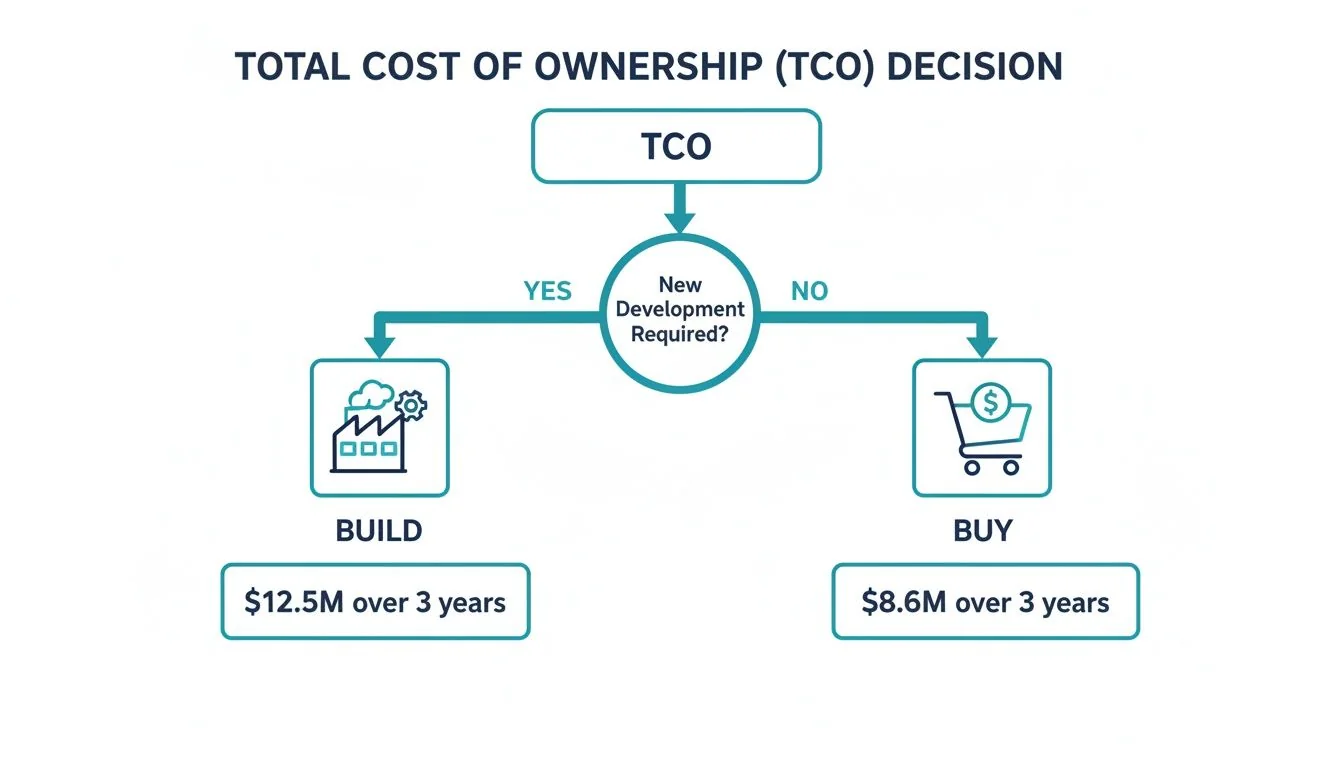
Enterprise surveys show companies that built their own platforms spent 45% more on implementation than those who bought solutions from vendors like Snowflake or Databricks. Over three years, the TCO for a custom-built platform often reaches $12.5 million, compared to $8.6 million for a purchased solution. Furthermore, 62% of build projects exceed their budgets by more than 50%.
The most expensive part of building isn’t the first sprint. It’s the multi-year commitment to funding a product team just to maintain, secure, and scale a platform that will always be playing catch-up with market leaders.
Buying a platform provides a clear financial model with guaranteed Service Level Agreements (SLAs). Building a platform launches a high-risk internal R&D project with an uncertain outcome and a budget that almost always balloons. Use our data engineering cost calculator to model your specific project expenses.
Comparing Time-to-Value and Performance Benchmarks
Speed from raw data to actionable insight is a primary competitive differentiator. Building a custom platform is a significant R&D effort, often taking 18-24 months to yield a production-ready system. In contrast, implementing a mature vendor solution with an experienced partner compresses this timeline to 6-9 months. This 12+ month gap is not just a delay; it’s a massive opportunity cost where competitors gain ground.
The Real-World Performance Gap
Data from the Everest Group 2026 PEAK Matrix assessment shows that companies building their own platforms took an average of 22 months to get data pipelines into production. Teams that partnered with top consultancies to deploy cloud solutions like Databricks or Snowflake achieved this in just 7 months.
Reliability is another differentiator. A 2025 Clutch survey revealed that 78% of build projects encountered major integration failures, adding 35% to the budget in rework costs. This contrasts with the 92% success rate for “buy” implementations leveraging battle-tested, pre-built connectors. The broader data science platform market reflects these industry dynamics.
When you buy a platform, you’re also buying guaranteed SLAs for uptime and performance. When you build it yourself, your team is the one getting paged at 3 a.m., and every performance issue is a distraction from delivering business value.
Going with an established vendor de-risks the entire initiative. You gain a proven ecosystem with performance guarantees, freeing your team to focus on generating insights now, not in two years.
Assessing Your Organizational Readiness and Talent
The build vs. buy decision is fundamentally about people—who you have, and who you can realistically hire and retain. Choosing to build means committing to creating an internal software company dedicated to infrastructure.
The True Cost of a “Build” Team
To build from scratch, you need to recruit a specialized and expensive product team capable of handling the entire lifecycle:
- Senior Data Architects to design a complex, scalable system.
- Platform Engineers with deep Kubernetes and DevOps knowledge to build and maintain the core infrastructure.
- Specialized OSS Engineers to manage, patch, and upgrade tools like Apache Airflow or dbt Core.
These professionals are in high demand. Analysis from DataEngineeringCompanies.com shows the blended annual salary for such a core team easily exceeds $1M. In the current market, sourcing this senior talent can take 6-9 months.
Buying a Platform Shifts Your Team’s Focus
Opting for a managed platform like Snowflake or Databricks doesn’t eliminate the need for talent; it changes the mission. Your team shifts from low-level infrastructure work to activities that directly create business value.
The required skills pivot toward:
- Analytics Engineering and data modeling within the platform.
- Data Governance and administration using the platform’s built-in toolset.
- FinOps and vendor cost management.
This shift often allows you to fill smaller, specific skill gaps with a few strategic hires or by engaging a specialized data engineering consultancy. For instance, exploring Apache Airflow alternatives might reveal an orchestration tool better suited to your team’s existing skills than a pure open-source approach. A “buy” decision transforms your team’s purpose from building infrastructure to delivering insights.
Evaluating Scalability, Governance, and Future-Proofing
A data platform’s value is tied to its ability to grow with your business. When you build, your team owns scalability—permanently. Every spike in data volume becomes a fire drill, pulling your best engineers away from revenue-generating projects to manually provision resources and re-architect bottlenecks.
Modern cloud-native platforms like Snowflake or Databricks offload this entire headache. They are designed for elastic scalability, automatically spinning resources up and down to match demand without manual intervention.
Governance and Future-Proofing
Building a custom governance framework is a monumental task. Your team would have to engineer systems for data lineage, access control, and audit logging—a slow, expensive, and difficult-to-maintain process. Leading managed platforms provide these sophisticated governance features out of the box, a non-negotiable advantage for any organization concerned with compliance and data trust.
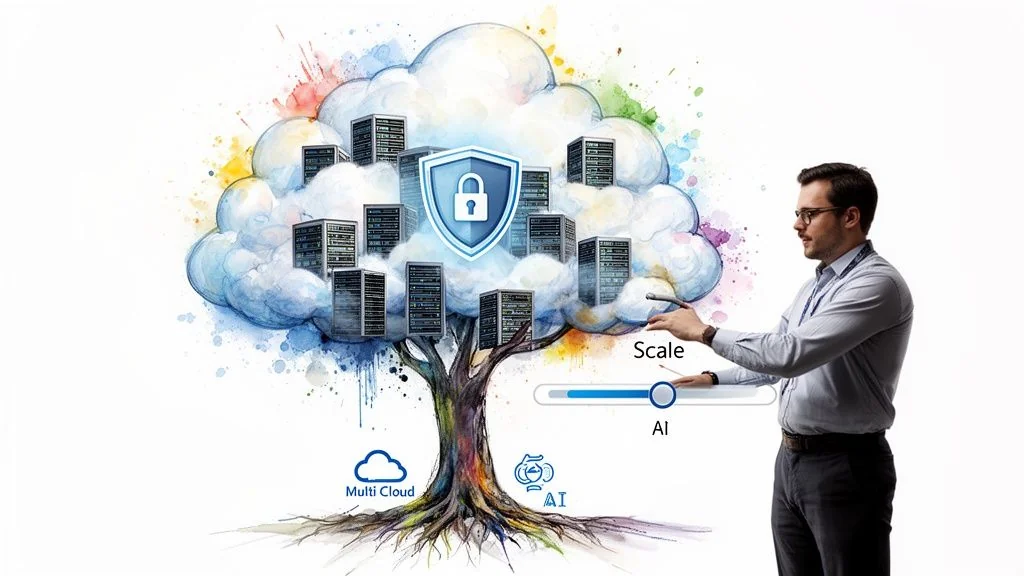
Vendor lock-in is a solved problem in 2026. Modern multi-cloud strategies and open standards like Apache Iceberg provide the architectural flexibility to avoid being tied to a single provider. This ensures your platform can evolve to support new technologies, like generative AI, without requiring a costly overhaul.
The financial argument is compelling. An analysis of the 2026 G2 Grid Reports found that enterprises choosing SaaS solutions had a 52% lower TCO over five years, with average costs of $4.2 million versus $8.9 million for in-house builds. This trend is industry-wide. Since 2020, the percentage of Fortune 500 companies building their own data platforms has dropped from 68% to just 32%. Dig deeper into the findings from recent market analysis to see the full picture.
Your Actionable Evaluation Playbook
Analysis paralysis on the build vs. buy question accrues technical debt and opportunity cost. It is time to make a firm, evidence-based decision. The goal is a final decision within the next quarter.
Step 1: Conduct the Internal TCO Assessment
Use the TCO model and decision matrix from earlier for a brutally honest internal assessment. Evaluate your team’s capabilities, budget constraints, and the strategic importance of data within your company.
If building a custom platform will cost over $1.5M in the first year and won’t deliver meaningful results for over 12 months, the “Buy” path is the only practical option.
Step 2: Initiate Vendor Evaluation
If your assessment points to buying, begin the vendor evaluation process. Use a structured framework, like our guide on how to evaluate data engineering vendors.
Your core RFP criteria must include:
- True multi-cloud support and a commitment to open standards to prevent lock-in.
- Integrated data governance tools for security and compliance.
- Transparent, usage-based pricing that scales predictably.
Engage a specialized data engineering consultancy at this stage. Their expertise in vendor selection, migration planning, and implementation can accelerate your return on investment from years to months.
Frequently Asked Questions
When does it make sense to build a data platform?
Almost never. Building a custom data platform is only justifiable in rare scenarios, such as:
- Truly unique processing needs that no commercial tool can handle.
- Extreme data sovereignty rules that forbid any third-party cloud interaction.
For over 95% of companies, the security, functionality, and predictable costs of a managed platform like Snowflake or Databricks make buying the superior decision.
How does a data engineering consultancy help in a buy decision?
A specialized data engineering consultancy acts as a strategic accelerator. Their value is in navigating the complex decisions that follow the “buy” choice.
They serve three critical roles:
- Unbiased Vendor Selection: They cut through marketing hype to help you select the right platform for your specific workloads.
- Architecture and Migration: They design an efficient cloud data architecture and execute a low-risk migration from legacy systems.
- Implementation and Optimization: They configure the platform for peak performance and cost-efficiency, building out your initial pipelines based on industry best practices.
What are the biggest hidden costs of building a data platform?
The most punishing costs of a “build” decision appear in years two, three, and beyond. These long-term operational burdens are the real budget killers:
- Talent Attrition: Retaining the specialized engineers who built the platform is expensive and difficult in a competitive market.
- Ongoing Maintenance: A custom platform is never “done.” It requires a permanent team for bug fixes, security patching, and compatibility updates.
- Scalability Rework: The platform built for today’s data volume will buckle under tomorrow’s, forcing expensive re-architecting projects.
- Integration Debt: Each new tool or data source requires a custom integration, creating a brittle system where maintenance costs continually rise.
Data-driven market researcher with 20+ years in market research and 10+ years helping software agencies and IT organizations make evidence-based decisions. Former market research analyst at Aviva Investors and Credit Suisse.
Previously: Aviva Investors · Credit Suisse · Brainhub · 100Signals
Top Data Engineering Partners
Vetted experts who can help you implement what you just read.
Related Analysis
BigQuery vs Snowflake: An Engineering Leader's Decision Framework
An evidence-based BigQuery vs Snowflake comparison of architecture, pricing, and performance to guide your 2026 data platform choice.
Actionable Playbook for Snowflake to Databricks Migration
Actionable playbook for engineering leaders: Snowflake to Databricks migration. Strategies for cost, execution & AI/ML value.
A CTO's Guide to Databricks Unity Catalog Implementation
A proven guide for CTOs on Databricks Unity Catalog implementation. Get actionable frameworks for architecture, governance, migration, and CI/CD.