What Is Map Reduce: A CTO's Guide to 2026 Modernization

Most advice on MapReduce is lazy. One camp calls it obsolete. The other treats it like sacred infrastructure because it still runs critical batch jobs. Both miss the actual executive question.
If you’re asking what is Map Reduce, you’re usually not looking for a computer science lecture. You’re deciding whether a legacy Hadoop estate still deserves budget, whether Databricks or Snowflake should replace part of it, and whether a consulting partner can execute that transition without breaking regulated pipelines.
MapReduce matters because it set the pattern for distributed batch processing at scale. It also matters because keeping it too long can trap your team in expensive operational drag. The right move isn’t ideological. It’s workload-by-workload, cost-by-cost, and partner-by-partner.
MapReduce Explained for Modern Data Leaders
MapReduce is a programming model for processing very large datasets in parallel across many machines. Google created it in 2004 to process multi-terabyte datasets across thousands of servers, and its core innovation was abstracting distributed systems complexity so developers without deep parallel computing expertise could run large-scale jobs reliably and fault-tolerantly, as IBM explains in its overview of MapReduce at Google and Hadoop.
For a modern CTO, the simplest way to think about MapReduce is this: it breaks one huge batch job into many smaller jobs, runs them close to the data, then combines the results.
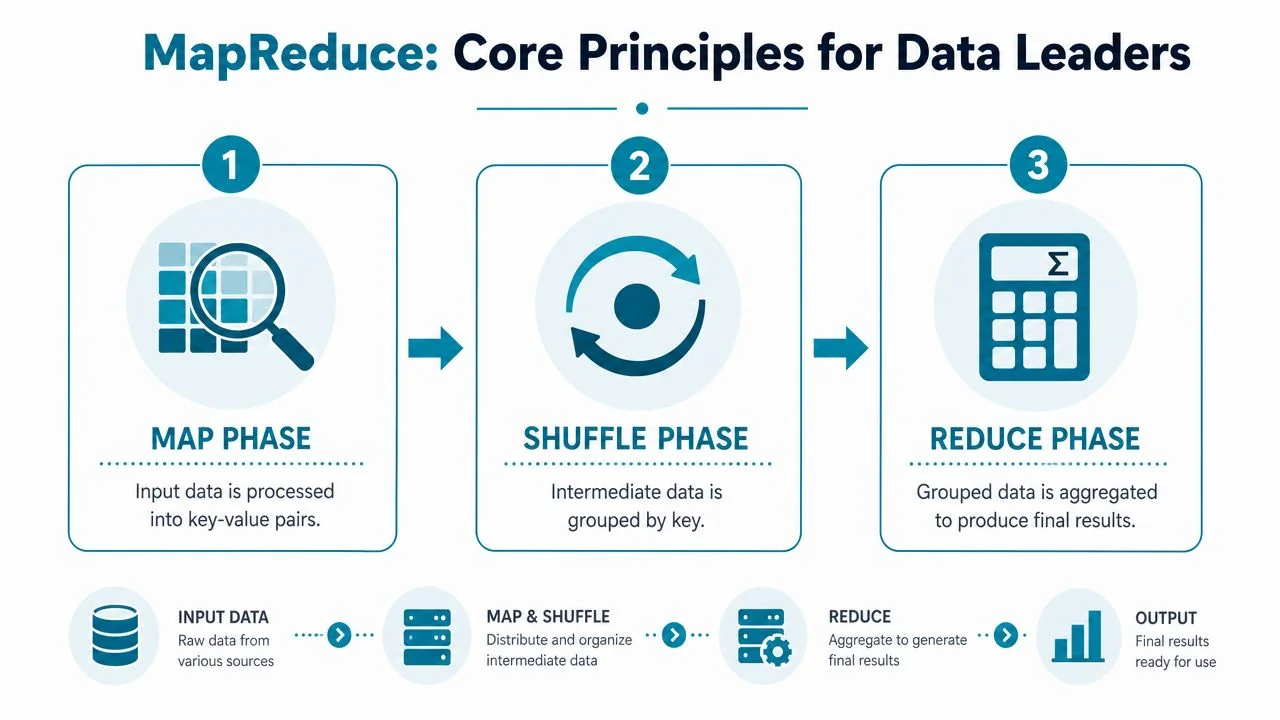
The three phases that matter
The model has three phases: Map, Shuffle, and Reduce.
- Map takes raw input and turns it into intermediate key-value pairs.
- Shuffle groups all values with the same key together.
- Reduce aggregates those grouped values into final output.
That sounds abstract until you use the classic word count example.
Word count is still the best mental model
Say your team needs to count every word across a massive archive of customer support transcripts stored in HDFS. A MapReduce job splits that archive into chunks across many worker nodes.
Each mapper reads a chunk and emits pairs like:
- “refund”, 1
- “delay”, 1
- “cancel”, 1
Then the shuffle phase gathers every identical word together so all the values for “refund” land in one logical group, all the values for “delay” in another, and so on.
The reducer sums each group and produces the final counts.
Practical rule: If a workload can be framed as “scan huge data, transform it, group it, aggregate it,” MapReduce is a natural fit.
Why this still matters in a modern stack
MapReduce became the original engine for batch processing on commodity hardware. That matters because many enterprise data estates still have historical ETL, reconciliation, and compliance pipelines that fit this pattern perfectly.
It is not a flexible interactive analytics engine. It is not a strong fit for low-latency streaming. It is a durable batch execution model that prioritizes scale, fault tolerance, and deterministic processing over developer speed.
For leaders evaluating Snowflake, Databricks, dbt, Airflow, AWS, Azure, or BigQuery, that distinction is the point. MapReduce isn’t just an old technology. It’s a specific architectural choice. If your workload is heavy batch ETL with stable logic, it still has a role. If your roadmap depends on rapid iteration, real-time processing, or tight AI/ML integration, it becomes a constraint fast.
MapReduce Performance vs Modern Alternatives
The easy answer is “use Spark.” That’s too simplistic.
Spark, Flink, and MapReduce optimize for different outcomes. If your team only cares about runtime, MapReduce usually loses. If your environment values highly consistent batch aggregation, the trade-off deserves a closer look.
What the benchmark data says
Benchmark research shows Apache Spark is 5x faster than MapReduce for training classification models, while MapReduce achieves 2 to 3 percent higher classification accuracy because of more effective aggregation logic, according to the benchmark study on MapReduce and Spark accuracy-performance trade-offs.
That doesn’t make MapReduce better overall. It makes it relevant for the small set of workloads where accuracy and deterministic aggregation matter more than speed.
Choose the engine for the failure mode you can tolerate. Slow jobs annoy stakeholders. Incorrect outputs create audit and revenue problems.
MapReduce vs Spark vs Flink
| Criterion | Hadoop MapReduce | Apache Spark | Apache Flink |
|---|---|---|---|
| Primary strength | Large-scale batch processing with strong fault tolerance | Fast analytics and iterative processing | Stream-first processing with event-driven architectures |
| Speed | Slower for iterative and model-training workloads | Faster for many analytics and ML tasks | Strong for low-latency stream processing |
| Accuracy trade-off | Strong option for high-fidelity aggregation workloads | Faster, but benchmarked classification accuracy can be lower in some scenarios | Best evaluated by streaming and state-management fit, not as a drop-in batch replacement |
| Fault tolerance model | Mature task re-execution and batch recovery | Strong resilience with in-memory execution advantages | Strong stateful recovery for streaming systems |
| Best fit | Historical ETL, heavy aggregation, stable batch jobs | Lakehouse analytics, ML pipelines, notebook-heavy engineering | Real-time event processing and streaming pipelines |
| Weakness | Slow development loops and poor fit for real-time demands | Requires discipline on cost control and workload tuning | Adds operational complexity if your estate is mostly batch |
The architecture decision
If your data platform strategy centers on Databricks, feature engineering, notebook-driven workflows, and faster experimentation, Spark aligns better. If you’re modernizing streaming or event-based architectures on AWS, Azure, or GCP, Flink deserves a serious look.
If you’re still running dense nightly ETL with stable transformations, don’t rip out MapReduce just because the market moved on. Optimize the target state with intent. Teams that skip tuning usually pay for it later with bloated clusters and disappointing migration economics. If Spark is your direction, treat Apache Spark optimization as part of the architecture decision, not cleanup after go-live.
A Framework for Your Hadoop Migration Decision
The wrong migration trigger is embarrassment. The right trigger is business friction.
A lot of Hadoop estates should be reduced, isolated, or retired. Some should be left alone. The key is separating strategic workloads from legacy noise.
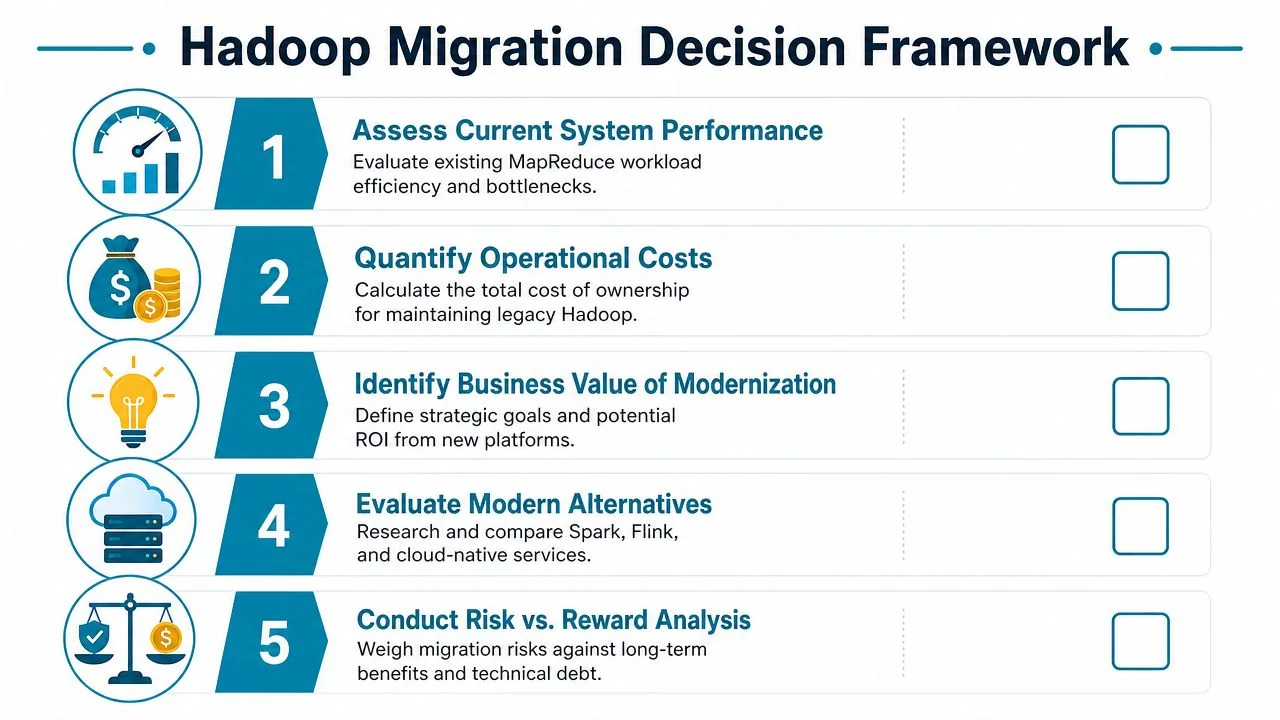
Keep it when the economics still work
MapReduce remains economically viable for some high-volume batch environments. Adoption for new real-time projects is below 5%, yet 62% of Fortune 500 data warehouses still rely on MapReduce for cost-effective historical ETL jobs, based on the verified industry figures provided for this topic.
That should kill the “MapReduce is dead” narrative. It isn’t dead. It’s just no longer the default platform for new analytical systems.
Migrate when these triggers show up
Use this checklist with your platform team, finance partner, and consulting vendor.
- Real-time requirements are now business critical. If product, fraud, operations, or customer teams need low-latency outputs, batch-first MapReduce is the wrong foundation.
- Your AI and ML roadmap depends on modern tooling. Databricks, feature pipelines, and iterative experimentation don’t pair well with legacy batch development patterns.
- Your operating model is brittle. When every change requires specialist Hadoop knowledge, platform risk goes up and delivery speed goes down.
- You’re duplicating data across old and new stacks. That usually means you’re already paying modernization costs without getting modernization benefits.
- Governance is harder, not easier. If lineage, testing, access control, and platform policy enforcement work better in your target stack, dragging old jobs forward becomes irrational.
Executive filter: Keep MapReduce only where it is still the cheapest reliable answer for stable batch processing. Everything else belongs on a modernization roadmap.
Don’t buy a “big bang” promise
The best migration programs sequence workloads. They classify jobs by business criticality, dependency complexity, and validation effort, then move the cleanest wins first. If you want a practical example of zero-downtime legacy transition planning, review AmasaTech’s migration success.
If Databricks is the likely destination, shortlist partners with real migration depth, not generic cloud badges. Start with firms that specialize in platform transitions, including leading Databricks consultants.
The Hidden Costs of Running MapReduce in 2026
The visible cost of MapReduce is infrastructure. The bigger cost is friction.
Legacy Hadoop environments drain engineering time through slow development cycles, rigid job orchestration, and brittle operational knowledge. Those costs rarely show up cleanly in budget reviews, but they slow every platform initiative built around Snowflake, Databricks, dbt, Airflow, or cloud-native governance.

Data skew is not a theoretical problem
Recent studies show a 43% performance degradation in MapReduce jobs when processing unevenly distributed data in multi-cloud environments. That data skew problem creates a real operational tax in heterogeneous cloud deployments.
If your architecture spans AWS, Azure, and GCP, this matters even more. Uneven partitions force some workers to do far more work than others. That means longer batch windows, harder capacity planning, and more tuning overhead for an already aging platform model.
The debt compounds in operations and talent
Three hidden burdens usually justify modernization even before raw compute cost does:
- Specialist dependency. Teams need engineers who understand Hadoop internals, legacy schedulers, and old batch failure patterns.
- Slow iteration. Disk-heavy processing and rigid job design make experimentation slower than it should be.
- Opportunity cost. Every hour spent nursing legacy pipelines is an hour not spent improving data contracts, governance, or cloud platform automation.
Old platforms don’t just cost money. They consume leadership attention that should be going into platform simplification and product-facing data work.
The practical implication is simple. Your TCO model for MapReduce has to include platform drag, not just servers and support.
Evaluating Partners for a MapReduce Modernization Project
Most firms say they can “migrate Hadoop to the cloud.” That’s not a selection criterion. That’s table stakes.
The firm you want can analyze legacy job logic, preserve business rules, validate outputs, and redesign the target operating model around tools like Databricks, Snowflake, BigQuery, dbt, and Airflow. Anything less is an expensive replatform with hidden rework.
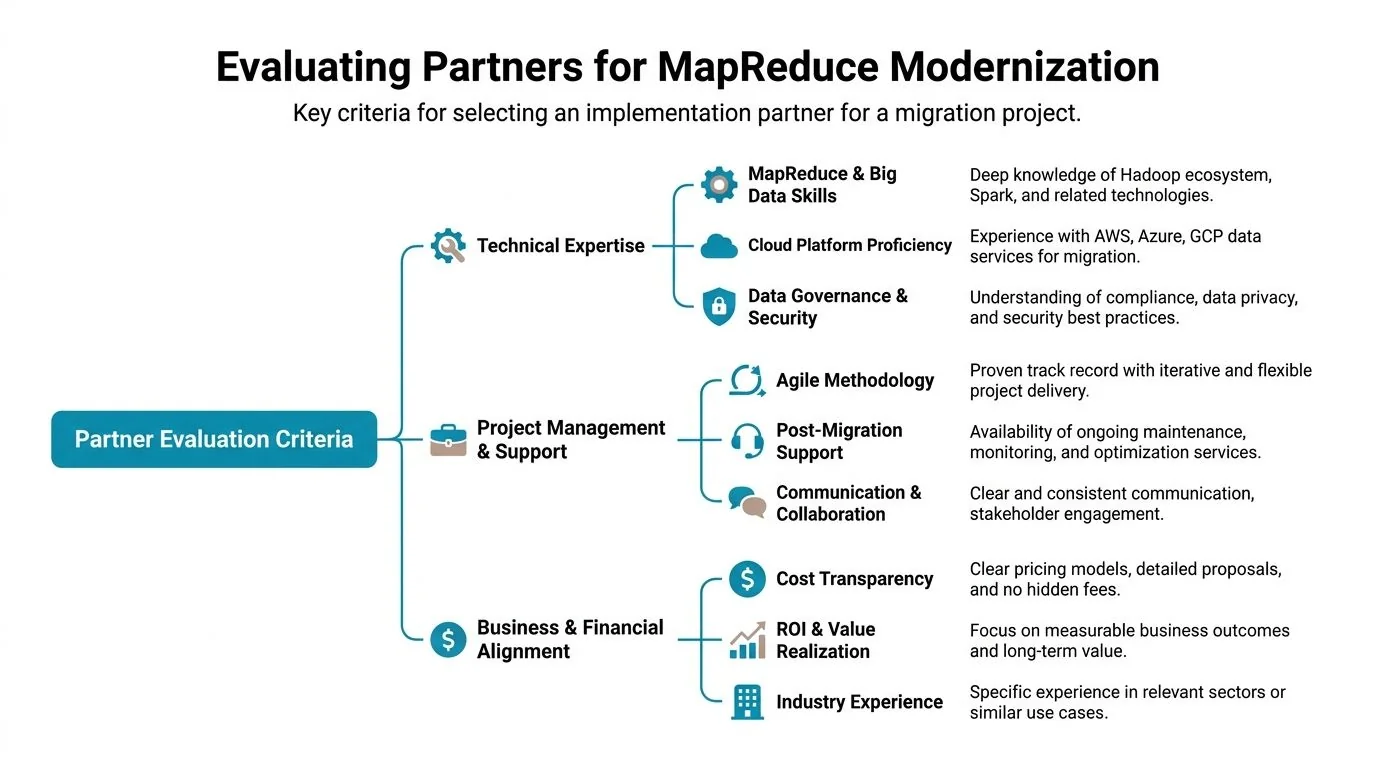
What to verify before you sign
According to DataEngineeringCompanies.com’s analysis of 86 data engineering firms, buyers should pressure-test migration partners across delivery mechanics, not marketing language.
Use this checklist.
- Source-platform fluency. Can the team read and untangle Hadoop MapReduce jobs, HDFS patterns, and legacy orchestration, or are they learning on your estate?
- Target-platform design skill. They should show strong architecture judgment in Snowflake, Databricks, BigQuery, dbt, Airflow, and your cloud of record.
- Validation discipline. Ask how they prove functional equivalence after migration. For consulting projects, Pipeline Completeness Rate must exceed 98% to ensure production stability, while rates below 95% signal critical incompleteness, as outlined in this data quality KPI guidance.
- Commercial efficiency. Delivery quality matters, but so does utilization. Consulting firms should target an 80% employee billable resource utilization rate for healthy project economics, according to the 2024 SPI benchmark summary.
- Governance competence. If they can’t map lineage, controls, access policy, and audit requirements into the new stack, they’re not a modernization partner. They’re staff augmentation.
Questions that expose weak vendors
Ask for a sample migration runbook. Ask how they regression-test aggregated outputs. Ask what they do with jobs that shouldn’t be lifted at all.
A strong partner won’t promise to migrate everything. They’ll tell you which jobs to retire, which to rewrite, and which to leave in place temporarily.
Also ask who owns post-cutover optimization. Plenty of firms can get workloads running. Fewer can make the target platform operationally better than the legacy one.
Your Action Plan for Platform Modernization
-
Inventory every MapReduce job. Group jobs by business criticality, refresh frequency, downstream dependencies, and whether the logic is still needed.
-
Classify each workload into keep, retire, or migrate. Stable historical ETL with no urgency to change belongs in a keep bucket until economics shift. Duplicative or low-value jobs should be retired. Anything blocking modern analytics or AI belongs in migrate.
-
Build a decision pack for finance and architecture leadership. Include current operating pain, migration rationale, governance implications, and target-platform options such as Databricks, Snowflake, or BigQuery.
-
Define validation gates before touching production. Set acceptance criteria for output parity, orchestration reliability, data quality, lineage, and rollback capability.
-
Run a partner evaluation process with technical proof. Require sample code analysis, migration methodology, testing approach, and post-migration support model. Don’t award on slideware.
-
Sequence the migration in waves. Start with lower-risk workloads that prove the operating model, then move high-dependency pipelines after your validation framework is working.
-
Use an RFP structure that forces clarity. If you need a faster start, DataEngineeringCompanies.com offers practical tools to shortlist firms, compare capabilities, and structure vendor evaluation for platform modernization programs.
If you’re still asking what is Map Reduce, the short answer is simple: it’s the batch processing model that built modern big data. The harder and more useful answer is whether it still deserves a place in your platform. For some workloads, yes. For your future-state architecture, usually not.
Researched & written by
Data-driven market researcher with 20+ years in market research and 10+ years helping software agencies and IT organizations make evidence-based decisions. Former market research analyst at Aviva Investors and Credit Suisse.
Previously: Aviva Investors · Credit Suisse · Brainhub · 100Signals
Vetted partners
Featured Data Engineering Partners
Vetted firms whose specialty matches this article.
Related Analysis
Data Engineering Vendor Scorecard Template (Free Download)
Download our free Data Engineering Vendor Scorecard Template. This guide explains our 8-factor methodology to help you evaluate and select the best consultancy.
Data Engineering Staff Augmentation: A 2026 Playbook
Your authoritative guide to data engineering staff augmentation. Learn when to use it, how to vet vendors, benchmark rates, and manage engagements for max ROI.

Data Dictionary Definitions: Achieve Data Engineering
De-risk 2026 data engineering projects. Master data dictionary definitions & evaluate consultancies for robust, actionable deliverables.