RAG vs LLM: The Data Engineering Decision Framework
rag vs llm, data engineering, snowflake cortex, databricks dbrx, enterprise ai
The question for a CTO before greenlighting RAG vs LLM for an enterprise build: do you want a model that knows things, or a data system that can prove them?
Treat this as an architecture decision, not a model preference. A native long-context LLM is a single inference endpoint, while RAG is a pipeline that adds ingestion, indexing, retrieval, and grounding around an LLM, which is why AWS frames RAG as connecting an LLM to external sources at query time before generating an answer (AWS RAG overview). IBM’s framing is even more useful for architects, because it makes clear that RAG changed enterprise AI from model-centric to systems-centric, where retrieval infrastructure, document indexing, and vector search matter as much as model weights (IBM on RAG).
| Criterion | Retrieval-Augmented Generation, RAG | Native Long-Context LLM |
|---|---|---|
| Data freshness | Strong, because the system retrieves current documents at query time | Weak unless the source material is already inside the prompt |
| Architecture | Multi-stage pipeline with ingestion, chunking, retrieval, and generation | Single computational endpoint |
| Governance | Better source grounding, but more corpus and retrieval risk | Simpler stack, but less direct traceability |
| Implementation effort | Higher, because it adds orchestration and retrieval layers | Lower, because it reduces pipeline components |
| Best fit | Dynamic, distributed, private enterprise knowledge | Whole-document reasoning and coherent synthesis |
If you need a practical way to think about stack choice, the logic in tips for selecting a tech stack maps cleanly to this decision. Start with the business requirement, then choose the least complex architecture that still satisfies freshness, governance, and latency.
Choosing Your AI Pattern: A Strategic Engineering Decision
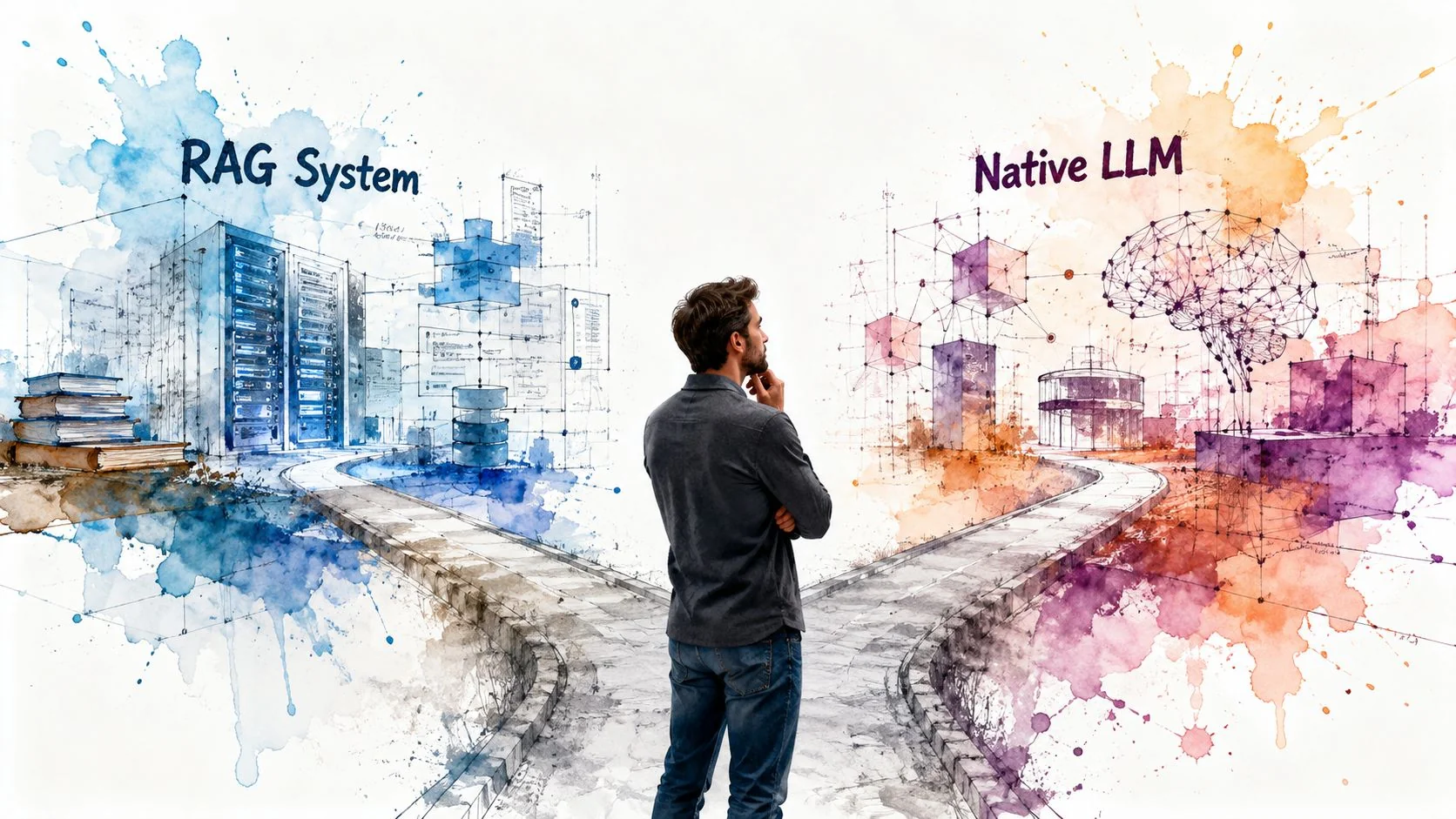
Choose the architecture from the data problem first. A native LLM keeps the system simpler, with fewer moving parts to build, monitor, and govern. RAG adds ingestion, chunking, retrieval, indexing, and grounding, which raises operational cost but gives you control over what the model can see.
AWS describes RAG as a pipeline that retrieves relevant context at query time and passes that context into the model, so the actual spend covers document processing, vector search, permissioning, evaluation, and observability as well as model selection (AWS RAG overview). That is the part enterprise teams underestimate. They budget for the model and then inherit a data engineering program.
If your use case depends on current facts from private systems, build the data pipeline first and choose the model second.
The decision is which architecture your team can operate without creating a maintenance burden, not which model is smarter. IBM’s framing of RAG as a hybrid operating model is the right one for architects, because retrieval handles freshness and source grounding while the model handles reasoning and generation (IBM on RAG).
If you are choosing a platform, Snowflake is a better fit when your knowledge is already organized in governed tables and documents and you want to keep retrieval close to the warehouse. Databricks is a stronger fit when you need heavier ingestion, embedding pipelines, and more control over the data engineering layer. For any team making that call, the logic in tips for selecting a tech stack applies cleanly.
Architectural Deep Dive: Pipeline vs Model
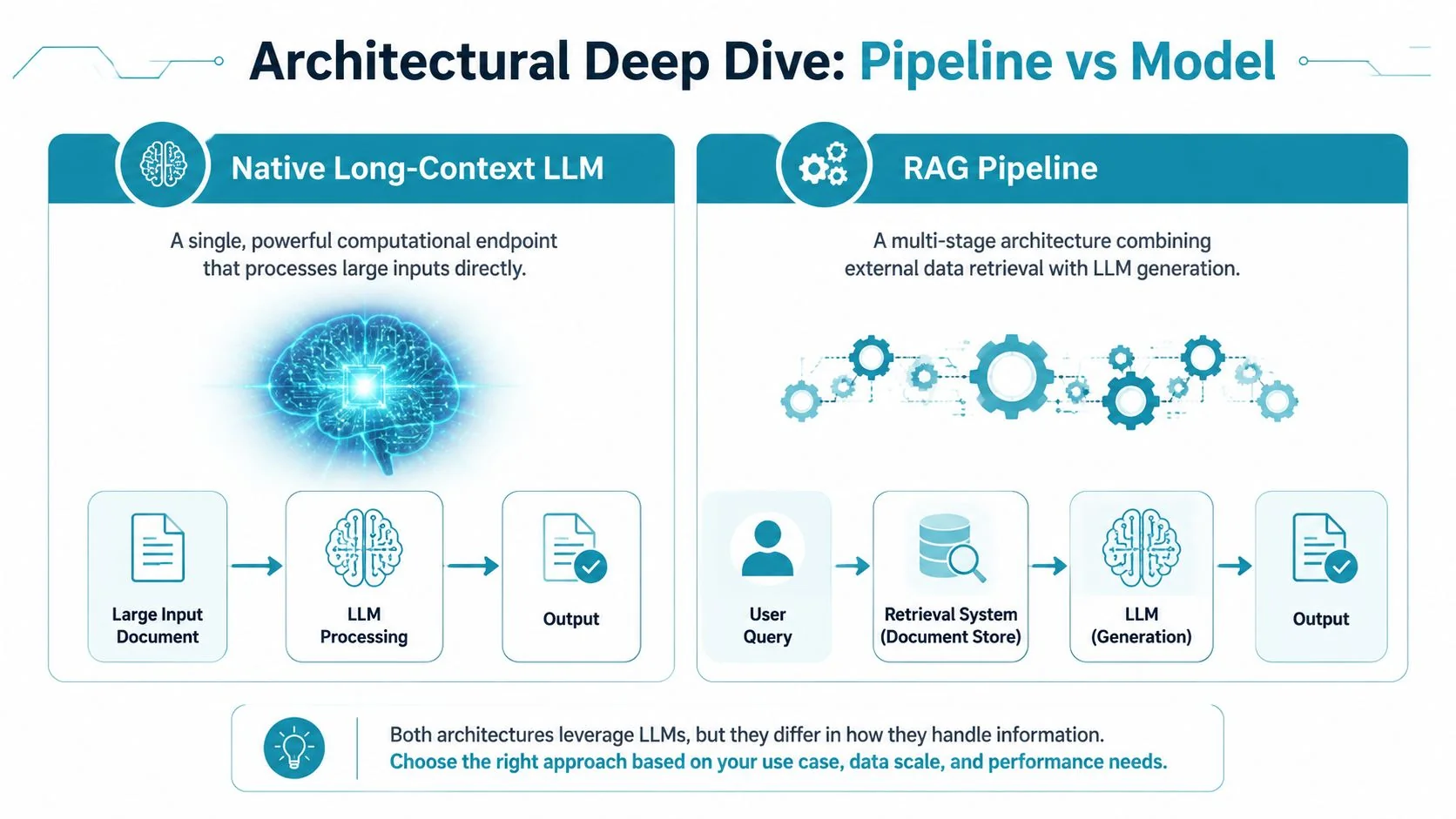
A native long-context LLM is the simpler architecture to operate. You send in a large, structured prompt, and the model reasons over that content in memory. For an enterprise data team, that smaller failure surface matters. There is no retrieval layer to tune, no chunking logic to debug, and no vector index to keep in shape.
What RAG adds to the stack
RAG turns the problem into a data engineering pipeline. You ingest documents, split them into chunks, create embeddings, store them in a vector index, retrieve the closest matches, and pass those results into the model. Each step forces an architectural choice, from chunk size to metadata design to ranking quality.
That added machinery is the tradeoff. RAG gives you control over what the model sees, which is why it fits enterprises with large, changing corpora and strict source requirements. It also creates more failure modes, because weak retrieval can surface the wrong passage even when the model itself is performing well.
Every extra layer adds work for ingestion, permissions, evaluation, and observability, and those are the parts enterprise teams end up maintaining long after the demo is over. If you are building a governed knowledge base, the AI powered knowledge base guide is a useful reference point for the operational shape of that work.
Why this changed enterprise AI architecture
The architectural shift is the system around the model becoming the product, not the model getting smarter. Once retrieval enters the design, the success metric moves from prompt quality to pipeline quality. Document normalization, lineage, vector quality, and access control start to dominate the implementation.
The LLM is the response layer. The retrieval system is the trust layer.
For CTOs, that changes the platform decision. If your team already has disciplined data ops, RAG fits naturally. If your team wants fewer moving parts and lower operational burden, native long-context access is cleaner.
For teams making platform calls, our Snowflake vs Databricks comparison is a practical lens because the stack you choose determines how much of the pipeline you own, how much governance you inherit, and how much ongoing maintenance the AI system will demand.
Core Tradeoffs: A Head-to-Head Comparison
Ask the wrong question and you’ll pick the wrong architecture. The useful question is which system fits your data shape, governance load, and operating cost. RAG and long-context LLMs solve different enterprise problems, and the tradeoff is architectural. A 2025 evaluation found that long-context models answered 56.3% of questions correctly versus 49.0% for RAG, while long-context models solved more than 2,000 questions that RAG missed and RAG uniquely answered almost 1,300 questions. That is a real split in capability.
The comparison that matters
| Criterion | Retrieval-Augmented Generation, RAG | Native Long-Context LLM |
|---|---|---|
| Accuracy on self-contained sources | Often weaker when the whole source fits in context | Stronger in the long-context setting, based on comparative evaluations |
| Accuracy on fragmented knowledge | Stronger when information is spread across many documents | Weaker if the evidence is distributed |
| Freshness | Strong, because updates happen in the corpus | Weak unless refreshed outside the model |
| Latency | Higher because retrieval adds steps | Lower because there’s no retrieval layer |
| Operational burden | Higher, due to indexing, chunking, permissions, and evaluation | Lower, because the system is simpler |
| Governance | Better source traceability, but more corpus risk | Less retrieval risk, but less built-in evidence plumbing |
| Best use case | Policy, support, knowledge bases, current enterprise facts | Whole-document synthesis, summarization, coherent reasoning |
The core issue is system fit, not model intelligence. Long-context wins when the evidence already lives in one place and the task is to synthesize it cleanly. RAG wins when knowledge is scattered, changes often, or sits across systems that cannot be flattened into one prompt. The EMNLP paper and the 2025 evaluation point in the same direction: the better choice depends on how much retrieval work your team can carry, not on marketing claims (EMNLP paper).
For a CTO, the operational cost matters as much as the answer quality. RAG adds chunking rules, embedding refreshes, access controls, retrieval evaluation, and index maintenance. That is a real data engineering program, and it gets more expensive as the corpus grows or the permission model gets stricter. Long-context LLMs cut most of that work out, which is why they are easier to run when the source material is already packaged for a single document or a bounded workspace.
Governance is the other dividing line. RAG gives you better source traceability, but it also creates more moving parts that can drift. Long-context systems reduce retrieval complexity, but they do not solve evidence management for you. If your team needs a build-versus-buy decision on the model layer itself, exploring custom LLM options is useful because it forces the same discipline around cost, control, and maintenance.
If your enterprise stack already centers on governed warehouse data, the link between architecture and platform choice becomes obvious. Use our Snowflake vs Databricks comparison to decide whether you want retrieval close to the warehouse or more control in a custom data engineering stack.
Platform Integration: Snowflake vs Databricks
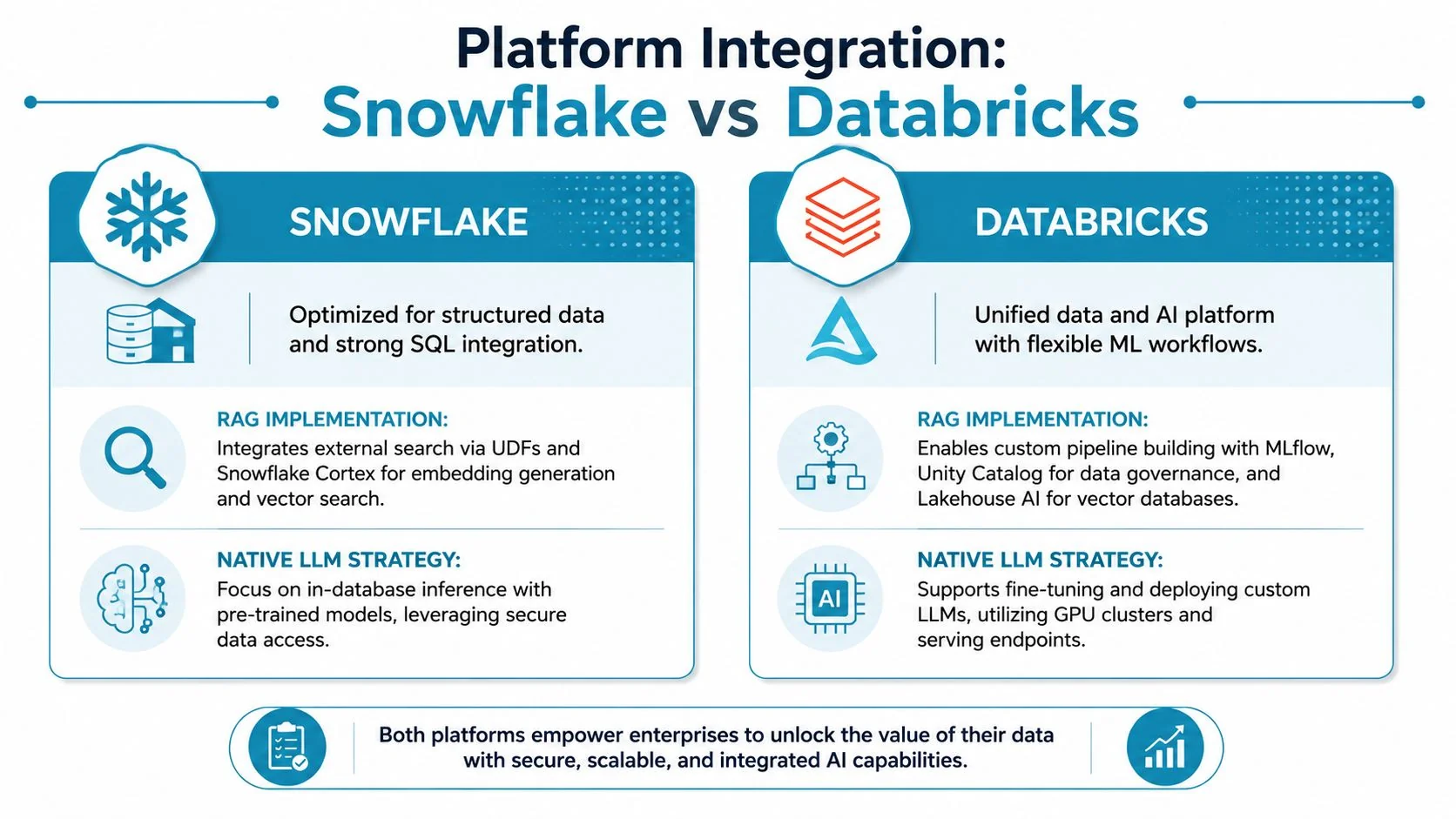
Snowflake and Databricks push teams toward different operating models. Snowflake Cortex AI is the cleaner choice when you want to keep retrieval close to governed data and reduce custom integration work. Databricks is the better choice when you want deeper control over the retrieval pipeline, custom model work, and the surrounding MLOps surface.
Snowflake for integrated RAG
Snowflake fits teams that want to stay close to SQL, governed tables, and managed analytics workflows. Cortex AI, vector search, and embedding functions lower the implementation burden, which is exactly what a conservative enterprise team needs when the priority is to ground answers in existing warehouse data without building a separate retrieval platform from scratch.
That makes Snowflake the safer default for data teams that already centralize content in the warehouse and want an enterprise-friendly path to RAG. It’s not the most flexible route, but it is the one that keeps platform sprawl under control.
Databricks for custom retrieval and model work
Databricks is the stronger fit when the consulting engagement needs custom orchestration, complex MLOps, or a more controlled approach to retrieval evaluation. Its lakehouse model gives platform teams more room to tune ingestion, governance, and model serving as a single workflow. That matters when the RAG system has to support multiple document types, custom ranking logic, or tight experimentation loops.
Choose Snowflake when you want faster adoption and less infrastructure variance. Choose Databricks when the AI program is broader than RAG and includes model iteration, retraining, or highly customized pipelines.
For teams working through the cloud stack tradeoff, our Snowflake vs Databricks comparison gives the most direct comparison. If you’re still early in the decision, that’s the right place to anchor the platform conversation before you commit to RAG implementation details.
The Decision Framework: When to Build a RAG Pipeline
If the answer has to stay coherent inside a single document, choose a native long-context LLM. If the answer depends on private, changing, or distributed enterprise data, build RAG. That is the cleanest decision line, and it matches the tradeoff described in comparative analysis of long-context and retrieval systems, including the Meilisearch analysis.
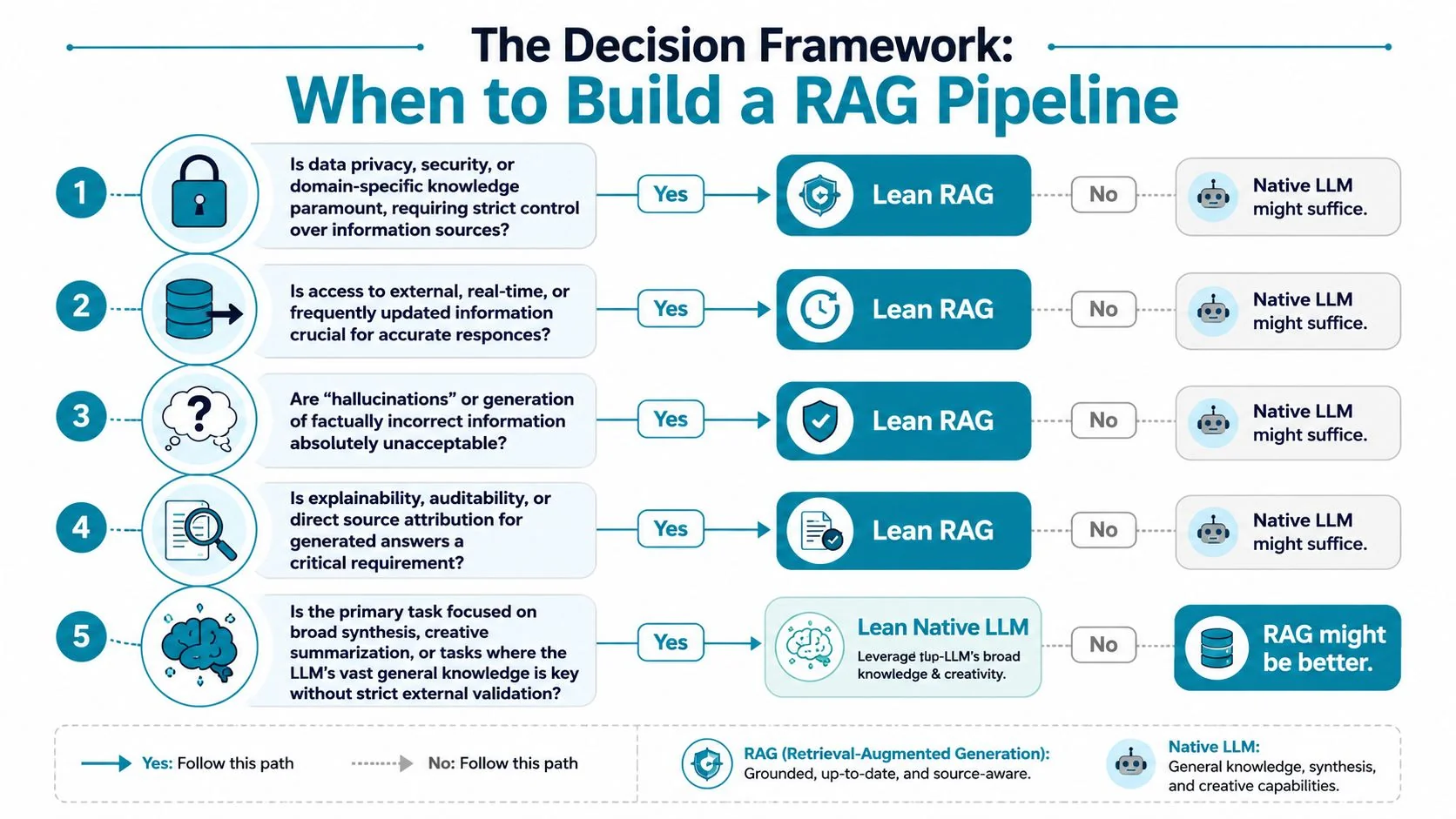
Use this checklist to make the call.
- Is the data private, sensitive, or governed by strict source controls? Choose RAG.
- Does the answer depend on live or frequently updated information? Choose RAG.
- Do you need explainability, citations, or auditability? Choose RAG.
- Is the source material a single document or a self-contained packet of documents? Choose a native LLM.
- Is whole-document coherence the main requirement? Choose a native LLM.
Retrieval handles factual lookup. Long-context generation handles whole-document synthesis. Keep those jobs separate, because teams get into trouble when they ask one architecture to do both and then try to patch the gaps with more prompts, more retries, and more human review.
RAG also creates an operational burden that gets ignored in conceptual comparisons. Beyond wiring embeddings and a vector store, you are building ingestion, chunking, metadata management, permissions, refresh logic, and evaluation, and all of that has to sit inside the existing data stack. For enterprise teams, that is why the question is governance and maintainability, not which model sounds smarter.
The safety side matters too. Yellow.ai on RAG safety is clear that retrieved text can carry bad instructions or misleading context into the response path, which means the system is only as safe as the corpus behind it. That makes filtering, access control, and corpus curation required from day one, not optional later work.
For teams that need the pipeline work done properly, how to build data pipelines is the right reference point. The architecture only holds up if the data pipeline is operationally sound.
Next Steps: Scoping Your AI Data Engineering Project
Start with scope, not model selection. If you choose RAG, define the ingestion sources, chunking strategy, embedding pipeline, retrieval method, and evaluation plan before anyone writes production code. If you choose a native long-context approach, define the document format, prompt boundaries, and latency target so a straightforward use case does not turn into a pile of brittle prompts.
If the source corpus is weak, the output will be weak, no matter how good the model is.
RAG changes the operational risk profile. The retrieval layer inherits the safety of the corpus, so permissions, content validation, and corpus hygiene have to be built into the design from day one. Your implementation partner needs to understand that reality. Embeddings and APIs are not enough.
According to DataEngineeringCompanies.com’s analysis of 86 data engineering firms, projects that fail to scope operational requirements upfront see a 40% cost overrun. That is a planning failure, not a model failure.
Define a proof of concept, lock the acceptance criteria, and choose a partner that has built governed data pipelines, not just demoed them. If you are in Snowflake, Databricks, AWS, Azure, or GCP, the right consulting team should map the architecture to your existing platform, not force a generic AI stack onto your data estate.
If you are scoping a RAG or long-context project now, run a scoping workshop that maps your data sources, governance requirements, and platform constraints in one session. Benchmark the architecture against your current warehouse or lakehouse, then greenlight the build only when the retrieval path, evaluation plan, and ownership model are explicit.

Researched & written by
Peter Korpak , Chief Analyst & Founder
Data-driven market researcher with 20+ years in market research and 10+ years helping software agencies and IT organizations make evidence-based decisions. Former market research analyst at Aviva Investors and Credit Suisse.
Previously: Aviva Investors · Credit Suisse · Brainhub · 100Signals
Featured Data Engineering Partners
Firms whose listed specialty matches this article.
Get ballpark quotes →- Algoscale200 people · unverified
Data engineering and analytics; distributed data processing
Listed, not reviewed - DataArt3000 people · unverified
Custom software development with data engineering; European nearshore
Listed, not reviewed - Dataroots50 people · unverified
AI-driven data engineering and MLOps implementation
Listed, not reviewed
Related Analysis
7 Top AI Automation Companies for 2026
How to choose among AI automation companies in 2026: seven firms by use case and fit, pricing questions to ask, and an RFP checklist for enterprise buyers.
A Leader's Guide to Apache Spark Optimization: Moving Beyond Quick Fixes
A practical framework for Apache Spark optimization: diagnosing the real bottleneck, tuning shuffle partitions and executor sizing, and choosing code fixes that cut runtime and cloud cost.
Data Contracts in Data Engineering: A Guide for Engineering Leaders
Data contracts in data engineering: what an enforceable contract includes, producer vs consumer enforcement, tooling, and how to make the business case.