Orchestration in Cloud: A Practical Guide for Modern Data Platforms
Cloud orchestration is the automated configuration, coordination, and management of interconnected computer systems, services, and software. It’s not about executing a single task; it’s about defining and controlling an entire end-to-end workflow—provisioning compute, configuring networks, deploying applications, and managing dependencies—to deliver a complete business service. This automated governance turns a collection of disparate cloud resources into an efficient, scalable, and resilient data platform.
Understanding Cloud Orchestration
At its core, orchestration in the cloud is the process of managing the intricate dependencies between discrete automated tasks. A simple script might automate one action, like provisioning a virtual machine. That is automation. Orchestration manages the entire sequence: provisioning the VM, attaching the correct storage volumes, configuring network security rules, deploying application containers, and deprovisioning the entire stack once a job is complete.
This distinction is critical. Manually triggering a series of automated scripts is not orchestration; it’s a brittle, error-prone process that creates operational bottlenecks. True orchestration defines the entire process as a single, stateful workflow, ensuring every step executes reliably and in the correct order.
Why It Matters More Than Ever
The need for robust orchestration is directly proportional to the rise of cloud complexity. Modern data platforms are not monolithic applications; they are distributed ecosystems of microservices, containers, and serverless functions, often spanning multiple cloud environments. Market analyses project substantial growth for the global cloud orchestration market, driven by the non-negotiable needs for automated provisioning, stringent cost controls, and a unified approach to managing multi-cloud complexity. You can find detailed projections on this growth at sites like coherentmarketinsights.com.
Attempting to manage this complexity manually is operationally infeasible and introduces significant business risk. Orchestration directly addresses these challenges.
- Accelerated Service Delivery: By codifying and automating the entire service lifecycle, teams deploy new infrastructure and applications in minutes, not weeks.
- Reduced Human Error: Workflows defined as code execute consistently, eliminating the configuration drift and costly errors inherent in manual processes.
- Embedded Governance and Compliance: Orchestration tools programmatically enforce security policies, access controls, and cost-management rules across every deployed resource.
- Improved Resilience: A well-designed orchestration system automatically detects and responds to failures, retrying failed tasks or executing compensatory actions without human intervention.
Orchestration shifts a company’s cloud operations from reactive to proactive. It is the engine that enforces best practices for security, cost, and operational resilience at scale, making it a foundational component of any serious data architecture.
The Business Impact of Effective Orchestration
Ultimately, the objective of orchestration is to align technical operations directly with business objectives.
When a data science team requires a GPU-accelerated environment for a model training job, orchestration can provision it on-demand, execute the workload, and deprovision it automatically to eliminate cost waste. When a marketing campaign is projected to increase application traffic, orchestration coordinates the scaling of load balancers, application servers, and database read replicas to handle the load without service degradation.
This responsiveness defines a modern data stack—one that adapts to business demands in near real-time. By treating infrastructure and complex workflows as code, organizations gain the agility to innovate without being constrained by manual operational friction. You can learn more about how these components fit together by exploring our guide on the modern data stack. This strategic automation enables data engineering teams to focus on high-value initiatives, not routine infrastructure management.
Orchestration vs Automation vs Choreography Explained
In cloud architecture, the terms orchestration, automation, and choreography are often used interchangeably, but confusing them leads to significant architectural and operational deficiencies. A restaurant kitchen provides a practical analogy to clarify their distinct roles.
Automation is a specialized tool performing a single, discrete task with high efficiency. It is the food processor that dices onions—a specific, repeatable action. In a cloud context, this is a script that provisions a virtual machine or a process that backs up a database. It is a point solution for a single function.
Choreography is the emergent coordination of independent experts reacting to events without a central commander. The sushi chef sees an order for a dragon roll and begins preparing rice; simultaneously, the grill chef sees a steak order and fires up the grill. They respond to events (incoming orders) and work in parallel, contributing to the final meal without direct, step-by-step instructions from a single authority.
The Role Of The Conductor
Orchestration is the head chef. The head chef does not dice every onion or grill every steak. Instead, they hold the master plan for a complex, multi-course meal. They direct the automated tasks (the food processor) and the choreographed sequences (the independent chefs) to ensure all components converge at the correct time. The head chef’s command—the orchestration—transforms a collection of individual dishes into a coherent dining experience.
This is precisely how orchestration functions in the cloud. It acts as the central control plane, coordinating resources like compute, storage, and networking to deliver a cohesive service.
As illustrated, orchestration is not a resource itself but the intelligence layer that governs and unifies disparate cloud components to achieve a specific outcome.
In a practical application deployment scenario, an orchestrator manages the end-to-end process:
- Provisioning infrastructure (an automated task)
- Configuring network rules (another automated task)
- Deploying the application code (a choreographed sequence of container initializations)
- Connecting to a database and executing validation tests (more automated steps)
Orchestration is the stateful logic that defines this entire workflow, manages dependencies between steps, and handles errors and retries.
Orchestration does not replace automation or choreography; it leverages them. It is the top-level process that provides purpose and direction to lower-level automated and choreographed actions, ensuring they combine to achieve a specific business outcome.
To formalize the distinctions, consider this comparison.
Orchestration vs Automation vs Choreography A Practical Comparison
| Attribute | Automation | Choreography | Orchestration |
|---|---|---|---|
| Scope | A single, discrete task. | Multiple, independent services communicating through events. | An end-to-end process or workflow involving multiple tasks and services. |
| Control | Task-specific. | Decentralized. Each service acts independently based on events. | Centralized. A single “conductor” directs the entire workflow. |
| Coupling | Self-contained, tightly coupled to its specific function. | Loosely coupled. Services do not require knowledge of each other. | Tightly coupled to the central controller, which manages dependencies. |
| Analogy | A food processor dicing onions. | Kitchen staff working independently on different orders. | The head chef directing the entire kitchen to create a full meal. |
| Cloud Example | A script to provision a single server. | An S3 event triggering a Lambda function. | A Kubernetes controller managing an entire application deployment. |
This table shows that while all three concepts involve execution, their architectural approach and scale are fundamentally different.
Bringing It All Together In Cloud Operations
Consider a daily ETL (Extract, Transform, Load) job in data engineering:
- Automation is the script that copies a file from an S3 bucket or the command that starts a Spark job. It is simple, direct, and focused.
- Choreography might be an event-driven system where a new file landing in S3 automatically triggers a Lambda function to perform a data quality check. The function reacts to the event, unaware of the broader process.
- Orchestration is the master workflow that manages the entire sequence. It waits for the file, triggers the choreographed data quality check, provisions a compute cluster (an automated task), runs the Spark job, loads the results into a data warehouse, and—critically—deprovisions the cluster to control costs. If the Spark job fails, the orchestrator executes a defined retry strategy or sends an alert.
Understanding these distinctions is essential for building resilient and efficient systems. Relying solely on a chain of automated scripts creates a brittle system. Using only choreography makes end-to-end process debugging exceptionally difficult. Cloud orchestration provides the necessary visibility and control to manage complexity at scale, making it the bedrock of any modern data platform.
Core Architectures and Leading Orchestration Tools
Understanding the “what” and “why” of cloud orchestration is necessary, but practical implementation requires knowledge of the “how.” Effective orchestration is not about finding a single tool but selecting the right architectural pattern and technology for a given use case.
The chosen architecture dictates how workflows are controlled and executed. The operational model for a high-volume data processing pipeline differs significantly from that of a real-time microservices application. Your orchestration strategy must align with these specific technical and business requirements.
Centralized Orchestration
The centralized model follows the “conductor and orchestra” paradigm. A single, authoritative orchestrator directs every task in a predefined sequence. This architecture is analogous to a detailed project plan where all dependencies and steps are explicitly mapped.
This model is ideal for environments requiring high predictability and tight control. The top-down structure provides a single source of truth for the entire workflow, simplifying monitoring, debugging, and state management.
- Best for: Predictable, sequential processes like batch ETL (Extract, Transform, Load) jobs where tasks have strict ordering dependencies.
- Strength: Excellent visibility and control over the entire workflow. Failure tracing is straightforward because all logic is centrally managed.
- Weakness: Can become a single point of failure and a performance bottleneck. If the central orchestrator fails, all processes halt.
Event-Driven Orchestration
In contrast, an event-driven model operates on a “react and respond” basis. Instead of a central controller, independent services react to events as they occur. For example, a new file landing in a storage bucket can trigger a service to process it. The event itself is the trigger, not a command from an orchestrator.
This pattern is highly scalable and resilient, making it a natural fit for real-time systems where responsiveness is paramount. Each component is loosely coupled, allowing individual services to be updated or fail without cascading failure across the entire system.
- Best for: Real-time data processing, IoT data ingestion, and microservices-based applications where actions are triggered by asynchronous events.
- Strength: High scalability and fault tolerance. Failures are isolated, as components operate independently.
- Weakness: End-to-end monitoring and debugging are complex. Tracing a single transaction across multiple independent services is a significant challenge.
A hybrid model is also common, blending both approaches. A central orchestrator might manage the high-level business workflow, while individual stages within that flow are event-driven. This can provide a functional balance of control and flexibility.
Mapping Tools to Orchestration Challenges
With these architectures in mind, let’s examine the tools that enable them. The objective is to select the right tool for each layer of the technology stack. For a deeper analysis of available platforms, our guide to leading data orchestration platforms offers detailed comparisons.
Here is a practical breakdown of key tools and their primary use cases:
-
Terraform for Infrastructure Provisioning: This is the foundational layer. Terraform uses an Infrastructure as Code (IaC) approach to define, provision, and manage cloud resources like virtual machines, networks, and databases. It orchestrates the environment.
-
Kubernetes for Container Orchestration: Once infrastructure exists, Kubernetes manages the applications running on it. It handles the deployment, scaling, networking, and health of containerized applications. It orchestrates the application runtime.
-
Apache Airflow for Data Workflow Orchestration: Apache Airflow is a dominant tool for centralized, batch-oriented data pipeline orchestration. It allows users to define workflows as Directed Acyclic Graphs (DAGs) to manage complex dependencies, retries, and scheduling. It orchestrates the data flow.
-
AWS Step Functions for Serverless Orchestration: For applications built with serverless components like AWS Lambda, AWS Step Functions provides state management. It is designed to coordinate multiple, discrete serverless functions into a cohesive application, often using an event-driven or hybrid pattern.
Effective strategies employ a layered approach. Terraform provisions the infrastructure, Kubernetes runs the applications, and Airflow manages the data pipelines that feed those applications. Each tool is a specialist in its domain.
The optimal combination of tools depends entirely on the workload. A system with heavy batch-processing requirements will rely heavily on a tool like Airflow. Conversely, a real-time microservices application is better suited for Kubernetes and an event-driven orchestrator like AWS Step Functions. Understanding these core patterns and tools is fundamental to building a powerful and sustainable orchestration in cloud strategy.
Best Practices for Enterprise-Grade Cloud Orchestration
Implementing a basic orchestration workflow is straightforward. Building one that is reliable, secure, and cost-effective enough for enterprise use requires a disciplined, engineering-led approach. These practices are the necessary guardrails that prevent automated systems from becoming fragile, insecure, and expensive liabilities.
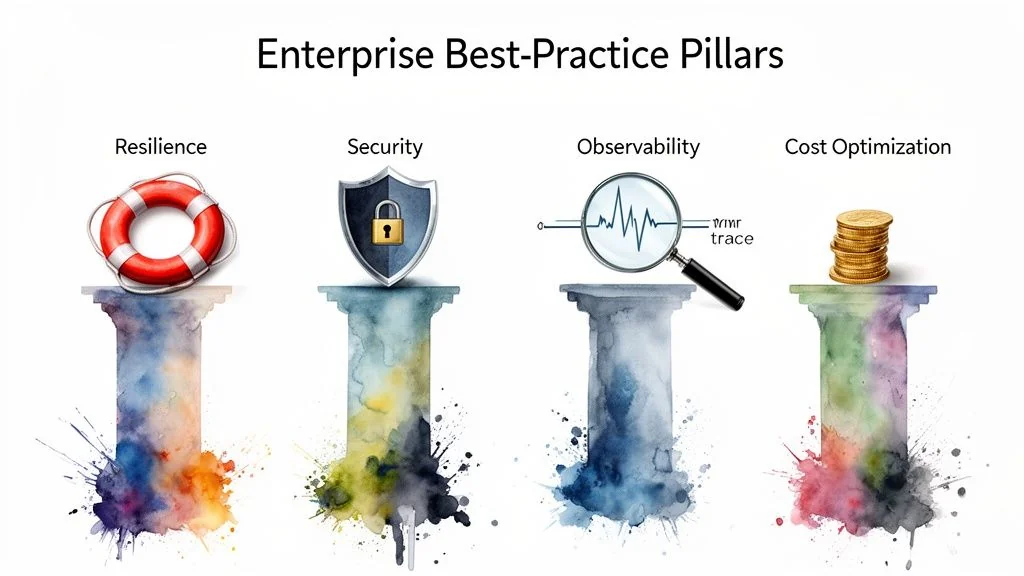
A robust orchestration strategy is built upon four pillars: Resilience, Security, Observability, and Cost Optimization.
Design for Resilience and Failure
The fundamental assumption of distributed systems is that components will fail. Networks experience transient failures, APIs time out, and services become unavailable. Enterprise-grade orchestration anticipates and plans for failure from the outset.
A core principle is idempotency: an idempotent task can be executed multiple times with the same outcome as a single execution. For example, a task that creates a specific resource should not fail if the resource already exists. This is critical for implementing safe, automated retries. When a task fails, the orchestrator can re-run it without causing duplicate data or other unintended side effects.
Workflows must also handle failures gracefully. A single task failure should not cause a catastrophic failure of the entire process.
- Implement intelligent retries: Instead of immediate, rapid-fire retries, use an exponential backoff strategy. This increases the delay between retry attempts, giving a struggling downstream service time to recover.
- Define explicit failure paths: Determine what happens when a task exhausts all retries. The process should trigger an alert, execute a compensating action, or move the failed item to a different queue. This must be explicitly defined.
- Use dead-letter queues (DLQs): For critical workloads, failed tasks cannot be discarded. Route them to a DLQ, where an engineer can investigate the failure without losing the data or the context of the job.
Red Flag to Avoid: Designing large, monolithic tasks. A 60-minute task that fails at the 59-minute mark is a significant waste of compute resources. Decompose workflows into smaller, modular, and idempotent steps to minimize the blast radius of any single failure.
Embed Security from Day One
In cloud orchestration, security cannot be an afterthought; it must be integral to the design. Orchestration tools are inherently powerful, often possessing extensive permissions to create, modify, and delete cloud resources. Without stringent controls, they become a significant security risk.
The security posture begins with robust secrets management. Hardcoding API keys, database credentials, or other secrets into workflow definitions is a critical vulnerability. Use a dedicated secrets manager like AWS Secrets Manager or HashiCorp Vault. The orchestration tool should retrieve these credentials dynamically at runtime, ensuring they are never exposed in logs or source control.
Equally important is the enforcement of the principle of least privilege through Identity and Access Management (IAM).
- Granular IAM Roles: Each workflow should execute with an IAM role granting only the minimum permissions required for its specific tasks.
- Role-Based Access Control (RBAC): Restrict which users can trigger, modify, or view specific workflows. A junior engineer should not have permissions to execute a production data deletion pipeline.
- Regular Audits: Periodically audit permissions and logs to ensure compliance and identify potential security risks, such as overly permissive roles. This process can be automated.
Red Flag to Avoid: Using a single, over-privileged service account for all orchestration tasks. This creates a massive attack surface and makes it impossible to attribute actions to a specific workflow during a security incident.
Implement True Observability
Traditional monitoring—checking CPU utilization and manually searching log files—is insufficient for complex, distributed workflows. You need observability: the ability to ask arbitrary questions about your system’s state without needing to deploy new code. This requires more than just logs.
True observability is built on three pillars of telemetry data:
- Logs: Structured (e.g., JSON) event records detailing what happened. Structured logging is essential for effective searching and analysis.
- Metrics: Aggregated, numerical data over time, such as task success/failure rates, execution duration, and resource consumption. Metrics are used for trend analysis and alerting.
- Traces: A complete, end-to-end view of a single request or workflow as it traverses multiple services. Distributed tracing is non-negotiable for identifying bottlenecks in microservices-based systems.
Combining these three allows you to move from “My workflow failed” to “My workflow failed at the data-validation step because the upstream API latency spiked to 3,000ms, which impacted 15% of all transactions.” This is an actionable insight.
Red Flag to Avoid: Relying solely on the orchestrator’s built-in UI for monitoring. A proper strategy involves exporting telemetry data from your orchestrator to a centralized observability platform like Datadog, New Relic, or Grafana to gain a holistic view of system health.
Optimize for Cost Continuously
While orchestration can drive cost efficiency, it can also become a source of uncontrolled spending if not managed properly. The objective is not just to automate tasks, but to use automation to enforce financial governance.
Begin by tagging every resource provisioned by your orchestrator. Tagging is non-negotiable. It enables you to attribute every dollar of cloud spend to a specific workflow, team, or project. With this visibility, you can implement cost optimization strategies.
- Automate Shutdowns: Ensure non-production environments are automatically deprovisioned during off-hours, such as nights and weekends.
- Right-Size Resources: Use orchestration metrics to analyze the actual CPU and memory consumption of tasks. If a job consistently uses only 20% of its allocated memory, resize it to reduce cost.
- Leverage Spot Instances: For fault-tolerant and non-time-critical workloads, orchestrate them to run on cheaper spot instances, ensuring the workflow is designed to handle potential interruptions.
Red Flag to Avoid: Allowing orchestrated jobs to hold expensive resources indefinitely. A common mistake is provisioning a large GPU cluster for a machine learning job and failing to deprovision it upon completion. This results in thousands of dollars in wasted spend. Orchestration logic must manage the full lifecycle of every resource it provisions.
How to Select the Right Data Engineering Partner
Implementing an enterprise-grade cloud orchestration strategy is a complex engineering challenge. While technology selection is important, the expertise of the implementation team is the critical success factor. Choosing a data engineering partner is not about hiring temporary staff; it’s about finding a strategic advisor who can translate complex technical requirements into tangible business outcomes.
A poor partner choice can result in a brittle architecture, budget overruns, and a system that fails to scale. The right partner accelerates your timeline, helps you avoid common implementation pitfalls, and enhances the skills of your in-house team. This decision requires rigorous evaluation.
Evaluating Technical Expertise and Proven Experience
The primary evaluation criterion must be technical competence. A prospective partner must demonstrate deep, hands-on experience with the specific tools and architectural patterns relevant to your project. Their expertise should be broad enough to understand the cloud ecosystem yet deep enough in key tools like Apache Airflow, Dagster, or Prefect to be effective.
Look for a proven track record. Request case studies and, more importantly, client references from organizations in your industry that have solved similar problems. A firm that has successfully migrated a financial services company from legacy cron jobs to a modern, DAG-based orchestrator possesses validated, real-world knowledge that a certification cannot provide.
A partner’s value is not in knowing how to configure a tool, but in knowing why one tool or architecture is a better fit for your specific business context than another. They should be able to defend recommendations with clear, experience-based reasoning.
Key Questions to Ask Potential Partners
To move beyond marketing claims, ask specific, technical questions that reveal a partner’s depth of knowledge and operational methodology. Vague answers are a significant red flag.
Use these critical questions to guide your evaluation:
- How do you approach migrating legacy workflows? A competent partner will describe a phased approach, beginning with a thorough dependency analysis. This often involves using a detailed cloud migration assessment checklist. They should advocate for modular implementation and parallel execution of new and old systems for validation, not a high-risk “big bang” cutover.
- What is your methodology for ensuring security and governance? Look for specific practices regarding secrets management, implementation of least-privilege IAM policies, and the creation of comprehensive audit trails. A generic “we prioritize security” is an insufficient answer.
- How do you design for scalability and long-term maintenance? They should discuss principles like task idempotency, building robust observability with tools like Datadog or Grafana, and establishing a CI/CD pipeline for managing orchestration code as a software asset.
- Can you describe your process for knowledge transfer and team enablement? A successful engagement concludes with your team’s self-sufficiency. A strong partner will have a clear plan for co-development, comprehensive documentation, and structured training sessions.
Recognizing Red Flags and Ensuring a Successful Partnership
During your evaluation, be vigilant for common warning signs. A partner that immediately proposes a preferred tool without a deep discovery of your specific needs may be prioritizing their own convenience over your success. A poorly defined plan for governance or the final handover to your team is another major red flag.
A successful partnership requires transparency, particularly regarding cost and scope. Ensure the statement of work is precise, with clearly defined milestones, deliverables, and acceptance criteria. This prevents scope creep and establishes a shared understanding of what “done” means.
Ultimately, the right partner functions as an extension of your own team. They provide essential technical expertise, but also a collaborative approach and a vested interest in your long-term success. By conducting a rigorous evaluation, asking incisive questions, and identifying red flags, you can select a firm that will help you build a cloud orchestration platform that is resilient, scalable, and delivers measurable business value.
Frequently Asked Questions About Cloud Orchestration
This section provides direct, practical answers to common questions faced by engineers and leaders implementing cloud orchestration.
How Do I Start Migrating from Cron Jobs to a Modern Orchestration Tool?
The migration from a legacy cron-based system should be incremental and risk-averse. Begin by selecting a single, non-critical workflow as a proof-of-concept. The objective is not to simply replicate the script but to re-engineer the process for a modern environment.
First, map all implicit dependencies and failure modes—conditions that cron silently ignores. What happens if a network share is unavailable? What is the behavior upon API timeout? Document these explicitly.
Next, containerize the individual steps of the workflow. Containerization ensures portability and consistency across different environments. With the logic containerized, select a modern orchestrator that aligns with your team’s skills. For Python-proficient teams, tools like Apache Airflow or Prefect are strong candidates.
Rebuild the workflow’s logic as a Directed Acyclic Graph (DAG) in the chosen tool. Decompose the process into small, modular, and idempotent tasks to ensure that failed steps can be re-run safely. Implement robust logging, alerting, and automated retry mechanisms from the beginning.
Do not perform an immediate cutover. Run the new DAG in parallel with the legacy cron job, comparing outputs to verify correctness. This parallel execution phase de-risks the migration and builds confidence before the final decommissioning of the cron job.
Can One Orchestration Tool Handle Everything?
No. Attempting to use a single tool to manage the entire technology stack is a common architectural error that results in brittle, over-extended systems. An effective orchestration strategy is layered, using the right tool for each specific domain.
Conceptualize your stack in distinct layers of responsibility:
- Infrastructure Orchestration: This is the foundation. Tools like Terraform are designed to provision and manage core cloud resources—compute instances, networks, and storage.
- Container Orchestration: This layer manages the application runtime. Kubernetes excels at deploying, scaling, and ensuring the health of containerized services.
- Workflow Orchestration: This top layer manages business logic. Tools like Apache Airflow or Dagster are built to manage complex, multi-step data pipelines and other business processes.
The objective is not a single tool, but a system where each layer can trigger and communicate with the next. Forcing a data workflow tool to manage raw infrastructure results in a system that is difficult to debug, scale, and maintain.
What Are the Biggest Hidden Costs of Cloud Orchestration?
The subscription or licensing fee for an orchestration tool is only a fraction of its total cost of ownership. The most significant costs are typically hidden in engineering time and operational overhead.
These hidden costs manifest in four primary areas:
- Team Enablement: The single largest cost is often the time required for engineers to achieve mastery of new tools and architectural patterns. The learning curve for distributed systems orchestration is steep and requires significant investment.
- Operational Overhead: The orchestration platform is itself a complex distributed system that requires monitoring, security patching, upgrades, and maintenance. This internal operational burden can be substantial.
- Architectural Missteps: Poorly designed workflows lead to direct financial waste. For example, monolithic tasks that must be re-run from the beginning after a minor failure consume excessive compute resources. The cost of a suboptimal design can easily exceed the software license cost.
- Inefficient Resource Usage: A common failure mode is orchestrated jobs that provision expensive resources (e.g., large GPU clusters) and fail to deprovision them upon completion. Without robust, automated lifecycle management, these idle resources generate significant, unnecessary costs.
Engaging an experienced data engineering partner can mitigate these risks. They provide proven architectural patterns, accelerate team enablement, and implement cost-control measures as a core part of the design process.
Finding the right expertise is crucial for navigating these challenges. DataEngineeringCompanies.com offers independent, data-driven rankings of top data engineering firms, helping you select a partner with confidence. Explore detailed profiles, cost calculators, and practical checklists to de-risk your next project.
Data-driven market researcher with 20+ years in market research and 10+ years helping software agencies and IT organizations make evidence-based decisions. Former market research analyst at Aviva Investors and Credit Suisse.
Previously: Aviva Investors · Credit Suisse · Brainhub · 100Signals
Top Data Engineering Partners
Vetted experts who can help you implement what you just read.
Related Analysis
A Practical Guide to Orchestration in Cloud Computing
Explore orchestration cloud computing with this practical guide. Learn how to choose tools, compare architectures, and build a strategy that delivers results.
A Practical Guide to Snowflake Cost Optimization
Discover proven Snowflake cost optimization strategies. This guide covers compute, storage, and governance to help you reduce your Snowflake bill.
10 Actionable Data Pipeline Testing Best Practices for 2026
Discover 10 actionable data pipeline testing best practices. This guide covers everything from unit tests to chaos engineering for modern data stacks.