A Guide to Fractional Data Engineering Services in 2026
fractional data engineering services, data engineering consulting, on-demand data engineers, data platform cost, snowflake consulting
Fractional data engineering services give you a senior engineer’s time in a fraction of a full-time role, typically 10 to 25 hours a week, embedded directly in your team. The model exists for a specific gap: you have a critical project on the roadmap, hiring a full-time senior engineer takes months you don’t have, and a full consulting engagement is more scope and overhead than the problem needs.
These are not advisors handing over a slide deck. They are hands-on-keyboard builders who execute specific, high-impact work - a Snowflake migration, a new Databricks environment, an AWS infrastructure overhaul. The rate spread reflects how specialized this work is: across the 86 firms profiled in the Data Engineering Companies Index, hourly rates for engineering and staffing engagements run $45 to $250, with a median around $100 - senior fractional work typically prices toward the higher end of that range.
What are fractional data engineering services?
The fractional model is built around embedding, not consulting drive-bys. A senior engineer joins your existing tools, your Slack, and your sprint cycle for their allotted hours each week, applying deep expertise exactly where you need it, without the overhead of a full-time hire or the rigid structure of a traditional consulting engagement.
How does fractional compare to a full-time hire or project consultant?
A full-time hire is the right call for sustained, core team growth. A project consultancy fits a large, bounded transformation. Fractional sits between the two: lower commitment than an employee, faster to start than a consulting SOW, and focused on a specific problem rather than a broad mandate.
| Attribute | Fractional Services | Full-Time Hire | Project-Based Consulting |
|---|---|---|---|
| Cost Structure | Predictable monthly retainer, priced for senior-only talent. | Full salary, benefits, and overhead - typically the largest fixed cost of the three. | A large upfront project fee scoped to a Statement of Work. |
| Commitment | Low (month-to-month) | High (long-term employment) | Medium (project duration) |
| Expertise Access | Senior, specialized talent | Varies by hire | Team of mixed-level talent |
| Integration | Embedded within your team | Fully integrated | External, SOW-driven |
| Time to Impact | Days to weeks | Months (3-6+ for hiring and onboarding) | Weeks to months |
If you’re weighing fractional against a staffing model instead, data engineering staff augmentation covers that comparison directly.
When does a fractional data engineer make sense?
Fractional engagements work best for a specific, high-stakes problem your current team can’t absorb without derailing its own roadmap. If the need is broad and ongoing rather than a single deliverable, a full-time hire is usually the better fit. This scenario is common enough that it shows up across analyses of why companies are turning to IT contractors.
Common triggers for a fractional engagement
-
Accelerate a critical migration. Your team is keeping the lights on. A fractional expert leads a complex migration to a platform like Snowflake or Databricks, architecting the new setup and managing the move while your team maintains operations.
-
Design scalable data architecture. You are launching a new product and cannot afford for its data pipelines to fail at scale. A fractional architect designs the system from the ground up, applying proven patterns to get you to market faster and with less rework later.
-
Evaluate and implement new tooling. A fractional engineer provides an outside, expert opinion on vendors for tools like dbt or Airflow. They have seen what works in production and can guide selection and implementation.
-
Backfill a leadership gap. Finding a Head of Data takes months. A fractional leader can step in to keep key initiatives on track, mentor the team, and provide direction, preventing a loss of momentum during the search.
This decision tree shows when a fractional hire makes the most sense.
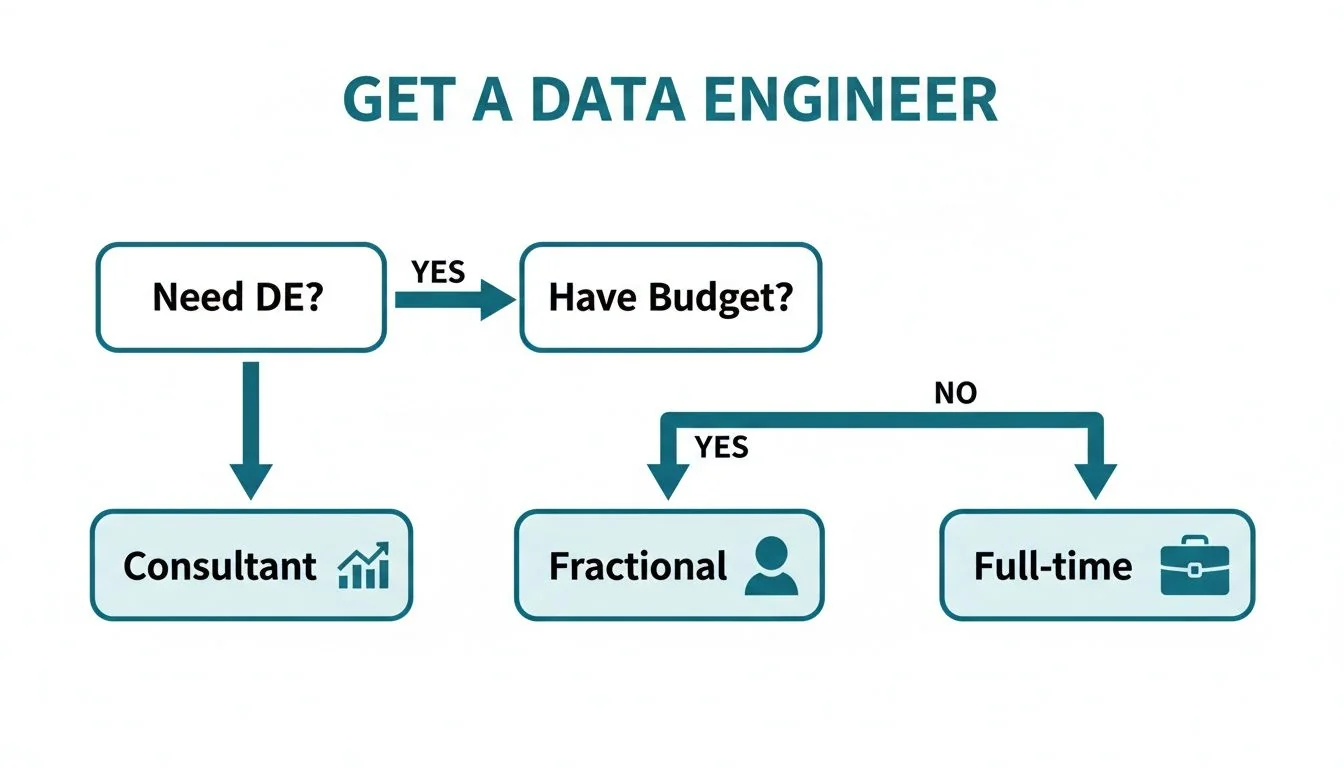
When you have a specific, project-based need and a clear budget, the fractional model gives you a direct path to senior talent without the overhead and commitment of a full-time employee.
How is fractional data engineering priced?
Fractional engagements typically fall into three structures - a monthly retainer, a block of hours, or a dedicated part-time arrangement - and pricing follows the structure rather than a flat hourly card rate agreed upfront.
Companies can put a senior data architect and an analytics engineer on retainer for under $10,000 per month, without recruitment fees, benefits, or long-term payroll commitments - a fractional team structure that works in practice, not just on paper.
Three fractional engagement models
Most fractional arrangements fall into one of three structures.
| Engagement Model | Best For | Typical Structure |
|---|---|---|
| Monthly Retainer | Ongoing support, architectural oversight, and team mentorship. | A block of 20-40 hours per month for a flat fee. |
| Block of Hours | A single, well-defined project with a clear deliverable. | A set number of hours purchased upfront for a specific goal, like a POC for dbt or Apache Airflow. |
| Dedicated Part-Time | Long-term leadership on a major initiative, requiring deep team integration. | A consistent schedule, like 2-3 days per week, functioning as a true team member. |
Retainers provide access to an expert, a block of hours completes a task, and a part-time role delivers project ownership. For a deeper look at how rates break down across specialties and seniority, see data engineering consulting rates in 2026. Our guide on fixed-price vs. time-and-materials contracts also helps with procurement.
Who actually does fractional data engineering work?

Fractional data engineers are senior specialists, not a training ground for junior talent. They’ve built, scaled, and repaired data platforms at established tech companies and fast-growing startups before going independent.
Only 3 of the 86 firms profiled in the Data Engineering Companies Index have fewer than 50 employees - most vendors in this market are built around larger, retained teams, not individual specialists. That gap is part of what draws senior engineers toward fractional and independent work instead of staying inside a firm. They bring deep expertise in specific domains like Snowflake architecture, Databricks optimization, or multi-cloud infrastructure across AWS, Azure, and GCP.
Why senior engineers choose fractional work
Senior engineers go fractional to focus on solving hard technical problems, without the meetings, politics, and management overhead of a full-time leadership role. It lets them work across industries - fintech, healthcare, enterprise SaaS - without being tied to one company’s org chart.
This is not an entry-level path. Market data on the experience levels of fractional professionals shows that 72% of people doing fractional work have 15 or more years of experience, and 30.4% have more than 26 years. Only 6.4% have less than 10 years. The model is built on proven, senior-level expertise, not a side gig for people early in their careers.
How do you evaluate and onboard a fractional partner?
Vetting a fractional partner isn’t a standard interview - you’re screening a specialist for their ability to deliver targeted impact fast. The right choice moves your roadmap forward in weeks; the wrong one burns budget and still leaves the problem unsolved.
Evaluation checklist
Use this checklist to screen potential partners before signing a contract. For a more comprehensive guide, review how to evaluate data engineering vendors.
- Hands-on technical validation: Ask for proof, not just a skills list. Are they certified in your platforms (Snowflake, Databricks, AWS, Azure, GCP)? Probe their real-world experience with critical tools like dbt or Apache Airflow.
- Relevant case studies: Vague success stories are a red flag. Demand case studies that mirror your data volume, complexity, and industry. They must walk you through the problem, the solution, and the measurable business results.
- Clear communication cadence: A strong partner proposes a communication plan, such as daily Slack stand-ups, weekly progress reports, and bi-weekly strategic check-ins.
- Explicit knowledge transfer plan: Ask directly: “What is your process for documenting work, training our team, and ensuring a clean handover?” A crisp answer indicates they plan to make your team self-sufficient, not keep you dependent on them.
- Defined security and access protocols: They must have standard operating procedures for secure system access, data handling, and a clean offboarding process.
30-day onboarding roadmap
A structured onboarding process is the best predictor of a successful fractional engagement. Ambiguity in week one creates drag that can last for months. If you need broader context first, external resources can help you hire a data engineer with the right skills.
Use this 30-day plan for execution:
- Week 1: Access and alignment. Grant necessary access to cloud consoles, code repositories, and project management tools. The kickoff meeting must establish a clear initial goal (e.g., “Audit our primary dbt project for performance bottlenecks”) and introduce key team members.
- Week 2: Audit and quick wins. The partner should audit your existing architecture, documentation, and code. By the end of the week, they must present initial findings and at least one quick win - a small, high-impact fix they can implement immediately.
- Weeks 3-4: Execution and reporting. The partner executes on the primary objective. The agreed-upon communication rhythm should be active, with clear progress updates and immediate flagging of any roadblocks.
What red flags signal a bad fractional hire?

The clearest warning sign is a pitch built from tech buzzwords instead of a clear rationale. If a provider can’t explain why a specific platform fits your business problem, they’re pitching what’s comfortable for them, not what actually solves your problem. Choosing the wrong fractional partner sets you back months.
Vague track record, unclear process
Pay close attention to their track record. If success stories lack specific metrics on performance gains or cost savings, the impact they delivered is questionable. A partner’s inability to detail their offboarding process is a clear sign they intend to create vendor lock-in. A true expert builds systems your team can own and operate independently.
Pricing red flags and overcommitment
Be wary of rigid contracts that lack clearly defined Service Level Agreements (SLAs). You need concrete commitments on response times and deliverables, not vague promises. Unusually low rates often mean you’re getting a junior engineer disguised as a senior expert, which leads to technical debt down the line.
Finally, ask them directly about their current client load. A fractional engineer stretched across too many projects will lack focus, which shows up as missed deadlines, rushed work, and a partner too busy to give your project the attention it requires.
Next Steps
If you have a specific, high-impact data engineering project blocked by your team’s capacity, and you need senior-level expertise now, a fractional engagement is the most direct path to execution.
- Define the scope. Identify the single most critical project. Write a one-page brief outlining the problem, the desired business outcome, and the key deliverable.
- Set the budget. Based on the benchmarks above, determine a realistic monthly budget for a retainer or a fixed budget for a block-of-hours project.
- Initiate vetting. Use the evaluation checklist in this guide to begin conversations with at least two potential fractional partners. Demand specific, evidence-based answers.
Don’t let a critical data initiative stall while you search for a full-time hire. A fractional expert can be working on the problem within weeks.
- Part of our guide: Enterprise Data Engineering →

Researched & written by
Peter Korpak , Chief Analyst & Founder
Data-driven market researcher with 20+ years in market research and 10+ years helping software agencies and IT organizations make evidence-based decisions. Former market research analyst at Aviva Investors and Credit Suisse.
Previously: Aviva Investors · Credit Suisse · Brainhub · 100Signals
- Accenture779000 people · unverified
Large enterprises running multi-cloud transformations across AWS, Azure, and GCP simultaneously, where a single integrator needs to own the full program.
Listed, not reviewed - Adastra2000+ people (see scope)
Enterprise data, cloud, and analytics work across financial services, insurance, retail, and other sectors. Ask for references from similar projects.
Reviewed - Capgemini300000 people · unverified
European industrial and engineering-intensive enterprises running Industry 4.0 or R&D data programs where manufacturing-domain depth and on-continent delivery are requirements.
Listed, not reviewed
More in Enterprise Data Engineering
The 10-Point Data Engineering Due Diligence Checklist for 2026
Don't hire a consultant without this data engineering due diligence checklist. Vet firms on architecture, cost, governance, and team skills before you sign.
Your Guide to Data Engineering Consulting Services
A practical guide to data engineering consulting services: costs, engagement models, vendor selection, red flags, and platform-specific guidance.
Data Engineering Partner Selection: The 2026 Five-Stage Framework
A 2026 framework for data engineering partner selection: pre-RFP signal scan, sourcing, evaluation, paid pilot, contract, and 90-day handover.