Fixed Price vs. Time and Materials: An Analytical Guide for Data Leaders
fixed price vs time and materials, data engineering, project management, vendor management, agile contracts
For data engineering work, pick Time and Materials (T&M) unless the scope is genuinely static: requirements shift, data sources surprise you, and a fixed-price contract punishes discovery instead of rewarding it. Fixed Price still wins for narrow, well-documented jobs like a lift-and-shift migration, where the deliverable is known before anyone writes code.
What’s the actual difference between Fixed Price and T&M?
Fixed Price sets one total cost for a defined scope; the vendor absorbs the risk of underestimating. T&M bills for actual hours and materials as work happens; the client absorbs that risk but pays only for effort actually spent, with full visibility into where the money goes.
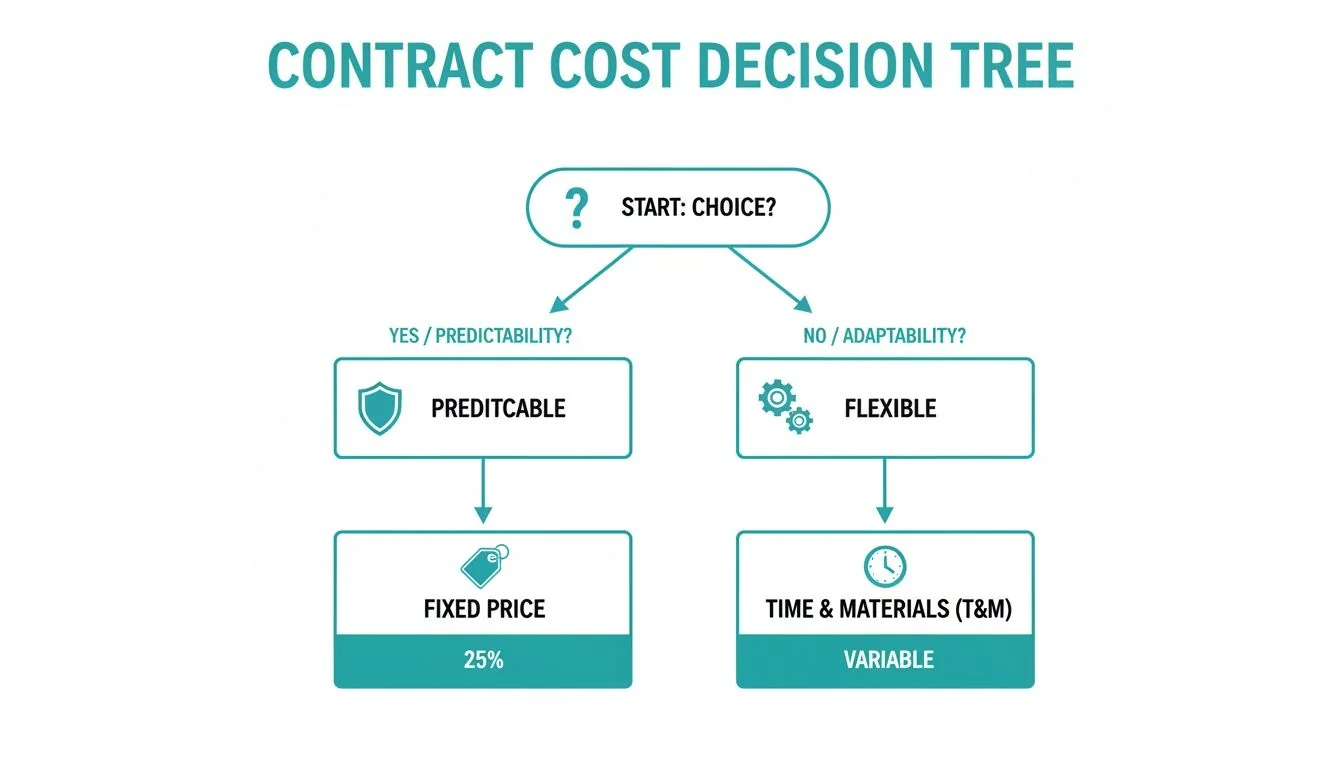
Choosing between them isn’t a pricing footnote - it sets who bears the cost when a migration turns up more technical debt than the RFP assumed, and how much say your team gets in a project that runs a year or longer.
Whether you’re migrating to Snowflake or building a new AI/ML pipeline, exhaustive upfront planning is rarely realistic. New data sources, shifting business logic, and technical debt show up mid-project as a matter of course. The contract model decides how those surprises get handled - and paid for.
A Norwegian study of 35 public-sector software projects found 83% of Time and Materials engagements succeeded, versus 38% of fixed-price ones. The same analysis found that forcing exhaustive upfront planning for fixed-price contracts delayed kickoff by 20-30% on average, without producing better outcomes. (Study cited via BayTech Consulting’s 2025 analysis, which discusses the original findings.)
The operative question isn’t “which model is cheaper?” It’s “which model creates the right incentives for this project?” The answer depends on who should bear the risk of uncertainty - the client or the vendor.
| Feature | Fixed Price Model | Time & Materials (T&M) Model |
|---|---|---|
| Primary Benefit | Budget predictability and low financial risk | High flexibility and adaptability |
| Best For | Well-defined, stable, short-term projects | Complex, long-term, or evolving projects |
| Scope Management | Rigid; changes require formal change orders | Agile; scope can be adjusted iteratively |
| Client Involvement | Low day-to-day engagement required | High collaboration and regular feedback |
Who carries the risk in each model?
In Fixed Price, the vendor carries nearly all the financial risk: they’ve committed to a scope and a price, so underestimated complexity eats their margin, not your budget. In T&M, the client carries the risk: you pay for whatever time and resources the work actually takes.
That difference shapes behavior on both sides. A vendor locked into a fixed price has an incentive to defend the original scope and resist changes, even useful ones, because every addition erodes their margin. A vendor on T&M has less reason to fight scope changes, but the client has to stay engaged to keep costs in check. Fixed Price buys a feeling of safety; T&M buys a working partnership, at the cost of closer oversight.
How does budget control differ between the two?
Fixed Price gives you one number up front, which simplifies financial planning and stakeholder reporting - barring scope changes, there are no surprises. T&M gives you a variable total but a transparent one: detailed reporting shows exactly where every hour and dollar went, and you can scale resources up or down as priorities shift.
The trade-off is a predictable total versus visibility into a variable one. The right choice depends on whether your organization needs a fixed forecast more than it needs the ability to adapt spending to what the project actually requires.
How is scope managed under each model?
A Fixed Price project runs on a Statement of Work (SOW) that spells out every feature and deliverable in advance; any deviation triggers a formal change-control process, with the delays and cost that implies. A T&M project typically runs on an agile backlog - a prioritized, living list of tasks that can be reprioritized sprint to sprint without renegotiating the contract.
That flexibility matters most when discovery is part of the job. If mid-project feedback on a data platform modernization suggests a better approach, a T&M team can pivot in the next sprint. A fixed-price team has to raise a change order first.
Do the incentive structures actually differ, or is this a talking point?
They differ in a concrete way: under Fixed Price, a vendor protects margin by finishing as fast as possible, which can mean cutting corners on scalability or test coverage. Under T&M, the vendor is paid for the time either way, so there’s less pressure to rush - and more room to fix technical debt properly, since client satisfaction (not a fixed invoice) determines whether the engagement continues.
Which model demands more admin work, and when?
Fixed Price front-loads the admin burden: weeks or months of detailed requirements-gathering before development starts. T&M spreads it across the project instead - lighter upfront planning, but continuous engagement afterward: reviewing weekly progress, tracking burn rate, and sitting in on sprint planning.
Core mechanics, side by side
| Project Dimension | Fixed Price Model | Time and Materials (T&M) Model |
|---|---|---|
| Risk | Vendor absorbs cost overruns; high risk for the delivery team if scope is underestimated. | Client absorbs cost overruns; high risk for the client if scope is unclear or expands. |
| Budget | Predictable and fixed. Set at the start, making financial planning simple. | Flexible and variable. Based on actual effort, offering transparency but less predictability. |
| Scope | Rigid. Defined in a detailed SOW; changes require a formal, often costly, process. | Flexible. Managed via an agile backlog; can be adapted sprint-by-sprint. |
| Quality Focus | Incentive is on efficiency and speed to protect profit margins. Can risk technical debt. | Incentive is on thoroughness and quality to ensure client satisfaction and continued work. |
| Client Role | Heavily involved upfront in defining scope, then steps back for oversight. | Continuously involved in prioritization, feedback, and budget management. |
| Best For | Well-defined, stable projects with zero ambiguity (e.g., a lift-and-shift migration). | Complex, evolving projects where requirements are likely to change (e.g., AI/ML pipelines). |
There’s no universally correct choice here. It depends on how well-defined the project actually is, how much risk your organization can absorb, and how much flexibility the work genuinely needs.
Why does a “cheaper” fixed-price bid often cost more in the end?
Because vendors price in a risk premium you never see itemized. A fixed-price quote typically includes a 20-30% cushion over the vendor’s actual cost estimate, to protect their margin against scope creep and estimation error - and if the project goes smoothly, that cushion becomes pure vendor profit that never returns to you.
A straight comparison of a fixed-price bid against a T&M proposal is misleading for exactly this reason: the fixed-price number already has a hidden buffer baked in, while the T&M number doesn’t.
How big is the fixed-price risk premium in practice?
A project that actually requires $200,000 in effort commonly gets quoted at $240,000-$260,000 once the vendor’s risk cushion is added. You’re pre-paying for contingencies that may never happen; if the team works efficiently, that premium is money you’ll never see back.
A fixed-price contract doesn’t eliminate the cost of uncertainty - it transfers the risk to the vendor, and you pay a premium for the transfer. The real question is whether that insurance is worth the price.
This shows up clearly in data work: a $100,000 fixed-price pipeline quote likely carries a $20,000-$30,000 buffer for unknowns like shifting analytics requirements or a mid-project pivot between Snowflake and Databricks. According to elitecoders.co’s comparison of the two models, a T&M engagement that skips this embedded buffer can come in well below the fixed-price equivalent over the life of a project.
What makes T&M pricing transparent by comparison?
Because the invoice is the audit trail: you pay the agreed rate for actual hours worked plus materials, with no hidden buffer. If a task finishes faster than estimated, you keep the savings immediately - the cost structure has nothing to hide, unlike a fixed bid with an invisible margin built in. Run your own numbers with our data engineering cost calculator before you commit to either model.
That transparency comes with a catch: it puts budget oversight on you, not the vendor. Without discipline, T&M can drift. Three controls keep it in check.
- Weekly burn reports. The vendor should report hours logged, progress against milestones, and remaining budget - non-negotiable, not optional.
- Active prioritization. Your team needs to be in sprint planning so engineering time stays pointed at the highest-value work.
- Budget caps. A not-to-exceed clause, or per-phase caps, keeps flexibility without an open-ended bill.
The real cost of a project isn’t just the final invoice - it’s the value of what got delivered, plus the ability to adapt when new information shows up. A T&M project that runs 10% over budget but ships something aligned with current needs usually beats a fixed-price project that lands on budget but ships something already out of date.
Which model fits which kind of data engineering project?
Match the model to how well the scope is actually known, not to how the vendor prefers to bill. A rule of thumb: T&M for anything involving discovery or experimentation, Fixed Price for anything repetitive and already fully specified.
Cloud data platform modernization
Use T&M. Even when the end goal - moving off on-prem servers onto a modern cloud stack - is clear, hidden data dependencies and unexpected technical debt surface during implementation almost every time. T&M lets the team adjust sprint to sprint as those surface, so the final platform reflects what the business actually needs rather than a literal copy of the legacy system. Trying to pin a multi-year modernization to a fixed-price contract means defining every detail before you’ve seen the system - an approach that kills the discovery the project depends on.
Snowflake or Databricks migration
Use a hybrid. Migrations to Snowflake or Databricks usually split into two phases with very different risk profiles: a predictable “lift-and-shift” of existing, documented warehouses, followed by optimization work - refactoring logic, rewriting queries, building new models to use the platform’s features - that’s inherently harder to scope upfront.
- Phase 1 (lift-and-shift): Fixed Price. The tasks are repetitive and the scope is stable.
- Phase 2 (optimization and expansion): T&M. The team needs room to explore the new platform without a rigid SOW boxing them in.
AI and ML data pipeline development
Use T&M - it’s close to the only workable option. Building pipelines for AI/ML is an experimental cycle of hypothesis, feature engineering, and iterative training, where requirements change based on what the model actually does. Locking that into a fixed price forces the vendor to chase the original (often wrong) scope instead of the better model that discovery would surface.
Forcing an AI/ML project into a fixed-price contract sets it up to fail: it rewards delivering the original plan over delivering the right one, which misreads how exploratory work happens.
The same Norwegian dataset cited above found T&M models reaching 83% success rates in comparable environments, versus 38% for fixed-price. BayTech Consulting’s 2025 analysis covers how fixed-price contracts can work against innovation-heavy projects specifically.
What if I need some budget certainty without going full Fixed Price?
Three hybrid structures split the difference:
- Capped T&M: Standard T&M plus a not-to-exceed clause - flexibility with a hard ceiling on spend.
- Fixed Price Per Sprint: Each sprint is its own mini fixed-price engagement, so costs stay predictable in short intervals while the backlog can still be reprioritized before the next one starts.
- T&M with Performance Incentives: Part of the vendor’s fee is tied to milestones or metrics, aligning incentives without sacrificing day-to-day flexibility.
What should the contract and governance actually look like?
Picking a model is only step one - the SOW or MSA is what makes the model work in practice. Weak contracts lead to disputes and budget overruns regardless of which pricing model you picked.
What does a well-built Fixed Price contract require?
Precision, in three specific places. Vague deliverables like “a user-friendly dashboard” don’t hold up; you need measurable criteria - for example, “the sales dashboard loads in under 3 seconds with 50 concurrent users, with data latency under 15 minutes.”
- Ironclad acceptance criteria - testable, not descriptive.
- A defined change-control process - who approves changes, and how fast.
- Milestone-based payment - tied to delivery and formal acceptance, not just elapsed time.
A Fixed Price contract is only as good as its precision. If a deliverable can’t be defined with objective, testable criteria, it doesn’t belong in a fixed-scope agreement.
What clauses actually protect a T&M agreement?
The contract’s job shifts from defining what gets built to controlling how the engagement runs.
- Detailed rate cards - locked-in hourly or daily rates by role for the duration of the contract.
- Resource approval workflow - no one bills time without written client sign-off first.
- Transparent time tracking - weekly timesheets broken down by task, not just total hours.
- Budget caps or not-to-exceed limits - a hard ceiling that still preserves T&M’s flexibility.
What reporting cadence keeps either model on track?
A data engineering RFP checklist is useful before you sign anything, but the cadence below is what keeps a signed contract honest:
| Reporting Cadence | Fixed Price Focus | Time and Materials Focus |
|---|---|---|
| Weekly | RAG Status on Milestones | Budget Burn vs. Actuals Report |
| Bi-Weekly | Demos of In-Progress Deliverables | Review of Sprint Burn-Down Charts |
| Monthly | Review of Change Request Log | Resource Utilization & Team Efficiency Report |
How do you evaluate a vendor’s contracting approach during procurement?
Watch how they answer, not just what they say. A vendor’s stance on Fixed Price versus T&M tells you how they think about risk, change, and collaboration before you’ve signed anything.
- For Fixed Price bids: “Walk me through your change control process. What happens when a critical requirement shows up mid-project?” A vague answer is a red flag.
- For T&M proposals: “What reports do we get, and how often, to track burn and progress?” Look for specifics - weekly burn-down charts, direct dashboard access - not just a promise of “transparency.”
- For agile projects: “Tell me about a time you hit unexpected technical debt. How did you communicate it, and how did the plan change under T&M?”
How a vendor handles the unforeseen predicts their performance better than their opening quote does. A low fixed-price bid from an inflexible vendor often ends up costing more, through delays and rework, than a T&M engagement with a communicative team.
What are the red flags?
- Pushing Fixed Price for R&D work. A vendor insisting on fixed price for an experimental AI/ML pipeline either misunderstands the work or has priced in a heavy risk premium.
- Vague reporting practices. If a T&M proposal is fuzzy on how time gets tracked and reported, that’s a preview of weak project governance.
- No access to senior talent. If you can’t talk to a senior architect during vetting, you’re not actually evaluating the team that will do the work.
For a fuller evaluation framework, see how to choose a data engineering company. Rate expectations matter here too: see our data engineering consulting rates guide for how firm type and delivery model shape price, and get written quotes before judging whether a rate card is in line with the market.
Common questions
Can a T&M project just run forever and blow the budget?
Yes, but only under lax governance - T&M isn’t a blank check. Set a not-to-exceed clause, require weekly burn reports, and keep your team in sprint planning to control priorities. With those three controls in place, you get T&M’s flexibility without open-ended risk.
Is Fixed Price always cheaper for a well-defined project?
Not necessarily. A fixed-price quote almost always includes a 20-30% risk premium the vendor keeps as profit if nothing goes wrong. For a genuinely well-defined scope, T&M can come in cheaper precisely because you’re not paying for contingency planning you didn’t need.
How does a “Capped T&M” hybrid actually work?
It’s standard T&M - you pay for hours worked at an agreed rate - with a hard budget ceiling added on top. You keep the ability to reprioritize as the project evolves, while still having a guaranteed maximum spend, which suits projects that need flexibility but operate under a fixed budget cap.
Choosing the right pricing model gets you halfway there; the other half is picking the right partner. Our data engineering statement of work guide covers how to translate whichever model you pick into a contract that actually holds up - and the 2026 directory profiles 86 firms by rate, platform focus, and fit signals if you’re ready to shortlist vendors.
- Part of our guide: Enterprise Data Engineering →

Researched & written by
Peter Korpak , Chief Analyst & Founder
Data-driven market researcher with 20+ years in market research and 10+ years helping software agencies and IT organizations make evidence-based decisions. Former market research analyst at Aviva Investors and Credit Suisse.
Previously: Aviva Investors · Credit Suisse · Brainhub · 100Signals
- Slalom10,000+ employees · unverified
Consider Slalom for enterprise digital transformation, including AWS and GenAI programs. Ask for comparable implementations and the proposed cloud and data engineering team.
Listed, not reviewed - Accenture779000 people · unverified
Large enterprises running multi-cloud transformations across AWS, Azure, and GCP simultaneously, where a single integrator needs to own the full program.
Listed, not reviewed - Adastra2000+ people (see scope)
Enterprise data, cloud, and analytics work across financial services, insurance, retail, and other sectors. Ask for references from similar projects.
Reviewed
More in Enterprise Data Engineering
Mastering the Data Engineering Statement of Work
Craft a bulletproof data engineering statement of work. Our guide offers actionable clauses, pricing models, and a template to keep your data projects on track.
10 Actionable Vendor Management Best Practices for Data Engineering in 2026
Discover 10 actionable vendor management best practices for data engineering. Get practical insights on RFPs, SLAs, cost control, and risk reduction.
Data Engineering Vendor Evaluation Criteria: 35 Criteria for 2026
The complete 35-criterion evaluation framework for choosing a data engineering vendor in 2026 - definitions, verification, red flags, and weighting.