Your Guide to Data Engineering Consulting Rates 2026
Heading into 2026, expect to pay between $150 to $400 per hour for a skilled data engineering consultant. This is not a fixed number. Rates can exceed $850 per hour for global firms or drop to around $85 per hour for an experienced freelancer, contingent on project requirements.
The 2026 Data Engineering Rate Landscape
To budget effectively for the upcoming year, you need a clear understanding of the market. The demand for specialized data engineering talent—particularly for experts in platforms like Snowflake, Databricks, and Google Cloud—directly drives costs.
The consulting market is tiered. Each tier serves a specific project type and budget. Identifying where your needs fit is the first step in building a realistic financial plan.
Consultant Tiers and What They Cost
The cost of a data engineering consultant is directly tied to their experience and the type of company they represent. Our analysis at DataEngineeringCompanies.com identifies three main brackets.
-
Global System Integrators & Big Four Firms: This is the top of the market. Rates range from $350 to $850+ per hour. These firms are structured for large-scale, multi-year digital transformation initiatives where risk management and strategic oversight are as critical as technical execution.
-
Mid-Sized & Boutique Specialists: This is the optimal choice for many businesses. These firms provide deep, specialized knowledge for $125 to $175 per hour. They are ideal for targeted projects like a Databricks migration or Snowflake environment optimization.
-
Independent Freelance Consultants: Freelancers offer flexibility for specific tasks or to augment an existing team. A competent independent data engineer typically charges around $85 per hour, though rates can be higher for those with rare, high-demand skills.
By 2026, consultants who build data pipelines for generative AI models are in a distinct category. Their expertise in AI/ML infrastructure commands rates 20-30% higher than engineers focused on traditional business intelligence.
To help you compare these rates, here is a summary of typical costs.
2026 Data Engineering Consulting Rates at a Glance
This table breaks down hourly rates and project minimums by consultant type, helping you align options with your budget.
| Consultant Type | Typical Hourly Rate (USD) | Common Minimum Project Size (USD) | Best For |
|---|---|---|---|
| Elite Global Firm | $350 - $850+ | $1,000,000+ | Large-scale, strategic digital transformations |
| Boutique Specialist | $125 - $175 | $75,000 | Platform modernizations, specific outcomes |
| Independent Freelancer | $85 - $150 | $10,000 | Team augmentation, targeted task completion |
This table provides a solid starting point for any budget discussion. It frames the investment realistically, whether you need a single expert for a short-term task or a full team for a major overhaul.
How to Set a Realistic Budget Anchor
Knowing these rate bands is key to effective budget planning. It allows you to create a ballpark estimate before issuing an RFP or engaging with vendors, preventing sticker shock and giving you control of the discussion. For more detailed analysis, using specialized salary benchmarking tools can help you cross-reference market data and validate your figures.
For instance, if you are planning a six-month project requiring two senior consultants from a boutique firm, you can calculate a solid starting figure for internal discussions. This step shifts the conversation from “cost” to “investment,” linking the budget directly to the desired business outcome. The remainder of this guide will explain how to refine that number based on your project’s specifics.
Comparing Consultant Tiers: Enterprise, Mid-Size, and Freelance
The rate on a data engineering proposal is more than just a number; it reflects the resources, processes, and strategic thinking a partner brings to your project. The choice of partner is not just about budget; it determines the speed, scale, and strategic depth of your data initiative. The data engineering consulting rates 2026 market is segmented, and matching your project’s requirements to the right partner type is the first step toward success.
This graphic gives an overview of the data consulting landscape and how rates compare.
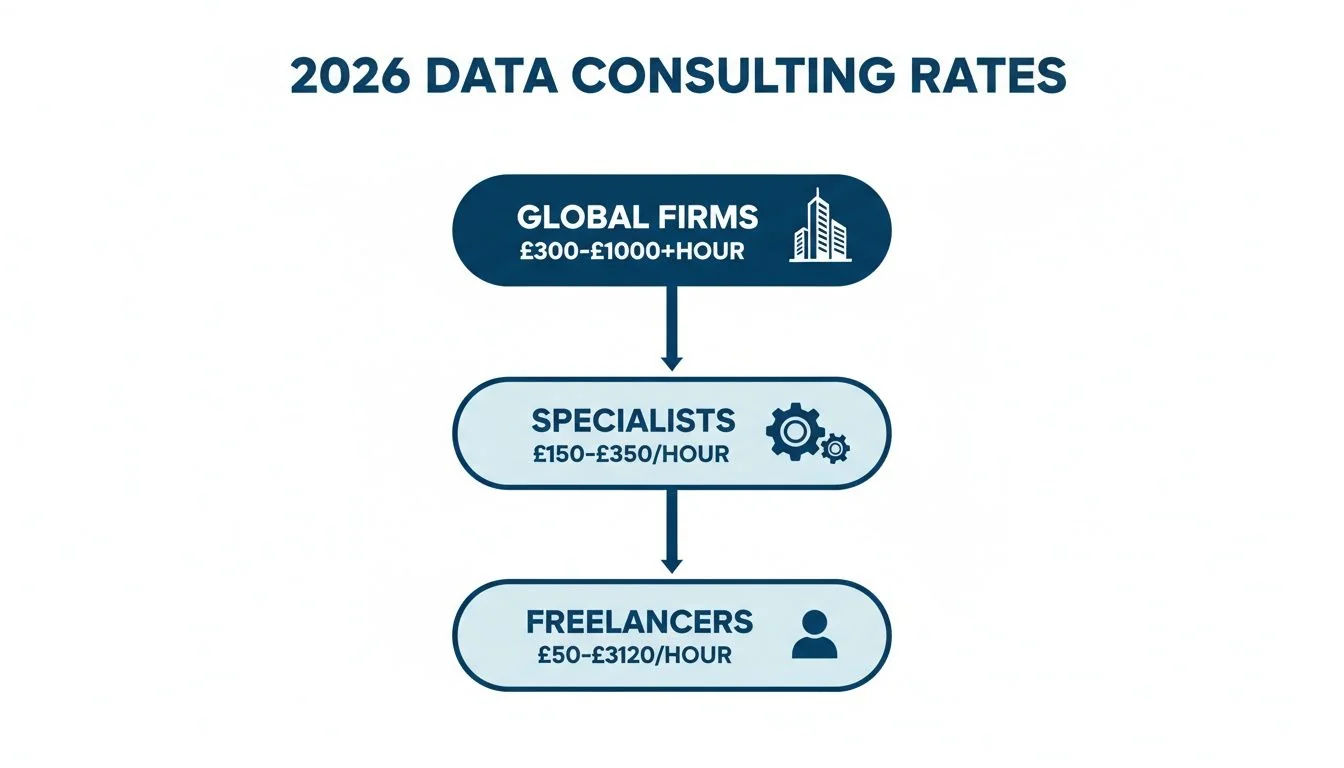
Rates increase significantly from a solo freelancer to a global enterprise firm. This price difference is attributable to the scope of services and the organizational infrastructure supporting the work.
Enterprise Firms: The Strategic Architects
At the top are enterprise-level players—the “Big Four” and major global system integrators. Their rates, in the $350 to $850 per hour range, are justified by the scope of their work. They are not just building data pipelines; they are managing large-scale business transformations.
You engage these firms when the project extends beyond technology. They excel in scenarios such as:
- Petabyte-scale transformations: Overhauling an entire data ecosystem for a Fortune 500 company.
- Complex regulatory environments: Navigating compliance in industries like finance or healthcare, where errors can have catastrophic consequences.
- Global program management: Coordinating work across continents, business units, and complex technology stacks.
When you hire an enterprise firm, you pay for a proven methodology, robust risk management, and C-suite-level strategic advice. The high hourly rate covers senior engineers, project managers, business analysts, and subject matter experts with deep industry knowledge.
Mid-Sized Specialists: The Value Sweet Spot
For most businesses, mid-sized and boutique consultancies offer the best balance of expertise and cost-effectiveness. With rates typically between $125 and $175 per hour, they deliver specialized talent without enterprise-level overhead.
Mid-sized firms are like special forces units. They deploy targeted, high-impact teams to solve specific, complex problems without the logistical footprint of a full army.
These specialists are the go-to partners for well-defined projects with clear outcomes. Consider them for initiatives like:
- Migrating a legacy data warehouse to Snowflake or Databricks.
- Building a new data governance framework.
- Optimizing data pipelines for new analytics or AI/ML models.
Their singular focus is data engineering. You get a team that lives and breathes data platforms. This intense focus often results in faster delivery and more pragmatic solutions for the platform modernization projects most companies face.
Freelance Experts: The Tactical Reinforcement
Independent freelance consultants provide a flexible, surgical way to access top-tier talent for specific needs. While average rates are often around $85 per hour, elite freelancers with in-demand niche skills can command $150 per hour or more.
Hiring a freelancer is a tactical decision, ideal for:
- Targeted expertise: A specialist to solve a problem with a tool like Fivetran or dbt.
- Staff augmentation: An extra senior-level engineer to help your team meet a project deadline.
- Short-term support: A temporary expert to design a critical data pipeline or perform a quick platform audit.
The trade-off is that working with freelancers requires more hands-on management from you, as you are not paying for the project management layer a firm provides. For companies with strong internal leadership, it is an effective way to get direct access to senior talent at a lower cost.
What Actually Drives Your Total Consulting Costs

The hourly rate on a proposal is just the starting point. To understand the potential investment, you must look beyond that single number and examine the factors that shape the final cost. The data engineering consulting rates 2026 you are quoted are one piece of a larger puzzle.
Multiple variables determine the true total cost of a data engineering project.
Project Scope and Complexity
The single largest cost driver is the project’s scope. A small, tightly defined task will always cost less than a complete overhaul of your data infrastructure.
-
A Targeted Fix: Optimizing a single slow data pipeline might take one consultant a few weeks. The scope is small, the goal is clear, and the cost is contained.
-
A Full Platform Migration: Migrating an entire analytics stack from a legacy on-premise system to a modern cloud platform is a massive undertaking involving months of work, multiple engineers, and significant project management. The total cost will be orders of magnitude higher.
Scope creep—the expansion of project goals beyond the original agreement—is a silent budget killer. A clear statement of work is your best defense against unplanned work and costs.
Required Expertise and Team Composition
The specific skills of the consultants on your project directly impact the blended hourly rate. Not all data engineers are equal, and their specialization is a major cost factor.
A project requiring a certified Databricks architect with extensive generative AI experience will command a premium compared to a project a generalist data developer could handle.
This is especially true as the market for advanced skills intensifies. For 2026, data engineering consulting rates for top-tier enterprise firms are rising to an average of $350 to $850 per hour. This surge reflects the intense demand for expertise in cloud platforms like Snowflake and Databricks, driven by the global push into AI and ML. A Forrester-inspired analysis shows that 70% of CIOs are now prioritizing cost-effectiveness, but weighed heavily against proven delivery quality. This is driving rates even higher for firms that have a track record of scaling solutions in complex industries like finance and healthcare.
Geography and Delivery Model
The physical location of your consulting team also plays a significant role in the final cost. Choosing between onshore, nearshore, and offshore resources can lead to dramatic price differences.
- Onshore: Consultants in your own country offer the smoothest communication but have the highest rates.
- Nearshore: Teams in nearby countries (e.g., Latin America for a US client) balance cost savings with convenient time-zone alignment.
- Offshore: Consultants in distant regions like India or Eastern Europe offer the largest cost reductions but can introduce communication and time-zone challenges.
Many firms now use a hybrid or “blended-shore” model, pairing senior onshore architects with offshore development teams to balance cost and quality. This has become an effective strategy.
As you engage consultants, it’s also important to understand what the best cloud cost management softwares for 2026 can do, as this is vital for controlling the project’s underlying infrastructure spending.
By mapping these cost drivers to your specific needs, you can move from a vague estimate to a confident budget. To refine your numbers further, try our specialized tool. Check out the Data Engineering Cost Calculator to get a more precise estimate.
Choosing the Right Engagement Model for Your Project
Hiring the right data engineering consultant is a critical first step, but how you structure the engagement is just as important. The commercial model sets expectations for incentives, risk management, and budget predictability.
Getting this choice right is fundamental to making a smart investment in your data engineering consulting rates 2026. The three main models are Time & Materials, Fixed-Price, and Retainer. Each has its place, and selecting the right one upfront helps avoid mismatched expectations and budget overruns.
Time & Materials (T&M): The Flexible Build
A Time & Materials (T&M) model is like paying a mechanic by the hour to restore a classic car. You pay for the actual time and parts used, which provides flexibility to adapt as unforeseen issues arise.
This model is a good fit for projects where requirements are not fully defined. Think of scenarios like:
- AI/ML experimentation: Testing different models where the project’s direction depends on early findings.
- Complex system troubleshooting: Investigating a data integrity issue where the root cause is unknown.
- Agile development sprints: Working with a dynamic backlog where priorities may shift.
The primary benefit of T&M is adaptability. You can pivot quickly without renegotiating the contract, ensuring the team is always focused on the highest-value tasks. The trade-off is less budget certainty. It requires strong project management and regular check-ins to control costs.
For a deeper look, see our guide on fixed-price versus time and materials models.
Fixed-Price: The Predefined Blueprint
A Fixed-Price project is like buying a pre-built shed from a catalog. You know the exact specifications and price beforehand. The consultant commits to delivering a specific outcome for one all-in price.
This approach works best when you have clear, well-documented requirements and a fixed scope. It’s a good choice for tasks like:
- A specific database migration: Moving a defined set of tables from SQL Server to Snowflake.
- Building a single, well-defined dashboard: Creating a sales performance dashboard with pre-agreed KPIs.
- A platform security audit: Evaluating your data platform against a known compliance framework like SOC 2 or HIPAA.
The power of a Fixed-Price project is its predictability. It transfers the risk of time and cost overruns to the consultant, giving you budget certainty. The catch is that any change, no matter how small, will likely require a formal—and often costly—change order.
Retainer: The Specialist on Call
The Retainer model is like having a specialist doctor on call. You pay a consistent fee to secure their time and expertise for ongoing needs, from emergencies to routine advice. This is about a long-term strategic partnership, not a single project.
Retainers are ideal for situations requiring ongoing maintenance, optimization, and expert guidance. Our analysis at DataEngineeringCompanies.com shows this is a popular model, especially with mid-sized firms.
By 2026, these consultancies—typically with 10 to 100 developers—offer significant value for cloud modernization projects, with rates around $125-$175 per hour in the US. Their expertise is especially sought in industries like logistics and retail, where specialized knowledge can drive rate variations of 20-30%. You can find more consulting trends and statistics in the full Runn.io blog post.
How to Evaluate Proposals and Negotiate Value
Once proposals arrive, the real work begins. It’s tempting to focus on price, but the lowest hourly rate rarely indicates the best value. This is a common trap.
True negotiation isn’t about haggling over hours; it’s about dissecting the proposal to understand the results you’re buying. The goal is to shift the conversation from cost to value. This requires looking past the price to scrutinize the team, deliverables, and the experience behind the estimate. A low bid from an unqualified team is a fast track to project failure and expensive recovery efforts.
Moving Beyond the Blended Rate
A “blended rate” can hide inefficiencies. It averages the cost of senior architects and junior developers into a single number. While simple, it often masks an unbalanced team structure.
Ask for a detailed breakdown of roles and responsibilities. What percentage of the project will a $300/hr senior architect handle versus a $125/hr junior engineer? An over-reliance on junior talent might lower the blended rate but can lead to slower progress, rework, and a project that ultimately costs more and delivers less.
The most effective proposals clearly define roles and responsibilities. They map specific senior resources to critical, high-risk tasks and assign junior talent to well-defined, lower-complexity work under proper supervision.
Scrutinizing Experience and Defining Success
Every consulting firm will claim “relevant experience.” Your job is to verify it. Don’t accept vague statements like “we’ve worked in your industry.” Ask for specific, verifiable proof.
- Who was the client?
- What was the specific business problem you solved?
- What technologies did you use, and what was the tangible outcome?
This level of detail separates firms with genuine expertise from those with just a polished sales deck.
Equally important is defining what success looks like for your project. Clear acceptance criteria are non-negotiable. These are the specific, measurable conditions that must be met for you to sign off on a deliverable. Without them, you risk disagreements over subjective opinions at the project’s conclusion.
This screenshot of the DataEngineeringCompanies.com homepage shows how you can filter firms by industry and platform expertise, which helps you build a shortlist of qualified partners from the start.
Using a resource like this lets you pre-vet consultancies, ensuring the proposals you receive are from firms with a proven track record in your specific domain.
Common Red Flags in Proposals
As you review proposals, watch for warning signs that may signal a poor fit or future problems.
- Vague Deliverables: Be wary of statements like “optimize data pipelines” or “improve data quality.” Without specific metrics, they are meaningless. A strong proposal will state, “reduce pipeline processing time by 30%” or “decrease the data error rate to less than 1%.”
- Over-reliance on Subcontractors: You need to know who is doing the work. If a firm heavily uses undisclosed subcontractors, you could face quality control and communication issues.
- No Risk Mitigation Plan: Every project encounters obstacles. A professional firm anticipates potential roadblocks and outlines a plan to navigate them. The absence of this foresight is a major concern.
It’s also worth noting the rise of freelance talent. Freelance data engineering consultants offer a flexible alternative, commanding a global average hourly rate of $83.42 in 2026. This trend allows executives to scale AI/ML pipelines more cost-effectively. In fact, methodologies sourced from Everest Group show that 55% of organizations now blend freelance talent with boutique firms. This hybrid approach has successfully lowered minimum project thresholds from $125,000 down to just $50,000. You can explore these freelance data engineering consulting rates and trends in more detail on ContractRates.fyi.
Connecting Consulting Rates to Business ROI

The true test of any data engineering project is not its cost, but the value it creates. It’s easy to focus on hourly rates, but this misses the larger picture. The goal is to shift the conversation from “expense” to “investment,” which requires a clear line of sight from consulting fees to tangible business returns.
Paying a premium for the right expertise often yields returns that make the initial price seem insignificant. Thinking in terms of ROI forces you to define success in financial terms before the project begins. This provides a powerful lens for evaluating proposals and holding your partner accountable for delivering results.
Building a Practical Business Case
Justifying the investment starts with a simple question: “If this project is successful, what will it be worth to our business?” The key is to translate technical outcomes into financial language. This exercise helps build a compelling story that resonates with stakeholders across the company, from the CFO to the sales team.
Here are a few common scenarios and how to quantify their impact:
- Faster Insights: If a consultant helps reduce your analytics cycle time by 30%, what does that mean? It could mean launching a product three months sooner or identifying a market trend before competitors.
- Lower Processing Costs: A project that cuts data processing overhead by 40% is a direct saving that drops to the bottom line or can be reinvested.
- Better Data Quality: What is the value of reducing data errors by 90%? Consider fewer failed marketing campaigns, more reliable financial reports, or preventing customer churn due to data errors.
The most successful data projects are built on specific, measurable goals. Instead of a vague goal like “improve our data,” a much stronger objective is to “cut operational costs by $500,000 annually by automating manual data entry.”
From Technical Metrics to Financial Outcomes
To build a solid ROI model, you must connect technical improvements to their financial consequences. This is how you confidently justify what might seem like high data engineering consulting rates in 2026.
Start by identifying your company’s key business drivers—what generates revenue or incurs costs? Then, work backward to see how better data engineering can influence them. This requires close collaboration between your technical and business leaders. A solid data strategy consultation is often the perfect starting point, as it helps align what’s technically possible with what’s strategically important.
An ROI Calculation Example
Let’s walk through a simplified scenario for a retail company.
The Problem: Their inventory system uses stale, batch-processed data, leading to stockouts of popular items and overstock of unwanted products.
The Solution: They hire a data engineering consultant to build real-time data pipelines connecting their point-of-sale systems to their inventory platform.
The Calculation:
- Consulting Cost: A six-week project at $150/hour costs $36,000.
- Value from Reduced Stockouts: The company estimates it loses $20,000 a month in sales from empty shelves. The new system is projected to cut this loss by 75%. ($20,000 * 0.75 = $15,000/month gain)
- Value from Reduced Overstock: Carrying costs for unsold inventory total $10,000 per month. Real-time data is expected to reduce this by 50%. ($10,000 * 0.50 = $5,000/month saving)
The total monthly value created is $20,000 ($15,000 + $5,000). The project pays for itself in less than two months. After that, it delivers an annual ROI of over 500%. This simple math reframes the $36,000 fee from a sunk cost to a high-yield investment.
Common Questions Answered
Here are practical, straightforward answers to some of the most common questions about data engineering consulting rates for 2026.
How Much Should a Data Engineering Project Cost in 2026?
While there’s no single price, you can build a solid estimate. A small, focused project, such as optimizing a single data pipeline, might cost between $15,000 and $40,000.
A major undertaking like a full cloud platform migration could range from $150,000 to over $1 million. The final cost depends on the project’s scope, team composition, and duration. A good starting point is to determine which type of consultant—freelancer, boutique firm, or large enterprise partner—fits your project’s complexity. This will provide a strong budgetary anchor.
Are Offshore Data Engineering Rates Always Cheaper?
On an hourly basis, almost always. A developer in a market like India or Eastern Europe might have a rate 40-60% lower than a comparable developer in the US. But that doesn’t guarantee a lower total project cost.
The sticker price of an offshore team is tempting, but true cost-effectiveness depends on managing communication overhead, time-zone differences, and cultural nuances. A poorly managed offshore project can quickly become more expensive than an onshore one due to rework and delays.
Many firms use a blended-shore model to balance cost and quality. This setup pairs senior onshore architects for strategy and client communication with offshore teams for core development, often providing an optimal balance.
What Is a “Blended Rate” and Should I Trust It?
A blended rate is an average hourly rate for the entire project team, mixing senior and junior developer costs. It simplifies a proposal but can be misleading. A low blended rate may indicate a team with too many junior, less experienced members.
Ask for a full breakdown. A trustworthy partner will provide details on team members, their individual rates, and their allocated hours. You want to see senior experts focused on the most complex parts of the project. Transparency is a positive sign.
How Can I Ensure I Get a Good Return on My Investment?
Shift your focus from technical tasks to business outcomes. Before signing a contract, define what success looks like in financial terms. Don’t just aim to “build a new data warehouse.” Instead, set a goal like, “reduce operational reporting time by 50%, saving $200,000 annually in labor costs.”
When you tie the data engineering consulting rates for 2026 directly to a calculated ROI, the project becomes a strategic investment rather than a cost center. This provides a clear yardstick for measuring success and holds your consulting partner accountable for delivering tangible value.
Ready to find the right data engineering partner for your 2026 initiatives? DataEngineeringCompanies.com provides transparent rankings, verified firm profiles, and practical tools to help you select a consultancy with confidence. Start your search and build your shortlist today.
Data-driven market researcher with 20+ years in market research and 10+ years helping software agencies and IT organizations make evidence-based decisions. Former market research analyst at Aviva Investors and Credit Suisse.
Previously: Aviva Investors · Credit Suisse · Brainhub
Top Data Engineering Partners
Vetted experts who can help you implement what you just read.