Business Intelligence Consulting Services: A Practical Guide
Business intelligence consulting provides external expertise to help an organization convert raw data into metrics and insights that drive operational decisions. It’s the mechanism for closing the gap between owning BI software and building the systems, processes, and governance required to extract measurable financial value from data assets.
What Business Intelligence Consulting Services Actually Deliver
Corporate data is a latent asset, like unrefined crude oil. BI tools like Power BI or Tableau are the engine. Business intelligence consulting services are the engineering function that designs and builds the refinery. They architect the pipelines, governance, and platforms required to turn raw data into a standardized, reliable fuel source for that engine.
The core function is to connect technical execution to specific business outcomes. A BI consultant’s primary mandate is to ensure the investment in data infrastructure and analytics translates directly into a quantifiable competitive advantage, whether through cost reduction, revenue generation, or risk mitigation.
Shifting from Reactive to Proactive Analysis
Most organizations are stuck in a reactive state of data analysis, using reports to answer historical questions like, “What were last quarter’s sales?” This is rearview mirror analysis; it’s necessary but insufficient for competing effectively.
Effective BI consulting reorients the analytical focus toward predictive and prescriptive questions that inform future actions:
- Which customer cohorts exhibit the highest probability of churn in the next 90 days?
- What is the demand forecast for Product X by region, and how should that inform inventory allocation?
- Which leading indicators in our supply chain data predict a future disruption?
This shift requires building a data foundation that supports forward-looking analysis, moving data from a passive record of past events to an active input for current strategic decisions.
A consultant’s objective is to ensure the investment in BI software translates directly into a competitive advantage. They connect technical work to specific business goals, ensuring every dashboard and data model serves a clear purpose—whether that’s cutting costs or finding new revenue.
The Tangible Outcome of BI Consulting
A successful BI engagement delivers a scalable, governed data foundation, not just a set of dashboards. It establishes reliable data governance so that metrics are trusted across the organization, trains personnel in self-service analytics, and produces a clear technology and capabilities roadmap.
This approach transforms business intelligence from a series of discrete projects into a core business competency. It enables teams to ask and answer more complex questions with reliable data, making that data a strategic asset rather than a source of operational overhead.
Scoping Your BI Consulting Needs
Engaging a business intelligence consulting firm requires a clear definition of the problem to be solved. The required expertise depends entirely on your organization’s current data maturity, strategic objectives, and specific operational pain points. Understanding the common engagement models is the first step toward defining project scope.
The market for business intelligence consulting services is projected to grow at a CAGR of 9.23% through 2025, outpacing the growth of the BI software market itself. This indicates a broad market realization: owning the tools is not enough. Expert implementation and strategy are required to generate ROI.
The initial decision often centers on whether to execute a BI project with internal resources or to engage external experts. This decision flowchart outlines the typical logic.
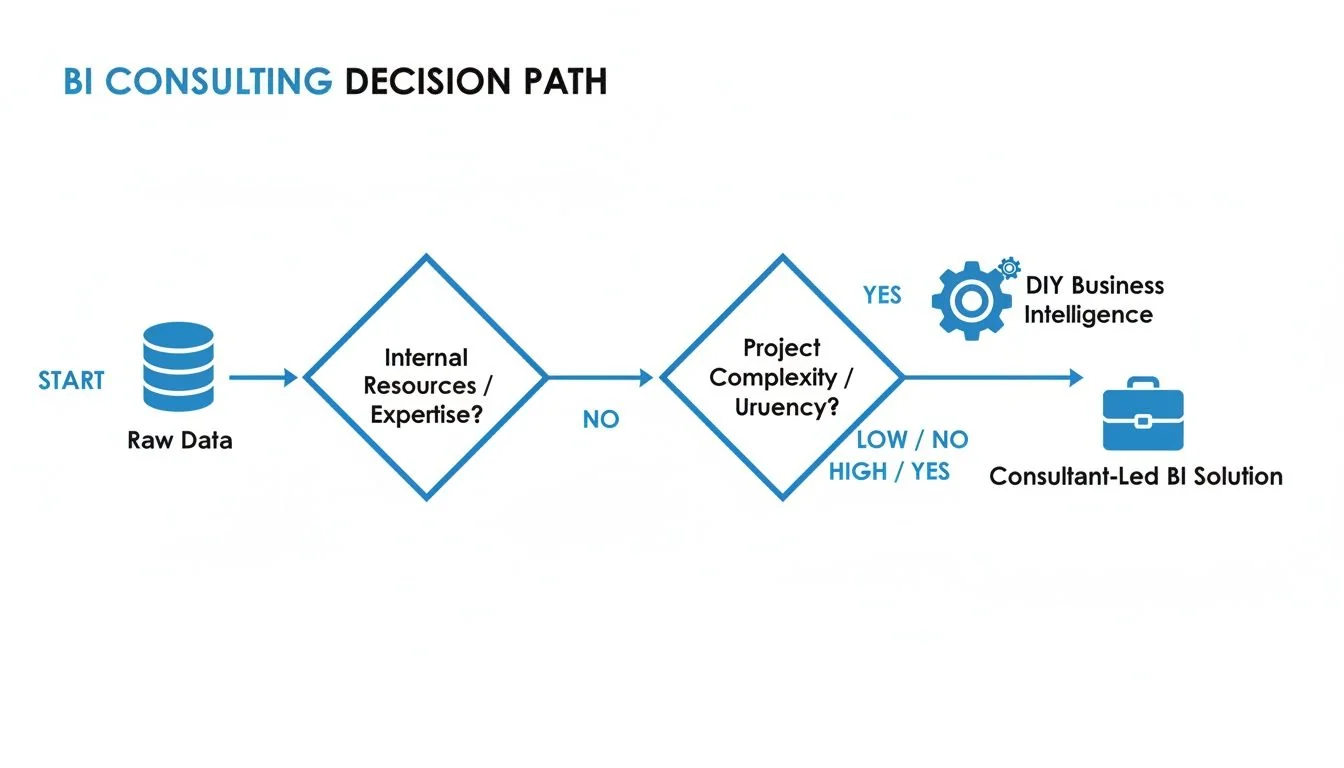
The decision typically balances internal capability, project complexity, and the required speed to value. Let’s analyze the four primary consulting engagement structures.
1. Strategic BI Roadmap and Assessment
This engagement is for organizations that recognize a data-related problem but lack a clear, actionable plan to solve it. A consultant conducts a thorough assessment of the existing technology, processes, and people involved in the data ecosystem.
The objective is to align future BI initiatives with specific business goals. The output is a clear, prioritized execution plan.
Key deliverables typically include:
- A BI maturity assessment against an established framework.
- A recommended future-state data architecture and technology stack.
- A prioritized roadmap of projects with estimated timelines and costs.
- A foundational data governance framework to establish data quality and trust.
2. Data Platform Modernization
This service is for companies whose data infrastructure is a direct impediment to performance. Symptoms include slow report rendering, data silos preventing integrated analysis, or legacy on-premise systems that cannot scale. A modernization project focuses on re-architecting this foundation.
A common scenario is migrating from a legacy data warehouse to a modern cloud data platform like Snowflake or Databricks. Consultants manage the cloud architecture design, data pipeline construction, and the secure migration of historical data, ensuring the new platform is scalable, performant, and reliable.
3. BI Tool Implementation and Optimization
This engagement model addresses situations where an investment in a BI tool like Power BI or Tableau has failed to generate the expected ROI due to low user adoption, poor performance, or lack of data trust. The focus is on maximizing the value of existing software licenses.
Consultants bring specialized expertise to restructure data models for improved query performance, develop “certified” core datasets for consistency, or implement a semantic layer to simplify self-service analytics for non-technical users.
A high-value deliverable from this type of project is a user adoption dashboard. It provides quantitative data on which users are accessing which reports and how frequently, enabling targeted training and a clear measure of project success.
4. Managed BI Services
This is an outsourced operational model. The consulting firm functions as the client’s BI team, responsible for the ongoing operation, maintenance, and enhancement of the analytics environment under a Service Level Agreement (SLA). This model is suitable for organizations without a dedicated internal BI team or those wishing to free internal IT resources for other priorities.
An SLA typically defines commitments such as:
- 24/7 support for mission-critical reporting.
- Guaranteed uptime for the data warehouse and ETL/ELT processes.
- A defined block of hours per month for new report development and enhancements.
This model provides predictable operational costs and ensures the stability, security, and currency of the BI platform without requiring direct internal management.
How to Calculate the ROI of BI Consulting
To secure executive approval, the cost of business intelligence consulting services must be framed as an investment with a measurable return, not an expense. A robust business case is built on three pillars of financial impact. This methodology translates abstract benefits like “better decisions” into a financial model that resonates with a CFO.

Pillar 1: Cost Reduction and Operational Efficiency
The most direct ROI comes from identifying and eliminating operational inefficiencies. These are typically the fastest wins and form the baseline of the business case. Automating manual, repetitive data tasks is the primary target.
For example, if a finance team dedicates 40 hours per month to manually aggregating data in Excel for reporting, a consultant can automate this process. The result is the reclamation of one full work week of a skilled analyst’s time, every month, which can be reallocated to higher-value strategic analysis.
Common sources of cost reduction include:
- Automating manual reporting: Calculate the saved person-hours per month multiplied by the fully-loaded employee cost.
- Optimizing data infrastructure: Identify and eliminate redundant data storage, underutilized cloud resources, or unnecessary software licenses.
- Reducing operational waste: Utilize data to optimize inventory levels, reduce supply chain inefficiencies, or improve asset utilization.
Pillar 2: Revenue Growth and Opportunity Identification
This pillar focuses on using data to increase top-line revenue. A BI consultant can identify revenue opportunities by analyzing customer behavior, sales trends, and market patterns to build models that drive revenue-generating actions.
A common retail application is market basket analysis. A consultant analyzes transactional data to identify products that are frequently purchased together. This insight directly informs targeted cross-selling and up-selling campaigns.
In a recent engagement with a retail client, consultants identified a key product pairing through data analysis, which led to a targeted marketing campaign. This initiative produced a 15% increase in average customer lifetime value within six months by encouraging strategic add-on purchases.
Other revenue-driving applications include:
- Price optimization: Analyze market elasticity and customer segmentation data to identify optimal price points.
- Customer segmentation: Focus marketing spend on high-value customer cohorts with the highest propensity to buy.
- Churn reduction: Develop predictive models to identify at-risk customers, enabling proactive retention efforts.
Pillar 3: Risk Mitigation and Compliance
This often-overlooked pillar calculates ROI based on the cost of negative events that were avoided. Using BI to prevent regulatory fines, data breaches, or internal fraud provides significant, quantifiable value.
For example, a GDPR violation can result in fines measured in the millions. A BI consultant can implement dashboards to monitor data access patterns and flag potential compliance breaches before they become liabilities. The consulting fee becomes negligible when compared to the potential penalty avoided.
Even as the global business intelligence market grows—from USD 21.96 billion in 2020 to a projected USD 32.4 billion in 2025—a significant operational risk persists. An estimated 82% of companies admit to using stale or outdated data for key decisions. Consultants directly address this risk by building reliable, automated data pipelines. You can find more details on this trend in the full report.
Choosing the Right BI Consulting Partner
Selecting the right partner for business intelligence consulting services is more critical than selecting the right software. A skilled partner can achieve results with adequate tools, whereas an unskilled partner will fail even with a best-in-class technology stack.
Evaluation must go beyond marketing materials and use a structured process to validate capabilities in three key areas: technical expertise, domain-specific experience, and project management discipline.

This structured process ensures the team you engage is the same high-caliber team presented during the sales cycle.
Evaluating Technical Expertise
Any potential partner must demonstrate verifiable proficiency on the specific platforms relevant to your technology stack. Vague claims of being “data experts” are insufficient.
Look for official certifications from major technology vendors. These credentials verify that consultants have passed standardized competency exams.
Key certifications to verify include:
- Data Platforms: Certified partner status with platforms like Snowflake, Databricks, or Google BigQuery.
- BI Tools: Current developer certifications for tools such as Power BI, Tableau, or Qlik.
- Cloud Providers: Partnership tier with AWS, Azure, or Google Cloud Platform.
Beyond certifications, require them to present the architecture of a recent, analogous project. This is a more effective test of applied, real-world problem-solving skills than a logo slide. You can dig deeper in our complete guide to BI software comparison to see how different platforms compare.
Assessing Industry-Specific Experience
Technical proficiency alone is not enough. A consultant with deep domain expertise in your industry—be it healthcare, retail, or manufacturing—will deliver value significantly faster. They understand the specific operational metrics, data sources, and regulatory constraints unique to your business.
A consultant with healthcare experience, for instance, already understands HIPAA compliance and the challenges of integrating Electronic Health Record (EHR) data. A retail specialist will arrive with pre-built models for market basket analysis and customer lifetime value calculation.
A partner’s industry experience acts as a project accelerator. It eliminates the time and budget spent on educating them on the fundamentals of your business, allowing them to focus immediately on solving high-impact problems.
To validate this, request case studies from your industry. More importantly, ask for client references from those engagements. A confident firm will readily provide them.
Verifying Project Management and Culture Fit
The consulting firm’s project management discipline and ability to integrate with your team are as crucial as their technical skills. A technically brilliant architect who cannot communicate effectively or collaborate with your staff will jeopardize the project. You are not just hiring contractors; you are embedding a temporary team within your organization.
During the evaluation, demand to see a detailed project plan that specifies:
- Methodology: Do they follow Agile, Waterfall, or a hybrid model? How is it adapted for clients?
- Communication Cadence: What is the defined schedule for status reports and stakeholder meetings?
- Team Governance: Who are the key points of contact and what are their specific roles and responsibilities?
Crucially, you must interview the specific consultants who will be assigned to your project, not just the sales lead or a senior partner. This mitigates the common “bait-and-switch” tactic where a firm sells you their A-team but staffs the project with a B-team.
Assess their technical background, communication style, and problem-solving approach. This is your primary opportunity to gauge “culture fit” and determine if they will function as a true partner or an isolated silo.
Vendor Evaluation Scorecard
To make an objective, defensible decision, use a weighted scorecard to compare vendors against your most important criteria. This tool replaces subjective feeling with structured analysis.
| Evaluation Criterion | Description | Weight (1-5) | Vendor A Score | Vendor B Score |
|---|---|---|---|---|
| Technical Certifications | Official partner status and individual certifications. | 4 | ||
| Relevant Industry Experience | Proven success with clients in your specific sector. | 5 | ||
| Client References | Positive feedback from past and current clients. | 5 | ||
| Project Management Process | Clear methodology, communication, and governance plan. | 4 | ||
| Consultant Interviews | Assessed skill and culture fit of the proposed team. | 5 | ||
| Cost and Value | Pricing structure relative to the proposed scope and value. | 3 |
Scoring each potential partner provides a data-driven basis for your decision, ensuring the selection of the firm best aligned with your project’s success factors.
Spotting Red Flags Before You Sign
Selecting a partner for business intelligence consulting services is a high-stakes decision. A successful partnership accelerates data maturity and profitability. A poor one results in wasted budget, missed deadlines, and a more convoluted data landscape than when you started.
A polished sales presentation can obscure significant operational deficiencies. To protect your investment, you must identify these warning signs during the evaluation process.
The Bait and Switch
This is the most common vendor malpractice. In the sales process, you engage with senior architects and subject matter experts. After the contract is signed, that “A-team” is reassigned, and your project is staffed with a more junior, less experienced team. This invariably leads to delays and suboptimal work quality as the new team learns on your time.
Antidote: Mandate interviews with the exact consultants who will be assigned to your account as a non-negotiable step in your evaluation. Further, insist that the names of these key personnel are written directly into the Statement of Work (SOW) with a clause requiring your approval for any staffing changes.
Vague Proposals and Buzzword Bingo
A proposal is a project blueprint, not a marketing document. If it is filled with ambiguous jargon like “leveraging data-driven synergies” or “enabling analytics transformation” but lacks specific details, it is a significant red flag.
A robust proposal must clearly define:
- Concrete Deliverables: What will be produced? Not “new reports,” but “Three Power BI dashboards for sales performance with fully documented data models and semantic layers.”
- Defined Milestones: What are the major project phases and their associated timelines and deliverables?
- Success Metrics: How will success be measured? A strong proposal will define this, e.g., “Reduce manual reporting time by 20 hours per month within 60 days of deployment.”
Vagueness in a proposal indicates that the firm has either failed to understand your requirements or lacks a credible plan to meet them.
Inflexible Technology Bias
A consultant’s role is that of a trusted advisor who recommends the optimal technology for your specific needs, not the one that benefits them through a partnership or the one they are most comfortable with. A consultant who immediately pushes a specific platform, like Snowflake, without a deep discovery process is a major red flag.
This “one-size-fits-all” approach often signals a limited skillset or a sales-driven partnership that conflicts with your best interests. The best consultants are technology-agnostic during the initial assessment phase. They focus on defining the problem before prescribing the solution.
To test for this bias, ask them to justify their recommendation against two leading competitors. A thorough, objective response indicates a genuine advisor; a dismissive one reveals a reseller.
Getting Your Budget and RFP Right
Before engaging a BI partner, two foundational steps are required: establishing a realistic budget and authoring a Request for Proposal (RFP) that elicits clear, comparable responses. Budgeting for consulting is not about finding the lowest price; it’s about understanding the market rates for the required skills and aligning investment with expected value.
Consulting firms typically use one of three pricing models. A time and materials (T&M) model bills for actual hours worked, offering flexibility at the cost of budget predictability. A fixed-price project defines a single cost for a detailed scope of work, providing cost certainty but less flexibility. A retainer model involves a recurring monthly fee for ongoing support and is ideal for long-term managed services.
What to Expect for BI Consulting Rates
While rates vary by geography and experience level, they generally fall within predictable ranges. Understanding these benchmarks is crucial for building an accurate budget.
- BI Solutions Architect: $175 - $250+ per hour. The senior strategist responsible for designing the overall BI architecture.
- Data Engineer: $150 - $225 per hour. The specialist who builds and maintains the data pipelines that power the BI systems.
- BI Developer/Analyst: $125 - $200 per hour. The practitioner who builds the dashboards, reports, and data models for end-users.
These benchmarks are a critical tool for proposal evaluation. A bid that is significantly below these ranges may indicate the use of junior, offshore, or less-qualified resources.
Effective budgeting focuses on the total investment required to achieve a business outcome, not just the hourly rate. A more experienced, higher-rate team that delivers results faster often provides a superior ROI.
Writing an RFP That Actually Works
A well-structured Request for Proposal (RFP) forces a true apples-to-apples comparison between vendors. It moves the conversation from sales claims to concrete execution plans. The quality of the responses you receive is a direct function of the quality of the questions you ask.
For a more comprehensive guide, see our article on RFP process best practices.
Here are five essential questions to include in your BI consulting RFP:
- Team Composition: Provide résumés and relevant project experience for the specific individuals who will be assigned to our account.
- Methodology: Detail your project management process. How do you manage scope, communicate progress, and mitigate risks?
- Risk Management: Based on the information provided, what are the top three risks you foresee for this project, and what is your specific mitigation plan for each?
- Knowledge Transfer: Describe your formal process for documenting the solution and training our internal team to ensure self-sufficiency post-engagement.
- Success Metrics: Propose 3-5 specific, measurable Key Performance Indicators (KPIs) that you would recommend for measuring the success of this project.
Common Questions We Hear About BI Consulting
Even with a clear understanding of the value proposition, business leaders often have practical questions before engaging a business intelligence consulting firm. Addressing these concerns is the final step before moving forward.
How Long Does a Typical BI Consulting Project Last?
The timeline is directly proportional to the project scope. A strategic roadmap or data maturity assessment can be completed in 4-8 weeks. A comprehensive data platform modernization, such as migrating a legacy on-premise warehouse to Snowflake, can range from 6 to 18 months.
Smaller, more focused projects, like optimizing a critical set of Power BI dashboards or building a single data mart, are often completed in a matter of weeks. A competent partner will provide a detailed project plan with distinct phases and milestones to establish clear timeline expectations.
BI Consulting vs. Staff Augmentation: What’s the Difference?
This is a critical distinction. Staff augmentation is a model for filling a temporary skills gap. You hire individuals to supplement your existing team and are responsible for managing their day-to-day work.
BI consulting is a results-oriented engagement where the firm takes ownership of a business outcome. Consultants are accountable for the project’s success and bring their own methodology, project management, and strategic oversight—components not included in a staff augmentation model.
How Is Knowledge Transferred to Our In-House Team?
A successful engagement concludes not with a handover, but when the client’s team is fully enabled to own, operate, and enhance the solution. A formal knowledge transfer plan is a non-negotiable component of the SOW.
This should be a continuous process throughout the project, including:
- Co-development sessions: Your team members work alongside consultants to learn by doing.
- Comprehensive documentation: All architecture, data models, and code must be thoroughly documented.
- Formal training workshops: Structured training ensures end-users and technical staff are proficient with the new tools and processes.
Should We Hire a Big Firm or a Boutique Agency?
The optimal choice depends on your specific requirements. Large, global consulting firms offer a broad spectrum of services and a large resource pool, but they often come with higher overhead costs and less agility.
A specialized boutique agency typically provides deeper expertise in a niche area, such as retail analytics or performance tuning for Databricks. With a boutique firm, you often get more direct access to senior talent. For projects requiring highly specialized skills, a boutique firm frequently delivers superior value and a more tailored service.
Finding the right partner is arguably the most critical step in your entire data journey. At DataEngineeringCompanies.com, we provide expert-vetted rankings, transparent cost data, and practical tools to help you shortlist and select the best BI consulting firm for your unique needs. Start your search with confidence today.
Data-driven market researcher with 20+ years in market research and 10+ years helping software agencies and IT organizations make evidence-based decisions. Former market research analyst at Aviva Investors and Credit Suisse.
Previously: Aviva Investors · Credit Suisse · Brainhub · 100Signals
Top Data Engineering Partners
Vetted experts who can help you implement what you just read.
Related Analysis
Your Practical Guide to BI Consulting Services
Unlock your data's potential with BI consulting services. This guide covers costs, engagement models, vendor selection, and common red flags to avoid.
7 Vetted Resources for Finding Data Consulting Companies in 2026
Cut through the noise. Our 2026 guide details 7 vetted directories to find top-tier data consulting companies. Compare rates, reviews, and specialties.
A Practical Guide to Data Analytics Services
Cut through the noise. This practical guide explains data analytics services, how to choose the right partner, and how to turn your data into a strategic asset.