What Is HDFS: Architecture, Limitations & 2026 Guide
what is hdfs, hdfs architecture, hadoop ecosystem, data engineering consulting, hdfs migration
Most advice on what is HDFS is stuck in the Hadoop boom years. That advice is obsolete.
If you’re a CTO, Head of Data, or enterprise architect, the pertinent question isn’t what HDFS is, but whether your team should keep operating it, contain it, or migrate off it as part of a broader data pipeline architecture modernization program. In 2026, HDFS is rarely a greenfield choice. It’s a legacy estate decision.
Why ‘What Is HDFS’ Is The Wrong Question in 2026
The popular framing treats HDFS like a default building block for big data. It isn’t.
A 2025 Gartner report notes that only 12% of new Hadoop deployments include HDFS as primary storage, as 78% of organizations running Hadoop today are actively migrating to cloud object storage (S3, ADLS, GCS) due to cost and latency limitations (bigdatatrunk.com coverage of that Gartner note). That should change how leadership evaluates every HDFS discussion.

What leaders should ask instead
Stop asking for a definition. Ask these:
- Is HDFS still aligned with the workload? Batch-heavy, large-file pipelines are one thing. Elastic analytics, lakehouse patterns, and cloud-native AI pipelines are another.
- What is the operating burden? HDFS carries storage, cluster, replication, and metadata management concerns that modern cloud storage services abstract away.
- What is the replacement path? For many organizations, the primary design decision sits upstream and downstream from storage. Think Databricks, Snowflake, dbt, Airflow, and governance controls across AWS, Azure, or GCP.
Executive view: HDFS is now a platform liability review, not a platform aspiration.
When HDFS still deserves a seat at the table
There are still legitimate reasons to keep it for now:
- Existing Hadoop dependencies that would be expensive to re-platform immediately
- Stable batch workloads built around large sequential reads
- Controlled on-prem environments where cloud migration is constrained by policy or timing
But if you’re launching a new analytics platform, building a new governed data lake, or hiring a consulting partner for platform selection, HDFS shouldn’t be your assumed starting point. It should be the incumbent system your modernization plan evaluates against cloud object storage and managed data platform services.
HDFS Architecture Through a Modern Lens
HDFS was built for a different era of data engineering. Understanding that architecture explains why it still works well in narrow scenarios and why it fails outside them.
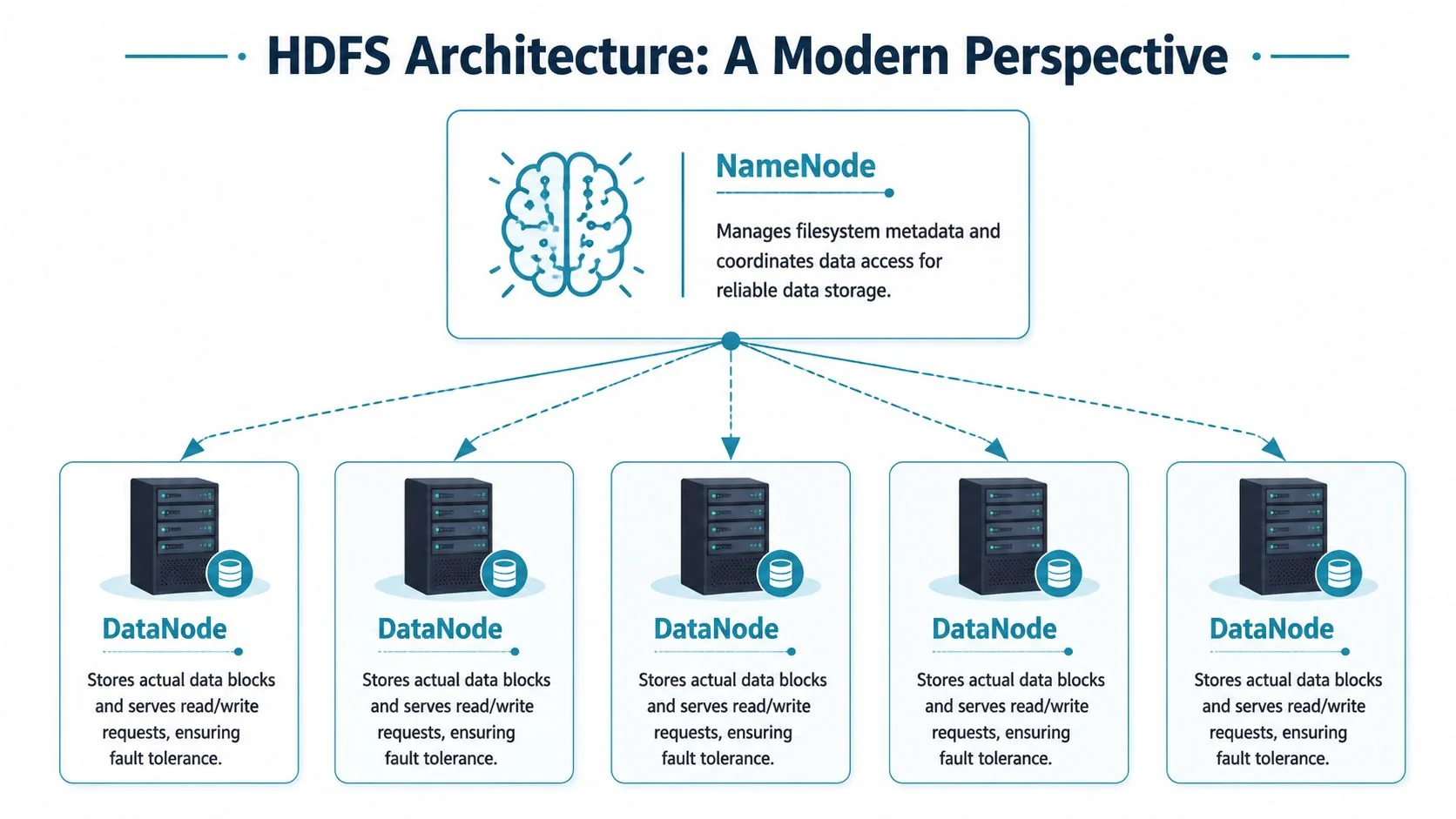
HDFS uses a master-slave architecture with a single NameNode storing filesystem metadata and DataNodes storing data in large blocks, typically 128 MB. This design reduces metadata overhead for sequential scans but consumes disproportionate NameNode memory for small files, limiting clusters to under 100 million files before performance degrades (Apache HDFS design documentation).
The design choice that made sense then
Think of HDFS like a warehouse optimized for pallets, not envelopes.
A 128 MB block works well when Spark, MapReduce, or Hive jobs scan very large files. Fewer, larger blocks mean less metadata overhead and better aggregate throughput across many nodes. That was the right design for log processing, archive-scale batch analytics, and petabyte-oriented storage on commodity hardware.
HDFS also separated concerns cleanly. The NameNode tracked the namespace and block locations. DataNodes handled the actual data blocks. For big sequential reads, that’s efficient and predictable.
Why that same design breaks modern patterns
Modern data platforms don’t behave like early Hadoop clusters. They deal with:
- Many more small objects
- Frequent table maintenance
- Interactive analytics
- Mixed batch and near-real-time pipelines
- AI and ML workflows that need lower-latency access patterns
Those patterns put pressure on metadata, not just throughput.
HDFS isn’t bad technology. It’s specialized technology. Most teams now run workloads outside that specialization.
For consulting buyers, this matters because architecture decisions cascade into vendor selection. A partner that only says “HDFS scales” is giving you a history lesson. A serious data engineering consultancy should explain how storage interacts with your orchestration layer, table formats, governance model, and cloud landing zone.
What this means for platform selection
If your target state includes Snowflake, Databricks, dbt, Airflow, BigQuery, or cloud-native lakehouse patterns, HDFS is usually the wrong control point. The strategic work shifts to:
- storage abstraction over object stores
- open table format choices
- workload isolation
- data governance and lineage
- cost controls by environment and team
That is why “what is HDFS” matters only as background. The primary leadership issue is fit.
How HDFS Operations Impact Business Agility
The business case against HDFS usually shows up in operations before it shows up in architecture diagrams.
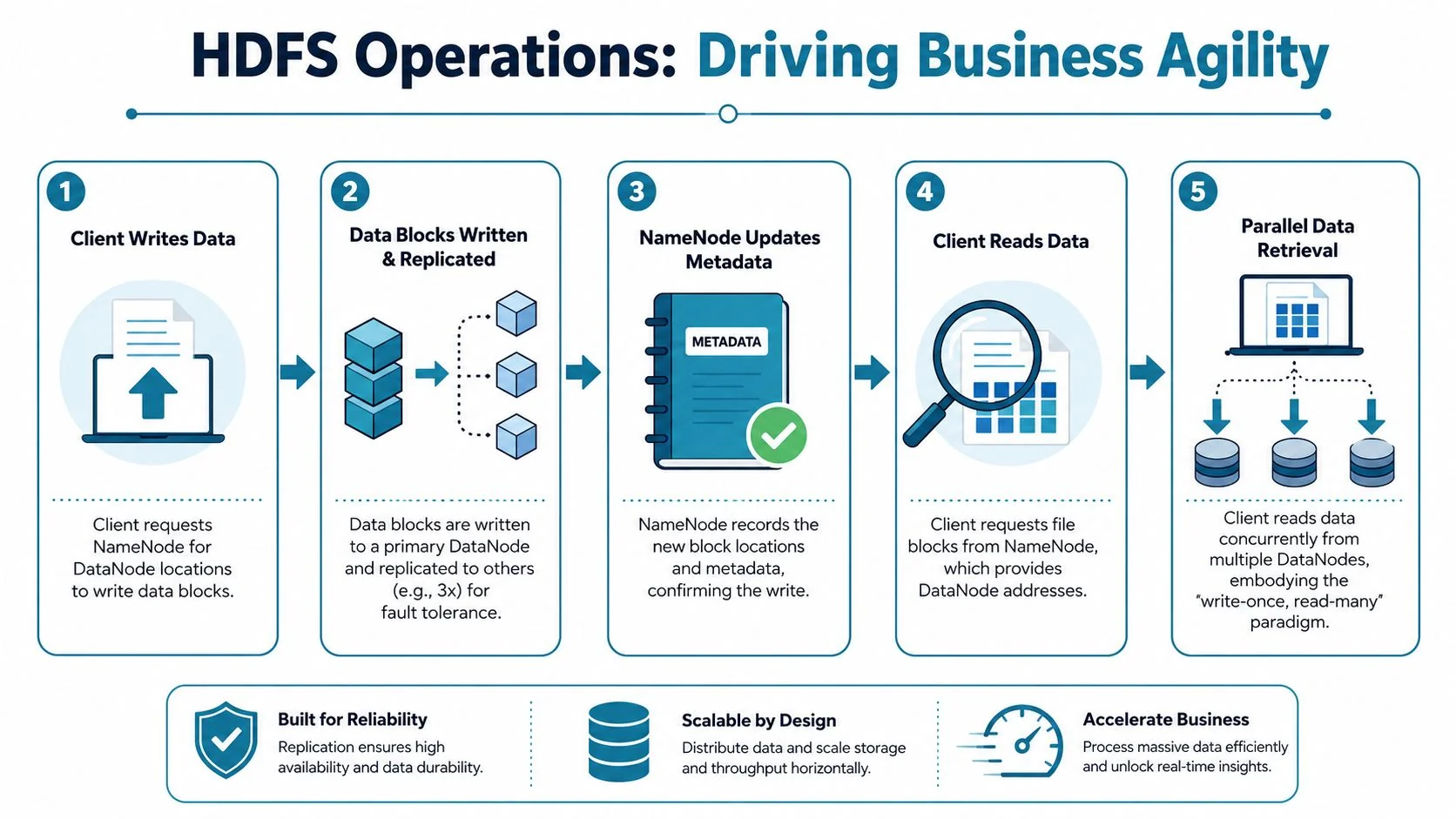
HDFS achieves fault tolerance with a default replication factor of 3, meaning each block is stored on three separate DataNodes. While this ensures resilience against node failure, it creates a 200% storage overhead and is optimized for a write-once-read-many access pattern, making it suboptimal for low-latency, real-time query workloads (Simplilearn HDFS overview).
The operational trade-off
Replication is the core bargain. You get resilience. You pay for it in storage duplication and operational rigidity.
That trade-off was acceptable when teams prioritized durable batch processing over flexibility. It becomes painful when the business wants rapid model retraining, faster ingestion cycles, or multi-engine access across SQL, notebooks, and downstream applications.
Why agility suffers
Three constraints show up repeatedly in HDFS estates:
- Storage overhead is fixed. Replication protects data, but it also locks in higher storage consumption.
- Update patterns are restrictive. Write-once-read-many is a poor fit for workloads that require frequent changes, compacting, or low-latency mutation patterns.
- Operational tuning stays manual. Teams spend time managing the platform instead of improving data products.
If your data team spends more energy preserving the storage layer than improving delivery speed, the platform is holding the business back.
The practical impact isn’t abstract. Product teams wait longer for data availability. Platform teams fight backlog instead of modernization. Finance sees infrastructure that doesn’t flex with demand. That’s why HDFS decisions belong in budget, architecture, and vendor review conversations together.
HDFS vs Cloud Object Storage A Strategic Comparison
The strategic replacement for HDFS usually isn’t another distributed filesystem. It’s cloud object storage combined with a modern data platform stack.
If you’re evaluating AWS data engineering, Azure data engineering, or GCP and BigQuery data engineering options, compare the operating model first. For a useful companion read on how storage choices affect warehouse, lake, and mart design, get HelpWithMetrics’ data insights before you lock the target architecture.
HDFS vs Cloud Object Storage
| Criterion | HDFS | Cloud Object Storage (S3/ADLS/GCS) |
|---|---|---|
| Primary model | Distributed filesystem tied closely to Hadoop-era patterns | Object storage used by modern cloud data platforms |
| Scaling model | Cluster-based expansion with infrastructure planning | Elastic storage model aligned to cloud services |
| Operational burden | Higher. Teams manage storage nodes, replication behavior, and filesystem concerns | Lower. Managed cloud services remove much of the storage administration layer |
| Workload fit | Strong for large-file, streaming batch access | Better fit for mixed analytics, lakehouse, sharing, and multi-engine consumption |
| Latency profile | Built for throughput, not low-latency interactive behavior | Better aligned with modern cloud analytics stacks and service integration |
| Small-file handling | Poor fit when file counts rise sharply | Usually easier to integrate with modern compaction and table-management patterns |
| Platform ecosystem | Best within legacy Hadoop environments | Native fit for Snowflake, Databricks, serverless query engines, and governed cloud lakes |
| Commercial model | Infrastructure-heavy and operationally fixed | Consumption-oriented and easier to align with cloud finance controls |
The real decision criteria
Leaders often frame this as HDFS versus S3, ADLS, or GCS. That’s incomplete. A more complete comparison is:
- legacy storage-centric platform
- versus
- cloud-native data operating model
That broader model includes orchestration, transformation, governance, security boundaries, environment promotion, and vendor support. Object storage wins because it enables the rest of the architecture your teams want to build.
Keep HDFS only if these conditions are true
Use this short filter:
- Your core workloads remain batch-oriented and stable
- Your Hadoop dependencies are still business-critical
- A cloud move would create more disruption than value in the near term
If those conditions aren’t true, stop optimizing around HDFS. Start planning the migration.
Executing the HDFS Modernization Playbook
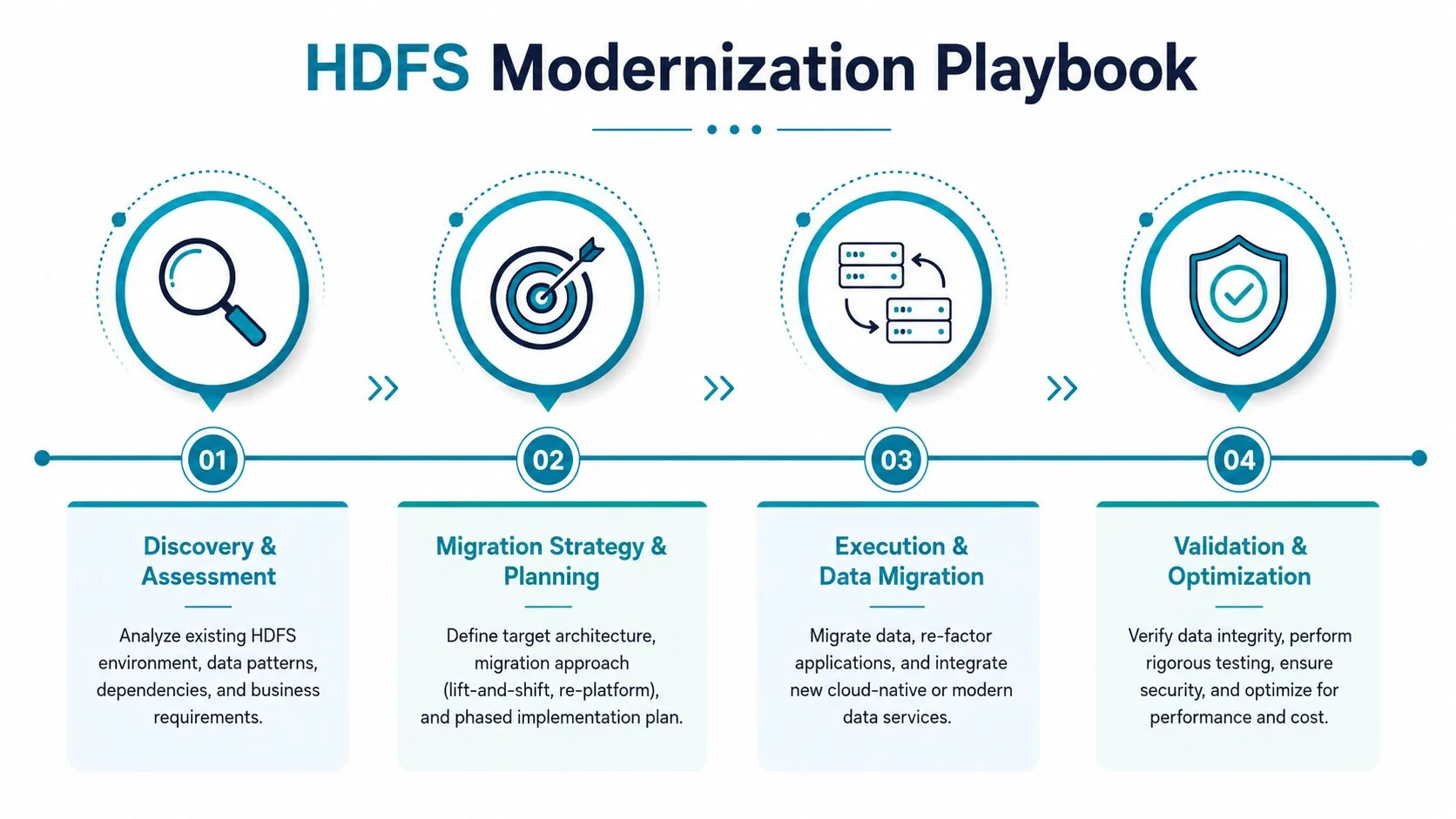
A successful HDFS modernization project is not a storage copy job. It’s a platform redesign with migration sequencing, validation, and cost control built in.
Data engineering consulting project costs have clear benchmarks: a Discovery Audit typically costs $8k–$40k (2–4 weeks), while a full Platform Build and migration ranges from $60k–$300k (8–16 weeks), giving leaders concrete budget thresholds for planning (data engineering consulting cost benchmarks).
The four-phase playbook
-
Discovery and assessment Inventory data domains, pipeline dependencies, table formats, access patterns, security requirements, and downstream consumers. During this phase, teams learn which workloads should move first and which should be retired.
-
Target platform selection
Choose the destination based on workload shape, governance requirements, and operating model. That usually means combinations such as Databricks plus object storage, Snowflake plus governed ingestion, dbt for transformation, and Airflow for orchestration.
A strong planning reference is DataEngineeringCompanies.com’s migration insights, especially for sequencing and risk control.
Before execution, align stakeholders around the migration path:
-
Migration and refactoring
Move data, rewrite or adapt pipelines, and replace HDFS-bound assumptions in jobs and access layers. Some assets can be lifted with minimal change. Others need full redesign. -
Validation and optimization
Don’t stop at cutover. Tune cost, performance, observability, and governance. For operating discipline, leaders should track Data Pipeline Latency, Data Accuracy Rate, System Uptime, and Cost Per Terabyte (KPI guidance for data engineering).
Practical rule: Fund the assessment properly. Cheap discovery creates expensive migration surprises.
The mistake to avoid
Don’t approve a migration scoped only around data movement. The meaningful work is dependency analysis, pipeline redesign, security mapping, and platform operating model changes.
How to Vet a Data Engineering Consultancy for Your Migration
HDFS migration is where generalist firms get exposed. You don’t need a vendor that knows Hadoop terminology. You need one that can redesign platform architecture, prove cloud execution capability, and tie migration choices to business latency requirements.
According to DataEngineeringCompanies.com’s analysis of 86 data engineering firms, the firms worth shortlisting are the ones that connect migration delivery to platform specialization, governance discipline, and measurable operating outcomes, not just “big data experience.”
The shortlist questions that matter
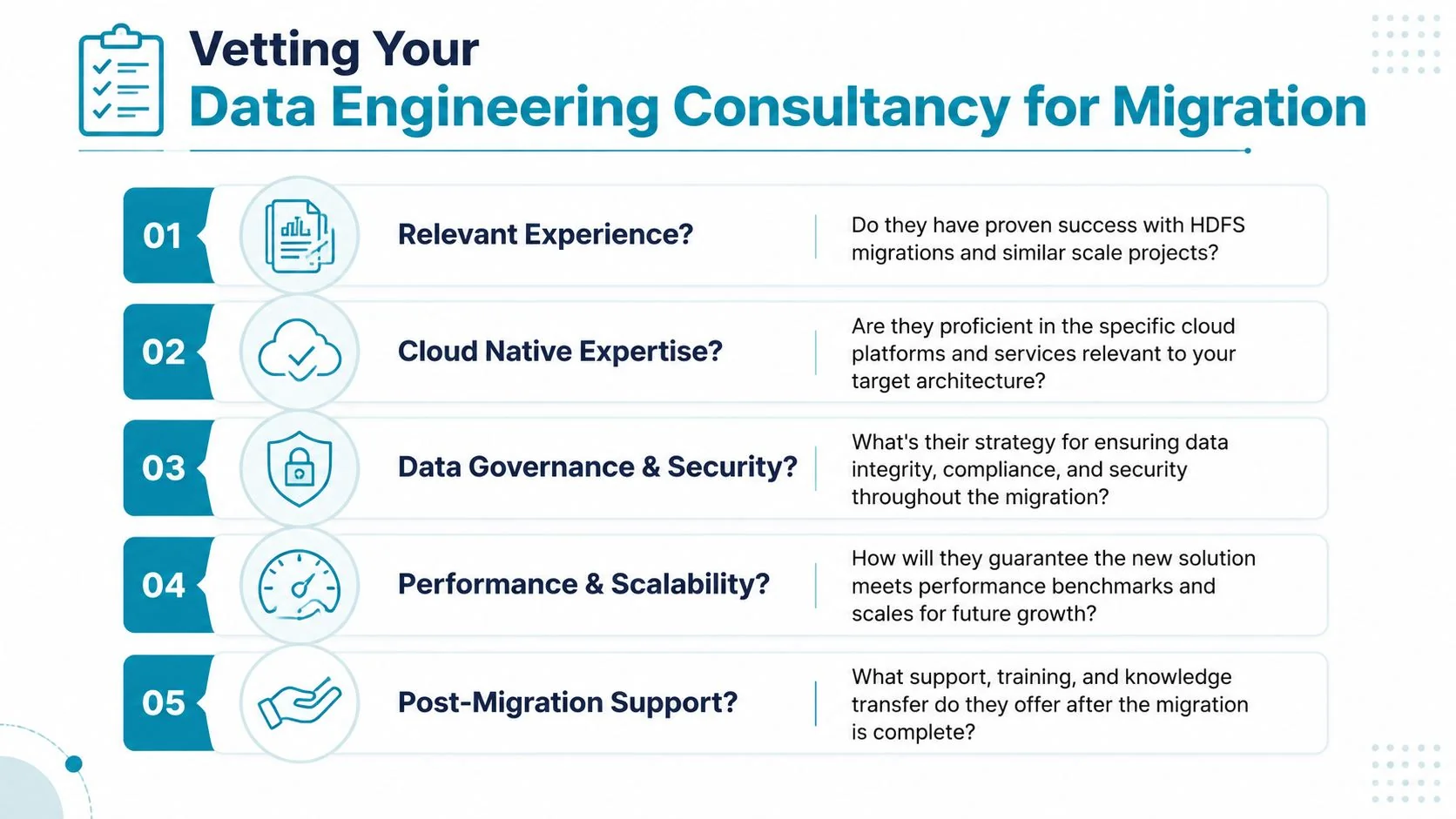
Ask every consultancy these five questions:
- How do you map workload latency to platform choices? A churn model may only need daily updates, while a fraud detection system needs sub-second latency, and the partner must prove it can meet that inference requirement (vendor evaluation guidance for predictive analytics).
- What target stack do you recommend and why? Force specificity. Ask whether the destination is Snowflake, Databricks, BigQuery, or a hybrid design, and how dbt and Airflow fit into delivery.
- How will you measure success after cutover? Require named operational KPIs such as Pipeline Completeness Rate, Data Freshness SLA Adherence, Schema Validation Pass Rate, and Mean Time to Detect (data quality KPI framework).
- What is your governance model during migration? This should cover lineage, access controls, auditability, and rollback handling.
- What happens after go-live? Demand enablement, documentation, runbooks, and knowledge transfer.
Specialist depth beats broad claims
If the consultancy positions itself as cloud-native, test it. Ask for point-of-view depth on warehouse and lakehouse trade-offs. For example, a partner discussing Snowflake data platform expertise should be able to explain where Snowflake fits versus Databricks, not just claim familiarity.
A migration partner earns trust by narrowing choices, not by praising every platform equally.
Use a formal scorecard, not sales impressions. This guide for selecting data engineering partners is a good starting point for procurement and technical due diligence.
The best next step is simple. Decide whether HDFS is a system you’re keeping temporarily or exiting deliberately. If you’re exiting, scope a discovery audit, define the target platform, and run vendor diligence with a migration-specific scorecard. For teams that want a faster shortlist, DataEngineeringCompanies.com helps buyers compare consultancies by platform expertise, budget fit, and modernization scope before the RFP process starts.

Researched & written by
Peter Korpak , Chief Analyst & Founder
Data-driven market researcher with 20+ years in market research and 10+ years helping software agencies and IT organizations make evidence-based decisions. Former market research analyst at Aviva Investors and Credit Suisse.
Previously: Aviva Investors · Credit Suisse · Brainhub · 100Signals
Featured Data Engineering Partners
Firms whose listed specialty matches this article.
Get ballpark quotes →- Accenture779000 people · unverified
Large enterprises running multi-cloud transformations across AWS, Azure, and GCP simultaneously, where a single integrator needs to own the full program.
Listed, not reviewed - Adastra2000+ people (see scope)
Enterprise data, cloud, and analytics work across financial services, insurance, retail, and other sectors. Ask for references from similar projects.
Reviewed - Aimpoint DigitalNot verified
Consider Aimpoint for programs using Snowflake, Databricks, and dbt. It lists credentials for all three; ask for relevant references and the names of the proposed consultants.
Reviewed
Related Analysis
Data Engineering Partner Selection: The 2026 Five-Stage Framework
A 2026 framework for data engineering partner selection: pre-RFP signal scan, sourcing, evaluation, paid pilot, contract, and 90-day handover.
7 Top Nearshore Data Engineering Companies for 2026
Our 2026 guide to nearshore data engineering companies profiles 7 top firms on rates, platforms (Snowflake/Databricks), and minimums. Find your ideal partner.
Data Engineering Staff Augmentation: A 2026 Playbook
Your authoritative guide to data engineering staff augmentation. Learn when to use it, how to vet vendors, compare quotes, and manage engagements for max ROI.