What Is Data Fabric? A Practical Guide to Modern Data Architecture
A data fabric is an architectural approach that creates a unified, intelligent data layer across disparate sources, whether they are on-premises, in the cloud, or at the edge. It does this without requiring data to be physically moved to a central repository. Instead, it uses active metadata, AI, and automation to connect, discover, govern, and deliver data on demand.
What Is Data Fabric in Simple Terms
Imagine your company’s data is stored in different, incompatible databases and applications—customer data in a CRM, sales figures in an ERP, and operational logs in a cloud object store. Historically, accessing a unified view meant building complex ETL pipelines to copy all that data into a central data warehouse. This process is slow, expensive, and creates data silos.
A data fabric offers a different solution. It acts as an intelligent abstraction layer over your entire data landscape. It doesn’t move the data; it connects to it. This virtual layer understands where every piece of data lives, what it means, and how it relates to other data, providing a seamless way to query and manage information as if it were all in one place.
This architecture is no longer a theoretical concept; it’s a practical response to sprawling data environments. As organizations increasingly operate in hybrid and multi-cloud settings, traditional integration methods fail to scale. The global data fabric market is projected to grow from $1.4 billion in 2021 to $12.91 billion by 2032, a clear indicator of its rising importance in enterprise architecture. Discover more insights on the data fabric market growth.
The Core Idea Behind the Fabric
The fundamental principle of a data fabric is managing data in-situ (where it resides). It integrates existing systems rather than replacing them, using an active metadata catalog as its core engine. This catalog continuously scans connected sources, automatically discovering data assets, profiling their contents, and mapping relationships between them.
A data fabric’s primary function is to abstract away the underlying complexity of the data landscape. It allows data consumers to focus on what data they need, not where it is or how to access it.
This intelligent foundation delivers several key capabilities:
- Unified Access: Provides a single, consistent interface (often SQL-based) to query data, whether it’s in Snowflake, a legacy SQL server, or a SaaS application.
- Automated Governance: Applies security and compliance rules universally from a central control plane, ensuring consistent policy enforcement across all data sources.
- AI-Powered Optimization: Leverages machine learning for data discovery, quality checks, and query optimization, automating tasks that traditionally required significant manual effort.
By intelligently connecting distributed data assets, a data fabric makes information more discoverable, trustworthy, and ready for use in business-critical applications and analytics.
How a Modern Data Fabric Actually Works
A data fabric functions as a connector, not a container. It avoids the need for mass data consolidation by weaving an intelligent layer across existing infrastructure, acting as a central nervous system for an organization’s data.
This diagram illustrates the architecture: the fabric sits between distributed data sources and the consumers who require insights, simplifying an inherently complex process. It is designed to turn raw, fragmented information into coherent, actionable intelligence without the cost and overhead of a massive data migration project.
The Intelligent Metadata Catalog
The core of a data fabric is its intelligent metadata catalog. This is an active system, not a static data dictionary. It continuously scans all connected sources—from cloud data warehouses to legacy on-premise applications—to discover and contextualize data assets.
Using AI, the catalog automatically profiles data, infers relationships between datasets, tracks lineage (data provenance), and suggests relevant business terminology. This “active metadata” creates a dynamic, machine-readable semantic graph of the entire data landscape, which is leveraged by both human users and automated processes.
A data fabric’s catalog doesn’t just list what data you have. It understands what it means and how it connects. This semantic understanding is the key to automating integration and governance.
Unified Data Integration Methods
With a comprehensive map of the data landscape, the fabric must provide efficient methods for data delivery. This is achieved through unified data integration. Unlike older architectures locked into a single method like ETL (Extract, Transform, Load), a fabric employs a flexible, multi-modal approach.
- Data Virtualization: Provides real-time, on-demand access by creating a logical view of data where it resides. This is ideal when moving large volumes of data is impractical or when latency is critical.
- Data Streaming: Processes and delivers data in real-time for event-driven use cases like fraud detection or IoT analytics.
- ETL/ELT Automation: When data movement is necessary for performance (e.g., populating a data warehouse), the fabric leverages its metadata intelligence to automate and optimize these pipelines, making them more resilient and efficient.
The system’s ability to select the optimal integration pattern for a given task is a core strength. These data integration best practices provide context on how different methods apply to various scenarios. A data fabric orchestrates all these patterns from a single control plane.
Automated Governance and Security
Managing security and compliance across hundreds of distributed systems is a significant challenge. A data fabric addresses this with an automated governance and security layer. Policies for data quality, privacy, and access are defined centrally and enforced universally.
This means a rule—such as “mask all personally identifiable information (PII) for users in the marketing group”—can be set once and the fabric will enforce it automatically, regardless of whether the data is queried from a SaaS tool or an internal database. Governance shifts from a reactive, manual cleanup process to a proactive, automated component of the architecture.
AI-Powered Orchestration
The final component is the AI-powered orchestration engine. This layer uses machine learning to continuously automate and optimize data management tasks. It analyzes query patterns to determine the most efficient execution plans, flags potential data quality anomalies, and can recommend relevant datasets to analysts.
This ongoing optimization reduces the operational burden on data teams. The fabric can adapt autonomously to new data sources and changing query loads, increasing the agility of the entire system. By offloading complex technical orchestration to AI, data engineers and analysts can focus on higher-value activities.
Data Fabric vs. Data Mesh vs. Lakehouse
The terms data fabric, data mesh, and lakehouse are often used interchangeably, but they represent distinct architectural concepts with different goals and philosophies.
A data fabric is a technology-driven architecture that creates a virtual, integrated data layer across a distributed landscape. It centralizes control through automation and AI to make fragmented data feel unified, without requiring data consolidation.
A data mesh is a sociotechnical paradigm that advocates for decentralizing data ownership. It shifts responsibility for data from a central team to domain-specific teams (e.g., marketing, finance) who treat their data as a product. It’s a strategic shift in organizational structure, not a specific technology.
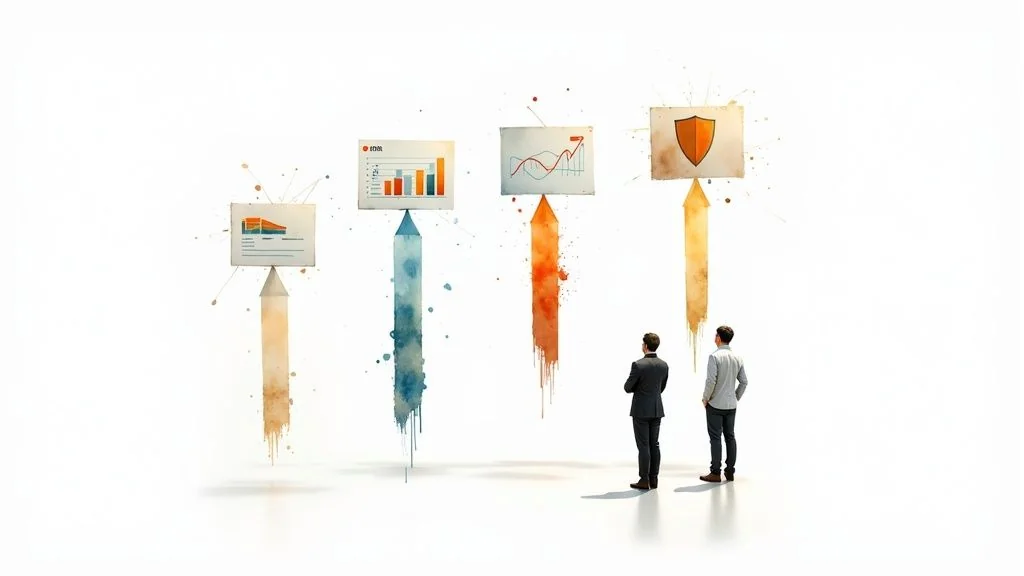
Core Philosophical Differences
The primary distinction lies in centralization versus decentralization. A data fabric centralizes control and governance via a technology platform while data remains distributed. It’s a top-down approach focused on abstracting complexity through automation.
A data mesh is a bottom-up, people-and-process-centric approach. Its core philosophy is that centralized data teams create bottlenecks and lack domain expertise. The solution is to empower domain experts to manage the full lifecycle of their own data products.
The data lakehouse is an architectural pattern for data storage. It merges the low-cost, flexible storage of a data lake with the structure and performance of a data warehouse. Its primary goal is to create a single, centralized platform for both business intelligence and machine learning workloads. For a deeper dive, learn what lakehouse architecture entails.
A concise summary:
- Data Fabric: Centralizes control over distributed data.
- Data Mesh: Decentralizes ownership of distributed data.
- Lakehouse: Centralizes the storage of data.
Ownership and Governance Models
In a data fabric, governance is typically centralized. A core data or IT team defines policies for security, access, and quality, and the technology platform automates their enforcement across all connected systems.
The data mesh promotes decentralized domain ownership. Each business unit (“domain”) is responsible for its data pipelines, quality, and API-based sharing. Governance becomes a federated model, where global standards are set centrally but implemented and enforced by individual domains for their data products.
A lakehouse usually reverts to a centralized ownership model. A central data team typically manages the platform, infrastructure, and core datasets consumed by the rest of the organization.
A Practical Comparison
This table outlines the key differences between these data architecture patterns. The optimal choice depends on an organization’s culture, technical maturity, and strategic objectives.
Comparing Data Fabric, Data Mesh, and Lakehouse
| Attribute | Data Fabric | Data Mesh | Data Lakehouse |
|---|---|---|---|
| Primary Focus | Technology-driven unification of distributed data | Organizational strategy for decentralized data ownership | Architectural pattern for unified storage and processing |
| Data Location | Leaves data in place (in-situ access) | Distributed across domains | Data is consolidated into a central platform |
| Governance | Centralized and automated by the fabric’s technology | Federated; global standards with domain-level implementation | Typically centralized, managed by a core data team |
| Implementation | Technology-led; implement a platform to connect sources | Culture-led; requires organizational change and domain teams | Platform-led; build or buy a lakehouse platform |
| Best For | Organizations with complex, hybrid/multi-cloud environments that need unified access and governance without a major re-architecture. | Large, decentralized organizations with mature data teams in different business domains that can operate with autonomy. | Companies aiming to consolidate BI and AI workloads onto a single, cost-effective storage and compute platform. |
These architectures are not mutually exclusive. An organization might use a data fabric to connect sources that feed a central lakehouse, or apply data mesh principles to how teams manage data products within that lakehouse. Understanding their individual strengths is the critical first step.
Real-World Wins: What Data Fabric Does for Your Business
Beyond architectural diagrams, a data fabric delivers tangible business value by solving persistent data challenges. Its primary function is to make existing data assets more accessible and valuable without requiring a disruptive and costly data consolidation project.
Achieve a True 360-Degree Customer View
Most companies strive for a complete view of their customers, but the data is fragmented across CRMs, e-commerce platforms, support systems, and marketing tools. A data fabric creates a virtual, unified customer profile by connecting to these systems and stitching the data together on demand.
A customer service agent can view a support ticket and, in the same interface, see that customer’s recent purchase history and marketing interactions—without logging into three different systems. This improves service quality and first-contact resolution.
Enable Real-Time Analytics and Operations
Traditional analytics often relies on stale data from nightly batch jobs. This latency is unacceptable for time-sensitive operations like fraud detection, supply chain logistics, or dynamic pricing. A data fabric provides direct, governed access to live operational data. It can query transactional systems in real-time to deliver an immediate, accurate view of business operations. The ability to reduce data integration timelines from weeks to days is a significant competitive advantage, a key driver behind the projected market growth to $12.91 billion by 2032, as noted in this in-depth industry analysis.
Simplify Governance and Compliance
Managing compliance with regulations like GDPR, CCPA, and HIPAA is exceedingly difficult in a distributed data environment. A data fabric acts as a central control plane for governance. Policies are defined once and enforced automatically everywhere.
- Consistent Policy Enforcement: Eliminates security gaps and inconsistent rule application between systems.
- Automated Data Discovery: The active metadata catalog automatically identifies and classifies sensitive data, providing a clear view of regulatory risk.
- Centralized Auditing: Data lineage capabilities provide a clear audit trail of data access and usage, simplifying compliance reporting.
Accelerate AI and Machine Learning Initiatives
Data scientists often spend up to 80% of their time on data discovery, cleaning, and preparation—a major bottleneck to innovation. A data fabric functions as a self-service data marketplace for data science teams. It provides a single portal to discover, access, and blend governed, high-quality datasets from across the enterprise. By removing data access friction, it significantly reduces the time required to build, test, and deploy machine learning models.
A Pragmatic Roadmap for Implementation
Implementing a data fabric is a strategic journey, not a single project. The most successful adoptions follow a phased, crawl-walk-run approach that demonstrates value early, builds momentum, and minimizes risk. This methodical rollout is essential, especially in large enterprises, which accounted for nearly 48.2% of market revenue in 2024. North America’s mature cloud infrastructure and governance requirements provide a strong model for this strategic implementation, as detailed in these data fabric market trends.
Phase 1: Discovery and Strategy
Effective data initiatives begin by solving a specific business problem, not by implementing technology for its own sake. This phase anchors the data fabric project to a tangible business outcome.
Identify a high-impact challenge where improved data access and integration could deliver measurable results, such as reducing customer churn or optimizing supply chain logistics. Map the critical data sources required to address this problem—whether in Salesforce, SAP, or other systems. Scope a small pilot project designed to deliver a quick win and build organizational confidence.
Phase 2: Foundation and Pilot
With a clear objective, the next step is to build the core infrastructure and execute the pilot project. This involves laying the technical groundwork for future expansion.
- Select Core Technology: Evaluate data fabric platforms based on their connectivity options, metadata management capabilities, and governance features relevant to the pilot.
- Build the Initial Catalog: Connect the chosen platform to the handful of data sources identified in Phase 1. Allow the tool’s automated discovery features to profile the data and build the foundational metadata graph.
- Execute the Pilot Use Case: Deliver the data products or dashboards for the pilot project. The goal is to demonstrate that the data fabric approach provides faster, more reliable insights than existing methods.
Successfully completing this phase transforms “data fabric” from an abstract concept into a practical solution for a real business problem, securing stakeholder buy-in for broader adoption.
Phase 3: Expansion and Automation
With the pilot’s success validated, the final phase involves scaling the implementation. This means systematically connecting more data sources, onboarding more business units, and addressing more complex use cases based on a prioritized backlog.
As the fabric expands, its intelligent features become more powerful, automating more data quality tasks and query optimizations. Governance policies are refined and applied consistently across the growing ecosystem. The ultimate objective is to evolve the data fabric into an enterprise-wide, self-service data utility that provides governed access to trusted data for all authorized users.
Choosing the Right Data Fabric Solution
Selecting the right data fabric technology is a critical decision. The market is crowded with vendors, so a disciplined, criteria-based evaluation is essential to cut through marketing claims and identify a platform that aligns with your specific technical and business requirements.
The ideal platform must integrate seamlessly with your existing technology ecosystem. The wrong choice can introduce more complexity, while the right one can accelerate your entire data strategy.
Core Evaluation Criteria
Focus your evaluation on four fundamental pillars. These areas will reveal the true capabilities and flexibility of a solution.
- Connectivity and Integration: Assess the breadth of pre-built connectors for various data sources, including databases, SaaS applications, and streaming platforms. A robust connector library minimizes the need for custom development.
- Metadata and Catalog Intelligence: The platform must use AI for automated data discovery, classification, and lineage tracking. Look for an active metadata graph that can infer data relationships and apply business context. Manual cataloging is not a scalable solution.
- Governance and Security Automation: Evaluate how the solution centralizes policy management. A top-tier data fabric allows you to define access rules, data masking, and quality checks in one place and enforces them universally across hybrid and multi-cloud environments.
- Scalability and Performance: The architecture must handle your data volume and query complexity. Analyze its capabilities for distributed query optimization and its ability to scale compute resources dynamically without creating performance bottlenecks.
These criteria are foundational for building a cohesive data ecosystem. For additional context on how these components fit together, review the principles of building a modern data stack.
The goal is to find a technology partner that reduces complexity, not one that adds another layer to it. The best data fabric solutions make the difficult work of data integration, governance, and delivery appear seamless.
Asking the Right Questions During Your RFP
Construct your Request for Proposal (RFP) with sharp, scenario-based questions that compel vendors to demonstrate their capabilities.
For example, instead of asking, “Do you support data governance?” ask: “Demonstrate how a single policy can be applied to mask PII in both an on-premise Oracle database and a cloud-based Salesforce instance simultaneously.”
This practical, proof-based approach cuts through sales pitches and provides the clarity needed to select a partner capable of delivering on the promise of a data fabric.
Got Questions About Data Fabric?
Here are answers to some of the most common questions about data fabric architecture.
Isn’t This Just a Fancy Name for Data Virtualization?
No. Data virtualization is a key technology within a data fabric, but it is not the entire architecture. Data virtualization is the component that enables querying data from multiple sources without physically moving it.
A complete data fabric builds upon this capability by adding other essential layers, such as an AI-driven metadata catalog (a knowledge graph), automated data integration workflows, and a unified governance framework. Data virtualization is the engine; the data fabric is the entire autonomous vehicle, including the chassis, navigation, and security systems.
Does This Mean I Have to Rip Out Everything I Already Have?
No. A core value proposition of a data fabric is that it is a non-disruptive, complementary layer that integrates with your existing technology investments.
Your data warehouses, data lakes, and operational databases remain in place. The fabric connects to them, making their data accessible through a unified interface. The goal is to enhance and integrate what you already have, not to initiate a costly “rip and replace” project.
A data fabric’s purpose is to unlock value from your current data landscape by building bridges between data silos, not by forcing a migration to a new platform.
How Does This Actually Help with Data Governance?
A data fabric centralizes and automates data governance. Instead of manually applying policies across dozens of systems, you define security rules, access controls, and quality standards once within the fabric.
The fabric then automatically enforces these policies across every connected data source. For example, a rule to mask personally identifiable information (PII) is applied consistently whether a user is querying a CRM, a cloud data lake, or an on-premise database. This provides centralized control and a comprehensive audit trail, significantly simplifying compliance with regulations like GDPR and CCPA.
What’s the Difference Between a “Logical” and a “Physical” Data Fabric?
This distinction refers to how data is handled by the architecture.
-
A logical data fabric primarily uses data virtualization. It leaves data in its original source and leverages a semantic metadata layer to create a unified view for users. This approach excels at real-time analytics and ad-hoc data exploration.
-
A physical data fabric focuses on the optimized movement and transformation of data. It may create performance-tuned data products or cache frequently accessed data in a central analytics platform. This is better suited for intensive analytics and machine learning workloads where query performance is paramount.
Leading data fabric platforms blend both approaches. They use an AI-powered orchestration engine to dynamically decide whether to virtualize a query (logical) or move the data (physical) based on the specific workload and performance requirements.
Choosing the right data architecture is one thing; bringing it to life requires the right team. At DataEngineeringCompanies.com, we offer independent, data-driven rankings of top data engineering consultancies. We’re here to help you find the perfect partner for your project. Explore our 2026 expert rankings to select your partner with confidence.
Data-driven market researcher with 20+ years in market research and 10+ years helping software agencies and IT organizations make evidence-based decisions. Former market research analyst at Aviva Investors and Credit Suisse.
Previously: Aviva Investors · Credit Suisse · Brainhub · 100Signals
Top Data Engineering Partners
Vetted experts who can help you implement what you just read.
Related Analysis
Data Governance vs. Data Management: A Practical Comparison
Understand the critical differences in the data governance vs data management debate. Learn how to align strategy and operations for a modern data platform.
Data Governance Consulting: A Practical Guide to Implementation
Explore data governance consulting to learn how experts deliver results, pricing, and how to hire the right firm.
A Practical Guide to Cloud Data Integration for Modern Data Stacks
Discover cloud data integration essentials, compare ETL vs ELT, and learn to secure and optimize your data strategy with trusted partners.