A Practical Guide to Data Modeling Techniques for Modern Data Platforms
Data modeling techniques are the architectural blueprints for organizing information within a data platform. The primary approaches—Relational, Dimensional, and Data Vault—are distinct strategies for storing, connecting, and retrieving data. Each is engineered for a specific purpose, whether for operational transaction efficiency or high-speed business analytics. Choosing the right one is a critical engineering decision with direct financial and performance consequences.
Choosing the Right Blueprint for Your Data
Data modeling is the architectural design phase for your data infrastructure. The choice of technique must align with the intended business outcome. A mismatch leads to slow queries, inflated cloud compute costs, and a data platform that fails to deliver actionable insights.
This guide provides a practical analysis of data modeling techniques for data engineers and leaders. We will examine how each model directly impacts analytics performance, scalability, and cost, particularly on modern cloud platforms like Snowflake and Databricks. A sound data model is the foundation of any high-performing data asset.
Why Data Modeling Remains Critical
The availability of cheap cloud storage and powerful compute engines makes it tempting to dump raw data into a data lake and defer structure. This approach typically creates a “data swamp”—an unreliable, disorganized repository unsuitable for serious analytics. Data modeling brings necessary structure to this potential chaos.
A well-designed data model delivers tangible benefits:
- Clarity and Consistency: It establishes a single source of truth by enforcing business rules and defining data relationships in an unambiguous, structured manner.
- Performance Optimization: By organizing data based on its query patterns, a proper model significantly reduces query latency and, consequently, compute expenditure.
- Scalability: It provides a robust framework that can accommodate new data sources and evolving business requirements without requiring a complete architectural overhaul.
- Effective Governance: It simplifies critical tasks like data lineage tracking, quality assurance, and compliance reporting by providing a clear, logical map of the data.
The Foundation of Modern Data Systems
Data architecture has evolved, but the core principles of organization remain. The relational model, formalized in 1970, introduced the foundational concepts of tables and keys that still power the majority of transactional systems.
Edgar F. Codd’s theoretical work became the industry standard by the late 1980s, supplanting older hierarchical systems. Its impact was durable.
Today, new techniques are designed for analytics at scale, but the fundamental need for structure persists. Modern architectures like the lakehouse are not a substitute for data modeling; they are a new environment where its principles are applied. For context on this evolution, see our guide on what is lakehouse architecture. Understanding this foundation is key to making the high-impact decisions discussed next.
The Three Core Data Modeling Philosophies
Data modeling involves choosing a philosophy for information organization. The major techniques are not rigid rulebooks but strategic frameworks, each with a specific purpose. Understanding the “why” behind each approach is crucial for matching the right technique to the right business problem.
1. The Relational Model: Optimized for Data Integrity
The relational model, typically implemented in its Third Normal Form (3NF), is the most established approach. Its core philosophy is the elimination of data redundancy to ensure data integrity. It deconstructs data into its smallest logical components, storing each in a separate, normalized table.
For example, a single customer order is atomized into tables for customers, orders, order line items, and products. This structure is the gold standard for data integrity. If a customer’s address changes, the update occurs in a single location, and the change is instantly propagated through relationships.
This focus on write-efficiency and consistency makes the relational model the standard for Online Transaction Processing (OLTP) systems. These are the databases that power daily business operations like e-commerce transactions, banking, and inventory management.
2. The Dimensional Model: Optimized for Analytical Queries
While the relational model excels at writing and updating data, its highly normalized structure is inefficient for analytics. Answering a simple business question can require joining numerous tables, resulting in slow and complex queries. The dimensional model, developed by Ralph Kimball, was engineered to solve this problem.
Its philosophy is to organize data for intuitive browsing and fast query performance. The model centers on a fact table (containing quantitative metrics like sales totals) surrounded by descriptive dimension tables (providing context like time, location, and product). This structure is known as the star schema.
Data is intentionally “denormalized,” reintroducing some redundancy to simplify the structure. A sales fact table holds key metrics (revenue, quantity) and is linked directly to dimension tables for date, customer, and product. This design enables BI tools to efficiently slice and dice data, answering questions like, “What were total sales by product category in the Northeast last quarter?” with minimal latency.
By prioritizing query performance and business usability over storage efficiency, dimensional modeling became the foundation of modern analytics. It is designed for read-heavy reporting workloads where speed and simplicity are paramount.
3. The Data Vault Model: Optimized for Scalability and Auditability
Modern data ecosystems are characterized by a high volume of disparate data sources and evolving business rules. Both relational and dimensional models can be brittle in this environment; integrating a new source often requires significant re-engineering. The Data Vault model was designed specifically to handle this complexity with agility and full auditability.
Its philosophy is to ingest raw data from source systems with complete traceability and historical context, without applying business logic upfront. It organizes data into three core components:
- Hubs: Store unique business keys (e.g., Customer ID, Product SKU). They represent the core business entities.
- Links: Define the relationships or transactions between Hubs (e.g., a link connecting a specific customer to a purchased product).
- Satellites: Contain the descriptive, time-stamped attributes associated with Hubs or Links (e.g., a customer’s address or a product’s price), capturing all historical changes.
This structure is highly resilient. Integrating a new data source involves adding new Hubs, Links, and Satellites without altering the existing model. This makes Data Vault an excellent choice for the raw integration layer of a data warehouse, providing a fully auditable, scalable foundation from which curated, business-focused data marts can be built.
Comparing Data Modeling Techniques at a Glance
This table breaks down the primary goals and trade-offs of the three core philosophies to help guide selection.
| Technique | Primary Goal | Best For | Key Weakness |
|---|---|---|---|
| Relational (3NF) | Eliminate Redundancy & Maximize Integrity | Transactional Systems (OLTP) | Complex and slow for analytical queries. |
| Dimensional | Optimize for BI & Fast Query Performance | Data Warehouses & Analytics (OLAP) | Can be less flexible for integrating new sources. |
| Data Vault | Maximize Scalability & Auditability | Raw Data Integration Layers | Overly complex for direct BI querying. |
The optimal model is context-dependent. The choice must align with the specific objective, whether it’s processing transactions with high fidelity, enabling rapid business insights, or building a future-proof foundation for enterprise data.
How Modeling Choices Drive Cloud Platform Costs
In on-premise data warehouses, a suboptimal data model led to slow reports. In the cloud, the consequence is more direct: financial waste. Every inefficient query consumes compute resources and incurs cost. Your choice of data modeling technique is a primary lever for controlling cloud data platform expenditure.
Consumption-based pricing models from platforms like Snowflake and Databricks have shifted the economic calculus. Compute is now the primary cost driver, not storage. This reality requires a re-evaluation of data modeling efficiency. A model considered efficient a decade ago can be a financial liability in the cloud.
Snowflake and the Power of Denormalization
Snowflake’s architecture is optimized for high-speed analytical queries and rewards models that align with its strengths. Running an analytical query on a highly normalized Third Normal Form (3NF) model requires the query engine to perform multiple complex joins, piecing together data from numerous tables.
Each join consumes processing power, spinning up virtual warehouses and accruing compute credits. While 3NF is ideal for eliminating redundancy in OLTP systems, it is an inefficient and costly approach for analytics in a consumption-based cloud data warehouse.
This is where a denormalized dimensional model, such as a star schema, becomes a cost-optimization tool.
By pre-joining and denormalizing data into wide fact and dimension tables, you dramatically reduce the complexity of analytical queries. Instead of multi-table joins, analysts execute simple, direct queries that Snowflake’s engine processes with high efficiency, minimizing warehouse usage and controlling costs.
Aligning the data model with the platform’s architecture is a critical cost management strategy. In Snowflake, implementing a star schema is not just a performance tactic; it is an economic decision.
Databricks, The Lakehouse, and Medallion Architecture
The Databricks lakehouse environment prioritizes flexibility and scalability, particularly for managing diverse and evolving data sources. The Data Vault modeling technique is highly effective in this context, especially when paired with the Medallion Architecture.
It is crucial to understand that the Medallion Architecture (Bronze, Silver, Gold) is a data quality and lifecycle management framework, not a data modeling technique itself. It provides a logical progression for refining data, and different modeling techniques are applied at each layer.
- Bronze Layer: Raw, unaltered data lands here. Minimal to no modeling is applied.
- Silver Layer: Data is cleansed, conformed, and integrated. This layer is the ideal home for a Data Vault model. Its structure accommodates schema changes from source systems and provides a fully auditable historical record without prematurely applying business rules.
- Gold Layer: Data is aggregated and optimized for specific business use cases. This layer is almost always built using dimensional models (star schemas) to serve high-performance, user-friendly datasets for BI and analytics.
This hybrid approach leverages the strengths of multiple techniques. The Data Vault in the Silver layer provides a scalable and governed foundation. From this stable core, multiple purpose-built, cost-effective star schemas can be provisioned in the Gold layer, ensuring analytics are both fast and based on trusted, auditable data. For a deeper comparison of these platforms, see our guide on Snowflake vs. Databricks.
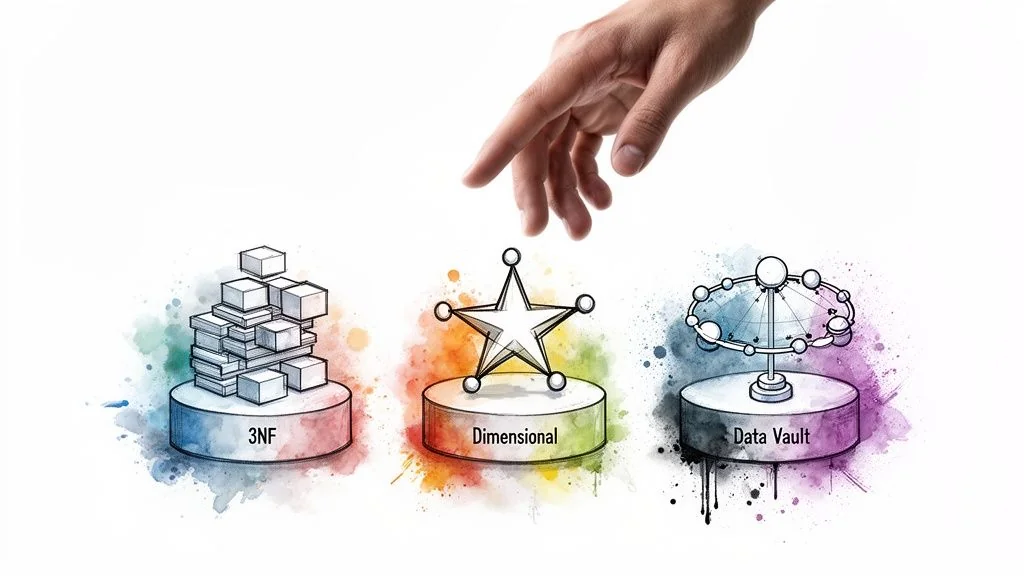
The infographic below illustrates the core philosophies behind these different modeling approaches.
This visual comparison clarifies how Relational, Dimensional, and Data Vault models are each optimized for different objectives—integrity, analytics, or auditability—which in turn dictates their cost and performance on cloud platforms.
Putting Data Modeling Techniques into Practice
To make these concepts tangible, let’s analyze a common e-commerce scenario—modeling customer orders—through the lens of each of the three techniques. The business needs to answer a standard analytical question: “What were the total sales by product category for the last quarter?” How each model derives this answer reveals its inherent strengths and weaknesses.
Example 1: The 3NF Relational Model
The relational model in Third Normal Form (3NF) prioritizes the elimination of data redundancy, making it ideal for operational databases that must process transactions with high efficiency and integrity.
For our e-commerce scenario, a single customer order is atomized into multiple specialized tables. Each piece of information is stored once.
Customers: Contains only customer data (CustomerID, Name, Address).Products: Contains only product information (ProductID, ProductName, Category).Orders: Records core transaction details (OrderID, CustomerID, OrderDate).Order_Items: Links orders to products and stores line-item details (OrderItemID, OrderID, ProductID, Quantity, Price).
Answering the Question:
To calculate total sales by category, an analyst must write a query that joins Orders to Order_Items and then joins that result to Products. While this ensures data consistency, the join complexity makes it computationally expensive and slow for recurring analytical workloads.
Example 2: The Dimensional Star Schema
The dimensional model reshapes the same data for analytical performance. The goal is to create an intuitive structure for fast querying, resulting in a star schema.
The model is built around a central fact table (numeric measures) linked directly to descriptive dimension tables (context).
fct_orders(Fact Table): Contains the core numeric measures likequantity_soldandtotal_sales_amount, along with foreign keys (customer_key,product_key,date_key) that reference the dimension tables.dim_customer(Dimension Table): Contains all descriptive customer attributes (name, location, segment).dim_product(Dimension Table): Contains all product attributes, includingname,brand, andcategory.dim_date(Dimension Table): A dedicated table for time-based analysis, with columns for day, month, quarter, and year.
The power of the star schema lies in its simplicity. We intentionally denormalize some data (e.g., storing the product category directly in
dim_product) to eliminate the complex joins required by the 3NF model.
Answering the Question:
An analyst writes a simple query joining the fct_orders table directly to dim_product and dim_date. They can filter by quarter in the date dimension and group by category in the product dimension. This clean, direct query path is what enables the rapid response times expected from modern BI tools.
Example 3: The Data Vault Model
A Data Vault model prioritizes auditability, scalability, and the non-destructive integration of data from multiple source systems.
It deconstructs the business process into its fundamental components: Hubs, Links, and Satellites.
hub_customer&hub_product(Hubs): Store only the unique business keys for core entities (CustomerID,ProductID). They are the “nouns” of the business.link_order(Link): Documents the relationship (transaction) between Hubs. It holds the keys forhub_customerandhub_product, plus the order identifier. It represents the “verb.”sat_customer_details&sat_product_details(Satellites): Contain the descriptive, time-stamped attributes for each hub. For example,sat_customer_detailsstores the customer’s name and address with load dates, providing a complete historical record of all changes.
Answering the Question: Generating the sales report from a raw Data Vault requires joining Hubs, Links, and Satellites to reconstruct the business context. Due to this complexity, a Data Vault is rarely queried directly by end-users for BI. Instead, it serves as a robust, auditable foundation—a single source of truth—from which user-friendly dimensional models (star schemas) are built for the final analytics layer.
Getting From the Whiteboard to Production
Implementing a data model in a production environment is where theory meets the complexities of real-world data operations. The chosen technique has immediate and significant consequences for your data pipelines and governance framework.
A data model is not a static artifact; it is the operational core of your data platform. Its design dictates pipeline complexity and establishes the foundation for your data governance best practices.
How Your Model Shapes Your Pipelines
The structure of your data model defines the logic for your ETL (Extract, Transform, Load) or ELT (Extract, Load, Transform) pipelines. The two are intrinsically linked. A mismatch creates brittle, inefficient processes that are difficult to maintain.
Different models require different pipeline logic:
- Dimensional Models: Building a star schema requires transformation-heavy pipelines. They must join data from multiple sources, calculate derived metrics, and manage slowly changing dimensions before loading the final, curated data into fact and dimension tables.
- Data Vault Models: In contrast, loading a Data Vault is typically a simpler, more direct process. Pipelines are designed to insert raw, unaltered data into Hubs, Links, and Satellites with minimal transformation. The complex business logic is applied downstream when building the consumption layer.
The decision is not about which approach is “easier” but about where to manage complexity. A dimensional model front-loads the transformation work to optimize query performance. A Data Vault simplifies the initial ingestion to maximize auditability and flexibility, deferring complex transformations to the final stage.
Building Governance Directly Into Your Model
An effective data governance strategy is impossible without a well-designed data model. The model provides the structural map needed to manage data quality, track lineage, and enforce compliance.
The choice of data modeling technique directly impacts governance capabilities. A Data Vault, for example, is inherently designed for auditability. Its structure captures historical changes and source system metadata by default, making data lineage a built-in feature rather than an add-on.
A dimensional model, conversely, acts as a powerful governance checkpoint. By enforcing business rules and consistency during the loading process, it ensures that data exposed to analysts is already cleansed and conformed, providing a trusted single source of truth for reporting.
Taming Schema Evolution and Setting Standards
Business requirements and source systems change. New fields are added, old ones are deprecated, and definitions evolve. How a data model handles this schema evolution determines its long-term viability.
Discipline around standards and tooling is non-negotiable.
- Enforce Naming Conventions: A consistent schema for naming tables and columns (e.g., using prefixes like
fct_,dim_,stg_) makes the data warehouse immediately comprehensible and maintainable. - Mandate Documentation: Every table, column, and transformation requires a clear, accessible description. This is essential for long-term maintenance and onboarding new team members.
- Leverage Tooling: Tools like dbt have become central to modern data engineering because they enable teams to define standards, automate data quality tests, and version-control transformation logic, effectively turning governance policies into executable code.
By implementing a robust process for managing change, you build a data model that can adapt without fracturing. This also positions you to properly evaluate engineering partners on their ability to build systems that are resilient to future changes.
So, Which Approach Should You Actually Use?
When implementing a data modernization project, abstract concepts become practical decisions. Understanding how your choice of data modeling technique impacts cost, performance, and agility is what separates successful projects from failed ones. Here are direct answers to common questions from data leaders and their teams.
Which Data Model Is Best for AI and Machine Learning?
There is no single “best” model; the right choice depends on the specific AI/ML application.
For feature engineering, a denormalized, wide-table format is typically most effective. This involves creating a single, feature-rich table that aggregates all the variables a model might need. Such tables are often derived from a dimensional model (the Gold layer in a Medallion Architecture), providing ML algorithms with a flat, easy-to-consume dataset.
However, for applications requiring high auditability, such as fraud detection systems that must trace transactions to their source, a Data Vault model is invaluable. Residing in the Silver layer, it provides the untransformed, historical data needed to source trustworthy features.
The final feature store consumed by an ML model will almost always be a denormalized view. The underlying Dimensional or Data Vault models provide the governed, structured foundation to create those features reliably and repeatably.
Can We Mix and Match Different Data Models?
Yes, and it is a modern best practice to do so. A hybrid approach that leverages multiple data modeling techniques within the same data platform typically provides the most flexible and powerful solution.
A highly effective pattern is to use a Data Vault in the integration layer (the “Silver” layer). It is designed to ingest raw data from diverse sources and maintain a perfect, auditable record. From this central vault, multiple data marts using dimensional models (star schemas) can be provisioned for different business domains.
This strategy combines the scalability and audit trail of a Data Vault with the query performance and business-friendliness of dimensional models, delivering the best of both worlds.
How Does the Medallion Architecture Fit into All This?
The Medallion Architecture (Bronze, Silver, Gold) is not a data modeling technique itself. It is a data quality and lifecycle framework that organizes the flow of data from raw to refined. Think of it as the factory layout, while data modeling techniques are the machinery within it.
They work together as follows:
- Bronze Layer: Raw data ingestion. Minimal or no formal modeling is applied.
- Silver Layer: Data is cleansed, validated, and integrated. This is the ideal layer to implement a normalized (3NF) or Data Vault model to create a single source of truth.
- Gold Layer: The presentation layer for analytics and BI. It is almost always built using dimensional models like star schemas because they are optimized for end-user queries.
Is the Inmon vs. Kimball Debate Still Relevant?
The core principles are still relevant, but their implementation must be adapted for the cloud. The classic Inmon approach—a highly normalized, enterprise-wide data warehouse feeding smaller, dependent data marts—was designed for on-premise systems where storage was the primary cost constraint.
Cloud economics are inverted. On platforms like Snowflake or Databricks, storage is inexpensive, while compute is the primary cost driver. Executing complex joins across a massive 3NF warehouse is financially inefficient.
The modern interpretation retains Inmon’s principle of a governed, central source of truth but updates the implementation. Instead of a strict 3NF core, many architects now use a Data Vault or Ralph Kimball’s bus architecture as the central hub, which then feeds the dimensional models. This provides the integrated core Inmon advocated for, but in a structure that is optimized for the cloud’s cost model.
Navigating the world of data engineering and finding the right implementation partner can feel overwhelming. At DataEngineeringCompanies.com, we provide independent, data-driven rankings and insights to help you choose the best firm for your needs with confidence. Explore our expert reviews and practical guides to get your data modernization project on the right track.
Data-driven market researcher with 20+ years in market research and 10+ years helping software agencies and IT organizations make evidence-based decisions. Former market research analyst at Aviva Investors and Credit Suisse.
Previously: Aviva Investors · Credit Suisse · Brainhub · 100Signals
Top Snowflake Partners
Vetted experts who can help you implement what you just read.
Related Analysis
What is a semantic layer? A Practical Guide for AI and BI Data Unification
Discover what is a semantic layer and how it unifies data for AI and BI, including Snowflake and Databricks.
A Practical Guide to Data Warehouse Data Modeling
Learn modern data warehouse data modeling. This guide compares Dimensional, Inmon, and Data Vault methods for platforms like Snowflake and Databricks.

Snowflake Partners vs. Databricks Partners: Who Should You Hire in 2026?
Confused between hiring a Snowflake or Databricks partner? We compare the ecosystems, partner specializations, and how to choose the right expert for your data platform.