Mastering the Data Engineering Statement of Work
A data engineering Statement of Work (SOW) is the binding blueprint for a project. It defines deliverables, timelines, technical specifications, and acceptance criteria. It serves as the single source of truth to align business objectives with technical execution, preventing the scope creep and ambiguity that derail projects and inflate budgets.
Why a Vague SOW Guarantees Project Failure
A poorly defined SOW is the primary point of failure for data engineering initiatives. It’s not a bureaucratic formality; it’s the foundation of the client-vendor relationship. If that foundation is weak, the project is compromised from the start, particularly for complex efforts like a cloud migration to platforms such as Snowflake or Databricks.
The consequences of ambiguity are tangible. Consider an SOW that specifies “data transformation logic” without defining the rules. The client expects complex business aggregations, while the vendor delivers basic data cleansing. This single point of ambiguity can trigger weeks of rework, blowing deadlines and stalling the AI initiatives dependent on that data.
The Financial and Operational Cost of Ambiguity
The financial impact of a weak data engineering SOW is severe. A 2024 analysis found that 42% of data engineering contracts exceeded their budget by over 30% due to poorly defined scope. This is particularly acute in cloud migration projects where unforeseen costs accumulate rapidly.
Operationally, the lack of defined benchmarks creates chaos. A deliverable like a “real-time analytics dashboard” is meaningless without a specific Service Level Agreement (SLA) for data latency. To the client, “real-time” might mean sub-five-second latency. To the vendor, it could mean five minutes. Without a quantifiable metric, the project stalls on subjective arguments.
A well-crafted SOW forces critical conversations upfront. It moves key decisions from the reactive, high-pressure environment of an active project to the strategic, low-pressure planning phase where they belong.
From Document to Strategic Blueprint
For a CIO or Head of Data focused on ROI, the SOW is a primary risk mitigation tool. It must be treated as a strategic blueprint, not a contract addendum.
To achieve this, the SOW must specify:
- Data Sources: Exactly which tables, APIs, or event streams are in scope? Name them.
- Transformation Logic: What are the specific business rules, joins, and aggregations required? Document them.
- Performance Benchmarks: What are the quantifiable metrics for pipeline speed and data freshness? Define them.
- Deliverables: What are the tangible outcomes? Define them clearly, moving beyond high-level activities.
Before we dissect each section, this table summarizes the essential components of a data engineering SOW.
Essential SOW Components at a Glance
| SOW Section | Primary Goal | Key Information to Include |
|---|---|---|
| Project Overview | Align on the “why” | Business problem, project goals, high-level objectives. |
| Scope of Work | Define the “what” | In-scope/out-of-scope activities, specific deliverables. |
| Technical Specs | Detail the “how” | Data sources, transformation rules, target architecture. |
| Acceptance Criteria | Clarify “done” | Measurable criteria for sign-off on each deliverable. |
| Pricing & Payment | Agree on the “cost” | Pricing model (T&M, Fixed), payment schedule, rates. |
| SLAs & Support | Guarantee “performance” | Uptime guarantees, data latency targets, support hours. |
Getting these core elements right is non-negotiable.
A robust and scalable data engineering project embeds essential data integration best practices directly into the SOW’s technical specifications. By treating the SOW with strategic importance, it becomes the primary tool for ensuring project success.
Deconstructing the SOW: Clauses That Prevent Failure
A Statement of Work becomes a functional tool when high-level objectives are translated into concrete, measurable clauses. This is where business requirements become technical and operational specifications that prevent misunderstandings and scope creep. Let’s analyze the four most critical parts of any data engineering SOW with specific, enforceable language.
The path from a vague SOW to execution is predictably costly. Ambiguity in the initial document sets the stage for project failure.
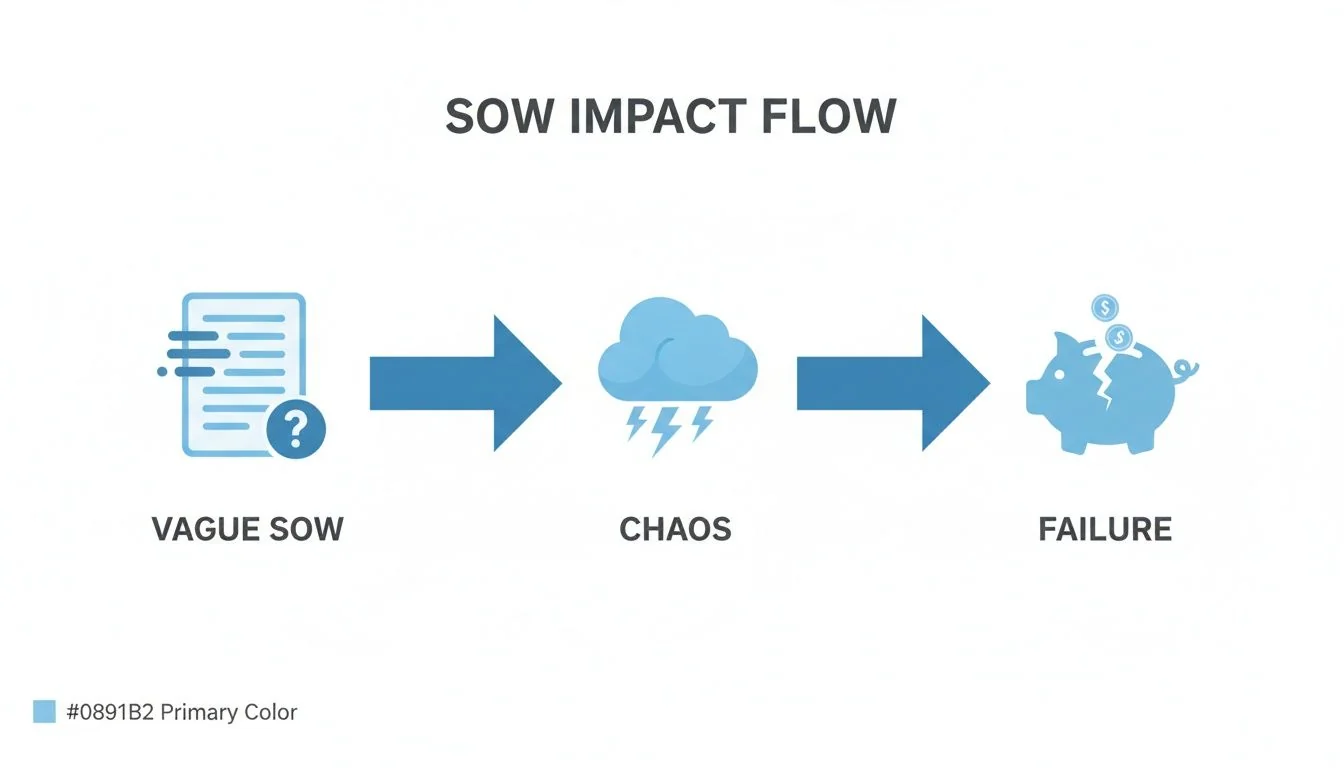
As illustrated, ambiguity is not a minor issue; it’s the root cause of project dysfunction that destroys return on investment.
Defining Project Objectives
The Project Objectives section establishes the “why.” It must clearly state the business problem and the quantifiable future state. Avoid vague goals like “improve data access” or “modernize the data platform.”
For instance, a weak objective states: “Migrate the on-premise data warehouse to the cloud.”
A strong, actionable objective is specific: “The primary objective is to migrate the legacy SQL Server data warehouse to a new Snowflake environment on AWS. This migration aims to reduce query latency for the ‘Executive Sales Dashboard’ from an average of 90 seconds to under 5 seconds and decrease monthly data infrastructure costs by at least 15% within the first quarter post-launch.”
This version provides a clear target. It defines success by linking technical work directly to measurable performance and financial outcomes.
Mapping Deliverables to Milestones
This clause deconstructs the project into tangible outputs (deliverables) linked to specific checkpoints (milestones), which trigger payments. This structure ensures you pay for verified progress, not just effort.
Every deliverable should be a noun—a report, a configured pipeline, a deployed data model. Verbs like “analyzing” or “developing” are activities, not deliverables, and should not be used as such.
Here’s a practical breakdown for a new ETL pipeline project:
-
Milestone 1: Discovery & Architecture Sign-off
- Deliverable: A detailed Technical Design Document outlining data sources, transformation logic for the top 5 critical entities, target schema in Databricks Delta Lake, and a data validation strategy.
- Payment: 15% of total project cost upon client approval.
-
Milestone 2: Core Pipeline Development & Unit Testing
- Deliverable: Deployed ingestion pipelines for Salesforce and Marketo data into the bronze layer. Deployed dbt models for transforming this data into the silver layer. A report showing unit test coverage of at least 85% for all transformation logic.
- Payment: 40% of total project cost upon successful test report review.
-
Milestone 3: UAT & Production Deployment
- Deliverable: Successful completion of User Acceptance Testing (UAT) with no more than 2 high-priority bugs outstanding. The full pipeline is deployed to the production environment and has run successfully for 5 consecutive business days.
- Payment: 45% of total project cost upon successful production run confirmation.
This approach creates a logical, defensible flow where payments are directly tied to working, tested components.
The single most effective way to de-risk a data engineering project is to link every payment to a physically demonstrable and pre-approved deliverable. If it cannot be tested or verified, it should not be paid for yet.
Detailing Technical Specifications
Ambiguous technical specifications are a primary source of conflict. This section must be ruthlessly detailed, leaving no room for assumptions about the technology stack, versions, or environments.
Assume no prior knowledge of your environment. Be explicit.
Essential Technical Specifications to Include:
- Cloud Platform and Region: Specify the provider and the exact region (e.g., Google Cloud Platform,
us-central1). This impacts latency, data sovereignty, and cost. - Core Technologies: List the primary tools and their required versions. For example: “The solution will be built using Databricks Runtime 14.3 LTS, with all transformation logic managed in dbt Core v1.8. All orchestration will be handled by Airflow 2.9.”
- Source Systems: Explicitly list every data source in scope. Include API endpoints, database names, and required authentication methods. For example: “Salesforce source data will be extracted via the Bulk API 2.0. The Oracle ERP connection will use a dedicated read-only replica database.”
- Coding and Style Guides: If you have internal standards, reference them directly. “All Python code must adhere to PEP 8 standards and include type hinting. All SQL transformations within dbt models must follow the established company style guide.”
This level of detail preempts debates about tooling and ensures the final product integrates with your existing ecosystem.
Establishing Roles and Responsibilities with a RACI Matrix
A project can fail despite clear objectives and a solid technical plan if roles are undefined. The Roles and Responsibilities section resolves this, and a RACI matrix is the most effective tool for this purpose.
RACI stands for Responsible, Accountable, Consulted, and Informed. It provides a visual map of ownership for every major task.
Here’s a sample RACI for a data warehouse modernization project:
| Task / Deliverable | Data Engineering Vendor | Client Project Manager | Client Data Architect | Client Business Analyst |
|---|---|---|---|---|
| Define Business Requirements | C | A | C | R |
| Draft Technical Design Doc | R | I | A | C |
| Approve Technical Design | I | C | A | I |
| Develop ETL Pipelines | R | I | C | I |
| Perform User Acceptance Testing | C | A | I | R |
| Final Production Sign-off | I | A | R | I |
This chart eliminates ambiguity. It is immediately clear that while the vendor is Responsible for development, the client’s Data Architect is ultimately Accountable for the design. This clarity is essential for maintaining momentum and ensuring accountability.
Defining Acceptance Criteria That Actually Work
This section is where project success is formally verified. Vague acceptance criteria are a leading cause of project disputes. This part of the SOW is the final quality gate, converting subjective sign-offs into objective, provable benchmarks.
Without it, the definition of “done” remains subjective, leading to conflicts between client expectations and vendor deliverables.
From Vague Hopes to SMART Criteria
Ambiguity is the enemy of a successful project. Criteria like “the pipeline should be fast” or “the dashboard needs to be accurate” are unenforceable wishes. Every criterion must be SMART: Specific, Measurable, Achievable, Relevant, and Time-bound.
Let’s use our data platform migration example.
A vague (and useless) criterion: The daily sales ingestion pipeline should be fast and reliable.
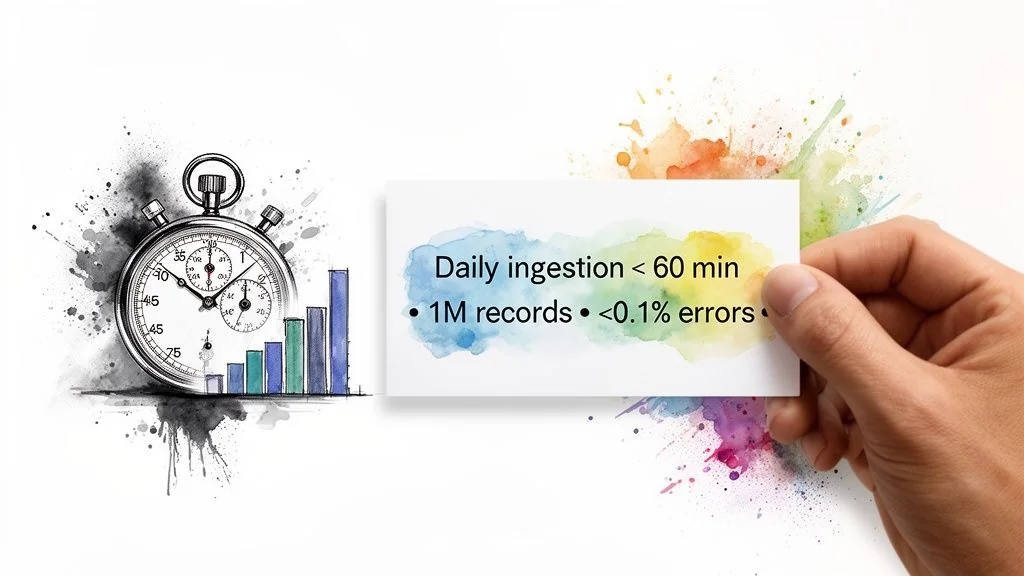
A SMART (and enforceable) criterion: The daily sales ingestion pipeline from Salesforce to Snowflake must complete its full run in under 60 minutes, starting between 2 AM and 3 AM UTC. It must successfully process a minimum of 1 million records with a data quality error rate below 0.1%, as verified by the project’s data validation framework.
The second version is contractual. It defines “fast” (< 60 minutes) and “reliable” (error rate < 0.1%) within a specific operational context. There is no room for interpretation.
Essential Testing Types for Data Projects
A strong SOW specifies how deliverables will be verified. This means mandating specific test types that must be passed before milestone sign-off. For data engineering, this involves three core validation layers.
-
Unit Tests for Transformation Logic: These tests isolate and verify the smallest code components—typically individual dbt models or Python functions. The SOW should mandate minimum code coverage. For example: “All SQL and Python transformation models must achieve at least 85% unit test coverage, validating critical business logic for calculations like Gross Margin and Customer LTV.”
-
Integration Tests for Pipelines: These tests verify that components work together. The entire pipeline is run, from source to target, with a representative dataset to check data flow, schema integrity, and system handoffs. A valid criterion is: “The end-to-end pipeline must execute successfully using the provided staging dataset, with source record counts matching target record counts within a 0.05% tolerance.”
-
User Acceptance Testing (UAT) for Dashboards: This is the final validation by business users. They use the output—typically a BI dashboard—to confirm it meets their requirements. Criteria must be tied to business scenarios. For instance: “The ‘Executive Sales Dashboard’ in Tableau must correctly display Q4 sales figures that reconcile with the legacy financial report, with a variance of no more than $100.”
This layered testing approach acts as a safety net, catching issues early, from bugs in individual functions to inaccuracies in executive-level reporting.
A data engineering statement of work without measurable acceptance criteria is just a wish list. It lacks the teeth needed to hold your vendor accountable for delivering a solution that performs under real-world conditions.
Quantifying Performance and Scalability
Performance is not just about speed; it’s about stability under increasing load. The SOW must define how the system should behave as data volumes grow. Neglecting this is a common and costly error.
A recent 2024 analysis on the impact of data engineering statistics from Gartner noted that 65% of SOWs lacked detailed KPIs for scalability, leading to a 25% rework rate post-launch. To avoid this, build future-state load scenarios into your acceptance criteria.
Here’s how to define scalability in your SOW:
Performance Under Load Test: “The system must demonstrate the ability to process a peak load of 5 million records (simulating end-of-quarter volume) within a 90-minute processing window. During this test, CPU utilization on the primary Snowflake warehouse must not exceed 80% for more than 10 consecutive minutes.”
This criterion is effective because it sets a clear performance benchmark under stress while also specifying resource constraints. This prevents the vendor from meeting performance targets simply by using excessive, costly compute resources, ensuring the solution is both functional and economically viable at scale.
5. Nailing Down the Commercials: Pricing, Rates, and SLAs
Selecting the right pricing model and defining service levels is as critical as the technical scope. These commercial terms establish the financial rules of the engagement and are foundational to the client-vendor relationship.
Incorrectly structured commercials lead to budget overruns and misaligned incentives. The goal is to protect your investment and incentivize the desired outcomes.
Choosing the Right Pricing Model
The optimal pricing model depends on the clarity of the project scope. The commercial structure must match the level of uncertainty.
The objective is to balance risk fairly between you and the vendor. The three most common models are:
Pricing Model Comparison for Data Projects
| Pricing Model | Best For | Pros | Cons |
|---|---|---|---|
| Fixed Price | Well-defined projects with zero ambiguity, like a lift-and-shift migration of 10 specific pipelines. | Predictable budget; vendor assumes risk for time overruns. | Inflexible. Any change requires a formal and often expensive change order. Can incentivize vendors to cut corners to protect margins. |
| Time & Materials (T&M) | Exploratory or agile projects with evolving requirements, like building a new ML feature platform. | Maximum flexibility to adapt. You pay only for actual effort. | Budget risk is entirely on the client. Requires tight project management to control scope creep. |
| Retainer | Ongoing operational support, maintenance, and continuous improvement for an existing data platform. | Guaranteed access to a dedicated team; predictable monthly cost for operations. | Can be inefficient if workload is inconsistent. You pay for team availability, not just output, which can be costly during lulls. |
For most complex data modernizations, a hybrid approach is most effective. A Fixed Price engagement can be used for an initial discovery and architectural design phase. Once the scope is clearly defined, the project can transition to a T&M model for core development sprints.
For a more detailed analysis, see this comparison of Fixed Price vs. Time and Materials contracts.
Benchmarking Vendor Rates
Effective negotiation requires market awareness. While rates vary by location, skills, and seniority, having a baseline is essential.
Market data for December 2025 indicates the following typical hourly rate bands for data engineering roles:
- Data Engineer: $120 - $180 / hour
- Senior Data Engineer: $160 - $220 / hour
- Lead Data Architect: $200 - $275+ / hour
- Project Manager: $110 - $165 / hour
For major platform builds on Snowflake or Databricks, a robust SOW requires more. A 2025 analysis of over 50 firms shows that top-tier SOWs now demand explicit rate cards, verified team compositions, and proof of platform certifications, a key trend in the big data engineering service market.
A vendor’s refusal to provide a transparent rate card is a significant red flag. It obscures true costs and makes it impossible to verify you are receiving the senior-level talent you were promised.
Drafting SLAs That Actually Have Teeth
A Service Level Agreement (SLA) is your project’s insurance policy. It is a business contract, not a technical wish list, that ensures the platform performs to an agreed-upon standard. Generic SLAs are ineffective; they must be specific, measurable, and tied to financial penalties.
Focus on metrics that directly impact business operations:
- Data Pipeline Uptime: Define this precisely. A target of 99.9% uptime monthly is standard, but you must define “downtime.” Is it a single failed run or a delay beyond a specific time window?
- Data Latency/Freshness: This is critical for analytics teams. Specify the maximum acceptable delay from source to target. Example: “Data from Salesforce opportunities must be queryable in Snowflake within 15 minutes of creation or update.”
- Issue Resolution Time: Define tiers based on severity with firm deadlines.
- Severity 1 (Critical Outage): Acknowledgment < 30 minutes; Resolution < 4 hours.
- Severity 2 (Degraded Performance): Acknowledgment < 2 hours; Resolution < 8 business hours.
Finally, attach consequences to SLAs. A “service credit” clause is the most effective enforcement mechanism. If an SLA is missed, the vendor issues a credit (e.g., 5% of the monthly fee) on the next invoice. This creates a financial incentive for the vendor to meet the agreed-upon standards.
Common SOW Pitfalls and Vendor Red Flags
A data engineering Statement of Work can appear solid but conceal significant risks. Identifying these issues before signing is critical to avoiding costly disputes. Certain subtle but dangerous traps appear consistently in these documents.

These are not minor oversights; they are foundational cracks. 2024 Forrester data shows 55% of vendor selections fail due to mismatched capabilities, often adding 20-40% in budget overruns. You can find more detail on drivers in the big data engineering service market.
The “Agile” Scope Creep Trap
A common tactic is using “agile collaboration” to justify an undefined scope. While agile development is effective, in an SOW it can be a vehicle for uncontrolled scope creep.
-
The Red Flag: The scope section contains vague verbs like “discover,” “explore,” or “iterate” without being linked to specific, time-boxed deliverables. Language about “flexible backlogs” appears without a clear process for pricing and prioritizing new items.
-
What to Do Instead: Mandate a hybrid model. The SOW must define a core set of non-negotiable deliverables for a fixed price. Exploratory work outside that scope should be managed in distinct sprints with separate budgets and a formal approval process.
Vague Resource Commitments
Another major red flag is ambiguous language about project staffing. A promise of senior talent is meaningless without a contractual guarantee.
A vendor’s “A-team” often appears during the sales process, only to be replaced by a more junior team post-contract. The SOW is the only tool to prevent this bait-and-switch.
Here is a common example:
-
The Red Flag: The SOW states you will have “access to senior architects” or be supported by a “team of experienced engineers.” These subjective phrases are legally unenforceable.
-
What to Do Instead: Insist on a “Key Personnel” clause. This section must name the specific individuals (e.g., Lead Architect, Senior Engineer) assigned to the project. Critically, it must also state that the vendor cannot reassign these individuals without your explicit written consent. This is non-negotiable.
The Missing Change Control Process
No project proceeds exactly as planned. New data sources emerge, priorities shift, and requirements evolve. An SOW lacking a formal change control process is a recipe for conflict, turning every minor adjustment into a major dispute.
Without this process, you are vulnerable to informal agreements that reappear as surprise invoices.
A Strong Change Control Clause Includes:
- A Formal Change Request Form: Specifies required information (description, business justification, impact analysis).
- A Clear Approval Workflow: Defines who from each team must sign off before work begins.
- Impact Assessment: Mandates a written assessment from the vendor on how the change affects the project’s timeline, budget, and other deliverables.
This structured process removes emotion and ambiguity from change management, turning potential arguments into standard business decisions. For more on this, see our guide on how to evaluate data engineering vendors.
Neglecting Security and Compliance
In 2025, data security is a core requirement, not an afterthought. Many SOWs gloss over this with a generic sentence like, “Vendor will adhere to industry best practices.”
This is insufficient, especially when dealing with data subject to regulations like GDPR, CCPA, or HIPAA.
-
The Red Flag: The SOW lacks a dedicated section for security and compliance. There is no mention of specific regulations, data handling protocols, encryption standards, or access control policies.
-
What to Do Instead: The SOW must be explicit. It should reference applicable regulations (e.g., “All data processing must be GDPR-compliant”). It must also detail technical requirements, such as “All data at rest must be encrypted using AES-256” and “Access to production data will be restricted to named individuals via role-based access control.”
Your Actionable SOW Template and Checklist
To make this practical, we’ve bundled these principles into a downloadable, editable data engineering Statement of Work template. It includes annotations explaining the purpose of each clause and prompts to guide you, with specific notes for projects on platforms like Snowflake, Databricks, AWS, or GCP.
Your Pre-Signature SOW Checklist
Before signing, perform a final review using this checklist. It can prevent significant problems by catching ambiguous language before it becomes a contractual issue.
- Are the Objectives SMART? Ensure every goal is Specific, Measurable, Achievable, Relevant, and Time-bound.
- Are Deliverables Nouns, Not Verbs? Every deliverable must be a tangible output (“Technical Design Document,” “Deployed Data Pipeline”), not an activity (“Analyzing,” “Developing”).
- Is Acceptance Criteria Quantified? Every deliverable needs hard numbers defining success: performance benchmarks, data quality thresholds, and specific functional tests.
- Are Key People Named? The SOW must list the lead architect and senior engineers by name and require your written approval for any changes.
- Is Change Control Spelled Out? There must be a formal process for requesting, estimating, and approving changes.
- Do SLAs Have Teeth? SLAs for uptime or support must be tied to financial credits or penalties for non-compliance.
For managing multiple contracts, an AI contract management system can help maintain consistency and organization.
The strength of your SOW directly correlates to the predictability of your project’s outcome. A few hours spent clarifying these details upfront will save you weeks of disputes and rework down the line.
For those in the vendor selection phase, our guide on creating a data engineering RFP is also a valuable resource.
Frequently Asked Questions
A well-constructed Statement of Work ensures alignment from day one. Here are answers to common questions that arise during its creation.
What’s the Real Difference Between an SOW and a Contract?
The Statement of Work (SOW) is the project’s technical blueprint—the “what.” It details the specific tasks, deliverables, timelines, and specifications.
The contract is the legal framework—the “how.” It’s the legally binding agreement that incorporates the SOW by reference and includes broader terms like payment conditions, liability, confidentiality, and intellectual property ownership. The SOW defines what to build; the contract ensures it gets paid for and outlines legal recourse.
Just How Detailed Does a Data Engineering SOW Need to Be?
It must be specific enough to eliminate misinterpretation. Any ambiguity will be interpreted differently by each party.
This means providing granular detail. A data engineer with no prior context should be able to understand precisely what to build from the SOW alone. This requires naming specific data sources, defining transformation logic, detailing target data schemas, and listing the full tech stack, including Python versions or the structure of dbt models. Performance KPIs are also essential.
Who Actually Writes the SOW?
Drafting an SOW is a collaborative process.
Typically, the client initiates by defining the business objectives and success criteria. The vendor then drafts the document, translating those needs into a technical approach, resource plan, and timeline. The client’s technical leads, project managers, and legal team must then review it meticulously. It is an iterative process of negotiation and refinement until both parties are in full agreement.
Precision is critical. The global big data engineering services market is projected to reach USD 91.54 billion in 2025 and grow to USD 187.19 billion by 2030. With this level of investment, ambiguity is unacceptable. Discover more insights about these data engineering statistics.
Finding the right partner is the first step to a successful project. At DataEngineeringCompanies.com, we provide data-driven rankings and tools to help you select the best data engineering firm with confidence.
Data-driven market researcher with 20+ years in market research and 10+ years helping software agencies and IT organizations make evidence-based decisions. Former market research analyst at Aviva Investors and Credit Suisse.
Previously: Aviva Investors · Credit Suisse · Brainhub · 100Signals
Top Data Engineering Partners
Vetted experts who can help you implement what you just read.