Data Engineering Consulting vs. In-House Team: A Decision Framework for Engineering Leaders
The choice between using a data engineering consulting firm and building an in-house team is a decision about resource allocation under pressure. Use a consultant to execute a complex, time-sensitive project like a cloud data platform implementation. Build an in-house team to cultivate long-term, proprietary data capabilities that become a competitive moat.
This decision dictates your company’s data velocity and cost structure for years.
The Core Decision Framework for Your Data Team
The “consulting vs. in-house” debate is not about which is universally better; it’s about which is the right tool for the immediate job, given your strategic goals. The decision pits short-term project execution against the long-term accumulation of institutional knowledge.
It is critical to distinguish between outcome-based consulting and simple capacity augmentation. Hiring a firm to deliver a finished data platform is fundamentally different from hiring temporary contractors to fill seats. This is the core distinction between project-based staff augmentation vs consulting.

Key Decision Criteria for Engineering Leaders
Engineering leaders evaluating this choice must weigh three primary factors:
- Speed-to-Value: How quickly can you deliver a production-ready data pipeline or platform that generates tangible business value?
- Total Cost of Ownership (TCO): What is the fully loaded cost beyond contractor rates versus salaries? This includes recruitment, benefits, management overhead, and opportunity cost of unfilled roles.
- Access to Specialized Skills: Can you acquire and retain elite talent with certified expertise in specific platforms like Snowflake, Databricks, or tools like dbt?
Data Engineering Models: An Executive Comparison
This table provides a direct, evidence-based comparison for your decision-making process.
| Criteria | Data Engineering Consulting | In-House Data Engineering Team |
|---|---|---|
| Speed-to-Value | High: A consulting team delivers production-ready systems in weeks or a few months, leveraging pre-built frameworks and avoiding internal learning curves. | Low: The ramp-up is slow. Hiring, onboarding, and internal knowledge acquisition can take 6-9 months before significant value is delivered. |
| Cost Structure | High Variable Cost (OpEx): Project-based fees with a defined end. No long-term overhead or liabilities. | High Fixed Cost (OpEx/CapEx): Salaries, benefits, and training are recurring, long-term financial commitments. |
| Skill Access | On-Demand: Instant access to a roster of certified experts in any modern data stack component, from platform implementation to data governance. | Limited & Competitive: Access is constrained by the hiring market. Finding niche specialists (e.g., Databricks optimization) is a time-consuming and expensive process. |
| Business Context | Low: Consultants start with zero institutional knowledge and must be actively managed to understand deep business nuances. | High: Over time, an in-house team builds irreplaceable institutional knowledge and aligns deeply with specific business unit needs. |
| Scalability | Flexible: Easily scale a team up for a major project and scale down upon completion without HR complexities. | Rigid: Scaling the team up or down is a slow, resource-intensive HR and management process. |
| Best For | Urgent platform migrations (AWS, Azure, GCP/BigQuery), designing complex data pipeline architectures, or implementing a data governance framework from scratch. | Long-term operational stability, ongoing platform maintenance, and developing a data capability that is a core, strategic business asset. |
Consultants are an accelerant for specialized, high-stakes projects. An in-house team is a long-term investment in building a core competency.
Analyzing the True Total Cost of Ownership
Comparing a consultant’s daily rate to a full-time employee’s salary is a fundamental error. A correct analysis requires calculating the Total Cost of Ownership (TCO), which accounts for all direct and indirect expenses associated with hiring.
The “fully loaded” cost of a data engineer far exceeds their base salary. Your budget must account for:
- Recruitment Fees: Agency fees average 20-30% of the first-year salary.
- Benefits & Payroll Taxes: These add 25-40% on top of the base salary.
- Training & Development: Continuous education for platforms like Snowflake, Databricks, and dbt is a mandatory, recurring operational expense to maintain skill relevance.
- Management & Onboarding Overhead: The time engineering managers and senior engineers spend recruiting, interviewing, and mentoring is a significant, hidden productivity cost.

The Hidden Costs of Hiring In-House
The intense competition for data engineering talent is the primary driver for using consulting firms. The talent pool is thin, driving up salaries, recruitment costs, and time-to-hire. According to DataEngineeringCompanies.com’s analysis of 86 data engineering firms, the difficulty in hiring for specialized roles is the #1 reason clients seek external help.
A senior data engineer with a $180,000 salary costs the business over $250,000 annually once fully loaded with benefits, recruitment fees, and overhead. This figure does not include the opportunity cost of a 6-month hiring cycle, which can delay a project by two quarters.
Modeling the Cost of Consulting
Data engineering consulting operates on a different financial model, typically project-based or retainer-based fees. While the initial proposal appears high, it is a predictable, all-inclusive cost that eliminates long-term liabilities like benefits, severance, and training budgets. Our analysis of data engineering consulting rates provides clear benchmarks for this OpEx investment.
When calculating TCO, you can explore pricing structures for external data engineering services to directly compare a predictable project expense against the unpredictable, loaded cost of employees. For a 12-month data platform implementation, a consulting engagement is frequently more cost-effective than attempting to hire, train, and manage a new team, especially when accounting for the risk of internal project failure due to skill gaps.
The decision is not about the hourly rate. It is a strategic choice about financial risk, predictability, and speed-to-value.
Evaluating Speed to Value and Project Acceleration
For high-stakes initiatives like a cloud data migration or the launch of a new data product, the project timeline is a direct proxy for business impact. Here, the gap between data engineering consulting and an in-house build is most pronounced.
Consultants arrive with battle-tested playbooks, code accelerators, and deep implementation expertise on platforms like Snowflake or Databricks. They have already navigated the common failure points, allowing them to bypass the learning curve an internal team must endure. They are paid to execute, not to learn on your budget.
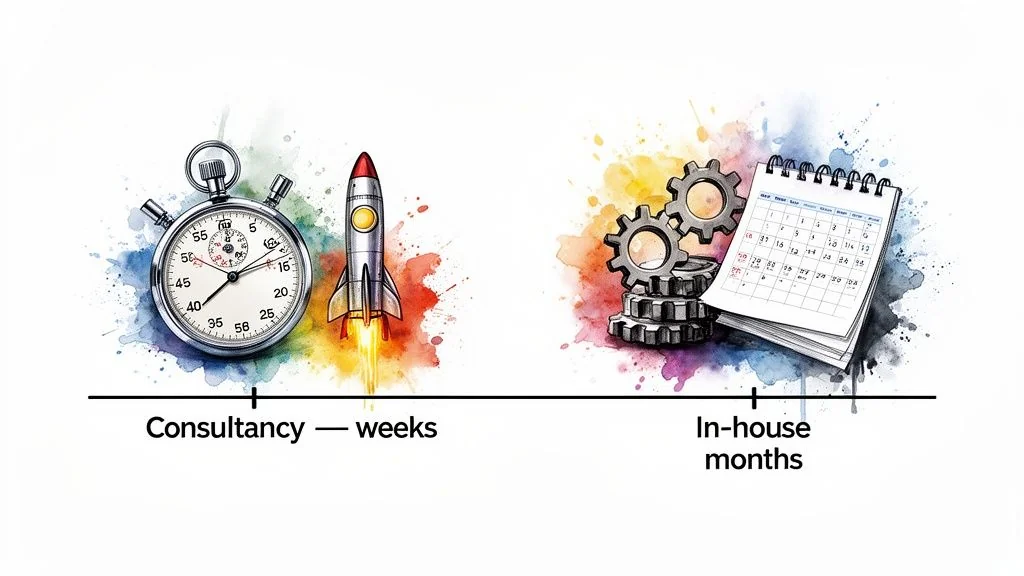
Contrasting Project Timelines: A Concrete Example
Building an in-house team follows a slow, sequential path. The project clock starts when the job description is approved, not when work begins. Finding and hiring one senior data engineer takes 3-6 months in the current market. Onboarding and ramp-up to full productivity consumes another 1-3 months.
During this 4-9 month period, no project work is accomplished. A consulting partner would have already provisioned infrastructure and delivered initial data pipelines.
For a standard data warehouse modernization project, an experienced consulting firm will deliver a production-ready solution in 4-6 months. An internal team starting from scratch will require 9-12 months to reach the same milestone, accounting for hiring and onboarding delays.
The Opportunity Cost of Delay
That 5-month gap is not just a schedule slip; it represents five months of lost business opportunity and compounding technical debt. The ripple effect across the organization is significant:
- Delayed Analytics: BI and data science teams operate with stale, unreliable data, forcing critical business decisions to be made with incomplete information.
- Stalled AI/ML Initiatives: Planned predictive models and revenue-generating AI applications remain on the back burner.
- Competitive Disadvantage: A competitor using a consultant may launch a data-driven feature and capture market share while you are still conducting interviews.
Engaging a data engineering consulting firm is a strategic investment to compress time. For urgent, high-impact projects, the acceleration they provide delivers business value months faster than an in-house team can achieve.
Bridging Specialized Skill Gaps on Demand
The modern data stack is a complex ecosystem of specialized tools. It is not feasible for most organizations to staff full-time experts in every niche—from Snowflake cost optimization and Databricks performance tuning to implementing data governance with Collibra or mastering CI/CD for data pipelines with dbt.
Using a data engineering consulting firm provides on-demand access to a bench of certified specialists, avoiding the futile search for a “unicorn” engineer.
Accessing a Roster of Experts
Partnering with a consultancy provides access to the firm’s collective knowledge base, a powerful asset for an Enterprise Architect or VP of Engineering planning a multi-year roadmap.
- Cloud Infrastructure: Get immediate access to a certified expert in AWS, Azure, or GCP/BigQuery to design and provision your data platform correctly from day one.
- Data Modeling & Transformation: Deploy a specialist to architect a scalable dbt project or solve a complex data modeling challenge without a six-month hiring cycle.
- MLOps & Advanced Analytics: As your platform matures, you can instantly bring in MLOps engineers to productionize machine learning models.
This model provides the right expert at the right time. It bypasses the recruitment delays and high costs associated with hiring for a niche, hard-to-fill role.
A consulting firm allows you to deploy a specialist for a focused, three-month engagement to solve a specific problem, such as optimizing a runaway Databricks cluster. You get the solution without the long-term cost and commitment of a full-time hire. This surgical approach is impossible to replicate with an in-house team.
Market data validates this shift. The global data engineering consulting market is projected to grow at a CAGR of 11.0%, a clear signal that engineering leaders view specialized consulting as a core component of a modern data strategy, not a temporary fix. You can review the drivers behind this growth by exploring the latest data engineering consulting market trends.
Long-Term Strategy: Governance, Scalability, and Knowledge Transfer
Your team model defines how your data practice will scale and remain secure. Consultants excel at rapidly implementing robust data governance frameworks, leveraging proven templates for data quality, access controls, and compliance monitoring on platforms like Snowflake or Databricks. However, their role is to build the framework, not to operate it long-term.
The Handoff: The Most Critical Phase of a Consulting Engagement
The most common failure point in a consulting project is an ineffective handoff. Without a structured knowledge transfer process, the delivered platform will degrade, and the project’s ROI will evaporate.
The success of a data consulting project is measured six months after the engagement ends: can your internal team confidently operate, maintain, and enhance the system? A poor handoff creates technical debt and a dangerous vendor dependency.
Knowledge transfer must be a contractual deliverable, not an afterthought. Your statement of work must mandate:
- Paired Programming: Your engineers must actively code and review alongside consultants.
- Living Documentation: Demand comprehensive, version-controlled documentation for all data pipelines, models, and infrastructure.
- Recorded Training Sessions: All technical walkthroughs and business logic explanations must be recorded and archived, creating a permanent onboarding asset.
Surge Capacity vs. Sustainable Operations
The two models offer distinct scalability profiles. Consultants provide immediate surge capacity—the ability to assemble a large, expert team for a massive undertaking like a cloud migration. This enables major technological leaps without permanently increasing headcount.
An in-house team provides steady, incremental capacity. They handle ongoing maintenance, bug fixes, and feature enhancements that ensure the data platform remains aligned with evolving business needs. This operational ownership is a function for which consultants are not designed.
A hybrid strategy is the most effective approach. Use consultants for high-impact, transformative projects that require specialized skills and speed. Simultaneously, empower your in-house team to own the long-term vision, manage daily operations, and absorb knowledge to ensure the platform delivers sustained value.
An Actionable Matrix for Making Your Decision
To move from analysis to a decision on data engineering consulting vs in-house team, use a framework that quantifies what matters most to your business right now.
Start by classifying the nature of the work. Is it a net-new, high-impact project or the establishment of a long-term operational capability? This flowchart provides an initial directional guide.
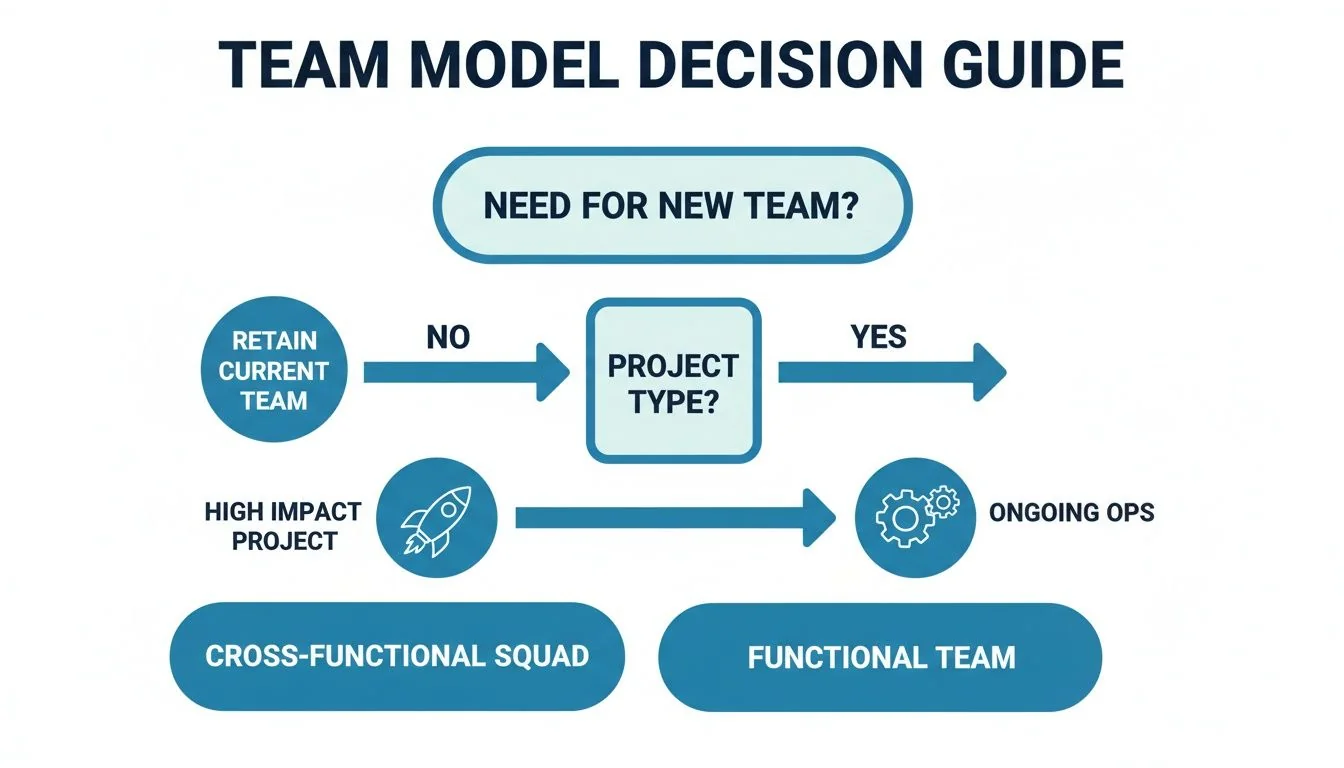
This acts as a first-pass filter. The type of work—transformative project vs. ongoing function—is the most critical determinant.
Decision Matrix: A Quantitative Evaluation Framework
This weighted decision matrix forces you to score each factor based on its current importance to your organization. Assign a Weight (1-5) to each criterion, then score each model on a scale of 1-10 for how well it delivers on that factor. The weighted score produces a quantitative, defensible result.
| Decision Factor | Weight (1-5) | Consulting Score (1-10) | In-House Score (1-10) | Weighted Score |
|---|---|---|---|---|
| Speed to Value | 5 | 9 | 3 | C: 45, IH: 15 |
| Long-Term TCO | 4 | 6 | 8 | C: 24, IH: 32 |
| Access to Niche Skills | 5 | 10 | 4 | C: 50, IH: 20 |
| Knowledge Retention | 3 | 4 | 9 | C: 12, IH: 27 |
| Scalability (Up/Down) | 4 | 9 | 5 | C: 36, IH: 20 |
| Total Score | C: 167, IH: 114 |
In this example, the heavy weighting on speed and access to niche skills makes consulting the clear choice. Your specific weights will differ, but this exercise provides a data-backed rationale for your decision.
Your Clear Next Steps
This matrix provides a clear path forward.
-
If consulting scored higher: Your immediate priority is to draft a precise scope of work (SOW). A vague request yields a vague proposal. Use this guide on how to evaluate data engineering vendors to structure a rigorous RFP and begin your vendor selection process.
-
If in-house scored higher: Your priority is to build a strategic and realistic hiring plan. Acknowledge the competitive hiring market and map an achievable timeline and budget for recruitment, interviewing, onboarding, and continuous training.
Common Questions from Engineering Leaders
These are the most frequent questions from engineering leaders facing this decision.
When Does a Hybrid Model Make the Most Sense?
A hybrid model is the optimal strategy when you must execute a major project quickly while simultaneously building long-term internal capability. This is common for large-scale platform migrations or complete data architecture overhauls.
In this model, consultants execute the initial heavy lifting—complex architectural design and intensive implementation. Your in-house team works directly alongside them, absorbing knowledge, contributing business context, and preparing to assume full operational ownership post-launch. This approach provides maximum acceleration without sacrificing long-term self-sufficiency.
Finding the right data engineering partner is the most critical step. At DataEngineeringCompanies.com, we provide transparent, data-driven rankings of top firms to help you choose with confidence. Start your search and find your ideal partner today.
Data-driven market researcher with 20+ years in market research and 10+ years helping software agencies and IT organizations make evidence-based decisions. Former market research analyst at Aviva Investors and Credit Suisse.
Previously: Aviva Investors · Credit Suisse · Brainhub · 100Signals
Top Data Engineering Partners
Vetted experts who can help you implement what you just read.
Related Analysis
The Real Cost and Timeline of a Data Mesh Consulting Engagement
A guide to data mesh consulting for engineering leaders. Learn to scope projects, select partners, and implement a data mesh that delivers business value.
Airflow vs Prefect vs Dagster: A 2026 Decision Guide for Engineering Leaders
A definitive guide to Airflow vs Prefect vs Dagster for enterprise data teams in 2026. Make the right choice for your data platform and avoid technical debt.
BigQuery vs Snowflake: An Engineering Leader's Decision Framework
An evidence-based BigQuery vs Snowflake comparison of architecture, pricing, and performance to guide your 2026 data platform choice.