Data Dictionary Definitions: Achieve Data Engineering

If a consultancy treats data dictionary definitions as a documentation afterthought, expect rework, metric disputes, and expensive platform churn. This sits squarely in the Data governance hub, but it directly affects Snowflake migrations, Databricks implementations, dbt model design, Airflow orchestration, and every cloud data platform rollout on AWS, Azure, and BigQuery.
The sharpest signal is simple. 68% of data engineers report that misaligned definitions cause at least one major rework cycle per quarter, yet fewer than 12% of public guides include both functional and technical definition components according to the NNLM data dictionary reference. If your consulting partner can’t define fields in a way that business and engineering both accept, they aren’t building a data platform. They’re laying down future change orders.
Why Inconsistent Definitions Derail Data Engineering Projects
Poor data dictionary definitions don’t break projects in theory. They break them in delivery.
A team migrates from SQL Server to Snowflake. Another standardizes transformation logic in dbt. A third stands up ingestion in Airflow. Everyone ships on schedule, and the business still rejects the output because “active customer,” “net revenue,” or “closed transaction” means something different in finance, product, and operations.
That’s why the 68% rework figure matters so much. The problem isn’t missing documentation for its own sake. It’s that teams build the wrong pipelines, the wrong marts, and the wrong tests when definitions are loose or split between departments. The result is rework in mappings, dbt models, semantic layers, dashboard logic, and migration signoff.
What failure looks like early
You can spot this before the project stalls:
- Business terms drift: Sales and finance use the same label for different calculations.
- Technical teams fill gaps themselves: Engineers invent assumptions because no approved definition exists.
- Validation meetings turn political: UAT becomes a debate over meaning rather than correctness.
- Migration scope keeps moving: Source-to-target mapping changes after build has already started.
Practical rule: If a consultancy starts implementation before resolving core business terms, they’re pushing risk downstream.
In regulated sectors, the damage gets worse. Healthcare teams especially run into this when local source systems encode the same real-world concept differently. If you’re dealing with domain harmonization, the healthcare data standardization guide is a useful companion because it shows why semantic consistency has to precede integration.
Core Concepts Your Consultant Must Master
A serious consultancy should answer four terms with precision, not buzzwords. If they can’t, stop the process.
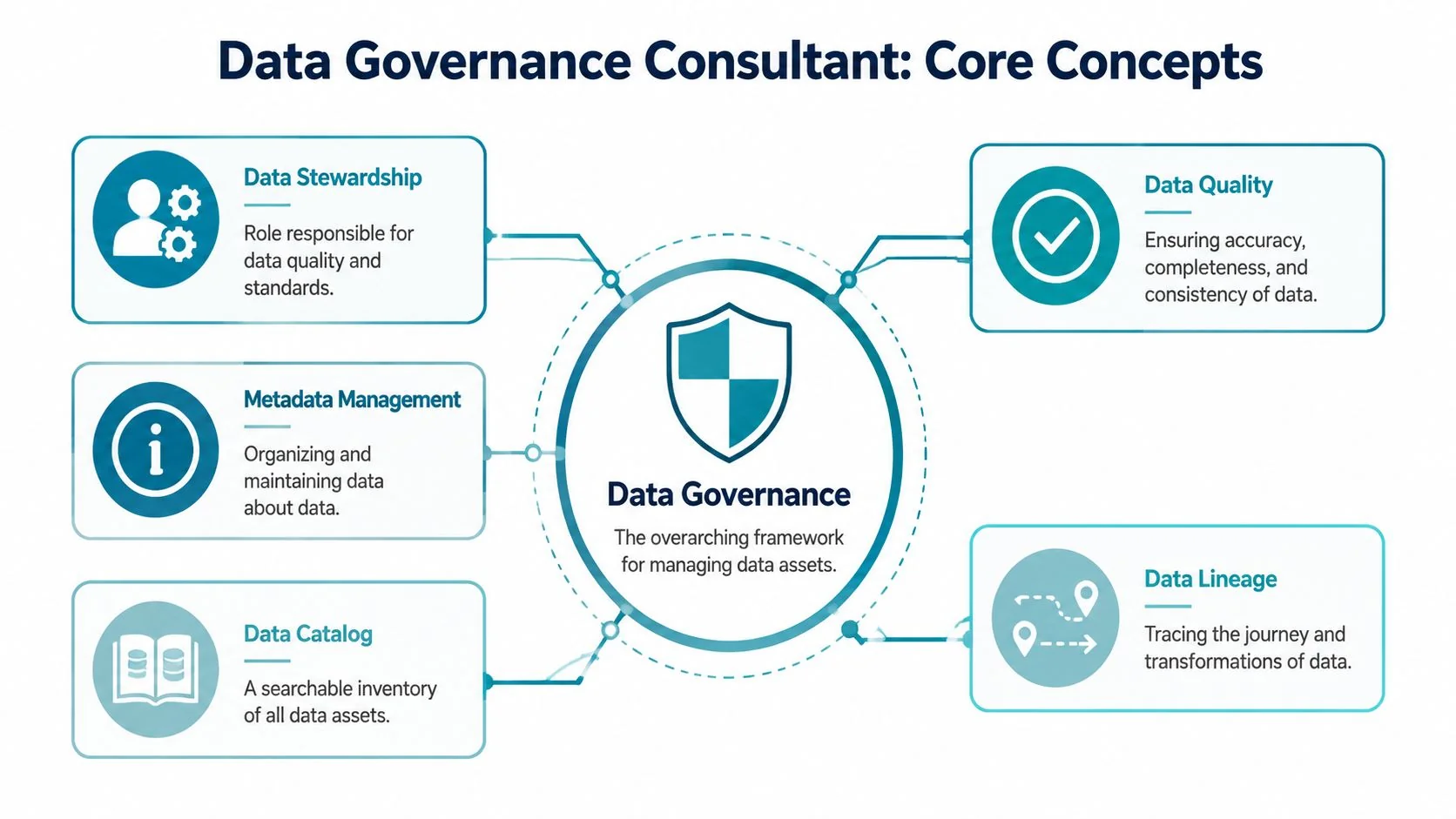
Data element
A data element is the actual field being documented. In a warehouse, that might be customer_email, product_sku, or net_transaction_value.
A good consultant explains the element at two levels. First, its technical properties such as type, format, length, and constraints. Second, its business meaning and usage rules. If they only talk about schema introspection, you’re hearing a tooling answer, not a governance answer.
Business term
A business term is the shared concept behind one or more fields. Think “active customer” or “recognized revenue.”
Strong partners separate business terms from physical columns. They know one business term can map to different source fields across Salesforce, Shopify, NetSuite, or EHR systems. Red flag: they use “business glossary” and “data dictionary” interchangeably without explaining how they connect.
Data type
A data type isn’t just VARCHAR or DECIMAL. It includes the storage definition plus the formatting and validation context that keeps the field usable.
A capable consultant will discuss format standards, null handling, allowed values, and how type changes propagate through dbt, Snowflake, Databricks, or BigQuery. A weak one says “we’ll document the column type” and moves on.
Data lineage
Data lineage traces where the field came from, how it changed, and where it’s consumed. That matters because analysts, auditors, and AI systems all need context.
The right answer links lineage to transformations, ownership, and impact analysis. The wrong answer is a generic diagram nobody updates.
Use these four concepts as a fluency test in vendor interviews. Ask for examples from a migration, a dbt implementation, or a governed analytics rollout. If they answer in abstractions, they won’t deliver usable data dictionary definitions.
Standard Metadata Attributes to Mandate in Your SOW
A CSV with column names and data types is not a data dictionary. It’s export residue.
According to the Splunk guide to data dictionaries, essential components include detailed properties of data elements, business rules, and entity-relationship diagrams, plus ownership, creation and modification dates, and approval status. That baseline belongs in your contract, not in a “nice to have” appendix.
Non-negotiable attributes
Mandate these fields for every high-value element:
- Business definition: Plain-English meaning, not a restatement of the column name.
- Technical specification: Data type, format, length, constraints, and nullability.
- Business rules: Inclusion, exclusion, derivation logic, and allowed values.
- Ownership model: Data owner, steward, and business SME.
- Lifecycle fields: Created date, modified date, approval status.
- Data profile details: Range, completeness, cardinality, distribution, and common values when available.
- Lineage references: Upstream source, transformation layer, downstream consumption.
- Relationship context: Entity relationships and join expectations where relevant.
If your stakeholders still blur the line between the field itself and the metadata that describes it, this short explanation of eCommerce data vs metadata explained helps reset the discussion fast.
Put it in the contract language
Don’t ask the consultancy to “document critical fields.” That’s weak language and they’ll exploit it.
Write the SOW so the deliverable includes required metadata attributes, review workflow, approval states, and update responsibilities across dbt docs, Snowflake comments, catalog entries, and BI annotations. If you need a stronger contracting baseline, this guide to data project SOWs is the right starting point.
What to reject: Any partner that proposes “initial documentation” without naming required fields, review cadence, approval workflow, and system-of-record for definitions.
Canonical Definition Templates That Prevent Ambiguity
Structure determines whether data dictionary definitions reduce confusion or create it.
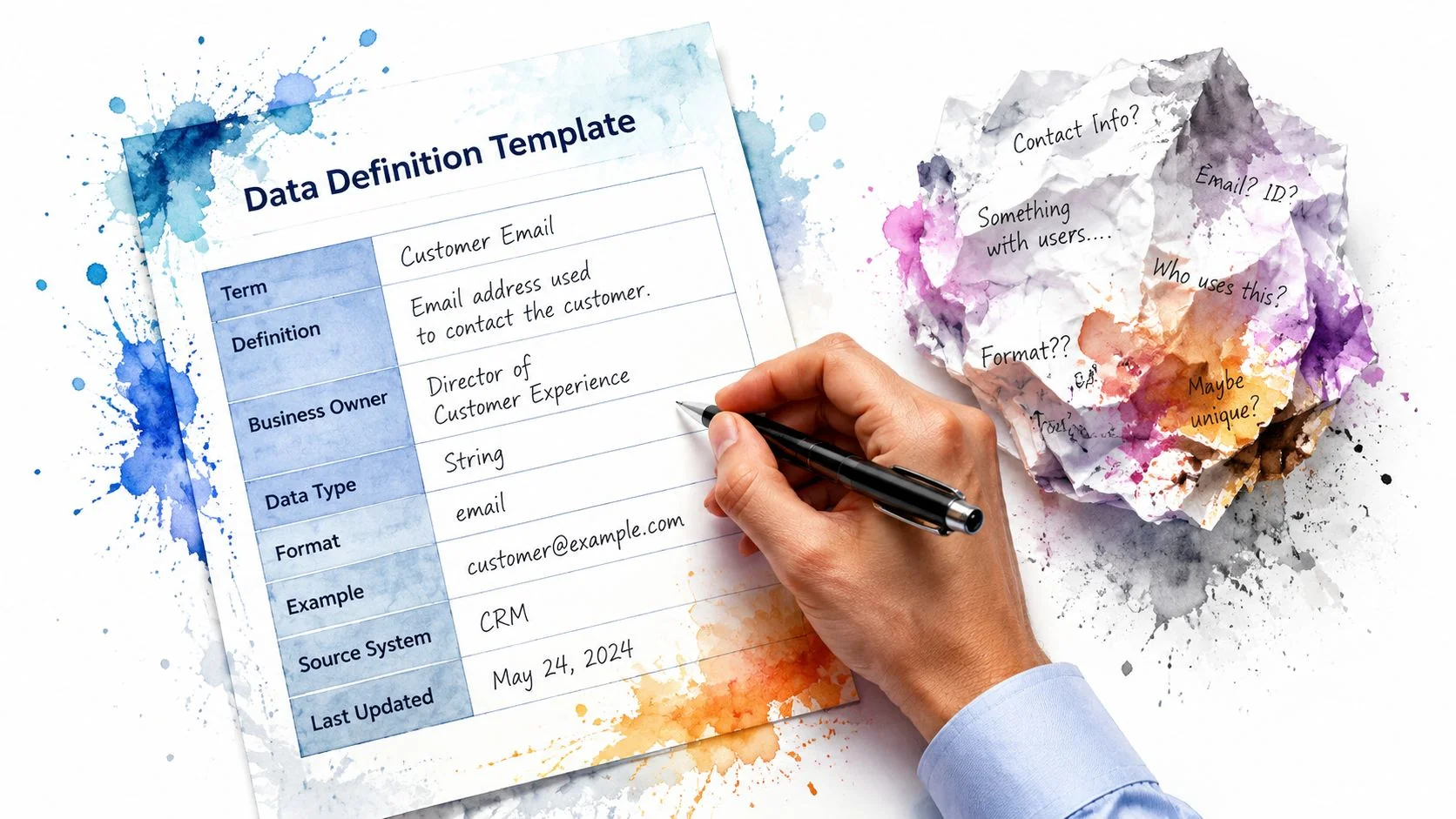
The standard I expect from a consultancy is simple. Every definition must combine business semantics with technical attributes. The Atlan overview of data dictionaries is right on this point. A data dictionary must document data type, format, and length alongside human-readable definition, context, and usage rules, and mature teams enforce validation for new fields through CI/CD to keep documentation coverage above 95%.
Bad versus good
| Definition quality | Example |
|---|---|
| Weak | customer_status: Status of customer |
| Strong | active_customer_status: Indicates whether a customer meets the company-approved criteria for active engagement. Calculated from approved transaction and account activity rules. Allowed values are constrained to the documented status set. Used in retention reporting and lifecycle segmentation. Not valid for credit risk decisions. Source logic and downstream dependencies are linked in dbt model documentation and catalog metadata. |
The weak version repeats the field name. The strong version tells the user what the field means, how it should be used, and where it doesn’t apply.
The template to require
Use this pattern in every review:
- Field name
- Business term
- Plain-English definition
- Business purpose
- Source system
- Transformation or calculation logic
- Allowed values or validation rules
- Usage guidance
- Known exclusions
- Owner, steward, SME
- Approval status and revision date
Ask the consultancy to show how this template is enforced in pull requests, model reviews, or release gates. If undocumented fields can enter production, the process is broken.
A quick visual walkthrough helps when you’re aligning technical and business reviewers:
Example Entries for Customer Product and Transaction Domains
Abstract standards aren’t enough. You need sample entries that prove the consultancy can write definitions people will use.
Customer domain example
Field name: active_customer_status
Business term: Active Customer
Definition: Indicates whether a customer currently meets the organization’s approved activity criteria for lifecycle reporting.
Business purpose: Supports retention analysis, segmentation, and customer health reporting.
Source system: Derived from CRM and transaction platform records.
Usage guidance: Valid for reporting and cohort analysis. Not intended for compliance determinations or credit decisions.
Known exclusions: Internal test accounts and records explicitly excluded by business rule.
Ownership: Revenue operations owner, analytics steward, lifecycle SME.
Product domain example
Field name: product_sku
Business term: Product SKU
Definition: Unique business identifier assigned to a sellable product unit for catalog, fulfillment, and reporting consistency.
Business purpose: Enables alignment between commerce platform, ERP, inventory, and analytics models.
Source system: Product master or ERP.
Usage guidance: Use as the primary product join key where the enterprise product master is authoritative.
Known exclusions: Temporary placeholders and deprecated SKUs retained only for historical traceability.
Transaction domain example
Field name: net_transaction_value
Business term: Net Transaction Value
Definition: Monetary value of a transaction after approved deductions defined by finance policy.
Business purpose: Used in performance, margin, and customer value reporting.
Source system: Derived from order and finance systems.
Usage guidance: Use for management reporting where finance-approved net logic is required. Do not substitute for gross booking analysis.
Known exclusions: Reversed records, non-reportable internal adjustments, and excluded operational events per finance rules.
Good definitions answer the first three stakeholder questions immediately: what does it mean, when should I use it, and who approves it?
If the consultancy’s examples don’t reach this level, their production deliverables won’t either.
Integrating Dictionaries with Your Modern Data Stack
A static spreadsheet is where data dictionary definitions go to die.
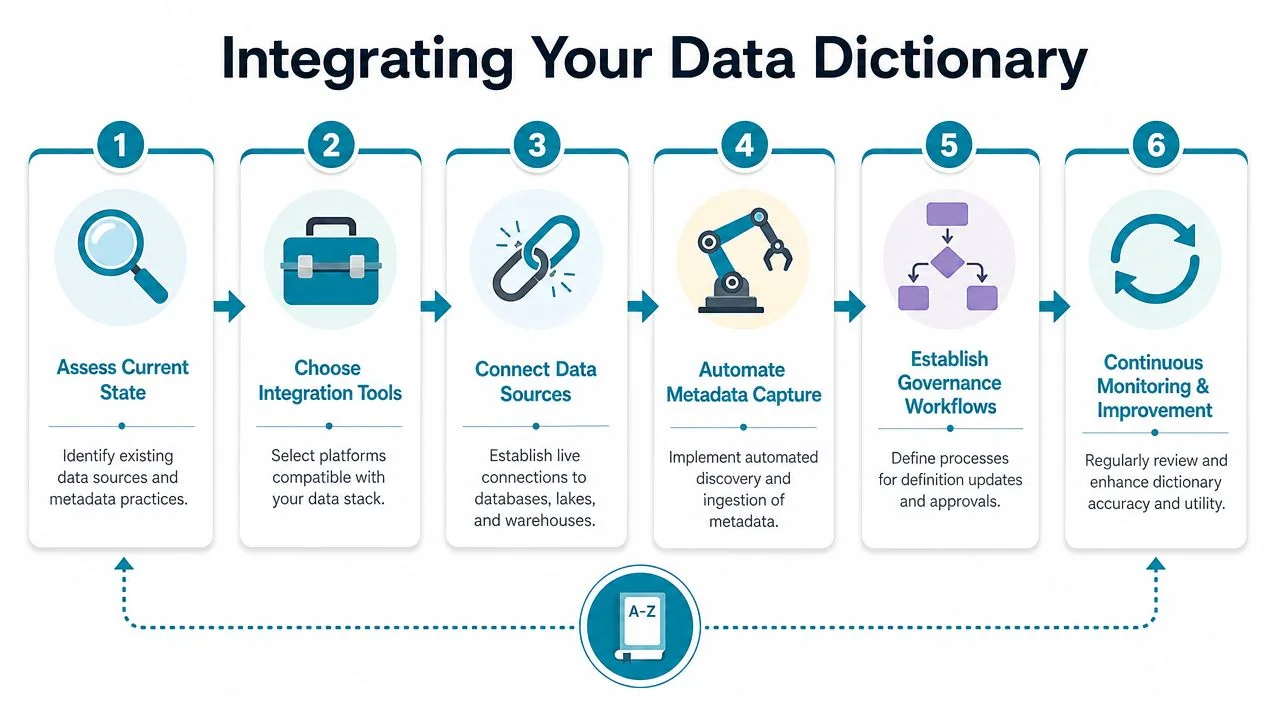
Modern consulting work has to connect definitions to the stack itself. That means Snowflake object comments, Databricks metadata layers, dbt model and column docs, Airflow pipeline context, and catalog synchronization across tools such as Atlan, Alation, or Collibra.
What integrated delivery looks like
A serious partner should propose:
- Automated technical harvesting: Pull schema metadata from warehouses and lakehouses instead of typing it manually.
- Controlled semantic enrichment: Business owners approve meanings, usage rules, and exceptions.
- Bidirectional visibility: Definitions appear where people work, including IDEs, catalogs, and BI tools.
- Release governance: New critical fields without approved definitions fail deployment review.
This is where dictionary work meets pipeline engineering. If metadata isn’t synchronized, changes in source systems and transformations break trust. Real-time pipeline oversight matters too. According to the Decube pipeline architecture article, 30 to 40 percent of information flows encounter failures weekly, and companies face 67 monthly information incidents that take about 15 hours to address. If your definitions, lineage, and monitoring are disconnected, incident response gets slower and root cause analysis gets murkier.
Questions to ask by platform
For a Snowflake consultancy, ask how they synchronize table and column comments with approved business definitions.
For a Databricks partner, ask how Unity Catalog or adjacent governance tooling stays aligned with transformation logic.
For a dbt-heavy engagement, ask whether model YAML documentation is treated as a governed artifact or just developer notes.
For Airflow, ask where operators, datasets, and lineage references surface for downstream consumers.
The right answer is operational. The wrong one is “we’ll produce a final document at handoff.”
Data Governance and Ownership Models That Scale
Centralized ownership sounds tidy and fails in practice. One team can’t keep pace with changing logic across finance, product, operations, and compliance.
The scalable model is federated ownership. Domain teams own meaning. Central governance defines standards, review rules, approval workflow, and tool integration. That split is what keeps definitions current after the consultancy leaves.

The Panoply best practices article gets the operating model right. To resolve conflicting definitions, organizations need cross-functional teams to reconcile meanings, document context, and update database annotations and BI tool comments simultaneously. It also recommends quarterly review cadences with federated ownership.
The roles you need
- Data owner: Accountable for the field’s accuracy and business policy.
- Data steward: Maintains definition quality, workflow, and documentation completeness.
- Subject matter expert: Resolves domain-specific interpretation questions.
- Platform team: Automates metadata sync and enforces workflow in the stack.
If you’re operating in tightly controlled environments, these broader governance insights for regulated industries are worth reviewing alongside your consulting plan.
Conflict resolution is a delivery capability
A mature consultancy should show you how they handle disputes. Sometimes one definition wins. Sometimes terms are renamed with explicit context. Sometimes both remain, but each gets a scoped purpose and approved usage boundary.
If a partner can’t describe that process clearly, they don’t know governance. For a broader operating framework, review these 2025 data governance strategies.
Checklist for Evaluating a Consultant’s Data Dictionary Capabilities
Most CTOs often get too soft here. They ask whether a vendor “does governance.” Ask instead whether the vendor can operationalize data dictionary definitions inside delivery.
According to DataEngineeringCompanies.com’s analysis of 86 data engineering firms, consultancies that mandate a data dictionary as a phase-one deliverable see 40% fewer change orders in subsequent data platform implementation phases at DataEngineeringCompanies.com.
Consulting Partner Evaluation Checklist Data Dictionary Services
| Evaluation Area | Criteria to Verify | Red Flag |
|---|---|---|
| Discovery method | Partner inventories critical business terms before schema design or migration mapping | They start building pipelines before term reconciliation |
| Definition quality | Deliverables include business meaning, technical attributes, usage rules, ownership, and approval state | Documentation contains only column names, types, and short descriptions |
| Platform integration | Definitions sync into Snowflake, Databricks, dbt, catalog tools, and BI metadata where relevant | Final deliverable is a spreadsheet with no system integration plan |
| Governance workflow | Review cadence, approval path, and stewardship roles are documented and assigned | Ownership is assigned to “data team” with no named domain accountability |
| Change management | New fields pass through documented validation in delivery workflow | Teams can add fields to production without approved definitions |
| Conflict resolution | Consultant runs structured cross-functional workshops for disputed terms | They leave business conflicts for the client to “work out later” |
| Migration readiness | Dictionary supports source-to-target mapping and test case design | Definitions are written after migration build is underway |
| Usability | Analysts and engineers can access definitions in daily tools | Users must ask the consulting team for clarification every time |
“Show me one approved field definition, where it lives in the stack, who owns it, and how a change gets approved.” If the partner can’t answer that in one workflow, keep looking.
If you’re evaluating partners for Snowflake, Databricks, AWS, Azure, BigQuery, governance, or pipeline architecture work, make the data dictionary a phase-one gating deliverable. Then compare firms that can prove they treat definitions as operating infrastructure, not project paperwork. DataEngineeringCompanies.com offers vendor research, comparison tools, and shortlists that help you screen for that level of consulting maturity before you sign the SOW.
Researched & written by
Data-driven market researcher with 20+ years in market research and 10+ years helping software agencies and IT organizations make evidence-based decisions. Former market research analyst at Aviva Investors and Credit Suisse.
Previously: Aviva Investors · Credit Suisse · Brainhub · 100Signals
Vetted partners
Featured Data Engineering Partners
Vetted firms whose specialty matches this article.
Related Analysis
Data Lakehouse vs Data Mesh: A 2026 Decision Guide
Choose the right architecture for your enterprise. A detailed comparison of data lakehouse vs data mesh on cost, governance, performance, and vendor selection.
The 10-Point Data Engineering Due Diligence Checklist for 2026
Don't hire a consultant without this data engineering due diligence checklist. Vet firms on architecture, cost, governance, and team skills before you sign.

Extract Transform Load Python: Production Pipelines Guide
Build production-grade Extract Transform Load Python pipelines. Learn architecture, scaling, orchestration, and how to evaluate consulting partners effectively.