Choosing Causal Analysis Software: A CTO's 2026 Guide
causal analysis software, causal inference, enterprise data engineering, data platform, vendor evaluation
Causal analysis software answers a different question than root cause analysis tools do: not “why did this incident happen” but “what would have happened if this variable had been different.” Buying the wrong one is common because both categories get marketed the same way. A CTO evaluating vendors needs to decide upfront whether the team needs a documentation and investigation workflow, or a statistical engine that infers cause-and-effect from observational data sitting in Snowflake or Databricks - those are different systems, different implementation paths, and different consulting requirements.
That distinction matters more as more of that data sits inside a governed platform. In the Data Engineering Companies Index, 64 of the 86 profiled firms list ML/AI capability - but causal modeling is a narrower, harder-to-verify skill than applied ML, and it rarely comes up unprompted in a vendor demo.
Why isn’t correlation enough for causal analysis?
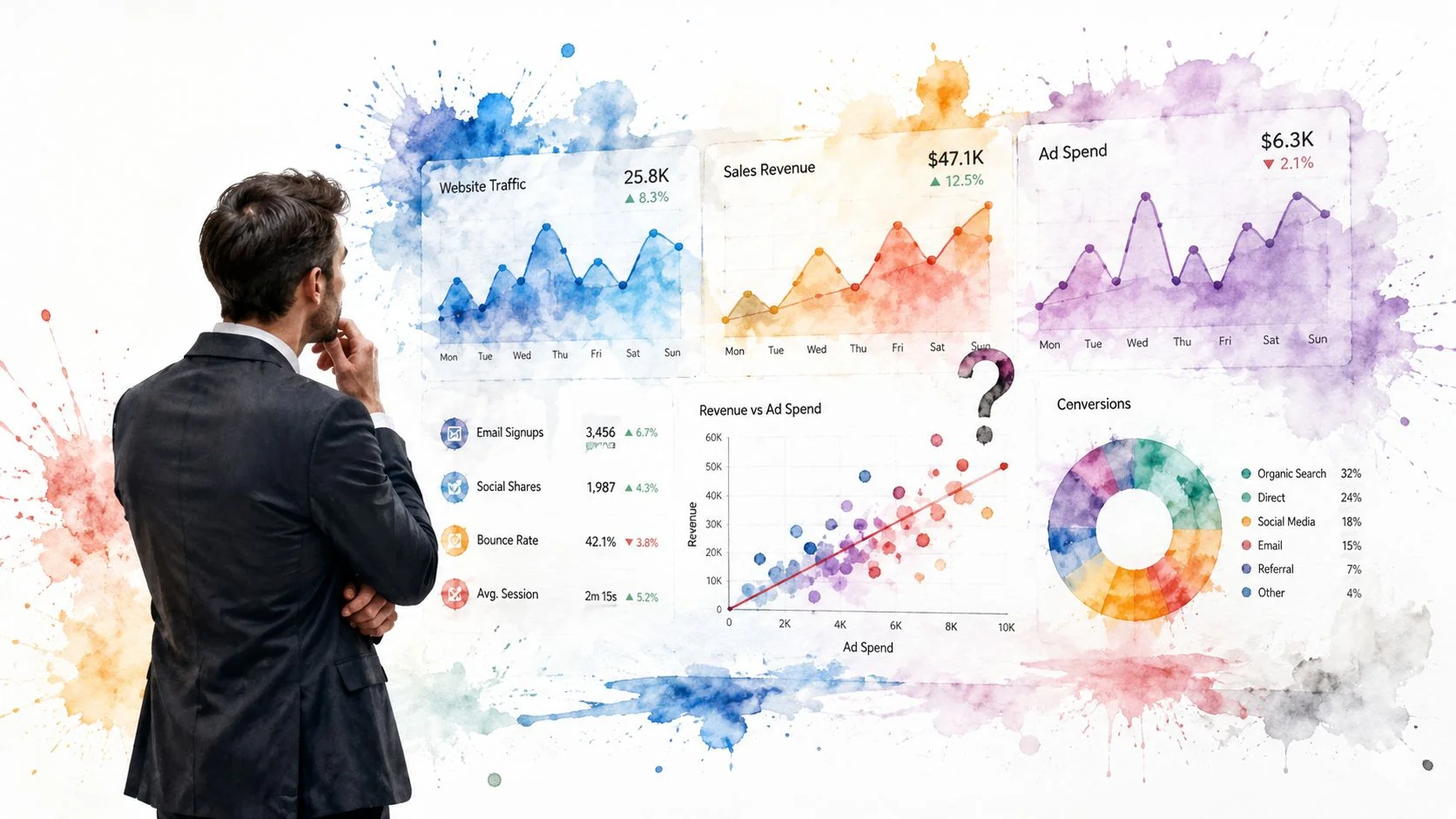
Most BI dashboards, observability platforms, and anomaly detectors surface association, not causation. They show that API latency rose after a deployment or that retention fell after a pricing change - they don’t prove which factor produced the outcome once traffic shifts, seasonality, parallel releases, and upstream data defects enter the picture.
That gap matters more in Snowflake and Databricks environments because those platforms centralize the exact data needed to move beyond correlation. Event streams, feature flags, deployment metadata, lineage, product telemetry, and business outcomes now sit close enough to be modeled together. If your tooling still stops at “these signals changed at the same time,” your team is fixing symptoms.
This is a platform shift, not a passing trend
Buyers in regulated and high-stakes environments are increasingly picking systems that explain decisions and estimate intervention effects, not just summarize incidents after the fact. That’s a procurement signal for CTOs: causal analysis software is moving into the core data stack for teams that need defensible experimentation and post-incident learning tied back to governed data assets, not a side tool bolted onto BI.
Practical rule: If your team needs to decide what action to take next, correlation tools aren’t enough. They describe patterns. They don’t validate interventions.
When correlation fails in practice
Three situations usually force the upgrade:
- Deployment-heavy systems: Your teams ship often, and multiple changes overlap in the same observation window.
- Shared platforms: Product, data, and infrastructure signals interact, so no single team owns the full cause chain.
- Executive decisions: Leaders need to know whether a change drove an outcome, not whether two metrics moved together.
In those conditions, causal analysis software stops being a research project and becomes data platform infrastructure.
How is causal inference different from root cause analysis?
RCA is a forensic workflow you run after a known failure - gathering logs, traces, and context to trace backward to a root cause. Causal inference is a modeling system that estimates whether X caused Y after controlling for confounders, using historical data before an incident happens rather than a single ticket after one.
Search results for causal analysis routinely blur it with traditional root cause analysis methods like the 5 Whys, and that confusion is exactly why many enterprise evaluations go off track before the RFP is even written.
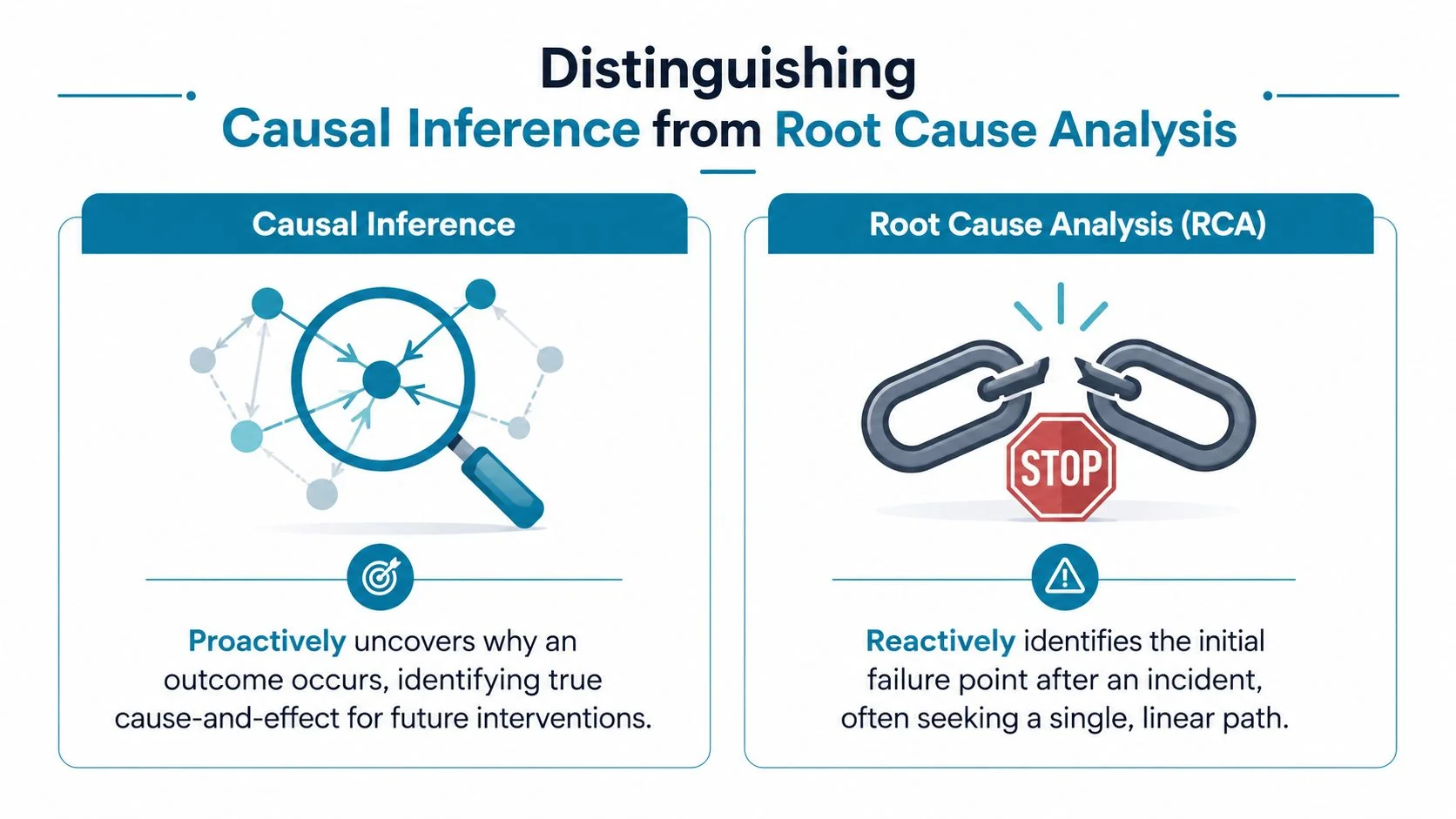
RCA is a forensic workflow
RCA is what you run after a known failure. An outage happened. A bad batch shipped. A pipeline broke. The team gathers logs, traces, ticket history, and human context, then works backward through contributing conditions until it identifies a root cause and corrective action.
Think of RCA as a detective at a crime scene. The event already happened. The investigator wants the earliest triggering failure and the controls that would’ve prevented recurrence.
RCA tools are useful when you need:
- Structured incident reviews
- Action tracking and ownership
- Cross-functional evidence capture
- Repeatable postmortem discipline
They are not designed to recover causal structure from observational datasets at scale.
Causal inference is a modeling system
Causal inference platforms do something else. They estimate whether X caused Y after controlling for confounding variables. In enterprise data work, that means modeling the effect of a release, policy, treatment, feature flag, routing change, or upstream data transformation on an outcome of interest.
Think of causal inference as a profiler building a model of system behavior before the next incident. It doesn’t wait for a single failure ticket. It uses historical data to infer likely causal pathways and intervention effects.
Causal inference answers “What happens if we change this variable?” RCA answers “Why did this incident happen?”
What buyers should separate in demos
A vendor is selling RCA if the demo centers on templates, investigation boards, fishbone diagrams, and task assignment. A vendor is selling causal analysis software if the demo centers on causal graphs, treatment effects, confounding control, and validation of inferred links.
Use this quick comparison:
| Question | RCA platform | Causal inference platform |
|---|---|---|
| Primary mode | Human investigation | Statistical inference |
| Timing | After incidents | Before and after incidents |
| Core data | Logs, tickets, interviews | Observational datasets, time-series, event data |
| Output | Root cause narrative, actions | Estimated effects, causal graph, intervention guidance |
| Best owner | SRE, ops, quality teams | Data science, data engineering, platform teams |
The wrong purchase creates a subtle failure mode. Leadership believes it has bought causal capability, while engineering has only bought better documentation.
How do you integrate causal platforms with Snowflake and Databricks?
Causal analysis software doesn’t drop into the stack like a dashboard plugin - it needs curated observational data, governance controls, and repeatable feature preparation before it produces output anyone should trust. The engineering lift is where most evaluations get superficial.
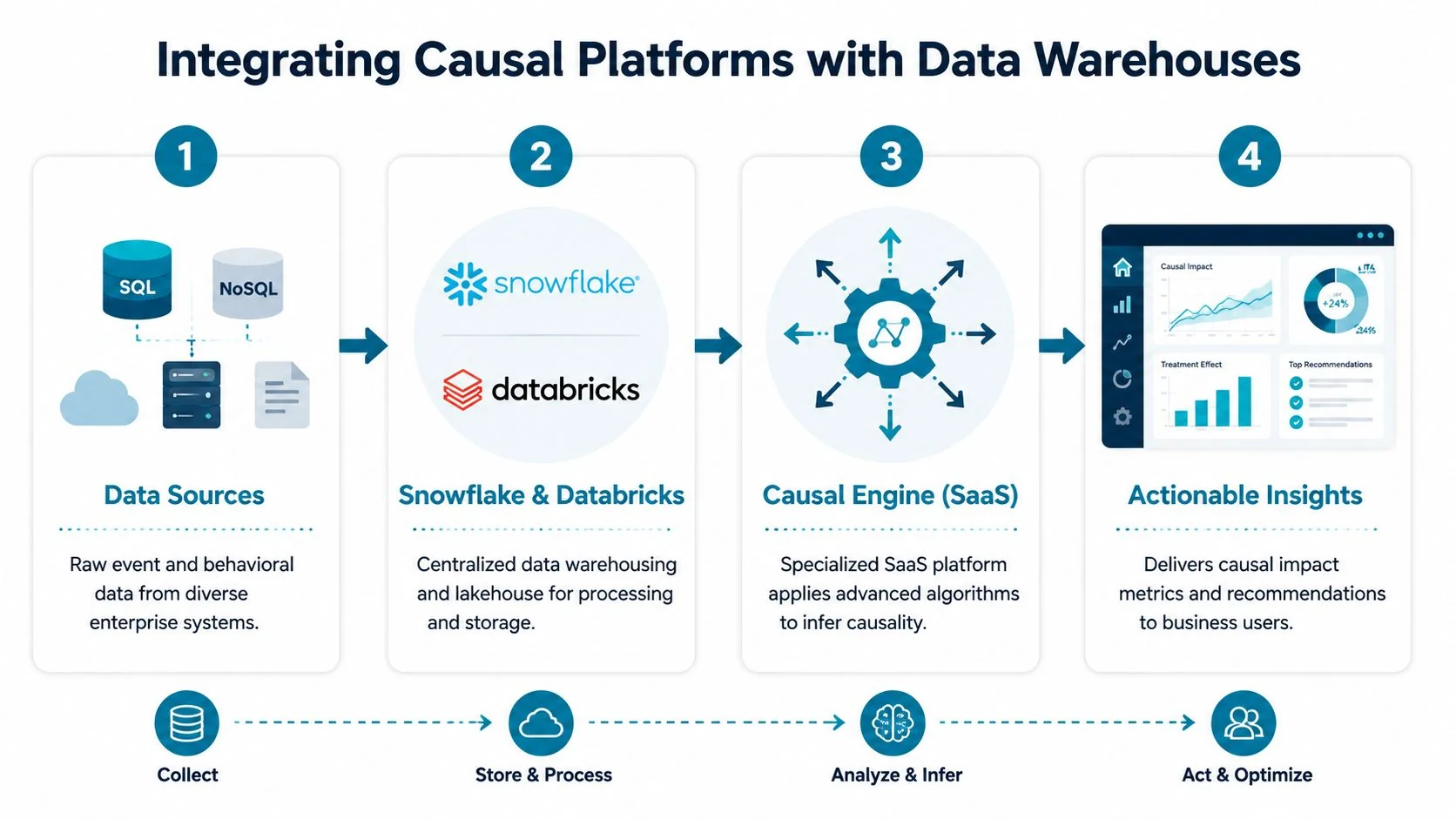
The integration pattern
Most enterprise deployments follow a simple pattern. Raw events land in cloud storage or ingestion services. Snowflake or Databricks becomes the system of record for cleaned, joined, and governed data. The causal engine connects through controlled access, reads prepared datasets, runs inference, and writes back outputs for downstream consumption.
Salesforce’s open-source CausalAI library is a useful blueprint here because it supports causal discovery on tabular and time-series data through Structural Causal Models, with support for observational datasets and heterogeneous data types.
That matters because most real enterprise use cases are not clean experiments. They are messy observational environments with confounding variables everywhere.
What data engineering has to build
A serious implementation usually requires these assets:
- Conformed event models: Product events, system events, deployment events, and business outcomes aligned on shared identifiers and time windows.
- dbt transformation layers: Semantic cleanup, time bucketing, treatment labeling, and exclusion logic belong in versioned models, not in a vendor UI.
- Metadata joins: CI/CD history, feature flag changes, incident tickets, lineage metadata, and config changes often contain the actual treatment variables.
- Governance controls: Service accounts, role-based access, data masking, and query boundaries need to match existing platform policy.
For Snowflake buyers, cost discipline also matters because iterative modeling can trigger broad scans if the vendor pushes compute-heavy queries into warehouse tables. Teams planning budgets should review Credit for Startups’ Snowflake guide before approving production-scale workloads.
After the commercial model is clear, review delivery support as closely as the product. Evaluating Snowflake consulting for modernization is useful if you need a partner to build governed data models, security boundaries, and workload patterns around the tool.
A short architectural walkthrough helps teams align on the target pattern:
Snowflake and Databricks require different operating assumptions
Snowflake environments usually emphasize governed SQL models, secure sharing patterns, and warehouse-level workload management. Databricks estates usually bring notebook-driven exploration, feature engineering flexibility, and lakehouse-native pipelines. Neither is better by default.
What matters is whether the causal platform respects your operating model. If your data team has standardized on dbt plus Snowflake, don’t accept a vendor that requires analysts to rebuild logic in proprietary modeling screens. If your platform team runs Databricks with strong ML workflows, don’t accept a product that can’t consume lakehouse-ready time-series and metadata joins without brittle extracts.
Where does causal analysis software deliver the most value?
The clearest use cases sit at the fault line between platform operations and business outcomes: deployment impact on reliability, feature flag effect on retention, and the upstream source of pipeline degradation. Generic marketing examples rarely match what actually shows up in a data platform.
Deployment impact on system reliability
A release goes out. Latency increases. Correlation tells you the release and the slowdown happened in the same window. It doesn’t tell you whether traffic shape, cache churn, an upstream schema drift, or a concurrent infrastructure change produced the result.
Software RCA still requires a disciplined workflow of defining the problem, gathering multi-source data, isolating causes, and implementing verified corrective actions, as Elastic outlines in its explanation of root cause analysis. Causal analysis software strengthens the hardest part of that process. It helps isolate cause with statistical rigor once logs, metrics, traces, and change history are assembled.
Feature flag effect on retention
A product team enables a feature flag and sees retention improve. Finance celebrates. Marketing had launched a campaign in the same period. A conventional dashboard can’t separate the treatment effect from the campaign effect.
A causal platform can model the feature flag as the intervention, retention as the outcome, and campaign exposure as a confounder. That’s the difference between allocating engineering budget based on evidence and rewarding the wrong team for the wrong reason.
If your experimentation program relies on observational data outside controlled A/B tests, causal modeling belongs in the platform roadmap.
Upstream source of pipeline degradation
A data quality incident shows up in the executive dashboard. The visible break appears in a reporting model, but the originating issue sits upstream in ingestion logic, a late source extract, or a schema contract violation.
Correlation-heavy monitoring floods the team with adjacent alerts. A causal workflow that incorporates lineage, job metadata, and change events can narrow the search to the originating operational change rather than the last downstream system that noticed the problem.
These are the use cases that justify the spend because they connect platform behavior to engineering decisions, not just to prettier incident reports.
What should a causal software vendor evaluation cover?
Most RFPs ask about connectors, dashboards, and collaboration features, but those don’t reveal whether a platform actually infers causality or just automates correlation with a nicer interface. Vendor rigor varies widely in this category, and the gap between marketing claims and actual methodology is where most RFPs fail to probe.
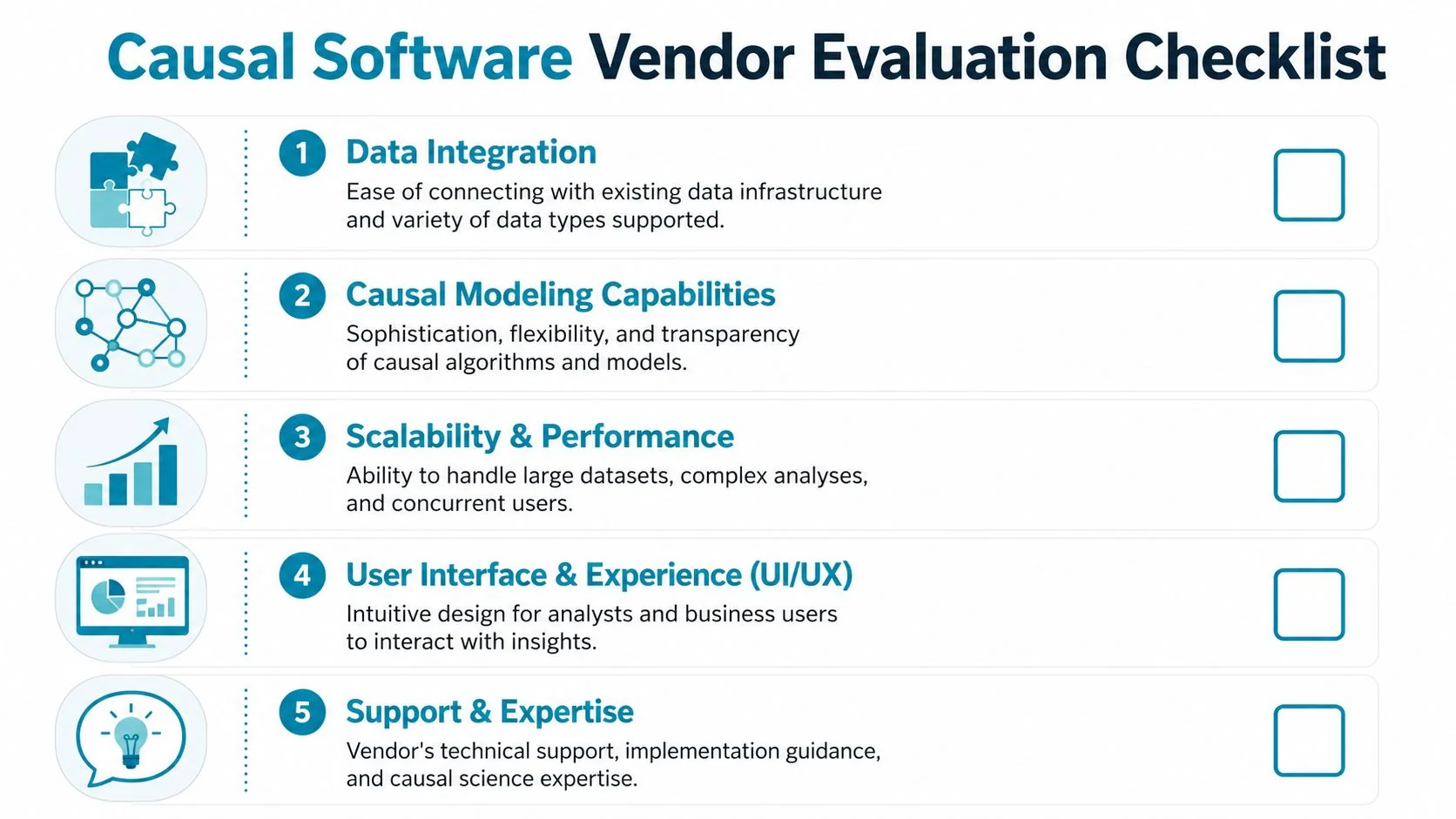
The five-part RFP checklist
| Evaluation area | What to ask in the demo | What good looks like |
|---|---|---|
| Statistical rigor | How do you distinguish causal effects from spurious correlations? | Clear explanation of causal discovery or inference methods, confounding handling, and validation steps |
| Data platform integration | How do you connect to Snowflake or Databricks without breaking governance? | Role-based access, support for governed datasets, minimal duplication, compatible deployment model |
| Scalability | What happens with high-dimensional enterprise data? | Explicit handling for many variables and repeatable performance expectations |
| Explainability | Can engineers interpret the output without a specialist translating it? | Readable causal graphs, assumptions exposed, intervention logic understandable |
| Support and services | Who helps build the data models and validate results? | Strong implementation guidance across platform engineering and causal methodology |
The question most buyers skip
Validation should dominate the evaluation. Rigorous causal discovery methods use techniques like permutation testing and threshold-based pruning to discard spurious edges before they reach a causal graph, but that level of rigor rarely shows up in a vendor demo unless you ask for it directly.
Ask these questions directly:
- Validation protocol: What tests do you run to reject false edges?
- Confounding control: How do you detect hidden or observed confounders?
- Intervention logic: Can you estimate treatment effects, or only rank likely causes?
- Auditability: Can my team trace how the model inferred a relationship?
- Operational fit: Can outputs feed existing dbt, Airflow, or incident workflows?
Board-level filter: If a vendor can’t explain how it rejects false causal links, don’t let procurement treat the product as decision-grade.
Procurement gates for enterprise teams
For large enterprise consulting engagements, baseline delivery standards still apply. The provider needs the scale, compliance posture, contractual accountability, and multi-cloud capability expected in serious enterprise data programs - team scale, SOC 2 Type II compliance infrastructure, multi-year SLAs with indemnification, and multi-cloud architecture capability are what enterprise data engineering procurement criteria typically screen for in Fortune 1000-grade engagements.
If you’re formalizing selection criteria, start with this RFP template for data engineering services and add a causal-specific workstream for validation, observational data modeling, and platform security review.
How should teams roll out causal analysis software?
Start with one decision problem that already has executive attention and usable historical data, not a platform-wide rollout. The sequence that works is pilot selection, data engineering, model validation, and controlled expansion, in that order.
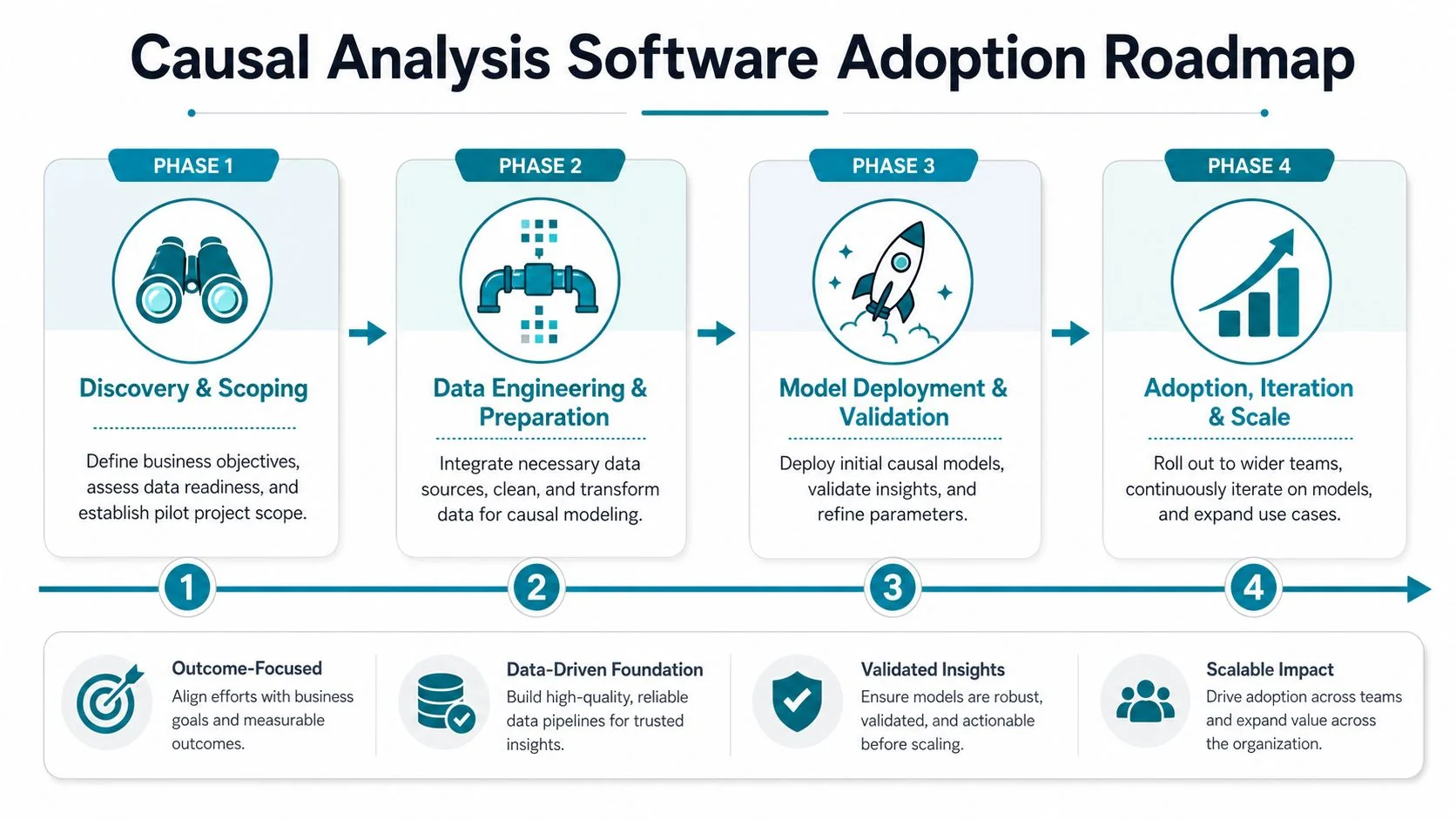
Phase 1 through Phase 2
Phase 1 is pilot selection. Choose one use case where the treatment, outcome, and major confounders are visible in existing platform data. Good candidates include deployment impact, feature flag effect, or a recurring data quality failure pattern.
Phase 2 is data engineering. Build the minimum governed dataset in Snowflake or Databricks. Use dbt or equivalent transformation logic to standardize identifiers, time windows, treatment labels, and exclusions. Keep this layer inside your existing SDLC.
Phase 3 through Phase 4
Phase 3 is model validation. Compare early findings against historical incidents or known interventions. The point isn’t to prove the model is magical. The point is to establish where it is reliable, where assumptions break, and which teams can act on its outputs.
Phase 4 is controlled expansion. Operationalize the output into engineering workflows, platform reviews, and business decision cycles. Train platform, analytics, and product teams differently. They won’t use the same outputs in the same way.
Start where your data platform is already strong. Don’t begin with the noisiest domain in the company.
Causal capability is moving from niche tooling into standard enterprise operating practice, driven by more teams centralizing the data needed to model cause and effect instead of just observing it. The winners will be the teams that wire it into governed data platforms rather than bolt it onto incident management after the fact.
If you’re turning this into an RFP or partner search, use DataEngineeringCompanies.com to compare enterprise data engineering providers, pressure-test consulting options, and shortlist firms that can support Snowflake or Databricks modernization alongside causal analysis software adoption.

Researched & written by
Peter Korpak , Chief Analyst & Founder
Data-driven market researcher with 20+ years in market research and 10+ years helping software agencies and IT organizations make evidence-based decisions. Former market research analyst at Aviva Investors and Credit Suisse.
Previously: Aviva Investors · Credit Suisse · Brainhub · 100Signals
Featured Data Engineering Partners
Firms whose listed specialty matches this article.
Get ballpark quotes →- Dagster Labs60 people · unverified
Modern data orchestration and data platform engineering context
Listed, not reviewed - EY5000+ people · unverified
Global compliance, audit-ready data platforms, and finance transformation
Listed, not reviewed - Hakkoda150 people · unverified
Healthcare and financial-services teams building Snowflake data platforms where compliance experience matters. Ask for references that match your requirements.
Listed, not reviewed
Related Analysis
Data Engineering Vendor Evaluation Criteria: 35 Criteria for 2026
The complete 35-criterion evaluation framework for choosing a data engineering vendor in 2026 - definitions, verification, red flags, and weighting.
Top Data Engineering Managed Services for 2026
Compare leading data engineering managed services. Find models, pricing, & vendors. Use our RFP checklist to select your ideal Snowflake or Databricks partner.
Data Engineering Staff Augmentation: A 2026 Playbook
Your authoritative guide to data engineering staff augmentation. Learn when to use it, how to vet vendors, compare quotes, and manage engagements for max ROI.