What Is Reverse ETL? A Practical Guide to Data Activation
Reverse ETL is the process of moving enriched, modeled data from a central data warehouse back into operational business systems.
In practice, it sends unified customer data and calculated metrics—like lead scores or churn risk—from your warehouse directly to tools like Salesforce, HubSpot, or Zendesk. This allows business teams to act on insights within the applications they use daily, rather than just viewing data in a separate dashboard. This process is often called data activation.
The Function of a Data Warehouse
Historically, data pipelines focused on consolidating data into a central warehouse using ETL (Extract, Transform, Load) or ELT (Extract, Load, Transform) processes. The primary goal was to create a single source of truth for analytics and reporting.
However, this often results in “trapped data”—valuable insights that are only accessible to data teams or through business intelligence (BI) tools. Reverse ETL addresses this problem by distributing the refined data from the warehouse, making it operational. It treats the warehouse not just as a repository for analysis, but as a hub for reliable, consistent data that powers other business applications.
Reverse ETL is a strategic component that transforms a data warehouse from a passive analytics database into an active, operational hub that feeds consistent data across the organization.
The Rationale for Operational Analytics
The objective of Reverse ETL is to make centralized data operational. It is a critical component of a modern data stack because it enables non-technical teams to leverage warehouse-native data without leaving their primary applications.
This capability is driving significant market adoption. The global Reverse ETL market was valued at $1.5 billion USD in 2025 and is projected to reach $8 billion by 2035, with a compound annual growth rate (CAGR) of 16.4%. This growth reflects a broader industry shift toward making better use of the estimated 68% of enterprise data that goes unleveraged for operational purposes. For further analysis, you can read more about the Reverse ETL market growth and its key drivers.
How a Reverse ETL Pipeline Actually Works
A Reverse ETL pipeline is a repeatable, structured process that moves modeled data from a central warehouse to operational endpoints. Its purpose is to make the insights generated in the warehouse actionable by syncing a “single source of truth” with the business applications used by marketing, sales, and support teams.
The process follows a logical flow from source to warehouse to operational tools.
As shown, raw data from various sources is ingested and modeled in a central warehouse. The Reverse ETL process then distributes this modeled data to downstream applications.
Step 1: Defining Your Data Model
The first step is to define the specific data to be moved. This involves creating data models in the warehouse that differ from those used for BI dashboards. Instead of broad datasets for exploration, Reverse ETL models are focused segments or calculated attributes designed for operational use.
These models are typically SQL queries or tables that define a specific business concept.
- Product-Qualified Leads (PQLs): A list of users who have met predefined product usage criteria.
- High-Value Customers: A segment of customers defined by metrics like lifetime value (LTV) or purchase frequency.
- Churn Risk Score: A calculated metric for each customer indicating their likelihood to cancel their subscription.
These models serve as the payload for downstream systems.
Step 2: Mapping Data to Destination Tools
The next step is mapping the data model to the destination application. This involves linking columns in the warehouse table to specific fields in a target system, such as Salesforce or HubSpot.
For example, a churn_risk_score column in a Snowflake table would be mapped to a custom “Churn Score” field on a contact record in Salesforce. Similarly, a pql_status field might map to a “Lead Status” field in a marketing automation platform. This mapping ensures that the correct data populates the intended fields, enriching the records within the destination tool. For a deeper look at system connectivity, consider reviewing core data integration best practices.
The objective of mapping is to augment operational tools with reliable, up-to-date data from the warehouse, eliminating the need for users to switch contexts to access insights.
Step 3: Scheduling and Automating Syncs
The final step is to automate the data sync. Reverse ETL pipelines are not manual, one-time data transfers; they run on a recurring schedule. Syncs can be configured to run at various intervals, from daily to near real-time (e.g., every 15 minutes), or be triggered by specific events.
When a sync executes, the Reverse ETL tool queries the defined data model in the warehouse. It typically performs a “diff,” identifying only the records that have changed since the last sync. This delta is then pushed to the destination tool via its API. This differential approach improves efficiency and minimizes API call volume. A robust platform will include logging and alerting to monitor sync health and flag failures, ensuring data reliability.
Putting Reverse ETL into Practice
Understanding the practical applications of Reverse ETL demonstrates its value. It enables a shift from passive data analysis in dashboards to active data utilization in frontline operations. This concept, known as data activation, directly impacts business functions by embedding warehouse-derived insights into operational workflows.
Below are common use cases where Reverse ETL provides tangible value by syncing warehouse data to tools used by specific teams.
Empowering Sales with Prioritized Leads
Sales teams often face the challenge of identifying high-potential leads from a large volume of contacts in a CRM. The CRM data alone typically lacks product usage context to signal buying intent.
- The Problem: Sales representatives spend significant time on low-probability leads, while high-intent prospects are not identified efficiently.
- The Fix: The data team builds a Product-Qualified Lead (PQL) model in the warehouse. The model scores leads based on product usage data, such as feature adoption, login frequency, and user invitations. A Reverse ETL pipeline syncs this PQL score to a custom field in the company’s Salesforce instance.
- The Outcome: Sales reps can create filtered views in Salesforce to prioritize leads with high PQL scores. They can initiate conversations with context about the prospect’s product usage, increasing the efficiency and effectiveness of their outreach.
Driving Hyper-Personalized Marketing Campaigns
Generic marketing campaigns yield low engagement. Effective personalization requires deep customer behavioral data, which is often consolidated in the data warehouse but disconnected from marketing automation platforms.
By syncing enriched customer segments from the warehouse to marketing platforms, organizations can execute highly targeted campaigns based on unified customer profiles, improving relevance and engagement.
- The Problem: Marketing campaigns are undifferentiated, resulting in poor open rates, low conversion, and high unsubscribe rates.
- The Fix: The data team creates dynamic customer segments in the warehouse, such as “Power Users,” “At-Risk of Churn,” or “Users Inactive for 30 Days.” Reverse ETL pipelines sync these segments to marketing platforms like Marketo or Braze.
- The Outcome: The marketing team can trigger precisely targeted campaigns. For example, they can send an advanced feature tutorial exclusively to “Power Users” or a re-engagement offer to the “At-Risk of Churn” segment. This level of targeting improves campaign performance and ROI.
Proactive Customer Support and Success
Customer support teams traditionally operate reactively, addressing issues only after a customer files a ticket. A proactive approach requires identifying at-risk accounts before they escalate.
- The Problem: The support team lacks visibility into customer health, leading to reactive problem-solving, higher churn, and a poor customer experience.
- The Fix: A customer health score is calculated in the data warehouse, incorporating signals like support ticket volume, product usage dips, and billing issues. This score is then synced via Reverse ETL to a support platform like Zendesk.
- The Outcome: Support agents receive automated alerts when a customer’s health score drops below a defined threshold. This enables proactive outreach to address potential issues before they become critical, which can significantly reduce churn and improve customer loyalty.
These applications are being adopted across industries, with the financial services sector representing 28% of the Reverse ETL market. For instance, firms in Kuwait’s $150 million cloud market use Reverse ETL to sync customer insights from Snowflake to their CRMs to comply with regulatory requirements and enhance customer personalization. To review additional data, you can explore more statistics on Reverse ETL usage.
Choosing the Right Reverse ETL Partner
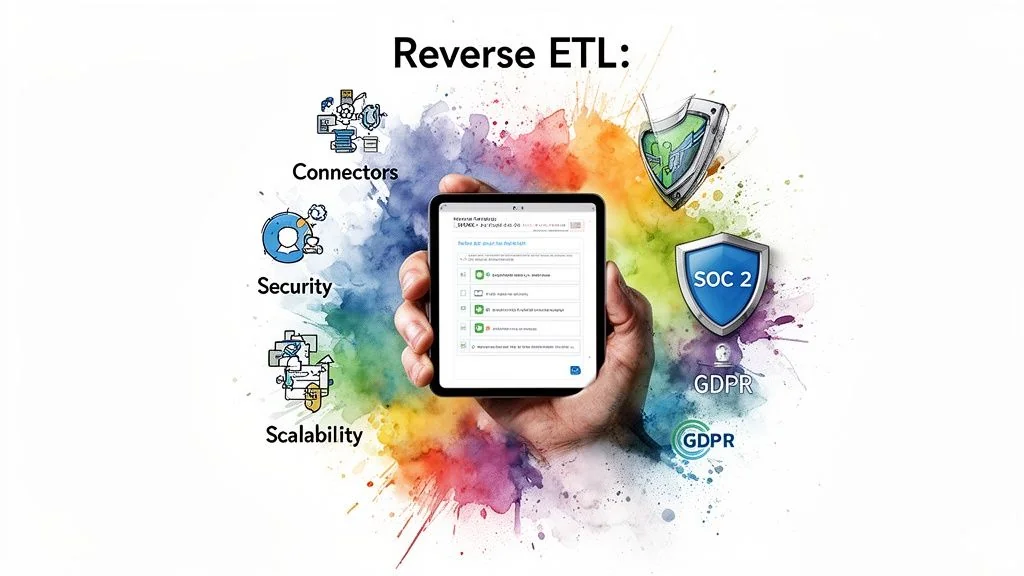
Selecting a Reverse ETL platform is a foundational decision for an organization’s data activation strategy. A proper evaluation framework is necessary to look beyond marketing claims and assess the core capabilities that prevent technical debt and ensure reliable data delivery. The objective is to choose a solution that addresses current needs and can scale with future data sophistication.
Evaluating Core Technical Capabilities
A Reverse ETL tool’s primary function is the reliable movement of data via its connectors. The quality and depth of these connectors are more important than the sheer number of supported integrations.
For example, when evaluating a vendor’s Salesforce connector, it is critical to determine if it supports custom objects and fields and how it manages API rate limits to avoid service disruptions.
Key technical criteria include:
- Connector Depth and Reliability: Assess how the platform handles source and destination schema changes. Does the tool require manual intervention from engineers when a destination API is updated, or does it adapt automatically?
- Performance at Scale: Investigate the platform’s architecture and its ability to handle large-volume data syncs. It must maintain low latency and high throughput to support operational workflows that depend on fresh data.
- Data Modeling and Usability: Evaluate the user interface for building data models. Can a non-technical user, such as a marketing operations manager, define a customer segment and map it to a destination tool without writing SQL? An intuitive UI is critical for adoption beyond the data team.
Assessing Security and Governance
Moving sensitive customer data from a secure warehouse to multiple SaaS applications requires stringent security and governance. This is a non-negotiable aspect of any Reverse ETL platform.
Security certifications are a baseline requirement.
A vendor’s commitment to security is a direct reflection of their reliability as a partner. Without certifications like SOC 2 Type II, you are exposing your organization to unnecessary risk.
Beyond certifications, examine the platform’s governance features. Key capabilities include role-based access controls (RBAC) to manage permissions for creating and viewing data syncs and a comprehensive audit log that tracks all platform activity. These are essential for maintaining control and ensuring compliance with regulations like GDPR and CCPA.
Finally, robust monitoring and alerting are critical. The platform must provide proactive notifications for sync failures or data discrepancies. Timely alerts are necessary to identify and resolve pipeline issues before they impact business operations. To see an example of these features, it’s useful to review what a platform like Hightouch offers for data activation as a benchmark for your evaluation.
Key Vendor and Consultancy Evaluation Criteria
This table outlines critical questions to guide the evaluation of a Reverse ETL partner.
| Evaluation Category | Key Questions to Ask | Why It Matters |
|---|---|---|
| Connector Quality | Do your connectors support custom objects/fields? How do you handle API rate limits and schema changes? | A connector limited to standard fields is insufficient. Robust error handling and adaptability are required to prevent pipeline failures. |
| Scalability & Performance | What is your architecture for high-volume data syncs? Can you share benchmarks for latency and throughput? | The platform must scale to handle growing data volumes without performance degradation, as operational needs will increase. |
| Data Modeling UI/UX | Can a non-technical user build models and map data without writing code? How intuitive is the workflow? | If the tool requires engineering expertise for basic tasks, it fails to empower business teams and creates a bottleneck. |
| Security Certifications | Are you SOC 2 Type II, GDPR, and CCPA compliant? Can you provide your security reports and documentation? | These certifications provide third-party validation that the vendor adheres to established security and data privacy standards. |
| Governance & Access Control | Does the platform offer role-based access controls (RBAC), SSO, and detailed audit logs? | These features are essential for controlling access to sensitive data, ensuring compliance, and preventing unauthorized modifications. |
| Monitoring & Alerting | How does the platform alert us to sync failures or data discrepancies? Are alerts configurable and sent to tools like Slack or PagerDuty? | Proactive monitoring enables rapid issue resolution before business operations are affected. |
| Support & Documentation | What are your support SLAs? Do you offer dedicated account managers? Is your documentation clear and comprehensive? | When critical pipelines fail, responsive and expert support is necessary. Clear documentation empowers teams to self-serve. |
Using a structured evaluation framework ensures a decision based on functional requirements rather than marketing promises, leading to a partnership that aligns with both technical and business objectives.
The Future of Data Activation
Reverse ETL represents a paradigm shift in how organizations use data. Looking toward 2026 and beyond, the concept of “data activation” is evolving from scheduled syncs toward an intelligent, real-time ecosystem where data flows instantly to points of action. The focus is shifting from simply moving data to making the process itself more intelligent, efficient, and automated.
The Great Convergence of Data Pipelines
Historically, ETL, ELT, and Reverse ETL processes were handled by separate, distinct tools. This created architectural complexity and increased the risk of data inconsistencies between systems. The market is now moving toward unified data movement platforms that handle data integration in any direction.
This convergence simplifies the data stack, reduces vendor management overhead, and establishes a single framework for data governance and security, regardless of the data’s flow direction.
The goal is a unified data integration function. Whether data is ingested into the warehouse for analysis or activated into an application for operational use, it should be managed through a single, cohesive system.
From Scheduled Batches to Real-Time Events
While scheduled batch syncs are suitable for some use cases, a competitive advantage often comes from real-time, event-driven activation. This model triggers data syncs based on specific events rather than on a fixed schedule. For example, a customer’s health score in a CRM could be updated the moment their product usage declines, not an hour later during the next batch run.
This shift enables proactive, real-time workflows:
- Instantaneous Lead Routing: A new user’s trial signup immediately triggers a record creation in Salesforce, assigning them to a sales representative in seconds.
- Real-Time Fraud Alerts: A suspicious transaction recorded in the data warehouse triggers an immediate alert in a fraud detection system to block the user’s account.
- Dynamic Personalization: A customer’s browsing behavior instantly adds them to a new audience segment in a marketing tool, allowing for immediate ad personalization.
This capability makes a business more responsive to customer actions. This trend is accelerating globally, with the Asia Pacific region projected to grow at a 38.4% CAGR from 2026 to 2033, driven by cloud adoption in markets like China, India, and Japan. You can discover more insights about the growing Reverse ETL market on dataintelo.com.
AI-Powered Automation and Intelligence
Artificial intelligence will increasingly be used to manage and optimize the data activation process itself. In the near future, machine learning models will not only be part of the data being synced but will also govern the pipelines.
Potential applications include AI that automatically identifies and flags data quality issues before they reach operational systems, suggests optimal data models for specific business objectives, or predicts API performance degradation in destination platforms and reroutes data accordingly. This intelligence layer will enhance the reliability, efficiency, and usability of data activation.
Common Questions About Reverse ETL
As organizations explore data activation, several common questions arise regarding Reverse ETL’s role and value.
Isn’t This Just a Fancy Name for Point-to-Point Integrations?
No. Point-to-point integrations create a complex and brittle “spaghetti architecture,” with custom-coded, direct connections between individual applications. This model is difficult to maintain, scale, and debug.
Reverse ETL uses a hub-and-spoke model, with the data warehouse acting as the central source of truth. Business logic, such as the definition of a “Product-Qualified Lead,” is defined once in the warehouse. This single definition is then propagated to all connected operational systems. This approach is more scalable, maintainable, and ensures data consistency across the organization, preventing sales, marketing, and support teams from operating with conflicting data.
Can’t We Just Build Our Own Reverse ETL Tool?
While building an in-house solution is technically possible, it is often a poor allocation of resources due to the high, ongoing maintenance burden.
A build-it-yourself approach requires:
- Continuous API Maintenance: Engineering teams become responsible for building and maintaining connectors for numerous SaaS tools. These third-party APIs change frequently and often without notice, leading to broken pipelines that require immediate engineering attention.
- Building for Resilience: A production-grade system requires robust error handling, retry logic, and comprehensive monitoring to ensure data integrity. Developing this level of reliability is a significant engineering effort.
- Lack of Business User Accessibility: Homegrown scripts are rarely usable by non-technical teams. A key value of dedicated platforms is their user interface, which empowers business users to configure data syncs independently without filing engineering tickets.
For most organizations, purchasing a dedicated solution delivers value faster and allows engineering resources to focus on core product development rather than data plumbing.
Building your own Reverse ETL is analogous to building your own CRM. The long-term engineering and maintenance costs almost always outweigh the benefits compared to using a specialized, supported platform.
How Is This Different from a Customer Data Platform (CDP)?
The distinction is architectural. Both Reverse ETL tools and Customer Data Platforms (CDPs) aim to activate customer data, but they operate differently.
A traditional CDP ingests data from multiple sources and builds its own separate database to create customer profiles. This can introduce another data silo that may become inconsistent with the data warehouse, which should be the organization’s single source of truth.
Reverse ETL adopts a “composable CDP” approach. It does not create a new database. Instead, it leverages the existing data warehouse as the central repository for all customer data. The Reverse ETL tool acts as an activation layer on top of the warehouse, pushing trusted, modeled data out to other systems. This model avoids data duplication, reduces complexity, and ensures that analytics and operational systems are powered by the same unified data source.
What’s the Best Way to Get Started?
Start with a well-defined, high-impact project to demonstrate value quickly. Avoid trying to sync all data to all systems at once. Instead, identify a single business problem that can be solved with a specific data model.
A good first project often involves activating a valuable customer segment already defined in the warehouse.
- Define the Segment: Select an existing data model, such as “users with a high likelihood to upgrade.”
- Pick a Destination: Determine where this data will have the greatest impact—for example, a marketing automation platform or a CRM.
- Sync the Data: Use a Reverse ETL tool to push this targeted list of users to the chosen application.
- Launch a Campaign: Collaborate with the relevant business team to launch a targeted campaign using this new, high-quality audience data.
This focused approach allows you to demonstrate tangible business results in a short timeframe, which helps build momentum and secure buy-in for broader data activation initiatives.
Finding the right partner to guide your data strategy is critical. DataEngineeringCompanies.com offers expert-vetted rankings and practical tools to help you confidently select the ideal data engineering consultancy for your needs. Explore the 2026 rankings and find your perfect match.
Data-driven market researcher with 20+ years in market research and 10+ years helping software agencies and IT organizations make evidence-based decisions. Former market research analyst at Aviva Investors and Credit Suisse.
Previously: Aviva Investors · Credit Suisse · Brainhub · 100Signals
Top Data Engineering Partners
Vetted experts who can help you implement what you just read.
Related Analysis
A Practical Guide to Modern Data Pipeline Architecture
Discover how a modern data pipeline architecture can transform your business. This practical guide covers key patterns, components, and vendor selection.
A Practical Guide to the Modern Data Stack in 2026
Explore the modern data stack with this practical guide. Learn about its architecture, core layers, AI integration, and governance to drive real business value.