Top 7 Resources for Vetting Machine Learning Consulting Firms
Choosing the right machine learning consulting firm is a high-stakes decision. The right partner accelerates innovation; the wrong one leads to costly project failures. The market is saturated with generic claims, making it difficult to identify firms with verified technical depth and a proven track record. This guide provides practical, actionable insights for CIOs, CTOs, and data leaders tasked with evaluating potential partners. We bypass subjective lists and focus on the most effective platforms and resources for vetting and shortlisting firms.
This analysis covers seven distinct resources, from specialized directories like DataEngineeringCompanies.com to curated talent networks such as Toptal and the major cloud marketplaces. The objective is to provide a repeatable, evidence-based process for finding a partner that aligns with your budget, tech stack, and strategic goals.
Each section provides a structured breakdown, detailing how to use each platform’s features to surface top-tier machine learning consulting firms. The analysis includes direct links and screenshots for clarity. We focus on the tools needed to compare vendors on signals that matter:
- Verified Client Reviews: Unfiltered feedback on project outcomes.
- Platform Certifications: Official validation of technical expertise.
- Minimum Project Thresholds: Quickly filter by budget compatibility.
- Typical Hourly Rate Bands: Establish realistic cost expectations upfront.
This guide provides an analytical framework to make an informed, confident decision, ensuring your next ML initiative is built on a solid foundation.
Directory Insight: AI/ML capability is the scarcest specialization in our directory. Of 86 verified firms, only 38% rate “Expert” in AI/ML enablement — compared to 65% for data modernization and 49% for platform migration. Meanwhile, 10% rate “Low” in AI/ML, meaning they lack meaningful ML bench strength despite marketing claims. When vetting ML consulting firms, this capability gap makes rigorous evaluation essential. The firms that do specialize command premium rates: the $150–$250/hr tier represents 28% of directory firms.
1. DataEngineeringCompanies.com
Best for: Data-driven vetting and accelerated shortlisting of verified firms.
DataEngineeringCompanies.com is a critical starting point for any organization evaluating machine learning consulting firms. It operates as a marketplace intelligence platform, engineered specifically for technology and procurement leaders. Its primary function is to reduce vendor selection risk through a transparent, independently verified ranking methodology.
Unlike platforms that rely solely on user-submitted reviews, this site builds its Expert Rankings from a composite index. This index synthesizes technical depth, verified client feedback, market presence, and case study evidence, cross-referenced with data from market-rate surveys and official partner directories. This auditable approach allows you to see why a firm achieves its score, providing a layer of confidence before initiating contact.
Key Features and Practical Tooling
The platform’s strength lies in its practical, buyer-centric tools designed to streamline decision-making for complex initiatives like AI/ML enablement and cloud data modernization.
- Transparent Cost Benchmarking: The site publishes clear hourly rate bands ($50–$275+/hr) and global averages (approx. $165/hr). This transparency is invaluable for early-stage budgeting and understanding typical project costs, from small migrations starting around $50k to enterprise modernizations running from $200k to over $1M.
- AI-Powered Shortlisting: Users can move beyond static lists with a 60-second matching quiz and dynamic filters for budget, industry, and platform expertise (e.g., Snowflake, Databricks, AWS). This surfaces a pre-vetted, actionable shortlist in minutes.
- RFP Acceleration: The platform includes a comprehensive RFP checklist with over 50 evaluation criteria. This resource helps teams prepare a robust request for proposal, ensuring all critical technical and business requirements are covered.
- Verified Partner Status: Official partner tiers like Snowflake Elite and Databricks Premier are clearly displayed with verified badges. This provides immediate, credible signals of a firm’s technical proficiency and strategic alliances.
Why It’s a Top Recommendation
For technology and procurement leaders, DataEngineeringCompanies.com transforms a time-consuming process into a structured, efficient evaluation. Its independent stance and data-driven methodology cut through marketing noise, while its practical tools directly address the core challenges of vendor discovery, budgeting, and qualification. It provides a clear path from initial research to a confident, RFP-ready shortlist. For teams looking to build a foundation for AI and analytics, this level of verified insight is indispensable. You can explore a broader perspective of the market in their guide to leading data analytics companies.
| Feature | Details |
|---|---|
| Primary Focus | Marketplace intelligence for data engineering & ML consulting |
| Pricing Transparency | Hourly rate bands ($50–$275+), project estimates ($50k–$1M+) |
| Verification | Independent; composite index of reviews, certifications, case studies |
| Key Tools | 60-second Match Quiz, Cost Calculator, 50+ Point RFP Checklist |
| Best For | CIOs, CTOs, Procurement, Analytics Leaders |
Pros:
- Independent, verified rankings with a transparent, auditable methodology.
- Practical buyer tooling accelerates shortlisting and RFP preparation.
- Clear cost transparency with published rate bands and project averages.
- Actionable filters and AI-powered shortlists surface best-fit firms quickly.
- Verified partner badges provide credible proof of expertise.
Cons:
- Pricing is presented in bands and averages, requiring direct vendor validation for fixed quotes.
- Coverage is focused on the top 50-80 firms; hyper-niche or very small boutiques may not be represented.
Website: https://dataengineeringcompanies.com
2. Clutch (Machine Learning Consulting category)
Clutch is an established B2B ratings and reviews platform, and its dedicated category for machine learning consulting firms is a useful starting point for a vendor search. It functions as a comprehensive, filterable directory for moving from a wide pool of potential partners to a manageable shortlist based on critical pre-qualification data. The platform’s strength is its aggregation of verified client feedback and quantitative project details, providing transparency often missing in the initial stages of procurement.
Unlike generic business directories, Clutch dives into service specifics. Each firm profile includes a “Service Focus” matrix, breaking down their expertise into granular areas like Natural Language Processing (NLP), Computer Vision, or Predictive Analytics. This allows you to identify specialists rather than generalists. The platform is particularly strong for North American and European markets, with robust filtering options for U.S. states and major cities.
Key Features and How to Use Them
Clutch’s value is in its powerful filtering and transparent data. To use it effectively, focus on these features:
- Financial Pre-Qualification: The ability to filter by hourly rate bands (e.g., $100-$149/hr) and minimum project size (e.g., $25,000+) is its most immediate benefit. This step saves time by eliminating firms misaligned with your budget.
- Verified Reviews & Scoring: Look beyond the overall star rating. Read the full-length, verified reviews, which are often based on phone interviews conducted by Clutch analysts. Pay attention to scores for quality, scheduling, and cost for a more nuanced view of performance.
- The Leaders Matrix: Clutch publishes its “Leaders Matrix,” a quadrant-style visualization that plots firms based on their “Ability to Deliver” and “Market Presence.” While useful, be aware this can be influenced by a firm’s activity on the platform. Use it as a guide, not a definitive ranking.
- Client Portfolio & Industry Focus: Drill down into each firm’s portfolio to see case studies and client lists. Cross-reference their stated “Industry Focus” with actual clients served to validate domain expertise.
Platform Pros and Cons
| Pros | Cons |
|---|---|
| High Signal on Budgeting: Publicly listed rate bands and project minimums help pre-qualify vendors quickly. | Indicative Pricing Only: Rates are bands, not firm quotes. Final pricing will require direct outreach. |
| Deep U.S. & European Coverage: Excellent filters for location, including specific U.S. states and cities. | Potential for Paid Placement: Prominent placements can be sponsored, which is disclosed but influences visibility. |
| Verified Client Feedback: Detailed, interview-based reviews provide authentic insights into project execution. | Rankings Favor Profile Activity: Firms that actively manage their profiles and solicit reviews may rank higher. |
Practical Tip: Use Clutch to build your initial “long list” of 5-7 potential machine learning consulting firms. Filter by your non-negotiables: budget, location, and core service focus (e.g., NLP). Then, use the information gathered to inform your initial RFI. For guidance on structuring that next step, you can review this comprehensive data engineering RFP checklist to ensure you ask the right questions.
Website: https://clutch.co/developers/artificial-intelligence/machine-learning
3. G2 (AI Development Services category)
G2, known for its peer-to-peer software reviews, offers a similarly robust platform for B2B services, including its AI Development Services category. This section is a valuable resource for cross-validating potential partners and understanding user sentiment. While Clutch focuses heavily on project-level details, G2 excels at providing a buyer-centric view, using a familiar review interface to compare machine learning consulting firms based on user satisfaction and market presence.
The platform’s core strength is its transparent scoring methodology. It aggregates user reviews to generate satisfaction ratings and G2 Grid Reports, which plot vendors into four quadrants: Leaders, High Performers, Contenders, and Niche players. This visual comparison tool is useful for quickly understanding a firm’s market perception relative to its peers and for discovering high-satisfaction “High Performer” firms that may not have the brand recognition of market “Leaders.”
Key Features and How to Use Them
To leverage G2 effectively for your vendor search, focus on its comparison and review-driven features:
- G2 Grid & Scoring: Use the interactive G2 Grid to visually shortlist vendors. Do not just focus on the “Leaders” quadrant. Investigate “High Performers,” which often provide excellent service and value with a smaller market presence. Click into the scoring details to see how ratings are broken down by factors like “Ease of Doing Business With” or “Quality of Support.”
- Side-by-Side Comparisons: Once you have a shortlist, use G2’s built-in comparison tool. This feature creates a feature-by-feature and review-by-review table, allowing you to directly compare up to four firms on key metrics like user satisfaction, industry focus, and company size.
- Review Sentiment Analysis: Go beyond the star ratings. Read individual user reviews and look for recurring themes. G2’s interface often highlights what users liked and disliked. Are clients consistently praising a firm’s technical expertise but noting issues with project management? This detail is critical for risk assessment.
- Explore Related Categories: A key advantage of G2 is its interconnected category structure. From the AI Development page, you can easily navigate to related service categories like “Data Engineering Services” or “Big Data Consulting” to ensure a potential partner has the end-to-end capabilities your project requires.
Platform Pros and Cons
| Pros | Cons |
|---|---|
| Rich User Review Content: Excellent for triangulating vendor sentiment and identifying recurring strengths or weaknesses. | Limited Granular Pricing Data: Mostly relies on a “pricing available” flag rather than specific hourly rate bands or project minimums. |
| Transparent Scoring Methodology: The G2 Grid scoring is well-documented, providing confidence in the vendor rankings. | Services Coverage Maturing: While extensive, its services categories are not always as exhaustive as its deep software directories. |
| Familiar B2B UX: The platform is intuitive, especially for those who already use G2 for software procurement. | Review Volume Varies: Newer or more niche firms may have too few reviews to draw statistically significant conclusions. |
Practical Tip: Use G2 as a validation and sentiment analysis tool for a shortlist developed on other platforms. Before scheduling a call with a promising firm, read through their G2 reviews to formulate specific questions about potential weaknesses or to validate claimed strengths. Ask them directly about any negative feedback: “I saw a review mentioning challenges with timeline communication; can you tell me how you’ve addressed that?”
Website: https://www.g2.com/categories/ai-development-services
4. Upwork (Hire Machine Learning Engineers/Consultants)
For organizations needing direct access to individual talent for staff augmentation or focused, short-term projects, Upwork is a leading freelance marketplace. Instead of engaging full-service machine learning consulting firms, the platform allows you to hire individual ML engineers, data scientists, and specialized consultants on an hourly or fixed-price basis. This model is effective for building a proof-of-concept (POC), adding specific expertise to an existing team, or tackling well-defined tasks without the overhead of a large consulting engagement.
Upwork’s primary advantage is speed and direct access. You can post a job and receive proposals from qualified freelancers, often within 24 hours. Each consultant has a transparent profile detailing their work history, client ratings, portfolio, and stated hourly rate, providing immediate visibility into market costs and individual capabilities. This direct-sourcing approach gives you granular control over team composition and is ideal for agile projects where requirements may evolve.
Key Features and How to Use Them
Upwork provides tools to find, vet, and manage individual experts efficiently. To maximize its value, leverage these features:
- Transparent Talent Profiles: Go beyond the job title. Scrutinize the “Work History and Feedback” section on a consultant’s profile. Look for successfully completed, high-value projects with detailed, positive feedback relevant to your needs. A history of long-term engagements is often a sign of reliability.
- Geographic and Skill Filtering: Use the “U.S. Only” filter to engage domestic talent if data residency or time zones are a concern. Combine this with specific skill tags (e.g., “PyTorch,” “TensorFlow,” “Scikit-learn”) to narrow the candidate pool to specialists.
- Project Catalog & Fixed-Price Engagements: For well-defined tasks like “build a recommendation engine prototype,” browse the Project Catalog. Here, freelancers offer pre-scoped, fixed-price services, which is an excellent way to de-risk a first engagement and evaluate a consultant’s work quality.
- Escrow and Work Diary: For hourly contracts, the platform’s escrow system and time-tracking Work Diary provide security and transparency. Payments are held in escrow and released only upon your approval of the hours logged, protecting your budget and ensuring accountability.
Platform Pros and Cons
| Pros | Cons |
|---|---|
| Fast Sourcing for POCs: Go from job post to hiring an expert for a proof-of-concept in a matter of days. | Buyer Diligence is Essential: The quality of talent varies. You are responsible for vetting and technical screening. |
| Clear Market Rate Visibility: Publicly listed hourly rates (typically $50–$200/hr for ML) provide immediate budget clarity. | Limited Full-Lifecycle Services: Solo consultants may not offer comprehensive MLOps, security, or enterprise-grade support. |
| High Flexibility: Scale your engagement up or down easily based on project needs without long-term commitments. | Primarily for Augmentation: Best for adding expertise to an existing team, not for outsourcing an entire strategic program. |
Practical Tip: When posting your job, be extremely specific about your technology stack, the business problem you’re solving, and the exact deliverable you expect. A detailed brief attracts higher-quality, more relevant proposals and allows freelancers to provide accurate time and cost estimates.
Website: https://www.upwork.com/hire/machine-learning-experts/
5. Toptal (Vetted ML/Deep Learning Experts and Managed Delivery)
Toptal is an exclusive network of highly vetted freelance talent. Its value proposition for machine learning projects is precision and speed. The platform is built around a rigorous screening process that reportedly accepts fewer than 3% of applicants, ensuring clients only engage with senior-level experts. This makes Toptal an ideal solution when you need to augment your team with a specific, hard-to-find skill set, such as MLOps for Kubeflow or advanced generative AI fine-tuning.
Instead of browsing profiles, clients submit their project requirements, and Toptal’s internal team hand-matches them with a suitable expert, often within 48 hours. This curated approach removes the friction of sourcing and vetting, positioning Toptal as a high-signal channel for acquiring elite contractors, interim ML leads, or small, specialized teams. While its core is individual talent, it also offers managed delivery options for more structured, end-to-end project execution.
Key Features and How to Use Them
Toptal’s strength is its ability to quickly connect you with pre-vetted, high-caliber talent without the overhead of a traditional search.
- Rigorous Vetting Process: The platform’s core feature is its multi-stage screening, which tests for technical expertise, problem-solving ability, and professionalism. This pre-qualification means you can trust the candidates presented have already met a high bar.
- Rapid Hand-Matching: You don’t search; you submit your need. Be extremely specific in your brief, detailing the required technical stack (e.g., PyTorch, TensorFlow, AWS SageMaker), project goals, and team dynamics. The more precise your request, the better the match.
- No-Risk Trial Period: Toptal offers a trial period with any matched expert. Use this to validate not just their technical skills but also their communication style and fit with your team’s workflow. If it’s not a match, you don’t pay for the trial time and can be re-matched.
- Managed Delivery Option: If your project requires more than staff augmentation, explore their managed delivery service. This provides a Toptal-managed team with project leadership, offering a structure closer to that of traditional machine learning consulting firms.
Platform Pros and Cons
| Pros | Cons |
|---|---|
| High Signal on Talent Quality: The <3% acceptance rate filters out noise, connecting you directly with senior experts. | Premium Pricing: Rates are significantly higher than on open freelance platforms, reflecting the talent’s caliber. |
| Fast Time-to-Hire: The matching process can place an expert on your project in days, not weeks or months. | Individual-Focused Model: The core offering is staff augmentation, not full-service strategic consulting. |
| Access to Niche Skills: Excellent for finding specialists in areas like reinforcement learning, LLM optimization, or MLOps. | Matching Depends on Brief Quality: The success of the match is highly dependent on how well you define your requirements. |
Practical Tip: Use Toptal when you have a well-defined technical gap in your team and need to fill it quickly with a senior expert. It is less suited for ambiguous, strategic projects where you need a firm to help define the problem statement itself. Be prepared with a clear technical brief and a plan for onboarding the expert to maximize the value of the engagement.
Website: https://www.toptal.com/deep-learning
6. AWS Marketplace (Professional Services: ML/GenAI)
For organizations embedded in the Amazon Web Services ecosystem, the AWS Marketplace has evolved into a channel for sourcing machine learning consulting firms. It functions as a procurement-friendly catalog where you can find and engage professional services providers whose offerings are directly aligned with the AWS stack. This centralized approach simplifies vendor onboarding, consolidates billing, and ensures the consulting work leverages your existing cloud investment and governance frameworks.
The key differentiator of the AWS Marketplace is its direct integration with your organization’s primary cloud provider. You are browsing services designed specifically for AWS tools like Amazon SageMaker, Bedrock, and EKS. This is ideal for companies looking to accelerate projects such as MLOps implementation, generative AI application development, or custom model training without the friction of a disconnected procurement process.
Key Features and How to Use Them
To leverage the AWS Marketplace effectively, focus on its procurement and integration features:
- Service-Specific Listings: Search for specific professional service offerings like “SageMaker JumpStart Implementation” or “Generative AI Strategy Assessment.” Each listing details the scope, deliverables, and the AWS Partner providing the service, allowing you to find highly specialized help.
- Private Offer Workflow: Most professional services do not have a public list price. Instead, you use the “Request a private offer” feature to initiate a discussion with the consulting firm. This allows you to negotiate custom pricing, scope, and terms that are then formalized and billed directly through your AWS account.
- Streamlined Procurement & Billing: The biggest advantage is simplifying vendor management. Engagements are billed to your existing AWS account, which drastically reduces the overhead for finance and procurement teams who would otherwise have to onboard a new vendor.
- Partner Competency Validation: Look for partners with official AWS Competencies, such as the “Machine Learning” or “Data & Analytics” competency. This is AWS’s stamp of approval, signifying that the firm has undergone a rigorous technical validation and has proven customer success.
Platform Pros and Cons
| Pros | Cons |
|---|---|
| Streamlined Procurement: Consolidates billing and vendor management directly into your existing AWS account. | Opaque Initial Pricing: Most listings require you to “request a private offer,” making initial budget comparisons difficult. |
| Enterprise-Friendly Governance: Simplifies vendor onboarding with terms and processes familiar to corporate procurement. | Selection Can Be Limited: The catalog of providers is not as exhaustive as open directories and can vary by region. |
| Tight AWS Stack Alignment: Ensures the consultants you hire are experts in the specific AWS services you use, like SageMaker or Bedrock. | Diligence Still Required: An AWS partnership doesn’t guarantee a perfect fit; you still need to vet the firm’s specific experience and consultants. |
Practical Tip: Use the AWS Marketplace when your project is definitively tied to the AWS stack and your primary goal is to accelerate procurement. Start by identifying 3-4 partners with the relevant AWS Machine Learning Competency. Initiate private offer requests with a standardized scope of work to compare their proposals apples-to-apples. For insights into how these partners compare, you can explore this comparison of AWS and Azure data partners.
Website: https://aws.amazon.com/marketplace/
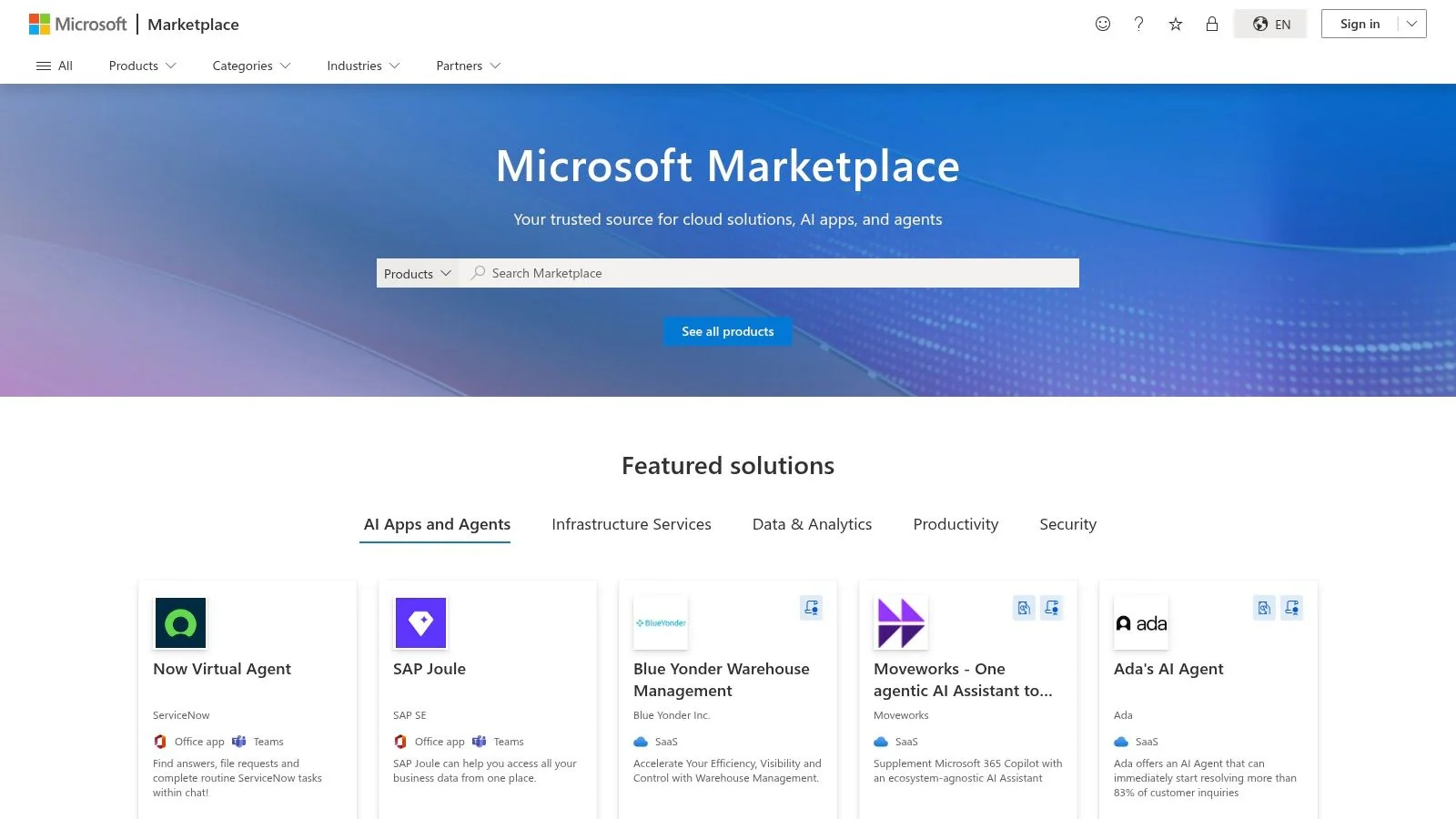
7. Microsoft Azure Marketplace (Consulting Services: AI/ML)
For organizations integrated into the Microsoft ecosystem, the Azure Marketplace offers an efficient procurement channel for machine learning consulting firms. It bypasses traditional vendor discovery by presenting pre-packaged, fixed-scope consulting offers directly within the Azure platform. This model is ideal for teams needing to deploy targeted solutions quickly, such as a 2-week Generative AI proof-of-concept or a 4-week MLOps accelerator, often with defined deliverables and set price points.
The core value proposition is the reduction of procurement friction. Teams can find, purchase, and deploy consulting services using their existing Microsoft Azure agreements and billing infrastructure. This is powerful for companies committed to Azure, OpenAI, or Databricks on Azure, as the available consulting offers are specifically designed to maximize value from that technology stack. It transforms the search for a partner from an open-ended exploration into a targeted acquisition of a specific, pre-defined business outcome.
Key Features and How to Use Them
The Azure Marketplace streamlines buying. To leverage it effectively, focus on these transactional features:
- Filter by Offer Type: Start by filtering specifically for “Consulting Services.” From there, you can narrow down by solution areas like “AI + Machine Learning” to find relevant, pre-scoped engagements.
- Defined Scopes and Deliverables: Each listing is essentially a productized service with a clear statement of work. Look for offers like “AI-Powered Document Intelligence: 4-Week Implementation” or “Predictive Maintenance PoC: 6-Week Accelerator.” This clarity helps secure internal buy-in and budget approval faster than a custom proposal.
- Integrated Procurement: The ability to transact through your company’s existing Microsoft Azure Consumption Commitment (MACC) is a significant advantage. This can simplify billing and help meet enterprise-wide cloud spend goals.
- Partner Vetting: The consulting firms listed are Microsoft Partners, which provides a baseline level of vetting on their technical capabilities within the Azure stack. Focus on partners with advanced specializations in AI and Machine Learning.
Platform Pros and Cons
| Pros | Cons |
|---|---|
| Transparent Scopes: Clearly defined deliverables and timelines accelerate internal approvals and bypass lengthy RFPs. | Limited Flexibility: Fixed-scope offers may require change orders if your use case has complex or evolving requirements. |
| Centralized Microsoft Billing: Streamlines procurement by leveraging existing Azure agreements and compliance frameworks. | Regional & Publisher Variability: Service availability and pricing can differ significantly by partner and geographical location. |
| Optimized for Azure Stack: Engagements are tailored for Azure, OpenAI, and Databricks, ensuring technical alignment. | Not a Discovery Platform: Better for buying known solutions than for open-ended discovery of the best-fit custom partner. |
Practical Tip: Use the Azure Marketplace to rapidly stand up proofs-of-concept or pilot projects. It is an excellent tool for demonstrating the value of an ML initiative with minimal procurement overhead. Once a POC is successful, you can engage the same partner for a larger, custom-scoped project outside the marketplace.
Website: https://azuremarketplace.microsoft.com/
Top 7 ML Consulting Platforms Comparison
| Provider | Implementation complexity | Resource requirements | Expected outcomes | Ideal use cases | Key advantages |
|---|---|---|---|---|---|
| DataEngineeringCompanies.com | Low — discovery & shortlisting (research tool) | Low — minimal internal effort to shortlist; vendor negotiation still required | Auditable shortlist, transparent rate bands, RFP-ready briefs | Shortlisting data engineering consultancies, cloud migrations, analytics/ML enablement | Independent verified rankings, transparent methodology, buyer tooling (quiz, calculator, RFP checklist) |
| Clutch (Machine Learning Consulting) | Low — browse profiles and leaders matrices | Low–Medium — review client feedback and filter vendors | Pre‑qualified vendor list with client reviews, rate bands, minimums | Finding ML consultancies, regional (US) searches, vendor pre‑qualification | Verified client reviews, detailed profiles, strong US coverage |
| G2 (AI Development Services) | Low — side‑by‑side comparisons and filters | Low — read user reviews; limited granular pricing | Vendor sentiment triangulation and shortlist validation | Validating shortlists; exploring related categories (data engineering) | Rich user review content, documented scoring methodology |
| Upwork (Hire ML Engineers/Consultants) | Low–Medium — direct hiring; contractor management needed | Low–Medium — manage hires, escrow, contracts, tracking | Fast staffing for POCs or augmentation; variable deliverable scope | Rapid POCs, short‑term staff augmentation, individual ML roles | Fast sourcing, transparent hourly rates, escrow and work tracking |
| Toptal (Vetted ML/Deep Learning Experts) | Low — hand‑matching with rapid time‑to‑match | Medium–High — premium talent and higher hourly rates | Senior, high‑signal talent or managed delivery for complex needs | Enterprise interim ML leadership, niche deep‑learning skills, critical roles | Rigorous vetting, high signal‑to‑noise, no‑risk trial, managed delivery option |
| AWS Marketplace (Professional Services: ML/GenAI) | Low–Medium — procurement via AWS with private‑offer flows | Medium — centralized billing and AWS governance alignment | Procurement‑friendly engagements aligned to AWS services | Enterprises buying AWS‑aligned ML professional services and managed services | Streamlined procurement, consolidated AWS billing, enterprise terms |
| Microsoft Azure Marketplace (Consulting: AI/ML) | Low–Medium — fixed‑scope/time‑boxed offers simplify buying | Medium — Microsoft billing/compliance; change orders possible | Transparent fixed‑scope POCs/accelerators and faster approvals | Azure/OpenAI/Databricks projects, short POCs and accelerators | Defined deliverables/pricing, centralized Microsoft purchasing and compliance |
From Shortlist to Selection: Your Next Steps
Navigating the landscape of machine learning consulting firms requires a structured, multi-faceted evaluation strategy. This guide has provided a toolkit of seven resources, each serving a specific stage of partner discovery and validation. The goal is to move beyond generic directories and leverage platforms that offer verified data, peer reviews, and direct access to vetted talent.
The core takeaway is that no single platform provides a complete picture. A robust selection process triangulates information from multiple sources to build a comprehensive vendor profile. An initial longlist from a specialized directory should be cross-referenced against client reviews and, where applicable, the consultants’ presence on curated talent or cloud marketplaces.
Synthesizing Your Search: A Practical Workflow
The most effective approach is a methodical one. Avoid jumping straight to sales calls. Instead, use these tools in a logical sequence to progressively narrow your options, ensuring each stage of diligence is informed by objective data.
A successful workflow looks like this:
- Build Your Initial Shortlist: Start with a data-rich platform like DataEngineeringCompanies.com to generate an unbiased list based on specific criteria such as industry expertise, cloud platform proficiency (AWS, Azure, GCP), and transparent rate bands. This data-first step prevents you from being swayed by marketing claims.
- Validate with Social Proof: Take your top three to five candidates and vet them on review-centric sites like Clutch and G2. Look for patterns in feedback, paying close attention to comments on project management, communication, and technical execution. Are the reviews recent and relevant to the services you need?
- Assess Tactical Fit: For projects requiring specific niche skills or agile team augmentation, compare your shortlisted firms against talent networks like Toptal or Upwork. This helps benchmark market rates for individual experts and evaluate the blended rates quoted by full-service consultancies.
- Align with Your Tech Stack: Finally, check if your leading contenders are listed on the AWS or Azure Marketplaces. A strong presence here often signals a deep, certified partnership with the cloud provider and can significantly streamline procurement and billing.
Key Factors for Your Final Decision
As you move from a shortlist to a final selection, keep these critical, non-technical factors in focus. The best machine learning consulting firms differentiate themselves not just on algorithms, but on their ability to integrate into your business.
- Communication & Collaboration Model: How do they manage projects? Do they prefer Agile sprints, a Waterfall model, or a hybrid approach? Ensure their methodology aligns with your internal team’s workflow to avoid friction.
- Knowledge Transfer & Enablement: A great partner doesn’t just build a solution; they empower your team to own and operate it. Ask specifically about their documentation standards, training sessions, and post-engagement support.
- Business Acumen: Can they translate complex technical concepts into tangible business outcomes? The right firm will speak the language of ROI, TCO, and competitive advantage, not just precision and recall.
By employing this structured, tool-assisted methodology, you transform the daunting task of finding the right partner into a manageable, data-driven process. You are no longer just choosing a vendor; you are architecting a partnership designed for success.
Ready to build your data-driven shortlist? Use DataEngineeringCompanies.com to filter and compare hundreds of vetted machine learning consulting firms by their specific capabilities, client reviews, and transparent pricing. Start your confident, informed search today at DataEngineeringCompanies.com and find the perfect partner for your next AI initiative.
Data-driven market researcher with 20+ years in market research and 10+ years helping software agencies and IT organizations make evidence-based decisions. Former market research analyst at Aviva Investors and Credit Suisse.
Previously: Aviva Investors · Credit Suisse · Brainhub · 100Signals
Top Data Engineering Partners
Vetted experts who can help you implement what you just read.
Related Analysis
A Practical Guide to Data Management Services
A practical guide to selecting the right data management service. Compare models, understand pricing, and learn key implementation steps to drive ROI.
RFP Process Best Practices for Data Engineering Partners
A practical guide to RFP process best practices. Learn how to plan, evaluate, and select the right data engineering partner without the guesswork.
Your Practical Guide to BI Consulting Services
Unlock your data's potential with BI consulting services. This guide covers costs, engagement models, vendor selection, and common red flags to avoid.