Load Balancer in Kubernetes: The Data Platform Guide

Your data platform doesn’t fail first in Spark, dbt, or Airflow. It fails where traffic enters the cluster.
That’s the pattern I see in consulting engagements that go sideways. The warehouse is provisioned, Kubernetes is live, the BI team starts testing, and then the Airflow UI times out, Superset gets intermittent errors, internal APIs behind the feature store flap under load, and every fix turns into a networking argument between platform engineers and the consulting partner.
The root problem is usually simple. Nobody treated the load balancer in Kubernetes as a first-order architecture decision. They treated it like plumbing. That’s a mistake. For a new data platform, your load balancing model controls cost, reliability, observability, and how much painful rework you’ll fund six months later.
Why Load Balancing Derails Data Platform Projects
You’re probably dealing with some version of this right now. A consultancy stands up Kubernetes for Airflow, internal APIs, notebook access, metrics endpoints, and a BI layer. The first release works. Then more services arrive. Each team wants its own endpoint, its own TLS policy, its own health checks, and its own exception. Suddenly the cluster is carrying a networking design nobody meant to create.
Kubernetes is now mainstream infrastructure, not an experiment. Over 90% of enterprises are using Kubernetes in production by 2025, and 78% prioritize load balancing strategies for high availability, according to the CNCF-related analysis published by Cilium. If your consulting partner still treats exposure patterns as an afterthought, they’re behind the market.
Where data platforms get hurt
Data platforms have awkward traffic patterns. You don’t just expose one web app.
You expose a mix of:
- Interactive UIs like Airflow, JupyterHub, Superset, and internal admin consoles
- APIs for feature serving, metadata access, governance workflows, and internal tooling
- Stateful services that often need transport-level routing rather than HTTP-aware routing
- Private east-west traffic between orchestration, transformation, and monitoring components
That mix punishes lazy design. If a firm defaults to one external load balancer per service, cost climbs fast. If they over-consolidate everything behind one smart edge without thinking about protocols and failure domains, reliability suffers.
Practical rule: If a consulting team can describe your data platform layers but can’t explain how traffic reaches each one, they haven’t finished the architecture.
My recommendation
For a new enterprise data platform, insist on a deliberate exposure model before implementation starts. That means naming which services stay internal, which need L4 exposure, which belong behind shared L7 routing, where TLS terminates, and how logs and metrics are collected.
If that isn’t in the design pack, expect budget creep.
Kubernetes Load Balancing Approaches Compared
Many teams don’t need more options. They need a default stance.
Here’s mine. Use internal service routing by default, Ingress or Gateway-style L7 consolidation for web interfaces and APIs, and reserve Service type LoadBalancer for cases where a service needs direct external exposure at the transport layer or you need a clean operational boundary.
Kubernetes load balancing strategy comparison
| Approach | Primary Layer | Cost Model | Best For | Common Pitfall |
|---|---|---|---|---|
| Service type LoadBalancer | L4 by default | Often one cloud load balancer per exposed service | Kafka-style TCP services, isolated external endpoints, strict service separation | Teams expose too many services this way and create unnecessary cloud cost and sprawl |
| Ingress Controller | L7 | Shared edge across many HTTP services | Airflow UI, Superset, internal portals, REST APIs | Teams force non-HTTP workloads through it |
| Gateway API | L4 and L7 policy model | Consolidated, but with more explicit traffic policy control | Organizations that want cleaner multi-team governance and modern traffic management | Teams adopt it without checking controller maturity and operating model |
| Cloud-native managed LB integration | Usually cloud-provider specific | Tied to provider implementation and service pattern | Fast delivery on AWS, Azure, or GCP when managed services are preferred | Architecture gets coupled to provider defaults instead of platform requirements |
What matters for a data platform
The key distinction isn’t old versus new. It’s per-service exposure versus shared routing.
If your consultancy exposes Airflow, Superset, a metadata API, and internal admin tools each through separate LoadBalancer services, they’ve chosen the fastest implementation path, not the best platform design. That choice often leaves you with fragmented TLS management, duplicated health-check policies, and more objects to monitor during incidents.
The better pattern for most data platforms is straightforward:
- Keep worker-to-worker and service-to-service traffic internal.
- Group HTTP services behind a shared L7 entry point.
- Isolate only the workloads that need direct network-level access.
If your delivery team also needs deployment discipline, this guide on Azure DevOps deploy to Kubernetes is useful because it forces the conversation beyond manifests and into repeatable release practice.
A good platform architecture reduces the number of externally exposed things. A bad one documents them.
My default decision tree
I’d push a consulting partner toward these defaults:
- Use LoadBalancer Service sparingly when a workload needs dedicated external transport handling.
- Use Ingress for most browser-facing tools in the data stack.
- Use Gateway API if platform governance matters and multiple teams will own routes and policies.
- Use cloud-native integrations carefully when speed matters, but don’t let provider defaults become permanent architecture.
That’s the practical way to keep your cluster understandable as the platform expands.
L4 vs L7 The Critical Choice for Data Services
This is the decision most CTOs need to understand well enough to challenge a vendor.
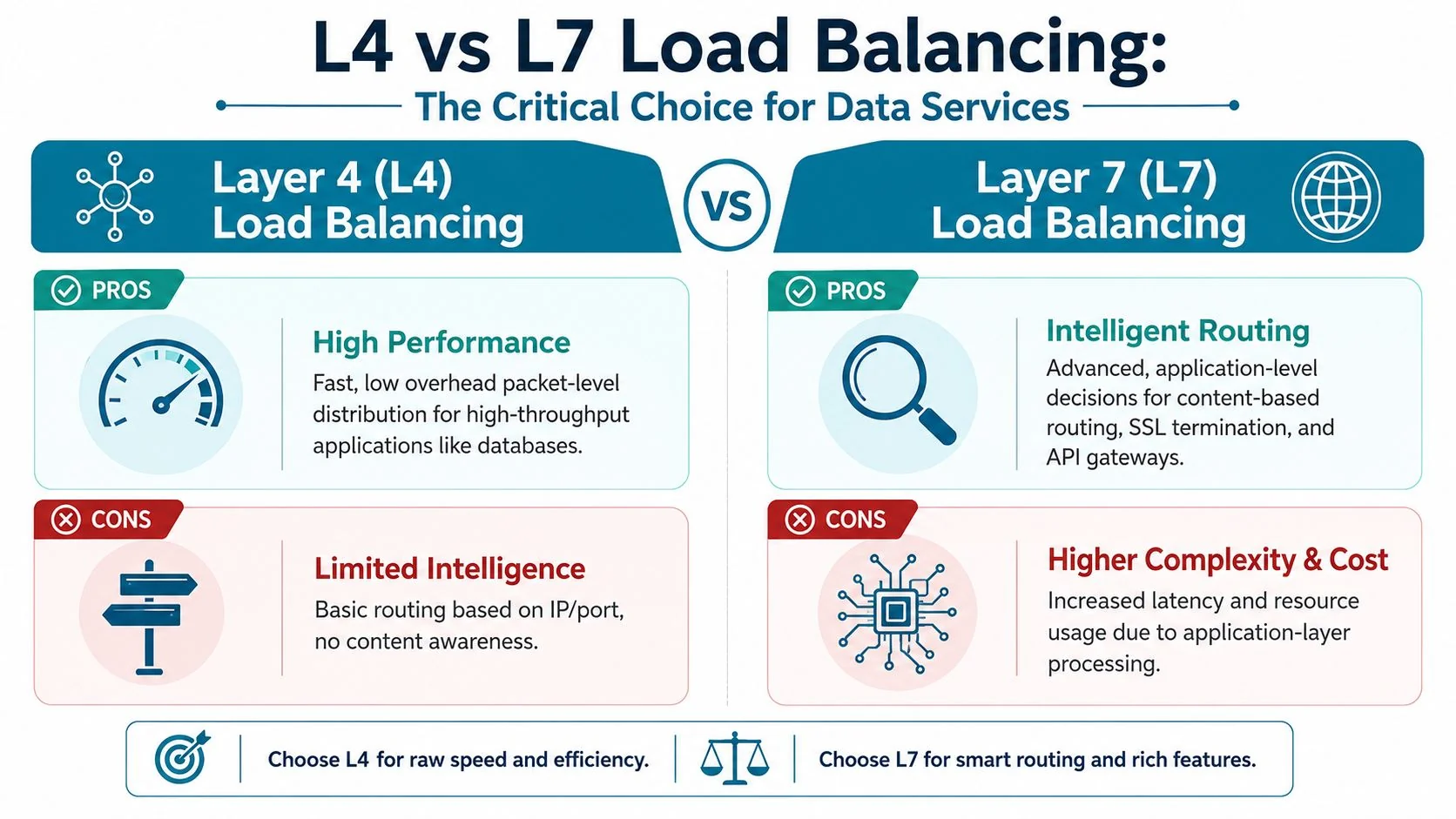
L4 load balancing works at the transport layer. It routes based on network and port information. It’s fast and simple. L7 load balancing understands the application layer, usually HTTP. It can route based on hostnames, paths, headers, and other request details.
For data platforms, that difference is not academic. It changes the shape of the whole system.
Where L4 fits
Use L4 when the application doesn’t need HTTP-aware decisions.
Good examples:
- Database-adjacent services
- Kafka brokers and other message-based infrastructure
- Raw TCP services used by internal data tools
- External endpoints that need strict separation and minimal processing
L4 is the right answer when the requirement is stable connectivity, low overhead, and clean transport handling.
Where L7 fits
Use L7 when humans or APIs interact with the platform over HTTP.
That’s where you want:
- Path-based routing such as
/airflowand/superset - TLS termination at a shared edge
- Centralized access logging
- Better control over auth integrations, redirects, and headers
That’s why most platform-facing data services belong behind L7. Airflow, Superset, internal APIs, lineage UIs, and governance portals are not just traffic endpoints. They’re application surfaces.
A quick visual explainer helps if you need to align engineering and procurement stakeholders:
The externalTrafficPolicy choice matters
There’s one Kubernetes detail that’s worth escalating to architecture review. With a Service of type LoadBalancer, externalTrafficPolicy: Cluster spreads traffic across all nodes but sacrifices source IP preservation, while externalTrafficPolicy: Local preserves client IPs and can reduce one network hop, but only nodes with ready endpoints receive traffic. That tradeoff affects observability and backend capacity, as described in Apptio’s Kubernetes load balancer guidance.
Preserve client IP when observability, auditability, or request tracing matters more than maximizing the pool of eligible backend nodes.
For data services exposed to internal consumers, I usually prefer preserving source context when the team uses that visibility. If they don’t, they’re paying complexity for a benefit they won’t operationalize.
Managing Cost and Quotas in Your Data Stack
The most common consulting failure here isn’t technical. It’s financial.
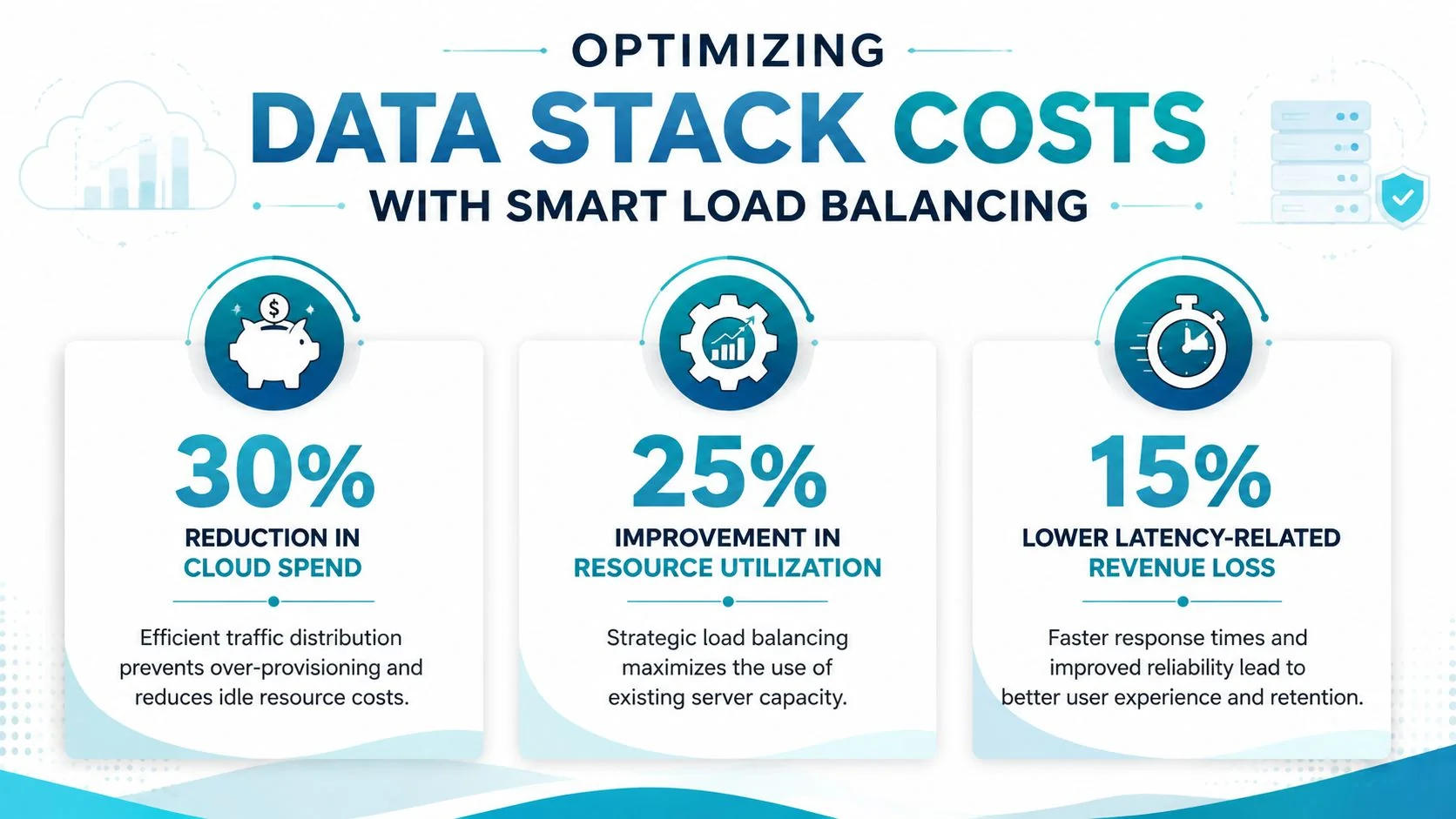
A LoadBalancer Service is convenient because it gives each service its own front door. In cloud environments, that convenience often means each front door comes with its own bill, its own lifecycle, and its own operational footprint. That’s acceptable for a small number of externally critical services. It’s bad discipline for a growing data platform.
The hidden cost pattern
When a consultancy ships quickly, they often expose services one by one:
- Airflow gets a LoadBalancer
- Superset gets another
- An internal API gets one more
- Notebook access gets another
- Monitoring endpoints start asking for exceptions
The platform still works, but you’ve created cost multiplication and control-plane clutter. Certificate handling spreads out. Security policy drifts. Incident response gets slower because nobody sees the edge as one managed surface.
The better design is usually consolidation. Put web-facing services behind a shared ingress layer. Keep internal services internal. Use dedicated load balancers only where isolation is worth paying for.
Quotas force architecture discipline
There’s also a hard limit problem. Some managed Kubernetes platforms cap how many load balancers you can attach to a cluster. OVH Cloud documents a limit of up to 16 load balancers per cluster, which is exactly why teams consolidate traffic behind Ingress when the service count grows, as shown in OVHcloud’s Kubernetes load balancer documentation.
That matters even if you don’t run on OVH. Quotas are a reminder that architecture can’t assume infinite edge resources.
If you’re selecting a consulting partner for AWS specifically, use this to evaluate AWS data engineering consultancies with cost governance in mind, not just migration credentials.
If a partner never asks how many externally exposed services your platform will have in a year, they aren’t designing for the platform you’re building. They’re designing for the sprint they’re billing.
What I’d require in a consulting engagement
Ask for these deliverables up front:
- A service exposure inventory that classifies every component as internal, shared L7, or dedicated external.
- A quota-aware design that explains how the platform avoids needless load balancer sprawl.
- A cost-control policy for when a team requests a new public endpoint.
- Readiness and health-check standards so the balancer only routes to healthy workloads.
That’s how you prevent networking from becoming a line item nobody owns.
Security and Observability Patterns
Security and observability should be designed at the edge, not bolted on after the first incident.
A mature architecture uses the load balancing layer to reduce exposed surface area, centralize TLS decisions, and create a cleaner trust boundary between external users, internal services, and sensitive data systems. That matters for platforms built around Snowflake, Databricks, dbt, Airflow, and internal APIs because the blast radius of a bad edge design is bigger than a single app outage.
Security patterns I’d insist on
Start with these:
- Terminate TLS deliberately. Decide whether termination happens at the ingress layer or passes through to services. Don’t let this vary by team preference.
- Hide internal topology. External consumers shouldn’t know which service runs where or how pods are distributed.
- Pair edge routing with network policy. Load balancing controls entry. Network policy controls lateral movement.
- Separate public and private classes of service. Your BI entry points and internal orchestration services shouldn’t share exposure assumptions.
Observability that actually helps during incidents
L7 routing gives you more than traffic flow. It gives you application-level evidence. That’s what helps when users say “the platform is down” but the issue is, in fact, one path, one upstream, or one auth flow.
According to Forrester’s 2025 Tech ROI Report cited in the AIP proceedings PDF, enterprises using cloud-native load balancing achieve 40% higher service availability and 35% faster traffic distribution compared to traditional methods, with 92% of clusters deploying external load balancers. For data platform leaders, the lesson is simple. Instrumented traffic management improves operations.
That’s also why this primer on Essential data observability for business leaders is relevant. Pipeline observability and traffic observability should support the same operational story.
Don’t accept “we monitor the cluster” as an answer. Ask what they log at the edge, what they measure per route, and how they trace a failed request from ingress to backend service.
Your Load Balancer Evaluation Checklist
Most vendors can talk about Kubernetes. Fewer can defend the networking choices that determine whether your data platform stays affordable and supportable.
Use this checklist in the next architecture review or RFP meeting.
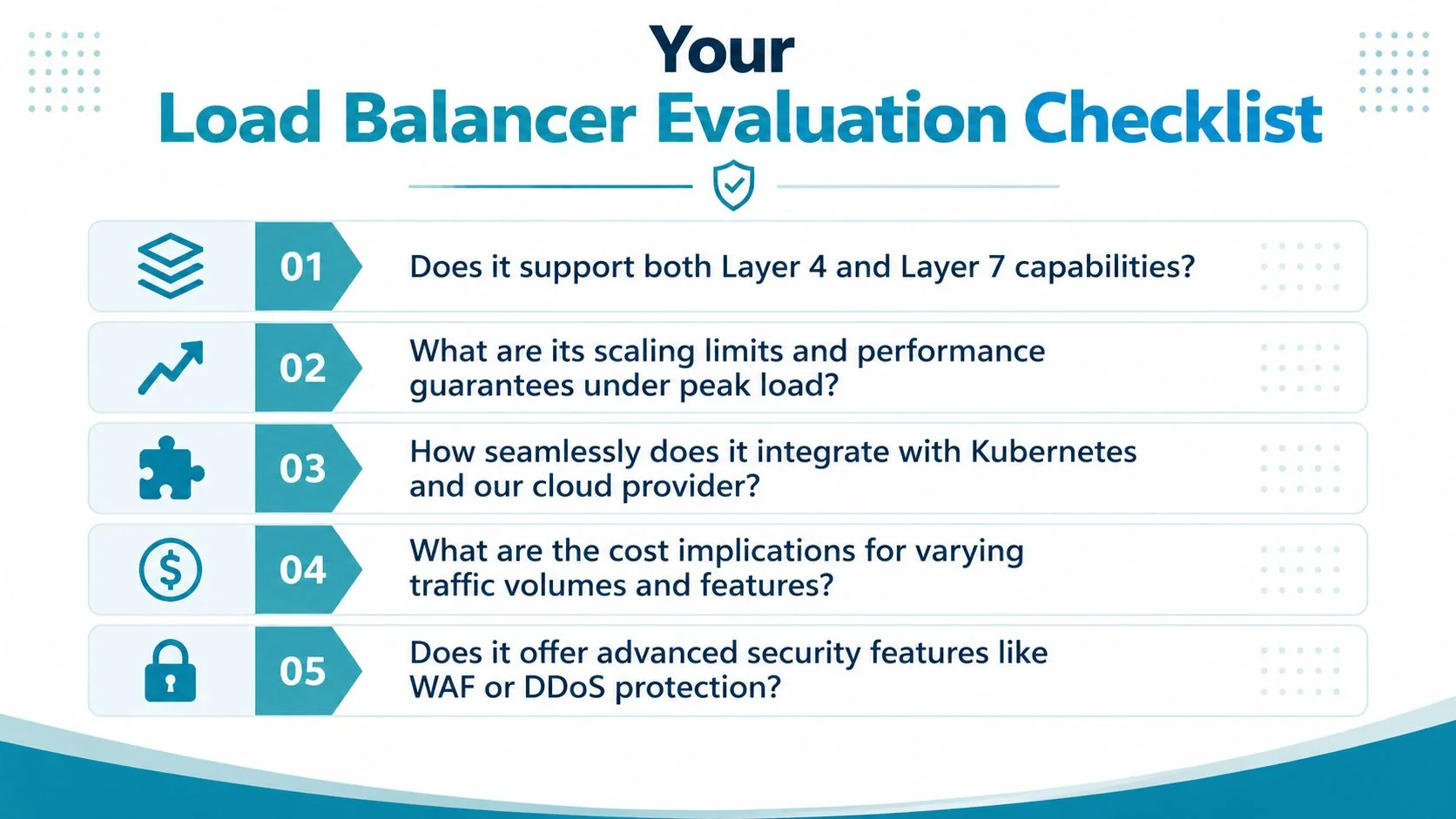
Questions that expose real expertise
-
What’s your default exposure model for a new data platform?
A serious partner should distinguish between internal services, shared L7 endpoints, and dedicated L4 exposure. -
When do you choose Service type LoadBalancer over Ingress?
The right answer should include cost and control-plane tradeoffs, not just implementation convenience. -
How do you handle Layer 4 and Layer 7 in the same platform?
Airflow and Superset don’t have the same needs as Kafka or database-adjacent services. -
What are your standards for TLS, health checks, and edge logging?
If they don’t have standard patterns, you’ll inherit inconsistency. -
How do you design around scaling limits and platform quotas? These design challenges expose hand-wavy architects.
-
Can you discuss newer traffic models such as BGP-based or eBPF-based approaches?
They don’t need to force those patterns into every build, but they should understand them. The broader point from CAST AI’s Kubernetes load balancer guide is correct: the choice between LoadBalancer Service and Ingress is a cost and control-plane tradeoff, and modern teams should at least be able to discuss more scalable traffic distribution models.
What a good answer sounds like
A strong consulting partner answers with principles, not product worship. They’ll explain why some services stay private, why HTTP workloads are consolidated, where direct L4 exposure is justified, and how they keep the edge observable and governable as the platform grows.
A weak one says, “We usually just create a load balancer per service and optimize later.”
That’s not architecture. That’s deferred cost.
If you’re comparing firms, use DataEngineeringCompanies.com to shortlist consultancies that can speak confidently about platform networking, cost control, and operational design, not just warehouse migration and pipeline delivery. The best partner won’t treat the load balancer in Kubernetes as a setup task. They’ll treat it like the control point it is.
Researched & written by
Data-driven market researcher with 20+ years in market research and 10+ years helping software agencies and IT organizations make evidence-based decisions. Former market research analyst at Aviva Investors and Credit Suisse.
Previously: Aviva Investors · Credit Suisse · Brainhub · 100Signals
Vetted partners
Featured Data Engineering Partners
Vetted firms whose specialty matches this article.
Related Analysis

Supervised vs Unsupervised Learning for Data Engineering
Choose between supervised vs unsupervised learning for your enterprise ML projects. A data engineering leader's guide to platform choice, cost, and vendor RFPs.

Data Engineering for AI Companies: A Strategic Guide
An expert guide to data engineering for AI companies. Covers architecture, platform choices (Snowflake vs Databricks), team models, and vendor evaluation.
Top Data Engineering Managed Services for 2026
Compare leading data engineering managed services. Find models, pricing, & vendors. Use our RFP checklist to select your ideal Snowflake or Databricks partner.