How to Evaluate Data Engineering Vendors: A Practical CIO Playbook
Choosing a data engineering vendor is a high-stakes decision with seven-figure consequences. A good choice accelerates your AI and cloud platform goals. A bad one leads to project failure, blown budgets, and significant business risk. This guide provides a practical, data-driven framework for evaluating vendors and de-risking your investment.
Your Vendor Choice Is A Multi-Million Dollar Decision
For a CIO or Head of Data, selecting a data engineering partner is a critical business decision. The right firm unlocks the value of platforms like Databricks or Snowflake. The wrong one sinks your budget, stalls projects, and introduces unacceptable risk.
The urgency is undeniable. The data engineering services market is projected to hit USD 91.54 billion by 2025 as companies race to modernize their data stacks. Simultaneously, a severe talent shortage means demand for skilled engineers outstrips supply by a three-to-one margin. This environment makes finding a truly expert partner a strategic imperative.
Shift Your Mindset: From Supplier to Partner
Many organizations fail by treating this as a commodity purchase, getting bogged down in hourly rates and ticking off checklists. This misses the point entirely.
The most important mental shift is to stop looking for a supplier and start searching for a strategic partner. A supplier executes tasks. A partner owns outcomes, challenges your thinking, and shares accountability for business results.
This distinction is crucial. A partner doesn’t wait for instructions; they bring proactive solutions and deep industry experience. To build a successful long-term relationship, it’s essential to apply rigorous vendor management best practices.
This guide cuts through the marketing fluff to offer a practical playbook. We will focus on gathering tangible evidence and hard data, enabling you to distinguish between firms with genuine expertise and those with a polished pitch. The goal is to provide a rigorous framework to minimize risk and maximize the return on your investment.
Building Your Vendor Evaluation Scorecard
To move beyond gut feelings and sales pitches, a weighted evaluation scorecard is your most powerful tool. This isn’t just a spreadsheet; it’s a strategic exercise that forces stakeholders to define what a successful outcome looks like before engaging with any vendor. A scorecard is a form of comparative analysis that enables you to stack vendors against each other using a consistent set of criteria. Without it, making an informed decision is impossible.
You are navigating a complex market. The need for external partners is real and growing.
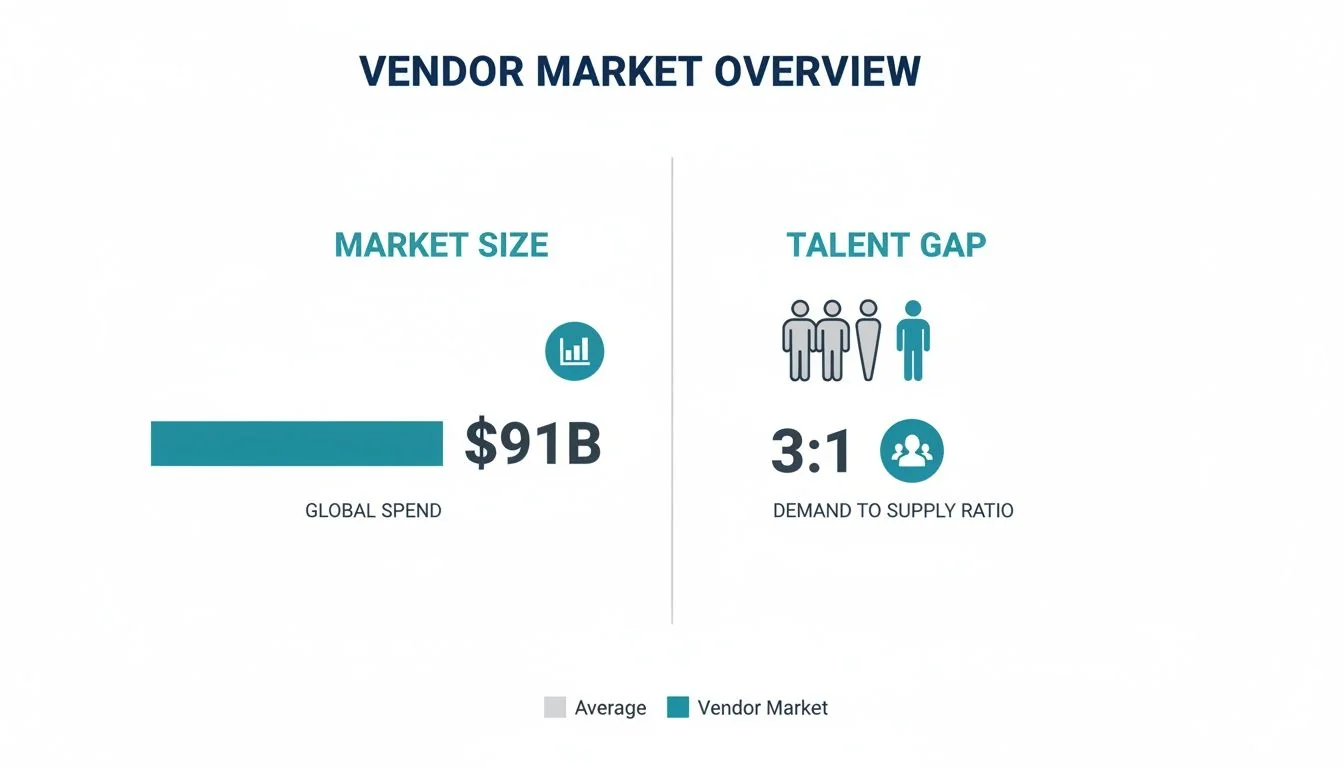
The numbers are stark. With a $91 billion global market and a 3:1 demand-to-supply ratio for data engineering talent, a poor vendor choice isn’t a setback—it’s a costly, project-killing disaster.
The Eight-Factor Evaluation Methodology
A robust scorecard must assess more than a checklist of technical skills. This eight-factor methodology provides a 360-degree view of a vendor’s capabilities, evaluating not just what they can build, but how they will deliver, support, and partner with you long-term.
These are the eight pillars of a strong evaluation:
- Technical Expertise: Do they have deep, hands-on skill with your specific tech stack?
- Delivery Quality: What is their process for ensuring the work is robust, well-documented, and production-ready?
- Industry Experience: Have they solved similar problems in your specific vertical?
- Cost-Effectiveness: What’s the total cost of ownership, not just the hourly rate?
- Scalability: How easily can they ramp the team up or down based on your evolving needs?
- Market Focus: Are they true data engineering specialists or generalist IT body shops?
- Innovation: Are they bringing new ideas and methodologies to the table, or just taking orders?
- Support: What does their model for post-launch assistance and knowledge transfer look like?
Each factor must be broken down into tangible, measurable criteria. For Technical Expertise, don’t just ask if they “know Snowflake.” Ask about their official partnership tier, the number of certified professionals on staff, and demand case studies where they used specific features you require, like dynamic tables or Snowpark container services.
Creating and Weighting Your Scorecard
The power of a scorecard lies in its custom weighting, which aligns the evaluation with your project’s unique requirements. A project with heavy regulatory burdens in finance will have a different risk profile—and thus different priorities—than an internal analytics dashboard for a retail company.
The weighting is where your strategy becomes tangible. It’s the clearest expression of your project’s priorities. If you say security is paramount but only give it a 5% weighting, your evaluation process is misaligned with your business goals.
Consider how you might customize weights in different scenarios:
- For a high-stakes regulatory project in financial services, you would likely weight Industry Experience and Delivery Quality (especially around documentation and audit trails) very heavily, perhaps 25% each.
- For a startup building a rapid AI prototype, priorities would shift. Technical Expertise with the latest ML frameworks and the vendor’s Scalability to ramp up quickly would be paramount.
- For a large enterprise migrating from on-prem to the cloud, factors like Cost-Effectiveness (analyzing global delivery models) and long-term Support become critical.
To get context before locking in your scorecard weights, you can browse a directory of data engineering consulting services.
A weighted scorecard is a powerful tool to objectively compare data engineering vendors. The key is to assign weights based on what truly matters for your specific project. Here’s a framework to get you started:
| Vendor Evaluation Scorecard Framework | | :--- | :--- | :--- | :--- | | Evaluation Factor | Key Criteria to Assess | Example Weight (Modernization Project) | Data Sources for Verification | | Technical Expertise | Certifications, partnership tiers, tech-specific case studies | 25% | RFP responses, vendor presentations, technical interviews | | Delivery Quality | QA processes, documentation standards, project management methodology | 20% | RFP responses, reference checks, POC performance | | Industry Experience | Relevant client logos, vertical-specific case studies, team member bios | 15% | Vendor website, RFP responses, reference checks | | Cost-Effectiveness | Blended rates, productivity accelerators, billing terms, TCO analysis | 15% | Pricing proposal, rate card analysis, reference checks | | Scalability | Team size, global presence, ramp-up/down SLAs | 10% | RFP responses, MSA/SOW terms | | Market Focus | Service offerings, company positioning, % of revenue from data services | 5% | Vendor website, analyst reports, initial discovery calls | | Innovation | R&D investment, proprietary tools, thought leadership (blogs, talks) | 5% | Vendor presentations, discussions with their technical leads | | Support | SLA for support, knowledge transfer plan, post-launch engagement model | 5% | SOW terms, reference checks, pricing proposal |
Adjust the weights and criteria to reflect your specific definition of success. The goal is to move from subjective feelings to objective, data-driven decisions.
Look Beyond Rates to True Cost-Effectiveness
A common mistake is fixating on the hourly rate. A low rate from a junior team that produces buggy code will cost you far more in rework, missed deadlines, and technical debt. It’s a classic false economy.
To gauge Cost-Effectiveness, you must think in terms of Total Cost of Ownership (TCO). This requires asking:
- What are their blended rates? How do they mix onshore, nearshore, and offshore talent to optimize for cost without sacrificing communication and quality?
- Do they have productivity multipliers? Does the vendor bring proprietary frameworks or code accelerators that speed up development? A more expensive team that delivers in half the time is the cheaper option.
- What are the billing increments? Do they bill in 15-minute chunks or full-day blocks? This detail significantly impacts your final invoice.
- What’s the real ramp-up time? How long will it take their engineers to become productive in your environment? A partner with deep experience in your stack will get up to speed faster, saving weeks of payroll.
By building your evaluation around a weighted scorecard focused on these deeper questions, you shift the conversation from a price comparison to a genuine value discussion.
Writing an RFP That Gets You Real Answers
Once your evaluation scorecard is locked in, it’s time to build your Request for Proposal (RFP). A generic RFP elicits generic, copy-pasted answers. A strategic one forces vendors to demonstrate their expertise, not just talk about it.
This is your first real test of a vendor’s problem-solving DNA. Your RFP must get past the marketing fluff. Any vendor can claim a “data quality framework” or an “Agile methodology.” Your job is to draft questions that reveal how they solve tough problems under pressure.
It’s All About Asking “How,” Not “What”
The biggest mistake in RFPs is focusing on binary, yes/no questions. To get meaningful responses, demand narrative, evidence-based answers. Stop asking if they do something and start asking them to describe how they’ve done it. This forces a vendor to provide specific, verifiable details.
The quality of your RFP questions directly determines the quality of your evaluation. Vague questions lead to vague answers. Scenario-based questions, on the other hand, reveal a vendor’s true operational maturity and problem-solving skills.
Consider the difference between these questions:
- Weak Question: “Do you have a process for managing data quality issues?” (The answer is always “yes.”)
- Strong Question: “Describe a recent project where your team discovered unexpected data validation failures post-launch. Walk us through the specific steps you took to diagnose the root cause, communicate the issue to the client, and implement a permanent fix.”
The second question reveals their technical troubleshooting process, client communication style, and commitment to building lasting solutions—all critical indicators of a true partner.
Key Areas to Probe with Scenarios
Your RFP needs to gather proof across several critical areas. Use your weighted scorecard as a guide to ensure your questions address your highest priorities.
Scenario-based questions are particularly effective for:
- Delivery and Governance: Instead of asking about their stated methodology, ask them to describe their process for handling scope creep, managing technical debt, and ensuring documentation is useful on a project of similar scale to yours.
- Team and Expertise: Resumes don’t tell the whole story. Ask them to propose a specific team structure for your project and justify each role. A good follow-up: “Describe your knowledge transfer process from a project where you successfully handed off ownership to the client’s internal team.”
- Problem-Solving and Resilience: You need to know what happens when things go wrong. Ask: “Describe a time when a key technical assumption made during design proved wrong during implementation. How did your team pivot, and what was the impact on the timeline and budget?”
This approach turns your RFP from a questionnaire into an active screening tool. For more guidance, see our guide on RFP process best practices.
An Example That Separates the Pros from the Pretenders
Imagine you’re migrating a legacy data warehouse to Databricks and are concerned about performance tuning and cost control.
A generic RFP might ask: “Do you have experience with Databricks performance tuning?”
A strategic RFP would ask this instead:
“For a recent Databricks project, provide a specific example of an optimization your team implemented that led to a measurable drop in cluster costs or job execution time. Please include:
- The initial performance bottleneck observed.
- The diagnostic steps your team took to find the root cause (e.g., analyzing the Spark UI, query plans).
- The specific code or configuration changes made.
- The quantified improvement achieved (e.g., 25% reduction in DBU consumption, 40% faster job completion).”
This level of detail is impossible to fake. The answers will immediately separate firms with deep, hands-on expertise from those who just list Databricks on their website.
Analyzing Costs, Contracts, and Hidden Red Flags
After vetting technical capabilities and RFP responses, the evaluation pivots from what a vendor says they can do to what they’re willing to commit to on paper. A vendor’s attitude toward costs and contracts reveals more about their partnership philosophy than any sales pitch. Getting this part right is about protecting your project from future complications.

Deconstructing The True Cost Of Engagement
The rate card is only the starting point. To understand the real financial commitment, you must analyze their pricing model and calculate the Total Cost of Ownership (TCO).
A sophisticated cost analysis involves comparing blended rates across onshore, nearshore, and offshore teams. A global delivery model can offer cost advantages, but you must verify that their communication and management structures are airtight to prevent savings from evaporating in rework and delays.
Also, examine details like the billing increment. A vendor billing in 15-minute increments offers better cost control than one rounding up to four-hour or full-day blocks. For more detail, see our analysis of data engineering consulting rates for 2026.
Navigating The Contractual Minefield
The Master Service Agreement (MSA) and Statement of Work (SOW) are your primary risk mitigation tools. Do not simply hand these to your legal team. Your technical and project leads must ensure the contractual language aligns with the project’s operational reality.
Pay special attention to these critical clauses:
- Intellectual Property (IP) Rights: The contract must state, without ambiguity, that your company owns 100% of the work product. Any hesitation from the vendor is a major red flag.
- Liability Caps: Vendors will try to cap their liability, often to a low figure like three months of fees. Push for a cap that reflects the potential business damage of project failure, not just the cost of their services.
- Termination for Convenience: You must have an exit clause. This lets you end the contract for any reason, avoiding a messy legal fight if the partnership is not a good fit.
- Data Security and Compliance: The SOW must detail the vendor’s obligations to follow your security policies and regulations like GDPR or CCPA.
A vendor’s flexibility during contract negotiations is a strong indicator of partnership potential. A willingness to negotiate reasonable terms for IP and liability shows confidence in their work. Stonewalling suggests otherwise.
Your Guide to Spotting The Red Flags
Experienced leaders learn to spot warning signs before they escalate. These red flags often appear late in the process when a vendor believes the deal is secured.
Large enterprises drove 58.91% of the USD 91.54 billion big data engineering services market in 2025. Yet, industry analysis, such as recent big data engineering services market share reports, suggests that as many as 40% of these partnerships fail to deliver, often because of warning signs ignored during the final evaluation stages.
Here is a practical checklist of red flags:
- Vague Project Methodology: If they can’t clearly explain their process for your project—including roles, ceremonies, and artifacts—they intend to improvise. Ask to see a sample project plan from a similar engagement.
- Resistance to a Defined POC: A confident vendor will welcome the chance to prove themselves in a Proof of Concept. Hesitation or attempts to make the POC scope too broad to measure suggest a lack of confidence.
- Stale or Irrelevant References: If their best references are from projects completed over 18 months ago or in a different industry, their current team may lack the right experience. Insist on speaking with recent clients.
- Signs of High Staff Turnover: A review of Glassdoor or LinkedIn can be revealing. High turnover or negative reviews about project management are signs of internal chaos that will likely impact your project.
- The “Bait and Switch” Team: The A-team from the sales cycle must be the delivery team. Insist on having the names of lead architects and senior engineers written into the SOW to prevent them from being replaced by a junior crew post-contract.
Trust your due diligence. These commercial details are as important as the technical assessment. Catching red flags early is the best way to avoid a costly mistake.
Running An Effective Proof Of Concept And Reference Checks
You’ve reviewed proposals and contracts. Now it’s time to see how vendors perform. The Proof of Concept (POC) and deep-dive reference checks are your opportunity to move beyond the sales pitch and observe how a potential partner handles real-world pressure.
Treat the POC as a paid, time-boxed slice of your actual project. It’s the best way to evaluate technical skill, communication, collaboration, and problem-solving. A vendor who resists a well-defined POC should be viewed with caution. Confident partners are eager to prove their worth.

Designing A POC That Delivers Real Insights
An unstructured POC is a waste of time and money. To get meaningful data, structure it with clear, measurable goals. The objective is to see them solve a genuine problem from your backlog, not build a demo.
Define a project slice that is complex enough to be a real test but small enough to complete in 2-4 weeks. A good POC might involve building a single, high-value data pipeline—for instance, ingesting data from a difficult source, applying complex business logic, and landing it in your target platform, like Snowflake or Databricks.
Crucially, define the success criteria before the POC begins to ensure an objective evaluation.
Focus on measuring what matters:
- Pipeline Performance: Set specific benchmarks, e.g., “The pipeline must process 1 million records in under 10 minutes with an error rate below 0.1%.”
- Code Quality and Documentation: Is the code clean, modular, and understandable? Is the documentation sufficient for your engineers to maintain the work?
- Problem-Solving Approach: When they hit a roadblock, did they flag it immediately with potential solutions, or did they go silent?
A successful POC is about more than just the final code. It’s an audition of their entire working style. Pay close attention to their daily stand-ups, response times on Slack, and the quality of their questions. Do they feel like an extension of your team or just a contractor?
Conducting Reference Checks That Uncover The Truth
While the POC is underway, conduct reference checks. Do not just accept the vendor’s curated list of clients. Push for references from projects similar to yours in scope and industry, preferably completed within the last 12-18 months.
The goal of a reference check is to get an unfiltered story. Vague questions yield useless answers. Ask probing, open-ended questions that encourage real examples.
Here are some effective questions:
- “Tell me about a time the project went off track. What was the challenge, how did the vendor’s team communicate it, and what specific steps did they take to resolve it?”
- “Walk me through the handoff process. How prepared was your team to take ownership after the engagement? What did the knowledge transfer actually involve?”
- “On a scale of 1 to 10, how would you rate their project management and communication? Can you share a specific example that justifies that score?”
- “Did you experience a ‘bait and switch’ with the team? Were the senior people from the sales process the ones doing the work, or were they replaced by junior staff?”
- “If you could start over, what is one thing you would change about the SOW or how you structured the engagement with this vendor?”
The answers will paint a clear picture of what it’s like to work with this company. Look for patterns between what you hear on these calls and what you observe in the POC. If a reference mentions poor documentation and you see the same in the POC deliverables, you have identified a genuine risk.
You have done the hard work of evaluation. Now it’s time to synthesize this intelligence into a compelling business case for your stakeholders.
Present your final recommendation by summarizing the key findings, connecting your choice directly back to the project goals and the weighted criteria you established. Be prepared to explain not just who you chose, but precisely why they offer the best value and lowest risk.
A rigorous evaluation process means nothing if it doesn’t lead to a successful project launch. The transition from vendor selection to project execution is where many partnerships falter due to a loss of momentum.
Onboarding For A Successful Launch
Once the contract is signed, the real work begins. Channel the momentum from your selection process directly into the project. A slow start can kill enthusiasm. A concrete 90-day plan is non-negotiable.
This checklist will help you start smoothly:
-
Establish Governance: Immediately schedule a weekly project status call for the core team and a bi-weekly steering committee with executive sponsors. Define decision-makers and a clear escalation path.
-
Define Communication Cadence: Set up a shared Slack or Teams channel for daily communication. Agree on a template and schedule for formal progress reports to keep stakeholders informed.
-
Grant System Access: Eliminate bureaucratic delays. Provide your new partner with day-one access to your code repository (GitHub), cloud environment, and project management tools (Jira).
-
Finalize The 90-Day Roadmap: The SOW is a starting point. Work with your chosen vendor to break it into a detailed, week-by-week roadmap for the first quarter, with specific, measurable milestones for weeks 1, 4, and 12 to ensure accountability.
Common Questions When Choosing a Data Engineering Partner
Even with a thorough evaluation process, certain questions frequently arise. Here is practical advice for addressing them.
Should We Really Pay for a Proof of Concept (POC)?
Yes. A free “proof of concept” is often a pre-packaged sales demo delivered by the vendor’s B-team. It is not a true test.
Investing in a paid POC, typically 2-4 weeks, changes the dynamic. It compels the vendor to assign their best people and treat it as a real engagement. You are not just buying code; you are paying for a preview of their communication style, problem-solving skills, and ability to perform under pressure.
What Matters More: Platform-Specific Skills or Core Engineering Strength?
While it is tempting to find a team that perfectly matches your current tech stack, like Databricks or Snowflake, strong engineering fundamentals should always be the priority. Platforms and tools change.
A team that understands foundational architecture, solid data modeling, and software engineering best practices can adapt to any new tool. A team with only platform-specific knowledge but weak fundamentals will build brittle, debt-ridden systems. One is a skill that can be learned; the other is a permanent flaw.
How Can I Tell if a Vendor is Actually Innovative?
Innovation is not about buzzwords on a sales deck. It’s about tangible, verifiable actions. When a vendor claims to be innovative, ask for proof.
Look for this evidence:
- R&D Spending: Ask what percentage of revenue they reinvest into research, development, and building internal tools. Serious firms invest in their own improvement.
- Open-Source Footprint: Do their engineers contribute to well-known open-source projects on sites like GitHub? This demonstrates active engagement with the broader data community.
- Real Thought Leadership: Look beyond generic blog posts. Have they published recent, in-depth whitepapers or presented at major conferences on new challenges in the field? This shows they are solving tomorrow’s problems, not just rehashing old solutions.
Finding the right data engineering partner is a major challenge, but DataEngineeringCompanies.com makes it manageable. Use our 2025 Expert Rankings and free comparison tools to build a shortlist of the top 50+ firms and evaluate them with confidence. Start your vendor evaluation here.
Data-driven market researcher with 20+ years in market research and 10+ years helping software agencies and IT organizations make evidence-based decisions. Former market research analyst at Aviva Investors and Credit Suisse.
Previously: Aviva Investors · Credit Suisse · Brainhub · 100Signals
Top Data Engineering Partners
Vetted experts who can help you implement what you just read.
Related Analysis
Your Guide to Data Engineering Consulting Services
Unlock the value of your data. This guide to data engineering consulting services covers costs, vendor selection, red flags, and platform-specific insights.
7 Practical Resources for Finding the Best Data Engineering Companies in 2026
Discover the best data engineering companies for your next project. We review 7 top directories to help you find the right partner with confidence in 2026.