The Real Cost and Timeline of a Data Mesh Consulting Engagement
Jumping into data mesh without a clear budget and timeline is a recipe for failure. Engineering leaders evaluating this shift need concrete numbers, not just theory. A data mesh initiative is not a single project; it is a phased transformation requiring a significant investment in both external expertise and internal resources. This guide provides the benchmarks, timelines, and evaluation criteria you need to build a business case and select a partner that can deliver.

Why You Can’t Afford to “Go It Alone”
The core problem data mesh solves is the monolithic data bottleneck. A central data team becomes a service desk, buried under tickets from business units waiting for data. This model does not scale. Data mesh inverts this by giving ownership of data products to the domains that know the data best—marketing, finance, or logistics.
This is a socio-technical transformation. Attempting it without experienced guidance is a high-risk, low-reward endeavor. According to DataEngineeringCompanies.com’s analysis of 86 data engineering firms, internal-only mesh initiatives have a failure rate exceeding 70%, typically stalling after 12-18 months due to organizational resistance and technical drift. A qualified data mesh consulting partner de-risks this by implementing a proven playbook that addresses technology, governance, and culture in parallel.
Centralized Bottleneck vs. Decentralized Data Mesh
The architectural and organizational differences are stark. A centralized model creates dependencies; a data mesh fosters autonomy and speed.
| Attribute | Traditional Monolithic Architecture | Data Mesh Architecture |
|---|---|---|
| Data Ownership | A central data team owns the platform, pipelines, and data models. | Business domains (e.g., Sales, Marketing) own their data as a product. |
| Team Structure | One large, specialized central team serves the entire organization. | Small, cross-functional teams are embedded within each business domain. |
| Architecture | A single data lake or warehouse acts as the single source of truth. | A distributed network of interoperable “data products.” |
| Bottlenecks | The central team is a bottleneck for all data requests and changes. | Bottlenecks are localized; domain teams are self-sufficient. |
The market recognizes this advantage. The global Data Mesh Consulting Services market, valued at USD 1.42 billion in 2024, is projected to hit USD 7.98 billion by 2033. This growth is driven by organizations realizing that decentralization is the only way to enable true Self-Serve Business Intelligence. When domain experts can directly build with their own data products, the feedback loop for innovation shrinks from months to days.
By decentralizing data ownership, organizations move accountability to the source. This ensures those who create the data also own its quality, documentation, and evolution, a stark contrast to relying on a backlogged central BI team.
An expert consultant’s job is to implement the four core principles of data mesh:
- Domain Ownership: Assigning data accountability to the business domains that create and understand it.
- Data as a Product: Treating data as a first-class product with defined SLAs, documentation, and a dedicated owner.
- Self-Serve Infrastructure: Building a platform that lets domains manage their data products with high autonomy.
- Federated Governance: Establishing a set of global rules for security, interoperability, and quality that all domains must follow.
This is distinct from a data fabric, which focuses on connecting disparate data sources through a metadata layer rather than fundamentally changing ownership. For a detailed comparison, see our guide on what is a data fabric? A data mesh consultant ensures these principles become an executed reality, not just architectural diagrams.
Scoping Your Data Mesh Consulting Engagement
A data mesh engagement is not a monolithic project. It is a series of well-defined phases designed to deliver value incrementally and build momentum. The scope you select depends entirely on your organization’s current maturity and strategic goals. Misaligning the engagement type with your starting point is a common and costly mistake.
Data Mesh Engagement Models & Timelines
Consulting engagements are structured to meet you where you are. They fall into three distinct phases, each with a specific objective, timeline, and cost structure.
-
Strategic Advisory (4-6 weeks): This is the mandatory starting point for any organization new to the concept. A consultant assesses your technical and organizational readiness, identifies high-impact business domains for a pilot, and delivers a strategic roadmap. The primary deliverable is a compelling business case with ROI projections to secure executive sponsorship. Jumping straight to implementation without this alignment phase is the leading cause of failure.
-
Pilot Implementation (3-6 months): This phase moves from strategy to execution. The consultant works hands-on with a single, selected business domain to build its first data product. This involves setting up the minimum viable self-serve platform on Snowflake or Databricks, defining data contracts, and establishing the initial federated governance rules. A successful pilot serves as a concrete, repeatable blueprint for the rest of the organization.
-
Full-Scale Transformation (12-24+ months): Following a successful pilot, the engagement shifts to scaling the data mesh across the enterprise. The consultant’s role transitions from hands-on implementation to strategic guidance. They help onboard additional domains, mature the self-serve platform with more advanced capabilities, and formalize the federated governance council. This is a long-term partnership focused on embedding data mesh principles into your company’s DNA.
A data mesh consultant’s role is to translate the four core principles—domain ownership, data as a product, a self-serve platform, and federated governance—into a step-by-step execution plan that works within your company’s culture and tech stack. This is what prevents a data mesh from becoming another failed IT initiative.
Choosing the right entry point is critical. An organization new to the concept must start with the Strategic Advisory phase to build alignment. Attempting a full-scale rollout from a standing start leads to wasted budget, team burnout, and a loss of stakeholder trust. Each phase builds on the last, delivering tangible value that justifies the next stage of investment.
The 4 Phases of a Data Mesh Implementation
A data mesh is not delivered in a “big bang” launch. A successful data mesh consulting engagement guides your organization through an evolutionary, four-phase process designed to deliver value quickly while building a sustainable foundation.
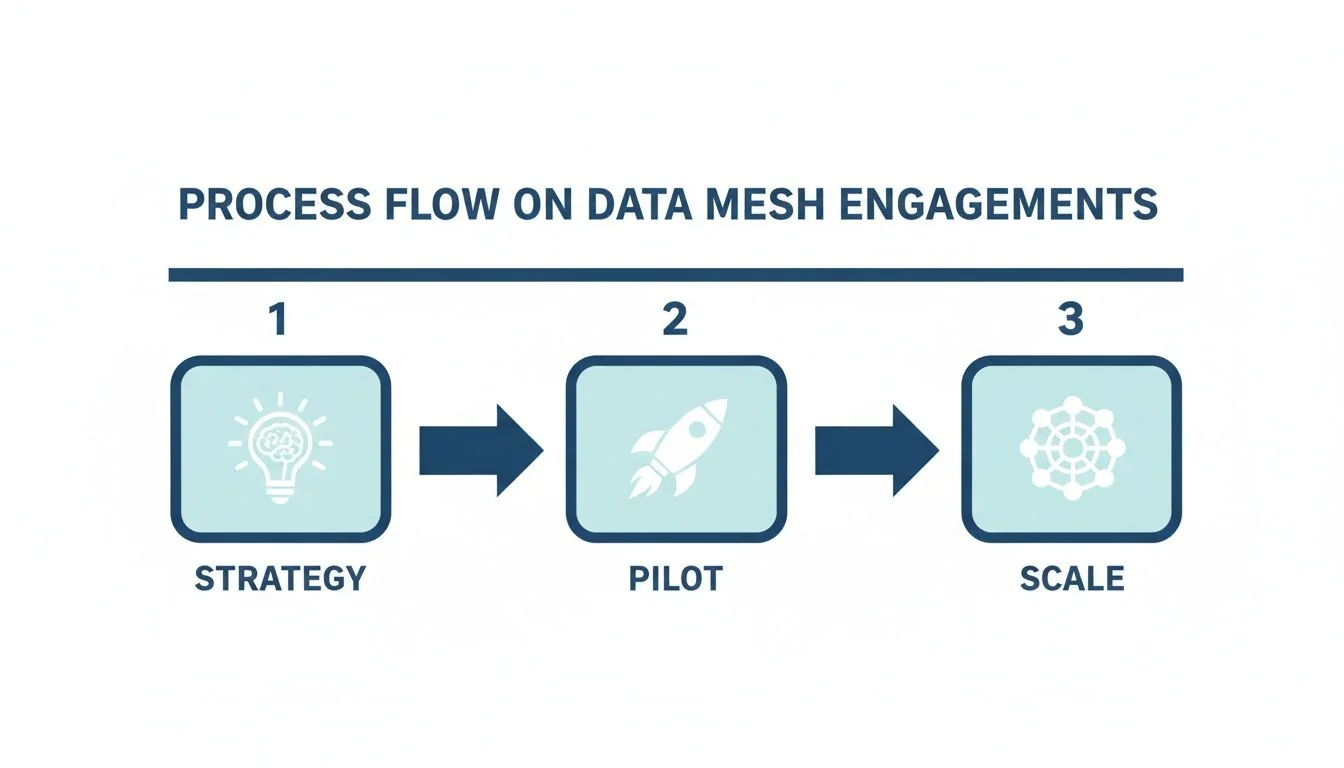
This approach de-risks the initiative by validating the strategy with a focused pilot before committing to an enterprise-wide rollout.
Phase 1: Assessment and Strategy (4-6 Weeks)
The engagement begins with a rapid, intensive discovery phase. Consultants embed with leadership and technical teams to identify the primary business drivers for the data mesh. They map current data-related pain points to specific business outcomes that will be improved, such as reducing time-to-market for analytics or improving data quality for AI models. This phase also includes a candid assessment of your organization’s readiness—evaluating technical skills, data governance maturity, and the cultural appetite for change. The key deliverable is a detailed roadmap that includes a business case, a high-level target architecture, and a recommendation for the first pilot domain.
Phase 2: Pilot Domain Identification and Onboarding (2-4 Weeks)
Selecting the right first domain is critical. The ideal pilot candidate is a business domain that experiences significant data friction but is not overwhelmingly complex, led by a team that is enthusiastic about pioneering a new approach. A marketing analytics team struggling to get a unified view of customer data is a common and effective choice.
A successful pilot is the single most important factor in a data mesh initiative. It is your internal proof-of-concept. It creates momentum, secures buy-in from skeptics, and gives you a repeatable playbook for everyone else.
Once selected, consultants work with the pilot domain team to define its first data product. This involves defining clear boundaries for the data, establishing formal data contracts (the API for the data), and setting service-level objectives (SLOs) for quality, freshness, and availability.
Phase 3: Self-Serve Platform Development (3-5 Months)
In parallel with pilot onboarding, the platform engineering team, guided by consultants, builds the minimum viable platform (MVP) required for the pilot domain to succeed. The goal is not a feature-complete platform, but a functional core that enables autonomy. This typically involves configuring a cloud data platform like Snowflake or Databricks and integrating essential tools for:
- Data Ingestion and Transformation: Using standards like dbt and Airflow.
- Data Discovery: Implementing a data catalog so the new data product is discoverable.
- Access Control: Establishing the foundational guardrails for federated security.
Phase 4: Scaling and Federated Governance (Ongoing)
With a successful pilot, the initiative shifts to scaling. The artifacts, infrastructure-as-code, and lessons from the pilot are codified into a playbook for onboarding subsequent domains. The consultant’s role evolves from direct implementation to strategic enablement. They help establish the federated governance council, a cross-functional body comprising representatives from data domains and the central platform team. This council becomes the long-term owner of the mesh, responsible for evolving the standards, policies, and platform capabilities as the ecosystem grows.
Assembling Your Data Mesh Delivery Team
A data mesh requires new roles and a new team structure. The traditional, centralized BI or data engineering team is replaced by a hybrid model that combines central platform enablement with decentralized, domain-specific expertise. Your data mesh consulting partner’s primary role is to provide the senior expertise needed to stand up this new operating model and upskill your internal teams.
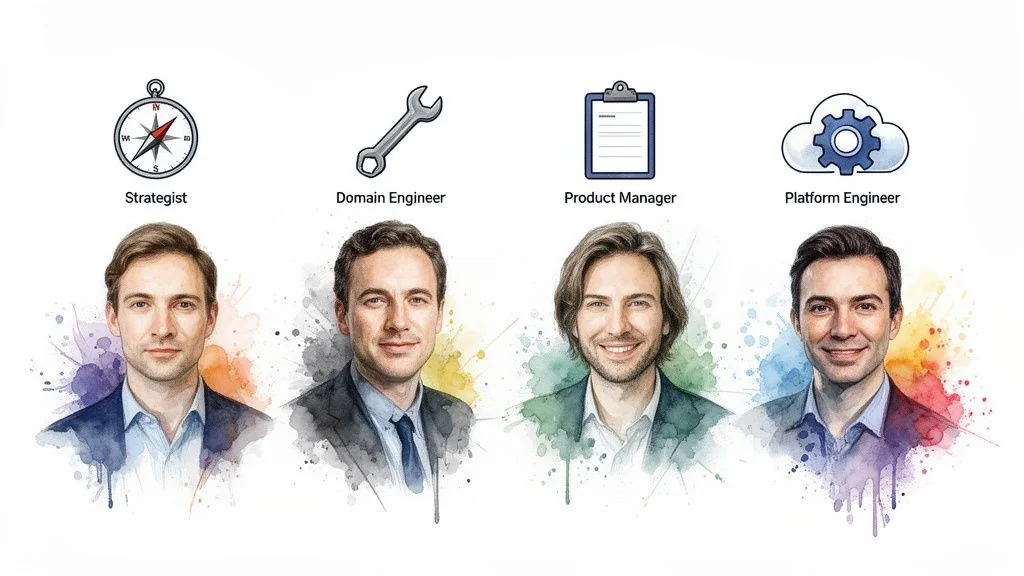
This new structure requires a mix of strategic vision, domain knowledge, product thinking, and platform engineering.
Key Roles for a Data Mesh Initiative
Your delivery team is a hybrid of external consultants and internal staff. These are the critical roles required for a successful implementation:
- Data Mesh Strategist (Consultant): The senior guide for the initiative. This consultant crafts the strategic roadmap, secures executive buy-in, helps identify pilot domains, and designs the federated governance model.
- Domain-Oriented Data Engineer (Internal/Consultant): Embedded directly within a business unit (e.g., Marketing, Supply Chain), this engineer builds, tests, and maintains the data products for that specific domain.
- Data Product Manager (Internal/Consultant): This critical role applies a product management discipline to data. They own the lifecycle of a data product, ensuring it is discoverable, well-documented, reliable, and provides clear value to its consumers.
- Platform Engineer (Internal): This team builds and operates the underlying self-serve data platform, enabling domain teams to create and manage their data products autonomously.
The consulting market has grown to fill the skills gap for these specialized roles. With the data mesh market drivers and future scope pointing toward USD 2.01 billion by 2026, it is clear that organizations are relying on external expertise. Our analysis shows that 75% of adopters report gaining insights 40% faster after a structured consulting engagement.
Data Mesh Consulting Team Roles and Rate Benchmarks
Budgeting for this expertise requires understanding market rates. Based on our proprietary dataset, here are the benchmark hourly rate bands for these specialized consulting roles.
| Consulting Role | Key Responsibilities | Typical Hourly Rate (USD) |
|---|---|---|
| Data Mesh Strategist | Defines vision, roadmap, governance; secures executive buy-in. | $250 - $400+ |
| Domain-Oriented Data Engineer | Builds, tests, and deploys data products within a business domain. | $175 - $275 |
| Data Product Manager | Manages data product lifecycle, from ideation to consumer value. | $180 - $280 |
| Platform Engineer | Builds and maintains the self-serve data platform infrastructure. | $170 - $260 |
These rates vary based on geography, consultant experience, and engagement complexity, but serve as a reliable baseline for financial planning.
DataEngineeringCompanies.com’s Analysis of 86 Data Engineering Firms Our research shows a clear rate structure for these specialized roles. While rates vary by geography and experience, leaders can use these benchmarks for initial budget planning.
How to Select a Qualified Data Mesh Consultant
Choosing the right partner is the most critical decision in a data mesh initiative. An unqualified partner will re-label your existing data warehouse, fail to drive the necessary cultural shift, and burn through your budget with no tangible change. A qualified partner acts as a change agent, bringing a proven methodology that addresses both technology and organizational dynamics.
Your vendor vetting process must be rigorous and evidence-based. Demand proof of past performance on actual data mesh transformations, not generic data platform projects. Dig into the specifics: What business outcomes were achieved? How was organizational resistance managed? Which specific data products were launched?
Evaluation Checklist for Data Mesh Consulting Partners
Use this checklist in your RFP to force vendors to provide specific, verifiable evidence of their capabilities.
| Category | Evaluation Criteria |
|---|---|
| Technical Expertise | 1. Do they have deep, hands-on implementation experience with Snowflake or Databricks? Ask for certified architect numbers. 2. Can they demonstrate prior work building self-serve data platforms with tools like dbt and Airflow? 3. What is their experience implementing data catalogs and federated governance tools? |
| Delivery Methodology | 1. Can they articulate a clear, domain-driven agile methodology? Request a sample project plan. 2. How do they operationalize “data as a product”? Ask for their definition of a data contract and SLOs. 3. What is their framework for identifying and prioritizing pilot domains? |
| Change Management | 1. What is their plan for upskilling your internal teams? A good partner works to make themselves obsolete. 2. How do they facilitate collaboration between central platform teams and decentralized domain teams? 3. Can you speak with 2-3 past clients about their experience with the consultant’s change management capabilities? (This is non-negotiable). |
Critical Red Flags to Watch For
Be vigilant for consultants who lack substance behind the buzzwords.
- The Technology-Only Pitch: The biggest red flag is a firm that cannot clearly articulate how data mesh differs from a modern data warehouse. If their proposal focuses exclusively on technology and glosses over the socio-technical principles of domain ownership and federated governance, they do not understand the paradigm.
- The One-Size-Fits-All Plan: A rigid, templated implementation plan is another warning sign. True data mesh consulting is adaptive, tailoring the approach to your organization’s specific structure, maturity, and culture.
- Weak Governance Expertise: A consultant’s value is heavily tied to their ability to implement a modern governance framework. This guide on what to expect from a Data Governance Consultancy provides a useful benchmark.
For a broader view of the specialist market, our overview of data engineering consulting services is an excellent starting point.
Next Steps: From Evaluation to Action
The theory is sound, but execution is what matters. A successful data mesh initiative starts with small, visible wins that build momentum and secure organizational buy-in. Do not attempt a “big bang” transformation.
Here is your three-step plan to move from concept to execution.
Step 1: Build a Compelling Business Case
Secure executive sponsorship by framing the initiative in terms of business outcomes, not technology. Use the ROI data and architectural diagrams in this guide to connect data mesh principles to specific business problems. Show how decentralized data ownership will allow the marketing team to accelerate campaign analysis or enable the supply chain team to achieve a unified view of inventory. Translate the technical shift into speed, efficiency, and better decision-making.
A data mesh is as much a cultural shift as it is a technical one. Getting executive sponsorship by clearly answering the “why” is the single most important thing you can do before a single line of code is written.
Step 2: Conduct a Pilot Readiness Assessment
With executive support, identify your pilot project. Find a business domain that is experiencing significant data friction but is also culturally ready to pioneer a new way of working. A team that is technically capable but consistently blocked by the central data queue is an ideal candidate. A win here becomes your internal success story and the blueprint for expansion.
Step 3: Shortlist Qualified Consulting Partners
With a business case and pilot domain identified, begin your partner search. Use the evaluation checklist from this guide to create a targeted RFP and shortlist 2-3 qualified firms. Focus your evaluation on finding a partner with verifiable, real-world experience building domain-driven data products and—equally important—guiding the organizational change required to make the transformation stick. A structured evaluation is the best way to see past sales pitches and identify a partner who has successfully executed this playbook before.
Frequently Asked Questions About Data Mesh Consulting
When engineering leaders get serious about data mesh, these are the first questions they ask. Here are the direct answers.
What is the typical cost of a data mesh pilot?
Budget $150,000 to $400,000 for a data mesh pilot. This covers a 3 to 6-month engagement focused on launching your first data product.
The cost is driven by three factors:
- Domain Complexity: A complex domain like finance or supply chain requires more discovery and data modeling, pushing costs higher.
- Platform Maturity: If your underlying platform (Snowflake or Databricks) is new, more consulting time is needed to build foundational self-serve capabilities.
- Team Readiness: A team unfamiliar with data product thinking, CI/CD, and agile methods requires more hands-on coaching, increasing the cost.
Can we implement data mesh without external consultants?
You can, but the risk of failure is high. Data mesh is an organizational change initiative disguised as a technology project. Consultants provide two key advantages: acceleration and de-risking. They bring a proven playbook for both the technical platform build and, more critically, the change management required to overcome internal resistance. Internal-only projects often reinvent technical wheels while failing to address the cultural inertia that stalls the project. The cost of delays and a failed initiative almost always exceeds the consulting fees.
Does data mesh work with our existing Snowflake or Databricks platform?
Yes. Data mesh is an architectural and organizational paradigm, not a product that replaces your cloud data platform. Platforms like Snowflake and Databricks are the ideal foundations for a data mesh. Their features—such as robust data sharing, granular security controls, and native integration with tools like dbt—are the essential building blocks for creating and managing autonomous data products. Your consultant’s job is to use these features to implement the data mesh principles effectively.
Ready to stop evaluating and start building? At DataEngineeringCompanies.com, we provide transparent rankings and practical tools to help you find the right data mesh consultant with confidence. Explore our 2025 expert rankings and shortlist your ideal partner today.
Data-driven market researcher with 20+ years in market research and 10+ years helping software agencies and IT organizations make evidence-based decisions. Former market research analyst at Aviva Investors and Credit Suisse.
Previously: Aviva Investors · Credit Suisse · Brainhub · 100Signals
Top Data Engineering Partners
Vetted experts who can help you implement what you just read.
Related Analysis
A Practical Guide to Cloud Data Integration for Modern Data Stacks
Discover cloud data integration essentials, compare ETL vs ELT, and learn to secure and optimize your data strategy with trusted partners.
What Is Data Fabric? A Practical Guide to Modern Data Architecture
Confused about what is data fabric? This guide explains its architecture, compares it to data mesh, and shows how it solves today's complex data challenges.
A Practical Guide to the Modern Data Stack in 2026
Explore the modern data stack with this practical guide. Learn about its architecture, core layers, AI integration, and governance to drive real business value.