8 Practical Data Governance Framework Examples for 2026 and Beyond
In 2026, effective data governance is the non-negotiable foundation for competitive advantage, AI readiness, and regulatory compliance. The challenge isn’t understanding its importance; it’s navigating a crowded landscape of theoretical models and marketing fluff to find a practical path forward. This guide cuts directly through that noise, moving beyond buzzwords to provide a strategic playbook for data leaders.
This article dissects eight proven data governance framework examples, offering a practical, analytical breakdown of their strategic value, implementation realities, and real-world applicability. Forget surface-level descriptions and generic success stories. Here, you will find a detailed analysis of each model’s strengths, weaknesses, and ideal use cases. We provide actionable takeaways and replicable strategies tailored for today’s data challenges.
Our focus is on tangible business outcomes. Whether you are standardizing data pipelines across Snowflake and Databricks, preparing for a critical audit, or building the data infrastructure for a new AI initiative, this resource is your starting point. We analyze canonical standards like DAMA-DMBOK and COBIT alongside modern, platform-specific approaches, giving you the clarity needed to select, adapt, and implement a framework that delivers measurable results. This is your essential guide to building a robust, future-proof data governance program.
1. DAMA-DMBOK (Data Management Body of Knowledge)
The DAMA-DMBOK (Data Management Body of Knowledge) is less a prescriptive framework and more a comprehensive encyclopedia for the entire data management discipline. Developed by DAMA International, it outlines 11 core “Knowledge Areas,” providing a shared vocabulary and set of best practices for treating data as a critical enterprise asset. It’s the most authoritative of the data governance framework examples.
This framework is the bedrock for many large-scale governance programs, especially in regulated industries. For instance, global financial institutions use DAMA principles to structure their data controls for GDPR and CCPA compliance, ensuring data lineage and quality are auditable. Similarly, large healthcare systems leverage its guidance on data security and lifecycle management to protect Patient Health Information (PHI) across complex, multi-platform environments like Snowflake and Databricks.
Strategic Breakdown & Analysis
DAMA-DMBOK’s core strength is its exhaustive scope. It forces organizations to think holistically about everything from metadata management and data quality to data architecture and security. Its “Knowledge Area Wheel” is an iconic representation of how interconnected these disciplines are.
- When to Use It: Ideal for large, mature enterprises with complex data landscapes seeking to establish a standardized, enterprise-wide data management function. It’s the go-to for organizations in heavily regulated sectors like finance, insurance, and healthcare.
- Why It Works: It provides a common language and a set of globally recognized principles that align diverse teams—from IT to legal to business units. This common ground is essential for breaking down data silos and fostering a culture of data stewardship.
Key Insight: The DAMA-DMBOK is a strategic compass, not a project plan. Its value comes from providing a standardized mental model for an organization to adapt to its specific context, not from implementing all 11 knowledge areas verbatim from day one.
Actionable Takeaways & Implementation Tips
Adopting DAMA-DMBOK can be overwhelming. The key is a phased, pragmatic approach focused on high-impact areas first.
- Start Small: Focus on 2-3 knowledge areas that address your most pressing pain points. For most, this means starting with Data Governance, Data Quality, and Data Security.
- Establish a Council: Form a Data Governance Council with executive sponsorship. This body will provide oversight, secure resources, and champion the initiative.
- Tailor to Your Tech Stack: Adapt its principles to your specific platforms. For example, map governance policies to Snowflake’s tagging features or Databricks’ Unity Catalog for fine-grained access control.
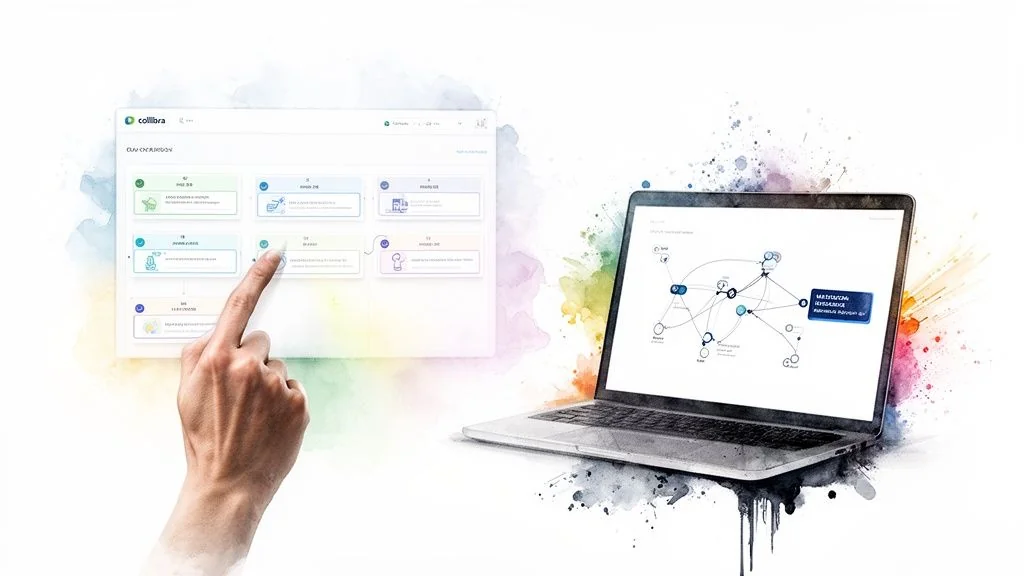
- Invest in Tooling: Manually implementing DAMA principles at scale is not feasible. Metadata management and data cataloging tools like Collibra or Informatica are essential for automating policy enforcement, lineage tracking, and stewardship workflows.
For organizations needing specialized guidance, exploring data governance consulting services can accelerate the adoption of a DAMA-aligned framework.
2. COBIT (Control Objectives for Information and Related Technology)
Developed by ISACA, COBIT is a comprehensive IT governance and management framework that places a strong emphasis on risk, compliance, and control. While its scope is broader than data alone, COBIT is one of the most critical data governance framework examples for organizations where data governance must seamlessly integrate with overall IT governance. It provides a structured approach to aligning data-related activities with business objectives and regulatory demands.
This framework is indispensable in sectors with strict oversight. For instance, banks use COBIT to build auditable data controls for regulations like SOX and Basel III, ensuring data processes are transparent and defensible. Similarly, healthcare providers leverage COBIT’s control objectives to manage HIPAA compliance, creating a clear line of sight from high-level policy down to specific security configurations on platforms like AWS or Azure. This top-down control is essential for managing today’s complex cloud data security challenges.
Strategic Breakdown & Analysis
COBIT’s primary strength is its focus on control and auditability. It translates high-level governance principles into specific, measurable control objectives, making it a favorite among internal audit, risk, and compliance teams. Its process-oriented model provides a clear, logical structure for managing and securing data assets.
- When to Use It: Essential for publicly traded companies, government agencies, and organizations in heavily regulated industries (finance, healthcare, insurance) that need to demonstrate compliance to external auditors. It’s also perfect for enterprises looking to unify data governance within a larger IT governance structure.
- Why It Works: COBIT provides a repeatable, auditable model that links business goals directly to IT processes and data controls. This direct linkage ensures that data governance initiatives are not just technical exercises but are demonstrably supporting risk mitigation and business strategy.
Key Insight: COBIT is not just about rules; it’s a framework for value creation and risk optimization. Use it to build a defensible governance program that auditors will understand and that business leaders can trust to protect enterprise assets.
Actionable Takeaways & Implementation Tips
Implementing COBIT requires a close partnership between IT, data teams, and audit functions. Its structured nature lends itself well to methodical, metrics-driven rollouts.
- Adopt a Hybrid Approach: Use COBIT for the high-level governance, risk, and control structure, but leverage a framework like DAMA-DMBOK for the detailed, operational data management practices. This combination provides both top-down control and bottom-up operational excellence.
- Use Maturity Assessments: Leverage COBIT’s Process Capability Model (which uses a 0-5 scale) to benchmark your current data governance maturity. Set realistic targets for improvement over a 2-3 year roadmap to demonstrate progress to stakeholders.
- Map Controls to RFPs: When evaluating vendors or data platforms, map your COBIT control objectives directly to RFP questions. This forces potential partners to demonstrate how their technology (e.g., Databricks Unity Catalog permissions, Snowflake data masking) helps you meet specific compliance requirements.
- Automate and Monitor: Avoid manual evidence gathering for audits. Implement automated controls and monitoring using tools like Varonis or native cloud platform capabilities. This reduces operational overhead and provides continuous compliance validation.
3. FAIR (Findable, Accessible, Interoperable, and Reusable)
The FAIR principles are not a formal framework like DAMA, but rather a set of guiding tenets that have become a cornerstone of modern data governance framework examples. Originating from the research community to promote data sharing, FAIR focuses on maximizing the value of data by making it Findable, Accessible, Interoperable, and Reusable.
This model has been rapidly adopted in the enterprise, especially by analytics-heavy organizations and AI/ML teams. Tech giants like Spotify and Google implicitly use FAIR principles to power their data democratization efforts, enabling data scientists to quickly discover and leverage datasets for model training. Companies migrating to cloud platforms like Snowflake or Databricks apply FAIR to ensure their new data lakehouse doesn’t become a data swamp, using rich metadata to make assets easily discoverable and usable.
Strategic Breakdown & Analysis
FAIR’s strength lies in its simplicity and focus on outcomes rather than rigid processes. It shifts the governance conversation from “control and restriction” to “enablement and reuse,” which resonates strongly with data consumers like analysts and scientists.
- When to Use It: Ideal for organizations aiming to build a self-service analytics culture, accelerate AI/ML development, or manage large, federated data ecosystems. It is particularly effective for businesses whose primary competitive advantage comes from data-driven innovation.
- Why It Works: It directly addresses the most common friction point in data workflows: finding and understanding relevant, high-quality data. By prioritizing machine-readability and rich metadata, FAIR lays the groundwork for automation and scale.
Key Insight: FAIR is a philosophy for data product management. It treats data as a reusable product, not a byproduct of a business process. This mindset shift is critical for driving adoption and realizing the full ROI of a modern data stack.
Actionable Takeaways & Implementation Tips
Implementing FAIR is about embedding its principles into your data lifecycle and tooling. The goal is to make good data practices the path of least resistance.
- Focus on Metadata First: FAIR lives and dies by metadata. Implement automated metadata extraction and cataloging using platform-native tools like Snowflake’s tag propagation or Databricks’ Unity Catalog. This makes data Findable.
- Define Clear Access Protocols: “Accessible” doesn’t mean open to everyone. It means having clear, documented, and preferably automated processes for gaining access. Use role-based access controls (RBAC) in your data platform to manage permissions efficiently.
- Standardize with a Semantic Layer: To achieve Interoperability and Reusability, use a semantic layer tool like dbt or Looker. This creates standardized business logic and definitions, ensuring metrics are calculated consistently across all tools and teams.
- Measure Enablement, Not Just Compliance: Shift success metrics away from simple policy adherence. Track metrics like “time to insight” or “self-service adoption rates” to measure how effectively FAIR principles are enabling your organization to use data.
4. NIST Data Governance Framework
The NIST Data Governance Framework, from the U.S. National Institute of Standards and Technology, offers a flexible, principles-based model focused on security and continuous improvement. Unlike heavyweight commercial data governance framework examples, NIST provides a government-endorsed, lightweight approach that prioritizes risk management and alignment with cybersecurity best practices. It’s built for adaptability rather than strict prescription.
This framework is the standard for U.S. federal agencies and is heavily adopted by defense contractors and critical infrastructure operators (energy, utilities) that must align their data handling practices with national security standards. For these organizations, NIST provides a clear, auditable path to demonstrate compliance and responsible data stewardship.
Strategic Breakdown & Analysis
NIST’s primary strength lies in its tight integration with broader security and risk management objectives, particularly its popular Cybersecurity Framework (CSF). It treats data governance not as an isolated discipline but as a critical component of an organization’s overall security posture.
- When to Use It: Essential for federal agencies, government contractors, and critical infrastructure sectors. It’s also ideal for any organization already using the NIST Cybersecurity Framework, as it allows for a unified approach to governance and security.
- Why It Works: Its flexibility and focus on continuous monitoring make it highly adaptable. Instead of dictating rigid rules, it provides a set of outcomes and controls that organizations can tailor to their specific risk profile, technology stack, and regulatory requirements.
Key Insight: The NIST framework excels at linking data governance directly to security controls and risk mitigation. Its value is in making governance a measurable and integral part of an organization’s security program, not just a data management exercise.
Actionable Takeaways & Implementation Tips
Implementing the NIST framework effectively means leveraging its connection to security and its cyclical nature.
- Align with Cybersecurity: If you already use the NIST Cybersecurity Framework, integrate your data governance initiative directly into that program. Map data governance roles and responsibilities to existing security functions to create synergy and avoid duplication.
- Use Control Mappings: Leverage NIST SP 800-53 control mappings when evaluating data platform vendors and tools. This ensures your technology choices (e.g., in Databricks or Snowflake) can meet specific security and privacy controls out of the box.
- Adopt Continuous Monitoring: Implement quarterly assessment cycles for your data governance program, mirroring the NIST model for continuous monitoring. This keeps the program dynamic and responsive to new threats and business needs.
- Layer for Comprehensiveness: Use NIST as your foundational layer for security and risk, but layer principles from a more comprehensive framework like DAMA-DMBOK for areas like data quality and metadata management. For a practical starting point, you can find a NIST-aligned data governance framework template to structure your documentation.
5. ISO/IEC 38505 (Corporate Governance of IT)
ISO/IEC 38505 extends the principles of corporate governance to IT, providing a top-down model that squarely places data governance responsibility on the board and executive leadership. Unlike more operationally focused data governance framework examples, this standard establishes a framework for directors to evaluate, direct, and monitor the organization’s use of data. It ensures data is treated as a strategic business asset, with accountability defined at the highest level.
This framework is critical for multinational organizations that must demonstrate uniform governance standards across different legal jurisdictions. A FTSE 100 or DAX-listed company, for example, uses ISO 38505 to align its subsidiaries on data handling principles, ensuring that board-level risk appetite is consistently applied. Technology vendors also pursue alignment with this standard to provide assurance to enterprise clients that their products support robust governance practices.
Strategic Breakdown & Analysis
ISO/IEC 38505’s primary strength is its strategic, board-level focus. It shifts the conversation from technical data management to strategic asset oversight, integrating data governance directly into corporate risk management. The framework is built on six key principles: Responsibility, Strategy, Acquisition, Performance, Conformance, and Human Behavior.
- When to Use It: Essential for large, publicly traded, or multinational corporations where board-level oversight is mandatory. It is also ideal for organizations seeking to align their IT governance with broader ISO certification efforts.
- Why It Works: It creates unambiguous accountability at the C-suite and board level, which is crucial for securing the resources, authority, and long-term commitment for a data governance program to succeed. This top-down mandate ensures governance is not just an IT initiative but a core business function.
Key Insight: ISO/IEC 38505 is not a substitute for an operational framework like DAMA-DMBOK; it’s a strategic overlay. It provides the “why” and “who” from the boardroom, while other frameworks provide the “how” and “what” for the operational teams.
Actionable Takeaways & Implementation Tips
Implementing ISO/IEC 38505 means embedding data governance into the fabric of corporate leadership and decision-making.
- Draft a Board-Level Charter: Begin by creating a formal Data Governance Charter based on ISO 38505’s six principles. This document should be reviewed and approved by the board to signal its commitment.
- Establish Top-Down Accountability: Form a Data Governance Steering Committee that reports directly to a C-suite executive or a board subcommittee. Define and publish clear roles for data-related decisions.
- Combine with Operational Frameworks: Use ISO 38505 to set the high-level governance direction and DAMA-DMBOK or a similar framework to guide the day-to-day operational execution. This complementary approach ensures both strategic alignment and tactical effectiveness.
- Integrate into Vendor Management: Update your RFP and vendor assessment criteria to include questions about alignment with ISO 38505. This ensures that partners, especially those handling critical data on platforms like Snowflake or Azure, adhere to your governance standards.
6. Gartner’s Data Management and Analytics Framework
Gartner’s Data Management and Analytics (DMA) framework is less a standalone methodology and more a proprietary diagnostic and benchmarking tool. Synthesized from Gartner’s analysis of thousands of organizations, this model provides a practical 0-5 scale for assessing an organization’s capabilities across governance, quality, architecture, and analytics. This makes it one of the most respected data governance framework examples for strategic planning.
This framework is frequently used by CIOs and CDOs to create data strategy roadmaps and justify investments. A global retail company might use a Gartner maturity assessment to benchmark its data literacy program against industry peers, securing executive buy-in for new training initiatives. Similarly, a fast-growing tech firm can use the framework to evaluate its readiness for advanced AI/ML, identifying gaps in its data pipeline and governance controls before committing to expensive platform builds.
Strategic Breakdown & Analysis
The primary strength of Gartner’s DMA framework is its external validation and peer-based context. It moves the conversation from internal opinion to objective, industry-vetted benchmarks, which is invaluable for securing C-suite support and budget. Its focus on maturity levels helps create a clear, phased roadmap for improvement.
- When to Use It: Ideal for organizations needing to build a business case for a data governance program, benchmark their capabilities against competitors, or evaluate technology vendors. It’s particularly useful for procurement and vendor management teams crafting RFPs.
- Why It Works: It provides an independent, authoritative perspective that resonates with executive leadership. The maturity model simplifies a complex domain into an understandable journey, making it easier to communicate progress and set realistic, incremental goals.
Key Insight: Gartner’s framework is a “what” and “why” tool, not a “how” manual. It excels at telling you where you are and where you should go next, but should be paired with a more prescriptive framework like DAMA-DMBOK or DCAM for detailed implementation guidance.
Actionable Takeaways & Implementation Tips
Using Gartner’s insights effectively requires integrating them into your strategic planning and procurement processes. The goal is to translate their high-level assessments into tangible actions.
- Conduct a Baseline Assessment: Use Gartner’s maturity model as a self-assessment tool to establish your current state. Be honest about capabilities across governance, quality, and analytics to create an accurate baseline.
- Justify Investment with Data: Reference Gartner’s peer benchmarking data in executive presentations. Showing how your organization lags behind competitors in critical data capabilities is a powerful motivator for securing governance funding.
- Inform Your Tech Stack Selection: Leverage Gartner’s Magic Quadrant reports, which are built on their framework’s principles, to shortlist and select governance technology. This helps ensure tools like Collibra, Alation, or Informatica align with your maturity goals.
- Embed in RFPs: When sourcing data engineering partners or consultants, include Gartner maturity level expectations as a requirement in your RFP. For example, specify that any proposed solution must help elevate your data quality maturity from Level 2 to Level 3.
7. Collibra’s Intelligent Data Governance Platform Framework
Collibra’s approach represents a pivotal shift from theoretical guides to technology-driven execution, making it one of the most practical data governance framework examples available. Rather than a standalone paper framework, it operationalizes governance principles through an intelligent software platform. This model embeds data stewardship, policy enforcement, and metadata management directly into the workflows where data is created, managed, and consumed.
This platform-centric framework is dominant in large enterprises governing complex, modern data stacks. For instance, major tech companies like Spotify and Airbnb leverage Collibra to enable data democratization at scale, providing a trusted, single source of truth for analysts using platforms like Snowflake and Databricks. Similarly, global financial services firms use its automated lineage and workflow capabilities to prove regulatory compliance for critical data elements.
Strategic Breakdown & Analysis
Collibra’s core strength is its ability to translate abstract governance policies into concrete, automated actions within a unified platform. It bridges the gap between the business (defining rules and data meaning) and IT (implementing those rules), making governance an active, ongoing process rather than a static document.
- When to Use It: Ideal for organizations that have defined their governance principles (often based on a framework like DAMA) and now need to operationalize them at scale. It is essential for companies with modern, cloud-based data ecosystems (Snowflake, Databricks, GCP) that require active metadata management and automation.
- Why It Works: It replaces manual, email-driven governance processes with automated workflows for everything from data access requests to business glossary updates. Its strong integration capabilities pull technical metadata directly from source systems, reducing manual effort and ensuring the data catalog remains current and trustworthy.
Key Insight: Collibra’s framework is an operating model, not just a tool. Success depends on treating its implementation as a business transformation initiative focused on changing how people interact with data, not just as a software deployment.
Actionable Takeaways & Implementation Tips
Implementing Collibra requires a strategic rollout focused on delivering business value quickly. Avoid a “big bang” approach that tries to govern everything at once.
- Target High-Value Domains: Start with a focused pilot on one or two critical data domains, such as Customer Data or Financial Reporting. Demonstrate clear ROI here before expanding enterprise-wide.
- Automate Metadata Ingestion: Leverage Collibra’s native connectors for Snowflake, Databricks, and other key platforms from day one. This automates technical lineage and metadata harvesting, providing immediate value and reducing the burden on data stewards.
- Define Workflows First: Before implementation, map out your key governance workflows (e.g., new report certification, data quality issue resolution). Configure these in Collibra to streamline approvals and drastically reduce the cycle time of manual processes.
- Budget Realistically: A successful implementation is a significant investment. Plan for a 6-12 month initial deployment. First-year costs for the platform, services, and training often fall in the $500K-$1.5M range for enterprise-level projects.
8. Everest Group’s Data Governance Maturity Model
Everest Group’s Data Governance Maturity Model is a business-centric framework focused on assessing organizational capability rather than dictating implementation steps. Developed from research across hundreds of global organizations, it evaluates governance programs across five maturity levels, linking them directly to outcomes like risk mitigation, operational efficiency, and tangible business value.
This model is a powerful tool for procurement teams and executives evaluating data engineering consultancies or benchmarking their internal programs. A financial services firm, for example, might use the Everest model to create a multi-year governance roadmap and justify investment to the board. Likewise, data engineering service providers often align their offerings to Everest’s criteria to demonstrate their governance expertise to prospective clients.
Strategic Breakdown & Analysis
The primary strength of this model is its external, objective perspective, making it one of the most practical data governance framework examples for vendor selection and investment justification. It shifts the conversation from technical implementation details to measurable business impact and maturity, which resonates with executive leadership.
- When to Use It: Essential for procurement and vendor management teams running RFPs for data engineering services. It’s also ideal for CIOs and CDOs looking to benchmark their governance initiatives against industry peers or justify budget requests.
- Why It Works: It provides a common, third-party language for evaluating capabilities. This avoids subjective assessments and allows for a more “apples-to-apples” comparison of service providers or internal team progress year-over-year.
Key Insight: Everest Group’s model is not a “how-to” guide for implementation like DAMA-DMBOK; it’s an assessment and benchmarking tool. Its power lies in helping you ask the right questions and measure what matters, particularly when evaluating external partners.
Actionable Takeaways & Implementation Tips
Leverage the Everest model to drive accountability and make smarter investment decisions, both internally and with third-party vendors.
- Embed in RFPs: Incorporate questions based on Everest’s maturity levels directly into your Request for Proposals (RFPs). Ask vendors to describe how their past projects align with Level 3 (Managed) or Level 4 (Optimized) governance outcomes.
- Justify Investment: Use Everest’s benchmarking data in board presentations. Showing how your current maturity level compares to industry leaders and quantifying the ROI of moving to the next level is a powerful way to secure funding.
- Combine with DAMA: Use Everest for the “what” and “why” (assessment, benchmarking, ROI) and a framework like DAMA-DMBOK for the “how” (implementation methodology). This creates a comprehensive approach covering strategy and execution.
- Annual Assessment Cadence: Conduct an annual maturity assessment aligned with your strategic planning cycle. This ensures your governance program evolves in lockstep with business priorities and demonstrates continuous improvement over time.
8 Data Governance Frameworks Compared
| Framework | Implementation complexity | Resource requirements | Expected outcomes | Ideal use cases | Key advantages | Typical cost/time |
|---|---|---|---|---|---|---|
| DAMA‑DMBOK (Data Management Body of Knowledge) | High — comprehensive, steep learning curve | Large cross-functional teams, metadata tools, training, governance council | Holistic data governance, improved data quality, clear roles and processes | Large enterprises, multi‑platform modernization (Snowflake, Databricks) | Industry standard coverage across full data lifecycle; clear role definitions | $500K–$2M+; 12–24 months typical |
| COBIT (Control Objectives for IT) | High — control‑focused and detailed | Audit/compliance teams, monitoring tools, governance processes, training | Strong controls, reduced audit findings, regulatory alignment | Regulated industries (banking, healthcare), vendor/procurement assessments | Strong risk/compliance emphasis and alignment with internal audit | Implementation services $300K–$1.5M; training $3K–$8K/person |
| FAIR (Findable, Accessible, Interoperable, Reusable) | Low–Medium — lightweight, principle‑based | Metadata/catalog tools, automation, technical stewards, semantic layers | Improved discoverability, interoperability, faster analytics and reuse | Cloud‑native analytics, AI/ML teams, Snowflake/Databricks migrations | Modern stack alignment enabling self‑service and faster time‑to‑insight | Tooling $30K–$200K/yr; initial consulting $50K–$150K; months to realize benefits |
| NIST Data Governance Framework | Medium — principles‑based and flexible | Internal resources, alignment with NIST cybersecurity, continuous monitoring | Improved security/compliance posture, continuous improvement cycles | Federal agencies, government contractors, critical infrastructure | Government‑endorsed, aligns with NIST Cybersecurity Framework | $50K–$200K; iterative implementation with lower upfront cost |
| ISO/IEC 38505 (Corporate Governance of IT) | High — executive/board level engagement required | Executive sponsorship, auditing, consulting, policy documentation | Board‑level accountability, cross‑border governance alignment, stakeholder confidence | Multinationals, organizations seeking ISO certification and investor assurance | International standard facilitating multi‑jurisdictional credibility | Certification $150K–$400K; implementation 18–36 months |
| Gartner Data Management & Analytics (DMA) | Low–Medium — assessment focused, proprietary | Gartner subscription/advisory, assessment services for validation | Maturity benchmarking, peer comparisons, prioritized investment roadmap | CIOs/CDOs, procurement, vendor evaluation and benchmarking | Empirical benchmarking and clear capability statements for decision‑making | Subscription $15K–$100K; assessments $50K–$200K |
| Collibra Intelligent Data Governance Platform | Medium–High — platform deployment and change mgmt | Platform licenses, implementation services, integrations, training | Operationalized governance: lineage, metadata, automated workflows | Enterprises needing tool‑driven governance on Snowflake/Databricks | Workflow automation, native cloud integrations, automated lineage | Licensing $150K–$500K+/yr; 6–12 month rollout; first‑year $500K–$1.5M |
| Everest Group Data Governance Maturity Model | Low–Medium — outcomes‑focused maturity assessment | Research subscription, assessment services, benchmarking data | Business‑aligned governance roadmap, vendor capability benchmarking | Procurement teams, vendor assessments, ROI‑driven governance programs | Outcomes and vendor benchmarking tailored to procurement needs | Subscriptions $10K–$50K; assessments $25K–$100K |
From Framework to Action: Your Next Strategic Move in Data Governance
The analysis of these data governance framework examples reveals a critical truth: a framework is a strategic blueprint, not a rigid prescription. The goal is not to find a single, perfect model to copy and paste. Instead, the most successful implementations are acts of strategic synthesis, borrowing principles from multiple sources to create a bespoke solution that aligns with specific business objectives, regulatory pressures, and your unique data culture.
We’ve seen how foundational frameworks like DAMA-DMBOK provide the architectural vocabulary, while compliance-oriented models like COBIT and NIST offer the necessary guardrails for risk mitigation. Simultaneously, modern principles from FAIR inject the flexibility needed to prevent governance from becoming a bureaucratic bottleneck. The goal is not theoretical perfection but a practical, living system that evolves with your organization.
Key Strategic Takeaways: From Theory to Reality
Your primary takeaway should be to shift from a “which one?” mindset to a “what combination?” approach. A financial services firm might anchor its strategy in COBIT’s control objectives for auditability while integrating DAMA’s knowledge areas for data stewardship and quality. A research-driven biotech might prioritize FAIR principles to maximize data interoperability, using a lightweight version of the NIST framework to ensure security and privacy.
The most pragmatic path forward involves a targeted, value-driven implementation. Avoid the “big bang” approach, which often overwhelms stakeholders and stalls momentum. Instead, identify a high-impact, low-complexity data domain to serve as your pilot project.
Strategic Insight: Your initial governance project should be a “quick win” that directly supports a major business initiative. For example, if your company is launching a new AI-powered recommendation engine, focus your initial governance efforts on the customer data domain that feeds it. Demonstrating a tangible ROI, such as improved model accuracy or reduced data prep time, will build the political capital needed for broader adoption.
Your Actionable Roadmap for Implementation
Translating these concepts into action requires a clear, phased plan. The following steps provide a practical starting point for any organization, regardless of its current maturity level.
- Conduct a Maturity Assessment: Before selecting a framework, understand your starting point. Use a simple maturity model, like one from Gartner or Everest Group, to benchmark your current capabilities across key domains like data quality, stewardship, policy enforcement, and tooling. This baseline is essential for setting realistic goals.
- Define Business-Centric Objectives: Do not define governance goals in technical terms. Instead of “implement a data catalog,” aim for “reduce the time for marketing analytics report generation by 30%.” This connects the governance initiative directly to business value and secures executive sponsorship.
- Create a Hybrid “Starter Kit”: Select components from the data governance framework examples we’ve explored.
- Structure: Borrow the core data domains (e.g., Data Quality, Metadata Management) from DAMA.
- Controls: Adapt key control objectives from COBIT or NIST relevant to your industry’s compliance needs (e.g., GDPR, CCPA).
- Roles: Define a simple RACI (Responsible, Accountable, Consulted, Informed) matrix for a single data domain, clearly outlining the responsibilities of Data Owners, Stewards, and Custodians.
- Pilot, Measure, and Iterate: Launch your pilot program in the chosen high-value domain. Track key performance indicators (KPIs) tied to your business-centric objectives. Gather feedback from stakeholders and use it to refine your framework before expanding to other areas of the business.
Ultimately, mastering these frameworks is about transforming data from a passive, siloed liability into an active, enterprise-wide strategic asset. A well-executed governance program is the essential foundation for every modern data initiative, from advanced analytics and AI/ML to ensuring regulatory compliance and building customer trust.
Ready to move from planning to execution? Finding the right implementation partner is crucial for translating framework theory into tangible business results. The vetted rankings and in-depth profiles on DataEngineeringCompanies.com are designed to help you identify consultancies with proven expertise in deploying governance frameworks on modern platforms like Snowflake and Databricks. Visit DataEngineeringCompanies.com to compare top firms and access resources that will streamline your partner selection process.
Data-driven market researcher with 20+ years in market research and 10+ years helping software agencies and IT organizations make evidence-based decisions. Former market research analyst at Aviva Investors and Credit Suisse.
Previously: Aviva Investors · Credit Suisse · Brainhub · 100Signals
Top Data Engineering Partners
Vetted experts who can help you implement what you just read.
Related Analysis
A Practical Guide to Data Management Services
A practical guide to selecting the right data management service. Compare models, understand pricing, and learn key implementation steps to drive ROI.
A Practical Guide to Hiring Data Governance Consultants
Hiring data governance consultants? This guide unpacks their roles, costs, and selection criteria to help you find the right partner for your modern data stack.
Data Governance vs. Data Management: A Practical Comparison
Understand the critical differences in the data governance vs data management debate. Learn how to align strategy and operations for a modern data platform.