7 Practical Resources for Finding the Best Data Engineering Companies in 2026
Choosing a data engineering partner is a high-stakes technical decision, not a marketing one. With budgets under scrutiny and pressure to deliver ROI from platforms like Snowflake, Databricks, and Microsoft Fabric, a poor vendor choice leads to cost overruns, project delays, and failed initiatives. The market is saturated with consultancies, making it difficult to separate qualified experts from firms with slick sales pitches but shallow technical depth.
This guide cuts through the noise. It provides a practical, analytical breakdown of the seven best directories and official partner ecosystems for finding and vetting top-tier data engineering companies in 2026. This is not a generic list; it’s a tactical blueprint for building a qualified shortlist efficiently. This is your starting point for a data-driven vendor selection process.
Inside, you will find a detailed look at the strengths, weaknesses, and ideal use cases for each resource, from independent directories like DataEngineeringCompanies.com to B2B marketplaces like Clutch and the official partner portals for major cloud data platforms. Each entry includes screenshots, direct links, and actionable insights to help you identify which platforms are best suited for your specific needs, whether you’re a CTO planning a large-scale cloud migration or a Head of Analytics seeking a specialist for an AI/ML pipeline project. Our goal is to equip you with the tools to make a smarter, more informed decision, minimizing risk and maximizing the return on your data investment.
1. DataEngineeringCompanies.com
DataEngineeringCompanies.com earns its top spot by providing a purpose-built platform for evaluating data engineering consultancies. In a crowded and often opaque market, this independent directory serves as a critical resource for leaders tasked with selecting the right partner. It moves beyond generic IT vendor lists by focusing exclusively on the data engineering niche, offering a depth of information tailored to a complex procurement process.
The platform is designed to streamline the Request for Proposal (RFP) process for technical leaders. Instead of starting from scratch, users gain access to pre-vetted, detailed profiles of over 86 leading firms. This allows for a more efficient and data-driven approach to finding the best data engineering companies for specific technical and business requirements.
Directory Insight: Our analysis of 86 verified data engineering firms reveals that hourly rates range from $45 to $250/hr (median $100/hr), with 41% of firms pricing under $100/hr — making specialized expertise more accessible than many buyers expect. Platform coverage is broad: 88% offer AWS services, 81% Azure, 77% Snowflake, and 74% Databricks. Notably, 65% of firms rate “Expert” in data modernization, but only 38% achieve “Expert” in AI/ML enablement — a critical distinction when shortlisting for advanced use cases.
Key Features and Buyer Tools
The site’s primary value lies in its actionable, buyer-centric tools. The interface is clean and functional, prioritizing efficient information discovery over marketing fluff.
- Curated Shortlists: Users can filter vendors by critical criteria, including budget tiers, platform specializations (e.g., Snowflake, Databricks), and industry focus (e.g., Healthcare, FinTech). This immediately narrows the field to relevant candidates.
- Transparent Data Points: Each firm profile includes verified rate bands, minimum project sizes, team sizes, and official platform certifications. This transparency is a significant departure from the typical sales-gated information common in the consulting world.
- RFP Toolkit: The platform provides a suite of practical resources, including a cost calculator to estimate project expenses, a direct Snowflake vs. Databricks comparison guide, and a comprehensive RFP checklist.
- Data-Driven Rankings: The site publishes its ranking methodology, which incorporates factors like verified client reviews, technical certifications, and market leadership. Profiles are updated regularly to ensure data remains current.
How to Use It Effectively
To maximize the platform’s utility, start with the 60-second matching quiz to generate an initial shortlist based on high-level project requirements. From there, dive into the detailed profiles of the matched firms, paying close attention to their minimum project size and platform certifications to ensure alignment. Before initiating outreach, use the provided cost calculator to set a realistic budget baseline.
For a deeper understanding of the partner selection process itself, the site offers a detailed guide on choosing a data engineering partner, which complements the tools available on the platform.
Platform Access and Pricing
Access to all profiles, rankings, and buyer tools on DataEngineeringCompanies.com is completely free for users. The platform operates as an independent resource, making it an accessible first step for any organization beginning its vendor search.
Pros & Cons Summary
| Pros | Cons |
|---|---|
| Highly Niche-Specific: Focuses solely on data engineering. | Curated, Not Exhaustive: Doesn’t list every firm. |
| Actionable Buyer Tools: RFP checklist and cost calculator. | Omits Smaller Firms: Focus on top performers may exclude viable new entrants. |
| Transparent Data: Clear rate bands and project minimums. | |
| Independent & Free: No cost to access the full platform. |
Visit DataEngineeringCompanies.com
2. Clutch – BI & Big Data Consulting Directories
Clutch is an established B2B marketplace that offers extensive directories for technology services, including a broad category for “BI & Big Data Consulting.” While not exclusively focused on data engineering, its sheer volume of company profiles and verified client reviews makes it a useful resource for initial research, especially for buyers prioritizing geographic proximity or seeking a wide array of potential partners. It serves as a generalist’s starting point for mapping out the vendor landscape.
The platform’s strength lies in its review-centric model, where detailed, analyst-verified client feedback provides qualitative insights into a firm’s project management, technical skill, and client communication. This allows leaders to move beyond marketing materials and assess a company’s proven track record, making it a useful tool for narrowing down a long list of potential providers.
Key Features and Buyer Tools
Clutch provides a robust set of filters and data points designed to help buyers compare and contrast a large volume of service providers quickly. The interface is built around search and discovery.
- Verified Client Reviews: Each profile features in-depth reviews collected through analyst interviews, complete with project summaries, cost ranges, and satisfaction scores.
- Geographic Filtering: Buyers can easily find onshore or nearshore partners by filtering for firms in specific countries, states, or major metropolitan areas.
- Detailed Search Filters: Users can refine their search by hourly rate, minimum project size, team size, and industry focus (e.g., Financial Services, E-commerce).
- Company Comparison: The platform allows for side-by-side comparisons of shortlisted firms, making it easier to evaluate key data points like client focus, review scores, and service lines.
How to Use It Effectively
Start by using the geographic and budget filters to create an initial, broad list of candidates. Since the “BI & Big Data” category is not specific to data engineering, carefully read the service line descriptions and client reviews to identify firms with core expertise in data pipelines, warehousing, and platform modernization. Pay close attention to the project descriptions in reviews to find examples that align with your specific technical needs.
Once you have a shortlist, use the information gathered as a preliminary step before a more formal evaluation. This data can be a valuable input for your vendor selection process, which can be further structured with resources like a dedicated data engineering RFP checklist.
Platform Access and Pricing
Using Clutch to search, filter, and read reviews is completely free for buyers. Service providers can claim a basic free profile, but the platform also offers paid sponsorship options that increase a firm’s visibility within the directory listings, which is a factor for buyers to consider during evaluation.
Pros & Cons Summary
| Pros | Cons |
|---|---|
| Very Broad Coverage: Extensive list of firms across the US. | Category is Too Broad: Not exclusively data engineering. |
| Deep Review Volume: Verified, detailed client feedback. | Pay-to-Feature Influence: Vendor prominence can be affected by sponsorships. |
| Useful Geographic Filters: Ideal for finding local or onshore teams. | Lacks Niche Tools: Missing data-specific tools like cost calculators. |
| Fast Profile Comparisons: Easy to shortlist firms side-by-side. |
Visit Clutch.co
3. GoodFirms – Data Engineering
GoodFirms is a broad B2B review and research platform, but its dedicated category for Data Engineering carves out a valuable niche for technical leaders. While not as hyper-focused as a purpose-built directory, its extensive database and established review collection process provide a powerful tool for initial vendor discovery and market research. It acts as a wide-net search engine, helping buyers identify a diverse range of potential partners across the globe.
The platform is particularly useful for organizations looking to cast a wide net or benchmark costs against a global standard. It aggregates hundreds of firms, from large-scale consultancies to smaller, specialized boutiques, offering a different lens for finding the best data engineering companies compared to more curated lists.
Key Features and Buyer Tools
GoodFirms excels at providing high-level data points that facilitate early-stage vendor shortlisting and budget validation. Its strength lies in the breadth of its listings and the transparency of its user-generated reviews.
- Dedicated Category: The “Data Engineering” filter is crucial, as it cuts through the noise of general “Big Data” or “BI” consultants to isolate firms with core data pipeline and platform expertise.
- Budget Benchmarking Filters: Users can filter potential partners by hourly rate bands (e.g., <$25/hr, $50 - $99/hr). This feature is invaluable for quickly aligning with budget constraints before engaging in deeper conversations.
- Verified Client Reviews: The platform puts a strong emphasis on verified reviews, offering candid insights into a firm’s project management, technical skill, and client communication.
- Leaders Matrix: GoodFirms uses a proprietary ranking methodology, the Leaders Matrix, which plots companies based on their ability to deliver and their market presence, providing a visual guide to top performers.
How to Use It Effectively
Start by applying the “Data Engineering” service filter immediately to narrow the search. Next, use the hourly rate and location filters to create an initial list that meets your geographic and budget requirements. Scrutinize the verified reviews, paying close attention to comments related to Snowflake, Databricks, or other platforms relevant to your tech stack. As many firms are global, it’s critical to validate their US presence and familiarity with any industry-specific compliance standards (like HIPAA or SOC 2) if required for your project.
Platform Access and Pricing
Access to browse company profiles, read reviews, and use the filtering tools on GoodFirms is completely free for buyers. The platform generates revenue from vendors who purchase premium profile features, but the core search and discovery functionality remains open.
Pros & Cons Summary
| Pros | Cons |
|---|---|
| Focused Category: Helps isolate true data engineering firms. | Global Scope: Requires extra vetting for US-specific needs. |
| Budget Signals: Hourly rates are useful for early benchmarking. | Profile Validation: Some data may need confirmation of US presence. |
| Broad Firm Selection: Mix of boutiques and mid-market players. | |
| Verified Reviews: Provides authentic client feedback. |
Visit GoodFirms – Data Engineering
4. Databricks Consulting Partners (Find Partners)
For organizations committed to the Databricks Lakehouse Platform, the official Databricks Consulting Partner directory is the most direct route to finding a qualified implementation partner. This resource shifts the focus from a broad market overview to a curated ecosystem of firms with proven expertise specifically within the Databricks environment. It serves as an essential validation tool for leaders who have already selected their core technology and now need a partner with deep, platform-specific experience.
The directory is built to give technology leaders confidence that they are engaging with firms that are not just familiar with Databricks but are actively certified and recognized by the platform creator. This makes it a critical checkpoint for anyone looking to de-risk a complex data engineering or AI implementation on the Lakehouse, ensuring the selected vendor is among the best data engineering companies for that specific stack.
Key Features and Buyer Tools
The value of the Databricks directory lies in its official badging and specialization signals, which help buyers differentiate between generalists and true platform experts. The interface is straightforward, designed to connect users with qualified partners quickly.
- Partner Specializations: Firms are searchable and categorized by key competencies like Data Engineering, Machine Learning & AI, Data Governance, and Migration. This allows for targeted searches based on project scope.
- Official Badges and Tiers: Partners are designated with tiers (e.g., Global, National) and showcase specific capability badges, such as the “Mosaic AI Delivery Provider” badge. These act as verifiable signals of a firm’s investment and success on the platform.
- Ecosystem Focus: The listings are not limited to consultancies; they also include technology and cloud partners, providing a holistic view of the ecosystem needed to support a Databricks implementation.
- Partner Connect Integration: For certain partners, the Partner Connect feature within the Databricks UI allows users to initiate trials and integrations directly, streamlining the initial technical validation process.
How to Use It Effectively
Start by filtering for partners that hold specific badges relevant to your project, such as “Migration Delivery” if you are moving from a legacy system. Pay close attention to the partner’s tier and the number of certified individuals they list, as these are strong indicators of their commitment to the platform. It’s also important to understand how these specialized partners fit into the broader ecosystem, as many companies operate in multi-cloud environments. For a detailed analysis of this dynamic, you can explore the key differences between Databricks and Snowflake partners.
Platform Access and Pricing
The Databricks Consulting Partner directory is completely free to access and use. It is a public resource provided by Databricks to help its customers find and vet implementation partners, with no cost or registration required to browse the listings.
Pros & Cons Summary
| Pros | Cons |
|---|---|
| High Confidence: Partners have verified Databricks skills. | Ecosystem-Biased: Not a neutral, cross-platform directory. |
| Platform-Specific: Ideal when Databricks is a requirement. | Under-represents Other Specializations: May omit firms strong in Snowflake, GCP, or other stacks. |
| Clear Expertise Signals: Badges indicate deep platform capability. | Lacks Commercial Data: No rate bands or project minimums are listed. |
| Direct & Free Access: No barriers to browsing partners. |
Visit Databricks Consulting Partners
5. Snowflake Partner Directory (All Partners + Partner Connect)
For organizations standardizing on the Snowflake Data Cloud, the official Snowflake Partner Directory is the most direct route to finding a qualified implementation partner. Instead of a generalist marketplace, this resource is a curated ecosystem of firms that have invested deeply in the Snowflake platform. It serves as a crucial starting point for leaders seeking certified experts for platform modernization, governance, and data pipeline development.
The directory’s primary strength is its direct connection to the Snowflake ecosystem, providing a layer of trust and verified expertise. This makes it an indispensable tool for technical buyers who have already committed to Snowflake and need to find the best data engineering companies with proven track records on the platform.
Key Features and Buyer Tools
The directory is focused on connecting buyers with both services and technology partners, with features designed to validate expertise and simplify integration.
- Partner Tiers and Certifications: Partners are categorized by tiers (e.g., Elite, Premier) which signal their level of investment, customer success, and certified expertise within the Snowflake ecosystem. This provides a clear hierarchy of capability.
- Comprehensive Partner Profiles: Users can filter partners by services offered, industry specialization, and geographic location. Profiles often highlight specializations like data governance, application development, or AI/ML.
- In-Product Partner Connect: For select technology partners, Partner Connect allows users to discover, trial, and integrate tools directly from within the Snowflake UI. This significantly streamlines the proof-of-concept phase for new technologies.
- Training and Enablement Resources: The Snowflake Partner Network (SPN) offers robust training and learning portals (like SPN Learn), ensuring that listed partners have access to the latest product knowledge and best practices.
How to Use It Effectively
Start by filtering for “Services” partners in your target region and industry. Pay close attention to the partner’s tier and the number of certified individuals they employ as an initial quality signal. For a more focused search, use keywords related to your specific needs, such as “data governance” or “pipeline modernization.” Before engaging a partner, confirm their specific specializations and ask for case studies relevant to your use case. Use Partner Connect to trial any recommended technology solutions to ensure they meet your requirements.
Platform Access and Pricing
Access to the public Snowflake Partner Directory is completely free and does not require a login. However, accessing deeper resources like certain training materials or the in-product Partner Connect feature requires an active Snowflake account.
Pros & Cons Summary
| Pros | Cons |
|---|---|
| Fastest path to vetted Snowflake experts: Direct and official. | Platform-Specific: Only useful if you are committed to Snowflake. |
| Clear certification signals: Partner tiers indicate capability. | Less centralized UX: Can feel less intuitive than a B2B marketplace. |
| Partner Connect simplifies trials: In-product tool integration. | Some resources require login: Deeper content may be gated. |
| Tight integration with platform: Partners are highly enabled. |
Visit the Snowflake Partner Directory
6. Microsoft – Fabric / Data & AI Partners (Find a Partner)
For organizations deeply invested in the Microsoft ecosystem, the official Microsoft Partner Center is an indispensable resource for finding validated data engineering expertise. While it serves a broader audience, its utility for identifying the best data engineering companies is most potent for those building on Azure and Microsoft Fabric. It provides a layer of vendor-backed assurance that is crucial for enterprise-grade projects.
The platform functions as Microsoft’s global directory, allowing technical leaders to find and vet partners with specific, certified specializations. For data engineering, the key designation is the “Solutions Partner for Data & AI (Azure),” which acts as a reliable signal of a firm’s capability to deliver complex data solutions on the Microsoft cloud.
Key Features and Buyer Tools
The platform’s value comes from its direct integration with Microsoft’s own credentialing and partner programs, offering a high degree of trust and reliability.
- Solutions Partner Designations: The “Data & AI (Azure)” specialization is a primary filter. This badge requires partners to meet stringent performance, skilling, and customer success metrics, effectively de-risking the selection process.
- Microsoft Fabric Featured Offers: The directory highlights partners with specific, pre-packaged consulting offers for Microsoft Fabric. This helps buyers quickly identify firms with demonstrated experience in Microsoft’s unified data platform.
- Detailed Competency Filters: Users can narrow their search by industry (e.g., Financial Services, Healthcare), company size, and specific product expertise within the Azure data stack, such as Azure Synapse Analytics or Azure Data Factory.
- Global and Local Coverage: The tool provides comprehensive coverage for finding partners in specific geographic regions, which is essential for US enterprise buyers seeking local support or needing to meet specific compliance standards.
How to Use It Effectively
To get the most out of the partner finder, begin your search by filtering for the “Solutions Partner for Data & AI (Azure)” designation. From there, apply secondary filters for your specific industry and any critical compliance needs (e.g., HIPAA). Review the resulting partner profiles, paying close attention to their customer success stories and any featured Microsoft Fabric offers, as these are strong indicators of practical, hands-on experience.
Use the platform primarily for validation and initial shortlisting. Since it lacks transparent pricing or project minimums, you will need to engage with potential partners directly to gather that information for your RFP.
Platform Access and Pricing
Access to the Microsoft Partner Center and its search tools is completely free. It is designed as a public resource to connect customers with qualified partners within the Microsoft ecosystem.
Pros & Cons Summary
| Pros | Cons |
|---|---|
| Reliable Credentialing: Specializations de-risk partner selection. | Platform-Aligned: Under-represents non-Microsoft specialists. |
| Broad US Coverage: Strong in various industries and compliance areas. | Best for Microsoft Stacks: Less helpful for neutral, multi-cloud shortlists. |
| Featured Fabric Offers: Highlights partners with specific expertise. | Lacks Commercial Data: No rate bands or project minimums are listed. |
| Enterprise-Grade Validation: Ideal for Azure-centric organizations. |
Visit Microsoft Partner Finder
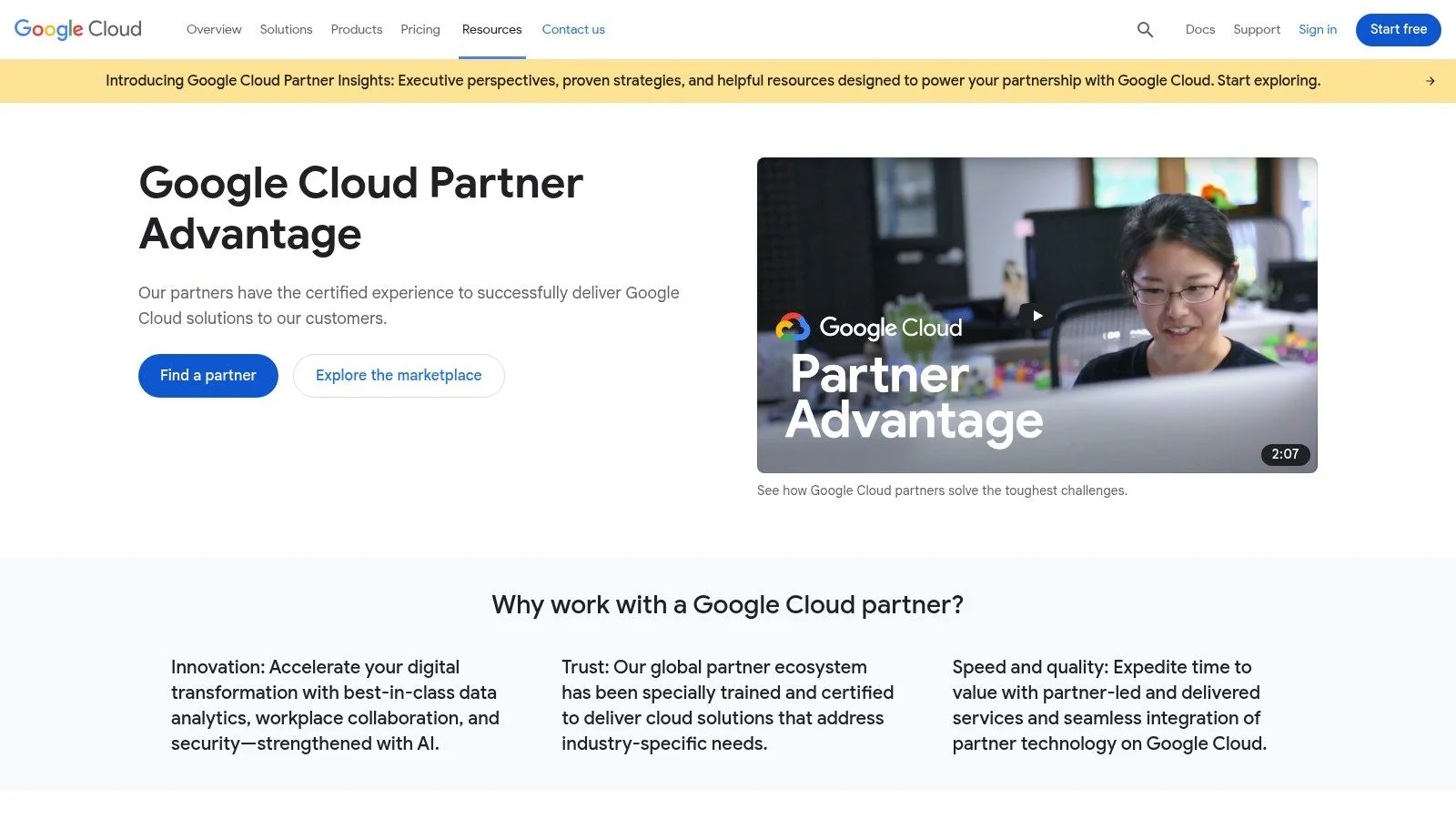
7. Google Cloud – Partner Advantage (Find Partners for Data Analytics)
For organizations committed to the Google Cloud ecosystem, the official Partner Advantage directory is an indispensable starting point for vendor selection. Instead of a general IT directory, this platform provides a curated list of partners validated by Google itself for technical competency and successful implementations. It’s designed for buyers who have already standardized on tools like BigQuery, Looker, and Vertex AI and need a partner with proven, in-depth expertise on that specific stack.
This directory helps leaders confidently find the best data engineering companies that are not just familiar with Google Cloud but have achieved specific, difficult-to-earn specializations. It provides a layer of assurance, as partners must meet rigorous requirements and demonstrate consistent customer success to earn these designations.
Key Features and Buyer Tools
The platform is less a comparison tool and more a verification and discovery engine. It prioritizes validating a partner’s official relationship and competency with Google Cloud over providing direct cost comparisons.
- Google Specializations: The core value lies in its filters for official specializations like “Data Analytics,” “Data Management,” and “Machine Learning.” These are not simple marketing badges; they represent a high bar for technical proficiency and validated customer solutions.
- Validated Solution Designations: Beyond specializations, partners can showcase specific, approved solutions, giving buyers insight into repeatable, successful service offerings.
- Marketplace Integration: The directory often ties into the Google Cloud Marketplace, which can streamline procurement for professional services and partner-delivered solutions.
- Global Partner Coverage: Users can filter partners by region, making it easy to find specialists that operate within a specific geography, whether in the US or globally.
How to Use It Effectively
Begin your search by filtering for the “Data Analytics” specialization, as this is the most relevant credential for data engineering work within the Google Cloud ecosystem. From that initial list, review individual partner profiles to see if they hold complementary specializations like “Machine Learning” or “Application Development,” which can indicate broader capabilities. Use the resulting shortlist as a verified pool of candidates to engage for more detailed proposals and pricing discussions.
Platform Access and Pricing
Access to the Google Cloud Partner Advantage directory is completely free. The platform serves as a lead generation and validation tool for Google and its partners. Note that all service pricing, project minimums, and rate information must be obtained directly from the partners themselves, as this data is not displayed in the directory.
Pros & Cons Summary
| Pros | Cons |
|---|---|
| Strong Competency Validation: Specializations verify depth. | Platform-Specific: Not useful for multi-cloud or agnostic buyers. |
| Ideal for BigQuery/Vertex AI: Finds experts in the GCP stack. | Opaque Pricing: No cost data; requires direct partner outreach. |
| Integrated with GCP Marketplace: Can streamline procurement. | Limited Comparison Tools: Focuses on validation, not side-by-side analysis. |
Visit Google Cloud Partner Advantage
Top 7 Data Engineering Directories Comparison
| Directory / Provider | Implementation complexity | Resource requirements | Expected outcomes | Ideal use cases | Key advantages |
|---|---|---|---|---|---|
| DataEngineeringCompanies.com | Low — research & RFP prep | Minimal — uses site tools and shortlisting | Vetted shortlist, cost estimates, RFP-ready materials | CIOs/CTOs running data-engineering RFPs; cross-platform partner selection | Specialized focus, practical buyer toolkit, transparent scoring |
| Clutch – BI & Big Data Consulting Directories | Low — browse & compare via reviews | Moderate — time to review profiles and contact vendors | Broad vendor shortlist with verified client reviews and pricing signals | Procuring many options, finding local/onshore teams, BI & analytics projects | Large review volume, strong geo and pricing filters |
| GoodFirms – Data Engineering | Low–Moderate — filter by category and reviews | Moderate — validate profiles for US/regulatory needs | Data-engineering focused shortlist and budget benchmarking | Identifying dedicated data-engineering specialists; cost benchmarking | Dedicated category, budget signals, mixed boutique/mid‑market coverage |
| Databricks Consulting Partners | Medium — platform-specific implementations | High — Databricks licenses and platform expertise required | Databricks-native implementations with certified partners | Organizations standardized on Databricks (Lakehouse, ML, migrations) | Platform certifications, Partner Connect, deep Databricks delivery signals |
| Snowflake Partner Directory | Medium — platform-centric projects | High — Snowflake licensing and certified partner engagement | Vetted Snowflake integrations, enablement and modernization support | Snowflake-first migrations, governance, pipeline modernization | Certification tiers, Partner Connect, training/enablement resources |
| Microsoft – Fabric / Data & AI Partners | Medium — enterprise-grade Azure/Fabric projects | High — Azure/Fabric licensing and compliance expertise | Enterprise-compliant Data & AI solutions on Microsoft stack | Azure/Fabric-first architectures, regulated industries, large enterprises | Strong credentialing, industry/compliance coverage, Fabric offers |
| Google Cloud – Partner Advantage | Medium — cloud-native BigQuery/ML implementations | High — Google Cloud resources and specialist partners | Validated BigQuery/Vertex AI solutions and integrations | BigQuery/Google Cloud standardization, ML/data analytics projects | Specialization badges, marketplace integrations, proven solution designs |
Your Next Move: How to Turn Your Shortlist into the Right Partner
You have navigated the complex landscape of directories and partner ecosystems, from the targeted filters of DataEngineeringCompanies.com to the platform-specific directories of Snowflake and Databricks. This article has provided a structured methodology for identifying potential partners, but the most critical phase is still ahead: transforming a list of names into a strategic partnership that delivers tangible business value. The goal is no longer discovery; it is validation.
The primary takeaway is that the “best” data engineering company is a subjective title. The right partner for a Fortune 500 financial institution migrating legacy systems to Microsoft Fabric will be vastly different from the ideal partner for a mid-market e-commerce startup building its first ML recommendation engine on Google Cloud. Your internal needs, technical roadmap, and budget constraints are the ultimate arbiters of quality.
From Longlist to Shortlist: A Practical Framework
Moving forward requires a shift from browsing to deep evaluation. Your next steps should be methodical, data-driven, and focused on de-risking your investment. Generic capabilities listed on a company profile are not enough; you need to dig deeper into the specifics of their delivery model, technical expertise, and project governance.
Here is a tactical checklist to guide your evaluation process:
- Define Your Non-Negotiables: Before you send the first email, document your core requirements. Is a specific industry certification (e.g., HIPAA for healthcare) mandatory? Do you require onshore-only talent for security reasons? Is experience with a niche technology like Fivetran or dbt a dealbreaker?
- Standardize Your Inquiry: Use a consistent Request for Information (RFI) or a detailed email template for your initial outreach. This ensures you can compare responses on an apples-to-apples basis. Leverage an RFP checklist to build your template, covering areas like team structure, project management methodology (Agile vs. Waterfall), and communication cadence.
- Scrutinize Case Studies: Look past the glowing testimonials. A relevant case study should detail the business problem, the technical solution implemented, the specific tools used, and, most importantly, the quantifiable business impact (e.g., “reduced data processing time by 40%,” or “increased data accuracy, leading to a 5% lift in marketing ROI”). If the metrics are vague, press for details during your calls.
Key Questions to Ask Potential Partners
When you start conversations, your questions should be designed to uncover their true operational DNA. Move beyond “Have you worked with Snowflake?” to more probing inquiries that reveal their depth of expertise and cultural fit.
- On Technical Depth: “Can you walk me through a complex data pipeline you built for a client with similar data volume and velocity challenges to ours? What were the key technical trade-offs you had to make and why?”
- On Project Management: “Describe your process for managing scope creep. Can you provide an example of a project where the requirements changed mid-stream and how your team adapted?”
- On Team Composition: “Who will be our day-to-day contact? What is the experience level of the specific engineers who will be assigned to our project, not just the senior architects we meet during the sales process?”
Pro-Tip: Ask for a “blind” reference. In addition to the curated list of happy clients they provide, ask if they can connect you with a client from a project that faced significant, unexpected challenges. How a partner navigates adversity is often more telling than a perfectly smooth engagement.
Choosing from the best data engineering companies is less about finding a flawless vendor and more about finding a resilient partner. The right firm will not only execute your current roadmap but will also act as a strategic advisor, helping you anticipate future challenges and capitalize on emerging data opportunities. Your methodical due diligence now will pay dividends for years to come, ensuring your data infrastructure becomes a true competitive advantage.
Ready to streamline your vendor selection process? The tools and calculators on DataEngineeringCompanies.com are designed to help you move from research to decision with confidence. Use our free RFP templates and cost comparison tools to build your business case and find the perfect partner for your next data project. DataEngineeringCompanies.com
Data-driven market researcher with 20+ years in market research and 10+ years helping software agencies and IT organizations make evidence-based decisions. Former market research analyst at Aviva Investors and Credit Suisse.
Previously: Aviva Investors · Credit Suisse · Brainhub · 100Signals
Top Data Engineering Partners
Vetted experts who can help you implement what you just read.