7 Top AI Automation Companies for 2026

You’re probably in one of two situations right now. Your team has an AI pilot that impressed stakeholders but stalled when it hit integration, governance, or change management. Or procurement is staring at a crowded field of AI automation companies that all promise transformation and none make vendor selection easier.
The wrong partner won’t just waste budget. It will leave you with brittle workflows, unclear ownership, and an automation stack your internal team can’t run confidently. That’s a serious risk when enterprise programs increasingly depend on strong data foundations, cloud architecture, and governance rather than demos alone.
This shortlist cuts through that noise. It focuses on seven firms that can support enterprise automation programs, while giving you a buyer framework grounded in delivery fit, operating model, and commercial reality. If you’re still building the internal business case, start with these strategies for AI adoption.
For engineering and architecture leaders, the true test isn’t who has the flashiest agent demo. It’s who can connect automation to production data systems, governance controls, and measurable operating outcomes.
1. Accenture
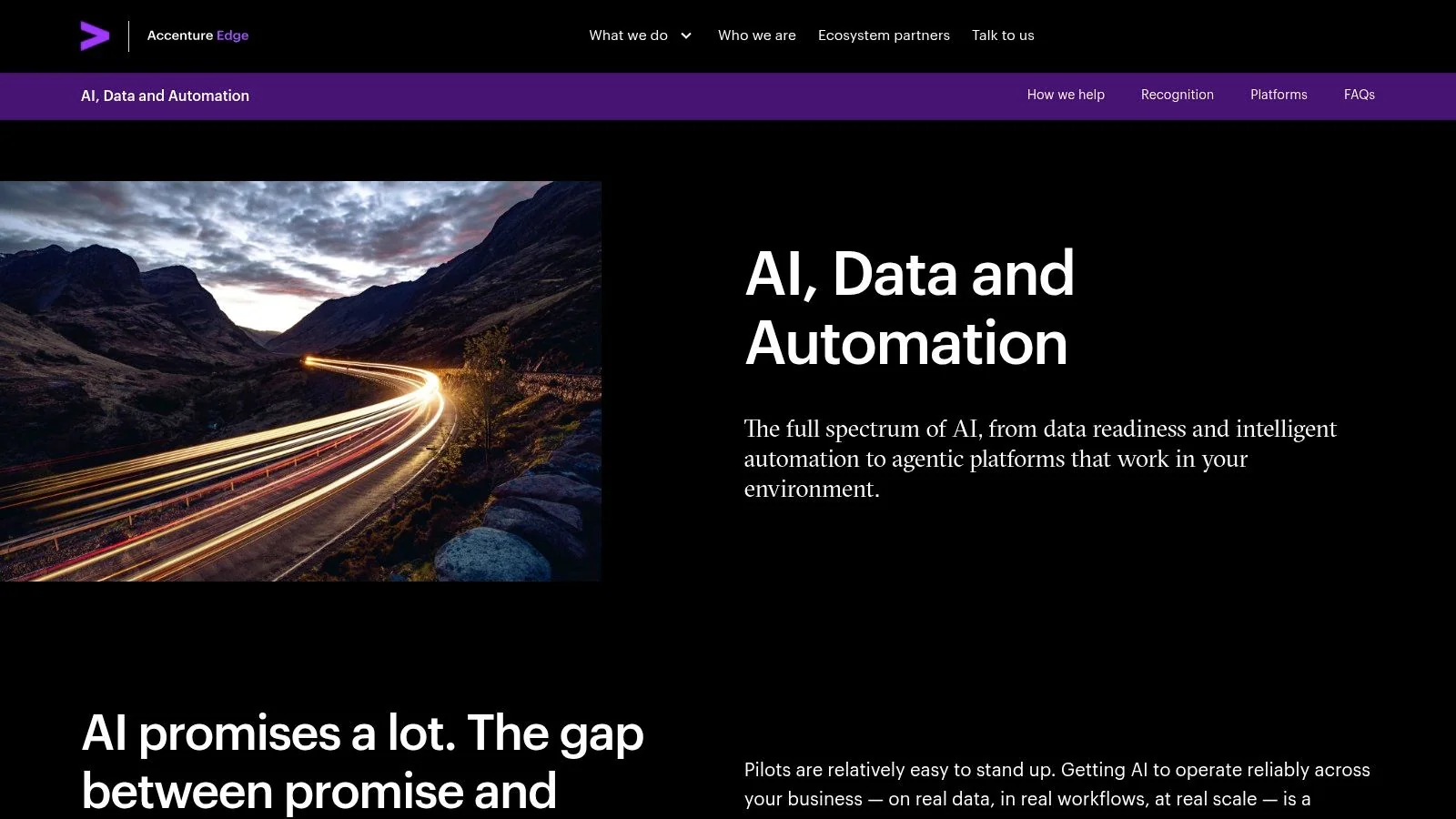
Accenture is the safest choice when the program is large, cross-functional, and politically complex. If you need one partner to cover strategy, cloud architecture, platform implementation, operating model, and managed services, Accenture belongs on the shortlist.
That fit matters because most organizations still haven’t turned AI into material business performance. Only 6% qualify as AI high performers that generate 5% or more EBIT impact from AI initiatives, according to Orbilon Tech’s 2026 AI automation market breakdown. Accenture’s value is its ability to move from pilot theater into operating discipline.
Where Accenture wins
Accenture is strong when automation depends on enterprise data plumbing. Think Snowflake or Databricks modernization, dbt model redesign, Airflow orchestration, cloud landing zones on AWS or Azure, and governance layers that legal and security teams will approve.
It also has one advantage many AI automation companies lack. It can absorb the change management load across operations, IT, risk, and business teams without forcing the client to coordinate five specialist vendors.
- Best for enterprise scale: Global programs, regulated environments, and multi-cloud estates.
- Best for platform-heavy work: Snowflake, Databricks, hyperscaler services, and automation platforms in the same program.
- Best for managed run: Teams that want a partner to stay after go-live.
Practical rule: Hire Accenture when internal alignment is your biggest execution risk, not when low cost is the priority.
The tradeoff is obvious. Pricing is premium, and the engagement model works best when your internal architecture, security, and process owners are ready to make decisions quickly. If you’re evaluating data-readiness before automation, read DataEngineeringCompanies’ AI insights.
Accenture website: Accenture AI, Data & Automation
2. Deloitte
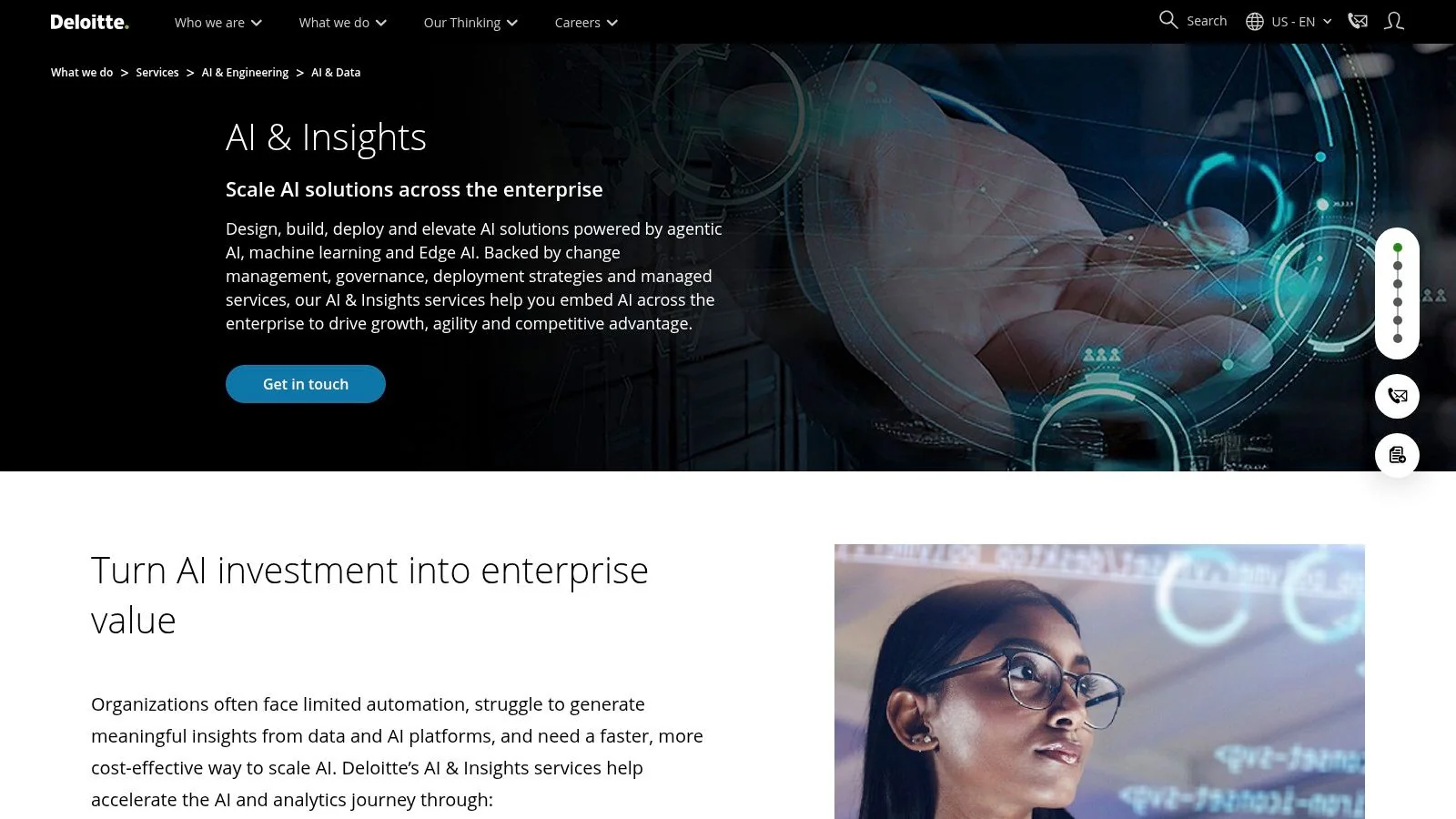
Your security lead wants model controls. Legal wants traceability. Procurement wants a defensible statement of work. Business units still expect results this quarter. Deloitte is a good fit when partner selection is less about flashy demos and more about getting an AI automation program approved, governed, and funded across the enterprise.
That bias toward control is rational. In Deloitte’s own State of Generative AI in the Enterprise report, many organizations reported that governance, risk, and implementation barriers were slowing production adoption. CIOs should read that as a buying signal. If those constraints define your environment, pick a firm built for them.
Where Deloitte fits best
Deloitte is strongest in buyer situations where the core problem is operating model design. It does well with policy design, control mapping, model risk processes, cross-functional governance, and PMO-heavy transformation work. That makes it a better choice for enterprise AI automation programs than for isolated task automation.
It also fits organizations that need a partner to survive procurement scrutiny. Deloitte usually shows up with strong documentation, audit-ready methods, and a clearer path from pilot to run-state ownership than smaller firms. That matters if your RFP scoring model gives real weight to security, compliance, transition support, and executive reporting.
- Best for regulated environments: Financial services, healthcare, public sector, and other audit-heavy industries.
- Best for multi-BU programs: Useful when business units have different process owners, data policies, and approval chains.
- Best for governance-led buying: Strong option when your shortlist will be scored on controls, change management, and post-launch support, not just build speed.
Practical rule: Hire Deloitte when governance failure is the main delivery risk. Do not hire Deloitte for a cheap, fast proof of concept.
Buyers should also price this correctly. Deloitte usually sits in the upper end of the market, and the delivery model can feel heavy for teams that just need a lean engineering squad to ship a narrow workflow. If your expected engagement is under a few hundred thousand dollars, or your success metric is speed over formal control, move them down the shortlist.
Deloitte website: Deloitte Ready, set, scale AI
3. Cognizant
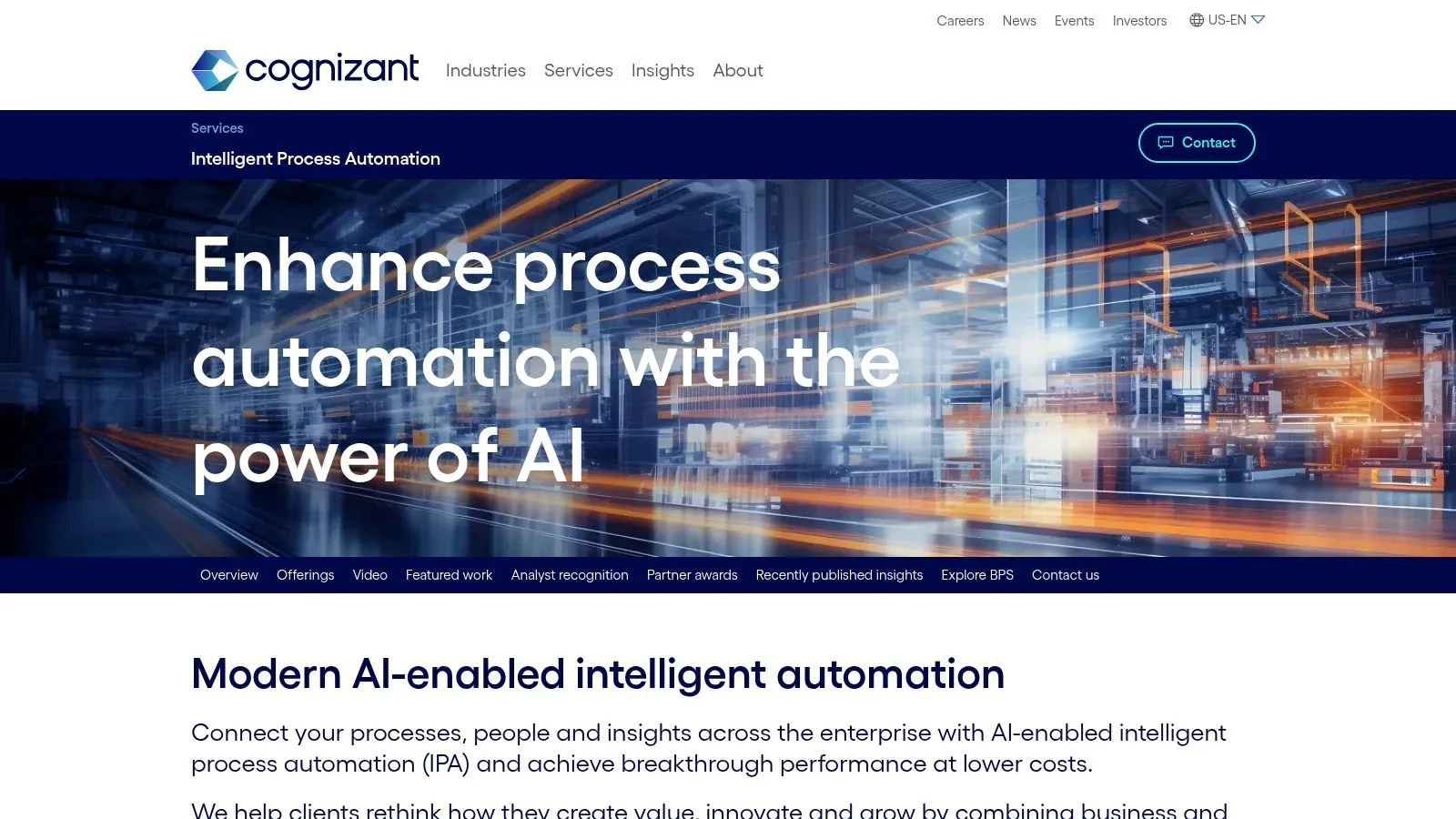
A common enterprise scenario looks like this: the workflow is broken across ERP, CRM, shared inboxes, and a few legacy systems no one wants to touch. The mandate is not just to automate tasks. It is to redesign the process, fix the data flow, and make the operating model hold up after go-live. Cognizant is a credible option for that kind of work.
Cognizant sits in a practical middle band for large buyers. It has the scale to handle multi-region delivery, but it usually sells implementation and process change more directly than pure boardroom strategy. For CIOs and procurement leaders, that matters. You are not only buying an AI layer. You are buying integration, workflow redesign, platform fit, and run-state support.
IDC’s research on worldwide AI and generative AI services points to sustained enterprise demand for services that combine advisory, implementation, and managed operations, not isolated model builds (IDC AI services research). That is the buying motion where Cognizant tends to make sense.
Best-fit buyer profile
Cognizant is strongest in programs where automation depends on adjacent modernization work. If source systems are messy, process ownership is split across functions, and the business case depends on operational rollout, keep them on the shortlist.
Use Cognizant for these scenarios:
- Cross-functional programs: Operations, service, supply chain, or back-office initiatives that need process redesign plus technical delivery.
- Hybrid enterprise estates: Good fit when legacy platforms, cloud data stacks, and multiple automation tools have to work together.
- Mid-to-large transformation budgets: Better aligned to buyers funding a real program, not a low-cost experiment.
Expect rate bands and contract shape to reflect that model. Cognizant usually fits buyers budgeting for a multi-workstream engagement rather than a narrow pilot. If your RFP should score implementation depth, transition planning, and managed support heavily, it deserves serious consideration.
There is a clear tradeoff. Cognizant can feel heavier than a specialist firm. Decision-making, documentation, and cross-team coordination are usually stronger than speed. That is good for enterprise control. It is bad if your main goal is to ship one narrowly scoped workflow in a few weeks.
Red flags to probe in diligence: too much reliance on offshore handoffs for process discovery, vague ownership for post-launch KPI tracking, and weak clarity on which accelerators are reusable versus custom-built. If the answers are soft, your timeline will slip and your operating costs will climb.
Practical rule: hire Cognizant when the actual problem is process complexity across systems and teams. Drop them down the list if you want the lightest possible delivery model.
Cognizant website: Cognizant Intelligent Process Automation
4. Quantiphi
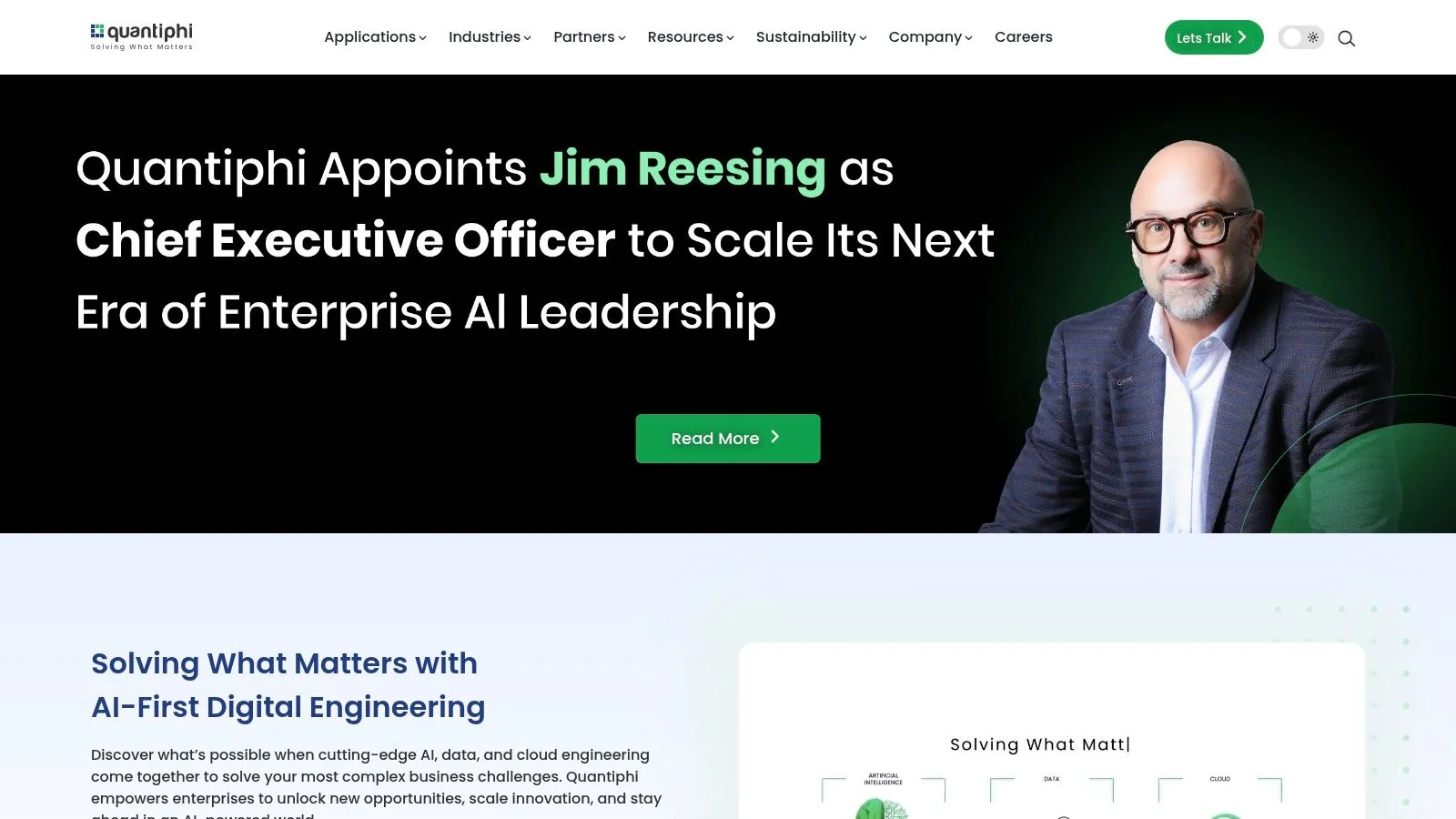
Quantiphi is the best option on this list for buyers who want an AI-first firm without going all the way down to a narrow boutique. It’s especially compelling for customer service automation, document-heavy workflows, and cloud-native implementations on Google Cloud or AWS.
Customer service automation currently sits at 30% and is expected to reach 50% by 2027, according to Grand View Research’s AI automation market report. Quantiphi is well aligned with that demand curve.
Best-fit buyer profile
If your roadmap includes contact center AI, document extraction pipelines, model operations, and domain workflows in healthcare or financial services, Quantiphi is a serious contender. The firm is often strongest when data engineering and applied AI have to move together, not in separate workstreams.
That makes it attractive for engineering leaders who care about implementation detail. You’ll generally get a more focused delivery posture than with the largest SIs, especially in cloud-native builds.
- Strong fit for Google Cloud and AWS shops: Especially for AI services tied to data platforms.
- Strong fit for document and service workflows: Good for unstructured data pipelines and workflow automation.
- Strong fit for domain-led use cases: Healthcare, public sector, and financial services stand out.
The main limitation is ecosystem breadth. If you need a fully on-prem program or a massive global rollout with dozens of business units, one of the mega-integrators is usually safer.
Quantiphi website: Quantiphi
5. Tredence
Tredence is the strongest choice here when the actual problem is operationalization. Many AI automation companies are good at discovery and weak at production engineering. Tredence is built for the opposite problem.
That matters because high-performing organizations don’t treat AI as an isolated tool purchase. They allocate over 20% of total digital budgets specifically to data foundations, top-tier talent, and governance frameworks, according to Fullview’s AI investment and ROI analysis. Tredence’s positioning lines up with that reality.
Why engineering leaders pick Tredence
Tredence is a fit for organizations modernizing data platforms while pushing ML and generative AI into production. For those working through LLMOps, MLOps, model governance, observability, and deployment workflows tied to real business processes, the firm particularly stands out.
It’s also a sensible option when your architecture team wants tight alignment between data platform design and AI delivery. That’s particularly relevant in retail, CPG, and financial services environments where data freshness, workflow orchestration, and model monitoring all matter.
Don’t separate the AI vendor from the data engineering vendor if the bottleneck is production data quality, orchestration, or governance. That split usually creates blame, not progress.
Tredence is less ideal if your roadmap leans heavily toward RPA or UI-driven automation outside a modern data platform context. In that case, pair it with a specialist or choose a broader systems integrator.
If your team is evaluating run-state controls and deployment standards, this guide for engineering leaders on MLOps is useful.
Tredence website: Tredence services
6. West Monroe
A portfolio company misses its margin plan, leadership wants automation savings inside two quarters, and the CIO needs a partner that can tie AI spend to operating results fast. That is the buying situation where West Monroe makes sense.
West Monroe is the strongest fit on this list for mid-market firms and private-equity-backed businesses that need execution tied to EBITDA, service levels, and working-capital impact. Unlike larger firms that can bury delivery under transformation language, West Monroe usually frames the work around a business case, an operating model, and a short path to measurable gains. For procurement teams, that matters because partner selection should start with economic accountability, not slide-deck ambition.
Where West Monroe is strongest
Choose West Monroe when you need an operator’s view of automation. The firm is well suited to banking, life sciences, and PE environments where diligence, process redesign, and KPI ownership matter as much as model performance. It is also a practical option when the buyer wants senior attention and faster decision cycles than a global SI typically offers.
This is a buyer-fit decision, not just a brand decision.
- Best for mid-market programs: Good fit when speed, executive access, and business alignment matter more than global bench depth.
- Best for PE-backed companies: Strong option when the value thesis needs to show up in cost takeout, throughput, or margin improvement.
- Best for KPI-owned automation: Useful when finance and operations leaders expect named owners, milestone reviews, and clear success measures.
Rate expectations usually fall below top-tier global consultancies but above narrow implementation shops. Ask for pricing by phase, team mix, and outcome assumptions. If a partner cannot explain what portion of fees goes to strategy, build, change management, and run support, your RFP process is too loose.
A clear red flag is vague language around agent-based workflows, governance, and handoffs between humans and systems. If your stakeholders need a sharper frame for autonomous process design, this primer on understanding agentic AI is useful.
The main constraint is scale. West Monroe is not the best choice for multi-country rollouts that need a very large managed-services footprint across regions and time zones.
West Monroe website: West Monroe AI services
7. Ashling Partners
Your team already picked the platform. The backlog is sitting there. The problem is delivery capacity, governance discipline, and whether the partner can turn automation demand into production releases without enterprise-consulting overhead.
That is where Ashling Partners fits best. Ashling is a specialist firm, and buyers should evaluate it that way. Do not hire Ashling to define a broad enterprise transformation from scratch. Hire it when the program thesis is already clear and you need a partner that can build, operationalize, and support an automation function quickly, especially in UiPath-heavy environments.
Rate discipline matters here. As noted earlier, specialist firms often price below large global consultancies because you are not paying for the same strategy layers, geographic footprint, or transformation overhead. For procurement leaders, the right move is to force a clean rate-card discussion by role, phase, and run-support scope. If Ashling cannot show where fees sit across advisory, build, testing, hypercare, and managed support, treat that as an RFP gap.
When to choose Ashling
Ashling is a strong fit when the use case portfolio is already defined and the bottleneck is execution. That includes teams standing up an automation center of excellence, formalizing intake and prioritization, or expanding from pilot work into a managed delivery model.
It is also a good choice when the buyer wants a narrower partner with real implementation focus instead of a strategy-first account team.
- Best for execution-heavy automation programs: Good fit when the roadmap exists and delivery speed matters more than broad enterprise advisory.
- Best for CoE buildout and managed run support: Useful when you need operating model design, release discipline, and post-launch support.
- Best for UiPath-led estates: Validate certifications, reusable assets, and governance experience early if UiPath is central to the program.
The main risk is buying too small for the mandate. If the initiative also includes major cloud modernization, enterprise data-platform redesign, or large-scale cross-border change management, Ashling will need to work alongside a broader partner. CIOs should be explicit about that boundary before contracting.
A second red flag is platform narrowness disguised as automation strategy. Ask whether the team can map process suitability, exception handling, human review points, and model governance, not just bot deployment. If the answers stay tool-centric, buyer fit is poor.
Ashling website: Ashling Partners
Top 7 AI Automation Companies: Capabilities Comparison
| Vendor | Implementation complexity | Resource requirements | Expected outcomes | Ideal use cases | Key advantages |
|---|---|---|---|---|---|
| Accenture (Applied Intelligence, AI, Data & Automation) | High, enterprise-scale integrations and change orchestration | Large cross-functional teams, cloud/vendor licenses, extensive change management | Scaled production deployments and organization-wide adoption | Global programs, multi-cloud enterprise transformations, large back-office automation | End-to-end delivery, pre-built accelerators, strong change management |
| Deloitte (AI & Insights, Intelligent Automation) | High, industrialized, governance-heavy rollouts | Significant consulting, governance frameworks, managed-run capabilities (IntelliForce) | Governed, repeatable, scalable automations with ROI focus | Regulated industries and enterprise-wide AI/automation scaling | Operating-model design, tool-agnostic delivery, broad industry depth |
| Cognizant (Intelligent Process Automation and AI Services) | Medium–High, process reengineering plus platform work | Advisory + delivery teams, platform integrations, partner tooling | End-to-end process orchestration and agent-based automations | Complex estates, contact centers, industrial operations | Cross-domain accelerators, strong partner ecosystem, Snowflake integrations |
| Quantiphi (Applied AI and Automation Services) | Medium, cloud-aligned, domain-focused implementations | GCP/AWS specialists, domain engineers, contact-center and doc automation tooling | Improved CX, automated document workflows, measurable contact-center gains | Contact centers, document-heavy workflows, healthcare/financials/public sector | Deep contact-center & document automation expertise, measurable outcomes |
| Tredence (Operationalizing GenAI with LLMOps/MLOps) | Medium, ML/LLM productionization and data modernization | ML/LLM engineers, data-platform modernization, observability and MLOps tooling | Production-grade GenAI/ML with robust LLMOps and observability | Data modernization, GenAI productionization, supply chain and retail analytics | Strong LLMOps/MLOps capability, deployment workflows, observability focus |
| West Monroe (AI Services, Agentic Transformation) | Medium, outcome-led with faster cycles than mega-SIs | Industry playbooks, operations/diligence teams, Intellio accelerators | KPI-tied automations and quantified operational savings | Mid-market banking, PE diligence, operations automation with P&L focus | Outcome-led approach, sector-specific assets, faster time-to-value for mid-market |
| Ashling Partners (Intelligent Automation Specialist) | Low–Medium, specialist RPA/agentic automation focus | UiPath-certified teams, CoE enablement, platform certifications | Rapid backlog reduction, CoE operationalization, reliable run capability | UiPath-centric RPA programs, CoE build-out, rapid automation delivery | UiPath Diamond-tier expertise, specialist focus, fast time-to-value |
Your RFP Checklist: 50+ Criteria for Vetting Partners
Before you sign anything, force every vendor through a structured scorecard. Most failed AI automation engagements don’t collapse because the demo was bad. They fail because the buyer didn’t validate delivery depth, data engineering capability, governance design, and post-launch ownership.
Start with commercial reality. Discovery audits typically cost $8k to $40k over 2 to 4 weeks, stabilize sprints run $25k to $120k over 4 to 6 weeks, and platform builds range from $60k to $300k over 8 to 16 weeks, according to Complere’s 2026 data engineering consulting buyer checklist. If a vendor can’t explain how it scopes work against those ranges, it’s not ready for enterprise procurement.
What your RFP must force vendors to prove
- Architecture depth: Ask how they design pipelines, orchestration, and storage across Snowflake, Databricks, dbt, Airflow, AWS, Azure, and BigQuery.
- Governance by default: Require tests, alerts, lineage, access controls, and documented core metrics in the base scope.
- Migration discipline: Ask for a named approach to cutover, rollback, environment promotion, and production support.
- Run-state ownership: Require a formal handover plan so your team can operate day-to-day workflows confidently.
- Cost control: Ask how they identify cloud waste and how they’d reduce it during the engagement.
According to DataEngineeringCompanies.com’s analysis of enterprise-grade firms, buyers should push vendors to show before-and-after metrics on refresh time, accuracy, and cost. Don’t accept abstract references to “business value.” Demand proof tied to system performance and operating metrics.
If a vendor can’t explain how it handles testing, lineage, orchestration failures, and ownership transfer, it isn’t selling automation. It’s selling future rework.
Red flags that should eliminate a vendor
- No named delivery team: If the pitch is senior and the delivery plan is vague, expect substitution risk.
- No platform point of view: Strong partners can explain when Snowflake, Databricks, dbt, Airflow, AWS, Azure, or BigQuery fit. Weak ones say they do everything equally well.
- No governance artifacts: If they can’t show examples of metric definitions, runbooks, or data quality controls, remove them.
- No implementation references by problem type: Similar industry is helpful. Similar architecture and operating complexity matter more.
- No handover plan: If they expect permanent dependence, that’s a commercial choice, not a technical necessity.
Use a weighted scorecard across technical capability, delivery quality, governance maturity, cost transparency, industry fit, and support model. Then run vendors through a live technical review, not just a procurement questionnaire. If you need a starting point, use this tool for assessing AI workflows.
Your next step is simple. Shortlist three firms. Make them respond to the same architecture, governance, and operating-model questions. Then pick the partner that can prove it can build, transfer, and support the system you require.
Researched & written by
Data-driven market researcher with 20+ years in market research and 10+ years helping software agencies and IT organizations make evidence-based decisions. Former market research analyst at Aviva Investors and Credit Suisse.
Previously: Aviva Investors · Credit Suisse · Brainhub · 100Signals
Vetted partners
Featured Data Engineering Partners
Vetted firms whose specialty matches this article.